 How to resolve AdBlock issue?
Recreation
- Details
- Written by: Editor
KELSEYVILLE, Calif. – The Lake County Wrestling Club, also known as the Kelseyville Krush, will host a K-8 wrestling scrimmage on Saturday, Feb. 15.
The scrimmage will begin at 9 a.m. at Kelseyville High School, 5480 Main St.
Other Lake County wrestling clubs attending are the Punisher Wrestling Club from Lower Lake and the Upper Lake Junior Cougars Wrestling Club.
Close to 100 local youth are expected to compete at this event, taking part in the world's oldest sport.
Come see firsthand how your local youth wrestlers are progressing.
- Details
- Written by: Carrie Wilson
For a new adventure, try shrimping
Question: I have been an avid “crabber” in Northern California for quite a while. For a new adventure I’d like to take up “shrimping” but need some information on where to go, when to go and how to catch shrimp.
Is it legal to recreationally catch shrimp? If so, what are the seasons and bag limits? Is there still a viable population of shrimp in California? Thanks for any information to point me in the right direction. (Tony M.)
Answer: You may take any type of ocean shrimp in California waters, but spot prawns are the most desirable and sought after for eating purposes.
According to California Department of Fish and Wildlife (CDFW) Environmental Scientist and Invertebrate Specialist Kai Lampson, because California’s spot prawns are found so deep – usually 100 fathoms (600 feet) or more – and the bag limit is only 35, most people are not interested in trapping these shrimp recreationally.
Another option though are the lesser known coonstripe shrimp, also referred to as dock shrimp for their habit of sometimes living around pilings.
Unlike spot prawns, coonstripe shrimp inhabit relatively shallow water and can be fished close to shore with lightweight traps.
They may occur out to depths of 600 feet, but fishermen often set their traps between 70-150 feet. The sport limit is 20 pounds (9 kilograms) per day and there is no closed season or size limit for the sport fishery.
While they range from Sitka, Alaska to (at least) Point Loma in San Diego County, the highest concentrations of coonstripe are found in far northern California, near Crescent City.
To learn more about fishing for these interesting shellfish, please check out the crustaceans section of the current Ocean Sport Fishing regulations for the regulations, legal gear, limits and other information you will need to know (California Code of Regulations Title 14, sections 29.80 through 29.88). Ocean sport fishing regulation booklets are available wherever licenses are sold or online at www.dfg.ca.gov/marine/sportfishing_regs2013.asp .
Carrying a loaded gun in a vehicle on a private road?
Question: I know that it is not legal to have a loaded gun in a vehicle when on public roads and in areas accessible to the public, but what about when on privately owned property where all access is controlled via locked gates? (Scott H.)
Answer: You are correct that it is against the law to carry loaded guns in a vehicle when upon or along a public way (Fish and Game Code, section 2006 and Penal Code 12031).
When behind locked gates, however, there are no laws preventing this, although common sense and safety should preclude doing so.
Many of the hunting accidents we investigate are caused by people getting into or out of a vehicle with a loaded firearm.
Despite this allowance, it is still unlawful to shoot at any game bird or mammal from a motor vehicle, even when on private property (FGC section 3002.)
Scattering ashes at sea
Question: A good friend recently passed away and his last wishes were to have his ashes scattered at sea. Are there any laws against this? (Jolene P., Modesto)
Answer: No laws against it, but a permit to scatter the ashes at sea is required by California law.
The permit is called “Application and Permit for Disposition of Human Remains.”
Check with the local county health department for rules and permits and any other specific requirements they may have.
Do fish farms pose threats to wild fish and the environment?
Question: I have questions and concerns about fish farms and the fish they produce.
Do fish farms pose any major threats to the environment? Are high disease rates in farmed fish due to improper fish management?
Is it true that wild fish are healthier to consume than farmed fish? How much do fish farms contribute economically to society and do they provide many jobs? Thanks for any insight. (Julie B.)
Answer: Commercial fish farms are required to have CDFW permits, and if properly sited and operated, they should have no negative impact on the environment.
If the farmed fish are allowed to escape and impact wild fish or other aquatic organisms though, then that might be another story and adverse environmental impacts may occur.
One potential problem might be if water discharge from the farm is not properly treated, then there could be impacts to water quality of adjacent receiving stream systems. Fish disease issues can be nearly eliminated at the farms if properly managed.
As far as whether farmed fish or wild fish are better for your health, there is no evidence that farmed fish are less healthy to consume than wild fish. However, wild fish quality is probably better in most cases.
While fish farming can certainly create jobs and provide more employment opportunities, harvesting wild fish also creates jobs. It’s hard to say whether one method creates more jobs than the other.
Carrie Wilson is a marine environmental scientist with the California Department of Fish and Wildlife. While she cannot personally answer everyone’s questions, she will select a few to answer each week in this column. Please contact her at
- Details
- Written by: Editor

KELSEYVILLE, Calif. – When the Sutter Lakeside Wellness Center closed its doors in November, it left many displaced members wondering where they would continue their fitness classes and exercise programs.
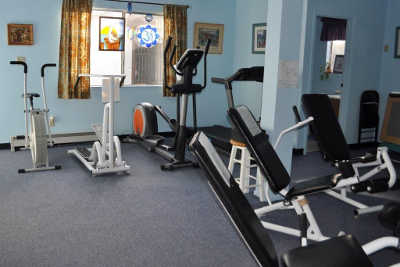
Mary Oom, a yoga teacher at the center for more than 10 years, stepped up to the plate, located a fixer-upper in Kelseyville and transformed that building into an attractive healing and fitness center to provide Lake County residents with a fun place to keep healthy.
“Transformations,” located in the Pioneer Plaza courtyard at 3970 Main St., offers yoga for everyone from age 3 to 93.
The center is currently offering 10 yoga classes per week as well as Tai Chi, hypnotherapy and massage.
Oom's classes are very affordable, keeping in line with the fees charged at Sutter Lakeside.
“We also have 18 exercise machines which include circuit workout equipment,” she said.
Although classes are currently being held every day, Transformations will hold its grand opening on Saturday, Jan. 25, from 11 a.m. to 4 p.m. The community is invited to come see what it's all about and visit the center.
Yoga is a personal “experience” coordinating the body and mind. Benefits include stress reduction, weight loss, flexibility, strength (muscle), relaxation and overall good health.
At the end of each session Oom rewards her students with guided visualization, a favorite for everyone. “Many of my students say they sleep better at night after a yoga class,” she said.
Oom has been practicing yoga for 34 years and has been a popular hatha yoga instructor in Lake County for 25 years.
She held classes at the spa at Konocti Harbor Inn for 10 years prior to her time at Sutter Lakeside. She is known for her fun, gentle, uplifting approach to learning yoga. Students of all ages and levels enjoy her classes.
Oom also is a certified clinical hypnotherapist who offers help for clients who need to reduce stress, quit unhealthy habits and find more joy in life.
Her hypnotherapy sessions include counseling in practical ways to change thoughts, emotions and physical stress resulting in positive life changes.
“I have helped hundreds of people in Lake County improve their physical, mental and emotional health with hypnotherapy,” she said.
The Tai Chi and Chi Gong classes at Transformations, led by Arch Kottler, teach students to relax, meditate, stretch, strengthen, breathe, re-energize and heal while learning an effective self-defense martial art.
Oom teaches gentle yoga classes on Mondays at 10 a.m., 4:15 p.m. and 5:45 p.m.; on Wednesdays at 4:15 p.m. and 5:45 p.m.; at 10 a.m. and 5:30 p.m. Thursdays; and at 1 p.m. Fridays.
Kids yoga begins Feb. 1 and will be held at 10:30 a.m. and 11:15 a.m. on Saturdays.
Yoga flow with Penny Dahl takes place at 6 p.m. Tuesdays, and Arch Kottler teaches Tai Chi on Tuesdays at 4:30 p.m. and 4 p.m. on Thursdays.
For more information on the Transformations classes and workout equipment, call Mary Oom at 707-245-5936 or meet her in person at the grand opening on Jan. 25.
- Details
- Written by: Editor
The California Department of Fish and Wildlife (CDFW) reminds abalone and lobster sport fishermen they are required by law to return their 2013 abalone report cards and 2013 calendar year spiny lobster report cards by Jan. 31, 2014.
Card holders are asked to review their cards carefully and check that the information is as complete and accurate as possible.
Information collected from report cards provides CDFW with data necessary to monitor and manage California’s recreational abalone and spiny lobster fisheries.
The new full season spiny lobster report card, which became available after July 31, 2013, is good for the entire lobster fishing season. The full season spiny lobster report card is not due until April 30 following the close of lobster season.
Any report card holder who fails to return their full season spiny lobster report card will be charged a non-return fee of $20 when purchasing a spiny lobster report card in the subsequent fishing season.
In the past, report card return rates have been too low to accurately estimate catch for these fisheries, but the Automated License Data System (ALDS) has greatly increased the ability of the CDFW to remind card purchasers of the need to return report cards.
ALDS was used last year to alert abalone report card purchasers if they had not returned their cards or entered data online for the cards before the January 31 deadline.
ALDS also was used to mail reminder notices to all spiny lobster report card holders to return their report cards through the mail or submit their harvest data online. If ALDS warnings fail to increase Abalone Report Card return rates, a non-return fee may be implemented in the future.
Report cards need to be returned even if no abalone or lobster were taken, or no attempt was made to take either species.
Report card data can be submitted online at www.ca.wildlifelicense.com/InternetSales/CustomerSearch/Begin .
Report cards also can be submitted by mail to:
CDFW – Abalone Report Card
32330 North Harbor Drive
Fort Bragg, CA 95437-5554
OR
CDFW – Lobster Report Card
3883 Ruffin Rd.
San Diego, CA 92123
Additional information and a list of frequently asked questions about these programs can be found on CDFW’s Ocean Sport Fishing Web pages, www.dfg.ca.gov/marine/invertebrate/abalone.asp (abalone) or www.dfg.ca.gov/marine/invertebrate/lobster.asp (spiny lobster).