
Recreation
Question: Why is there no season limit on the number of geese or ducks a hunter can legally take and possess?
I hunted ducks with my uncle last year who is retired. He had bought into a private hunting blind and has access from his home to three nearby state or national refuges.
Last year his season take on ducks was in excess of 190, and for geese it was 54. He hunted on refuges nine times in addition to his private hunting blind. On refuges, he stood in the “sweat line” to be admitted later in the day.
It seems to me that hunters who can afford the $2,000 price tag to hunt private property and who live close enough to the refuges to register in the “sweat lines” are taking an inordinate number of ducks and geese.
I’m sure any consideration to impose a take limit would have a severe effect on farmers leasing out their properties, but the opportunities to hunt ducks and geese are being limited to the fortunate few who have the big money to pay for hunting access.
Also, why not impose a limit on the number of times a hunter can gain access on a seasonal basis to all refuges? I submitted 38 lottery reservation cards last year but was not picked once. I would have tried the sweat lines, but to drive 228 miles to take a chance on being admitted, in front of locals who live nearby, are greater odds than being picked in the lottery. (Joe A.)
Answer: Waterfowl are protected under the Migratory Bird Treaty Act, which is administered by the U. S. Fish and Wildlife Service (FWS).
According to Department of Fish and Game (DFG) waterfowl biologist Shaun Oldenburger, restrictions on waterfowl hunting regulations (also called federal frameworks) are established by the FWS.
Laws have been established for the possession of migratory birds during the hunting season. Although there are no season-long limits, there are possession limits. For both ducks and geese, the legal possession limit for an individual is twice the daily bag limit.
For example, in California’s Balance of the State Zone, a daily bag limit consists of seven ducks and eight geese, and a maximum of 14 ducks and 16 geese (twice the daily bag limits) are allowed in possession at one time.
Regulations allow for the gifting of birds to other individuals. However, at no time during the hunting season may any individual possess more than the maximum number of birds (as mentioned in the example). In itself, this regulation limits the number of birds a person can legally harvest during the waterfowl hunting season.
The odds of drawing a reservation for any of the Type A wildlife areas are highly variable throughout the state depending on demand, location, timing of season, the particular hunt day (e.g. Saturday vs. Wednesday), and other factors.
While reservations are the best way to ensure access for the morning hunt, it is not the only means to get access to waterfowl hunting areas.
Many wildlife areas throughout the state do not completely fill (unless it’s opening weekend or when storm fronts are moving in), so depending on the area, walk-ons may be available.
While reservations are highly sought after, if a hunter is willing to modify his or her approach and try some afternoons, some great opportunities may be available on our public areas if you can’t get a reservation.
For more information regarding waterfowl hunting opportunities on public hunting lands, please contact a DFG regional office ( www.dfg.ca.gov/regions/ ), State Wildlife Area ( www.dfg.ca.gov/lands/wa/index.html ) or National Wildlife Refuge ( www.fws.gov/refuges/ ).
Number of crab traps allowed
Question: What is the limit on numbers of crab traps/rings that can be used by one person on a pier or dock? (Scott T.)
Answer: On public piers, no person shall use more than two rods and lines, two hand lines or two nets, traps or other appliances used to take crabs (CCR Title 14, section 28.65(b).
Rules on shed antler collection?
Question: What are the rules on shed antler collection in wildlife areas, refuges, parks, BLM and Forest Service properties? What are DFG’s policies on these different properties? (Kevin T., Shasta)
Answer: Generally, the Fish and Game Code and its implementing regulations do not prohibit the collection of shed antlers. However, there are restrictions as to where you can collect them.
While it’s OK to collect them on private property or Bureau of Land Management and Forest Service lands, in many cases it is against the law or the rules to collect them from other public lands, such as wildlife areas, wildlife refuges, state and national parks, etc.
Most of these areas do not allow any collecting of anything by the public without scientific collection permits.
Carrie Wilson is a marine biologist with the California Department of Fish and Game. While she cannot personally answer everyone’s questions, she will select a few to answer each week. Please contact her at
- Details
- Written by: Carrie Wilson
KELSEYVILLE, Calif. – If you are a birder or just interested in nature, grab your binoculars and camera and join Clear Lake State Park docent and volunteer Brad Barnwell on Saturday, Nov. 3.
Meet at 9 a.m. at the visitor center parking lot.
Finally the best season of the year has arrived.
With the shorter days and longer shadows, the campers disappear, the mornings turn brisk, the leaves change to yellow and gold, the lake level drops and the algae and waterweeds die and sink to the bottom of the lake.
With the lowering of the lake level, the mudflats and gravel bars along Cole Creek and Kelsey Creek are exposed, providing food foraging areas for migrating shorebirds.
With this seasonal change, one can expect a boom in the baitfish numbers, which can bring the “fish eaters” to the park in large numbers.
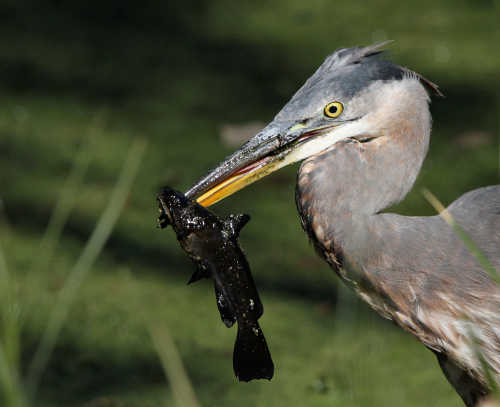
The “fish eaters,” those birds that have a primary diet of fish at this time of year such as herons, egrets, mergansers, cormorants and pelicans, are coming in as expected.
The gravel bar at the mouth of Kelsey Creek can have 75 to 100 American White Pelicans sitting on the bar, along with cormorants and occasional terns.
The banks and trees along both Cole and Kelsey Creeks are starting to fill with Black-crowned Night Herons, Great Blue Herons and Great Egrets as they sit and watch the creeks for a meal.
It is only a matter of time before the Eared Grebes and Common Mergansers show up to dine on the increasing numbers of fish exposed to predation in the low water created by the dropping lake level.
The two-hour walk will be at a slow pace and cover about two miles of paved road and established trails as well as 200 yards of wet trail and mudflats.
Participants should bring binoculars, water and wear shoes suitable for walking on the mudflats as well as established trails.
Park entry fees are waived for those participating in the walk.
Clear Lake State Park is located at 5300 Soda Bay Road, Kelseyville.
- Details
- Written by: Editor





 How to resolve AdBlock issue?