 How to resolve AdBlock issue?
Recreation
- Details
- Written by: California Department of Fish and Wildlife
Information collected from sport fishing report cards provides CDFW biologists with important data necessary to monitor and manage California's diverse recreational fisheries, including preparing recommendations for sport fishing seasons and limits that allow for sustainable levels of take.
This science-based management helps to ensure healthy populations of fish for future generations.
Anglers are required to return their report cards even if they lost their report card, they did not fish or they did not catch any fish. Cards should be reviewed carefully for accuracy prior to submission.
There are two ways to meet the mandatory angler reporting requirement. Online reporting through the CDFW website is easy, fast and free, and includes instant confirmation that the report has been received and accepted.
Sport fishing report cards may also be returned by mail to the addresses listed below:
North Coast Salmon Report Cards
CDFW - Klamath River Project
5341 Ericson Way
Arcata, CA 95521-9269
Steelhead Report Cards
CDFW - Steelhead Report Card
P.O. Box 944209
Sacramento, CA 94244-2090
Sturgeon Report Cards
CDFW - Sturgeon Report Card
P.O. Box 944209
Sacramento, CA 94244-2090
The Jan. 31, 2020 deadline does not apply to spiny lobster report cards. Spiny lobster report cards are due by Apr. 30, 2020, following the last day of spiny lobster season on March 18.
Please note that license sales agents cannot accept report cards. More information about report cards is available at www.wildlife.ca.gov/licensing/fishing .
- Details
- Written by: Elizabeth Larson
There is no charge for the walks and parking is free for those attending.
The next walk will be at 8:30 a.m. on Saturday, Feb. 8.
There will be a tour of the historic Anderson Ranch House after the February walk. Rain will cancel the walk. If rain cancels the walk, the Ranch House tour will begin at 8:30 a.m.
Guided nature walks at Anderson Marsh State Historic Park will be held in 2020 on the second Saturday of each month, with the exception of December. All walks begin at 8:30 a.m. There will be a tour of the historic Anderson Ranch House after many of these walks.
The nature walk in January was held on New Year’s Day as part of the national First Day Hikes program. The seventh annual First Day Hike at Anderson Marsh attracted more than 130 people and everyone had a chance to enjoy the park on a clear winter day.
For the third consecutive year, the Jan. 1 hike at Anderson Marsh State Historic Park had the largest number of people attending of all of the Jan. 1 hikes in the California State Parks system.
February’s nature walk will be led by park docents Henry Bornstein and Lisa Wilson. The hike will last about two hours. Participants should bring binoculars if they have them, bring water and wear sturdy shoes and a hat. The route taken will depend on the weather and the condition of the trails.
Participants are asked to arrive at the parking lot by 8:15 a.m. so they can have time to explore the wildlife found in the ranch house yard.
According to hike co-leader Henry Bornstein, who is also a certified California Naturalist, “Winter is a great time to visit the park because the trees are bare, allowing a better view of the birds. We will be looking for the year-round resident birds and animals such as the great blue herons and great egrets, as well as white pelicans, hawks, diving ducks and grebes, and other birds which winter over at the park.”
Anderson Marsh State Historic Park is located on Highway 53, between Lower Lake and Clearlake.
For more information about the walks, email
- Details
- Written by: Elizabeth Larson
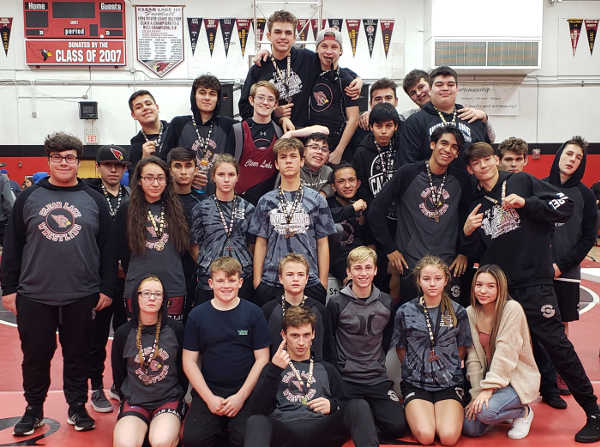
LAKEPORT, Calif. – On Saturday, Jan. 11, the Clear Lake Cardinals hosted their eigth annual Michael Kroppmann Memorial Wrestling Tournament.
The Cardinals entered 26 wrestlers – 22 boys and four girls – to compete.
The Cardinals finished with 21 medals: three firsts, four seconds, six thirds, three fourths, three fifths, two sixths and in second place overall for the boys’ team, just missing by four and a half points behind Lower Lake and over teams, Ukiah (third), Fort Bragg (fourth) and Upper Lake (fifth).
“The 2020 Michael Kroppmann Memorial tournament was a smashing success. Bringing in over 175 boy and girl wrestlers from 11 different schools, it was a day full of fierce competition while celebrating the culture of wrestling and honoring the memory of Michael Kroppmann,” said Head Coach Nathan Powers.
Team Championship trophies were awarded to Lower Lake boys and Upper Lake girls. Closely contested by Clear Lake boys and Windsor girls, the differences in each were both less than five points.
Most outstanding wrestler awards were handed out to Arianna Groves of Windsor, Bradley Sneathen of Upper Lake and Quentin Vilmenay of Lower Lake.
Clear Lake Coach Chris Clarkin was awarded for having 10 years of dedication to the local wrestling community and even longer contributions to the sport.
“I was overwhelmed with joy from the support of individuals and businesses in town that donated to the team and provided for the raffle. I couldn't have done it without all the support from my team’s parents alongside help from my own family, coaches and members of the community,” Powers said.
Powers offered special thanks to Joe Szupello, the local referee, who donated and cooked the coaches’ prime rib banquet along with $500 in oil changes from Lake fleet repair.
“This young team stood strong together as they battled in their home arena. We look forward to start our league campaign in the upcoming week as we continue to sharpen our skills and abilities. I am so proud how these young men and women showcase the best of both worlds in wrestling; intensity on the mat and integrity in all arenas,” Powers said.
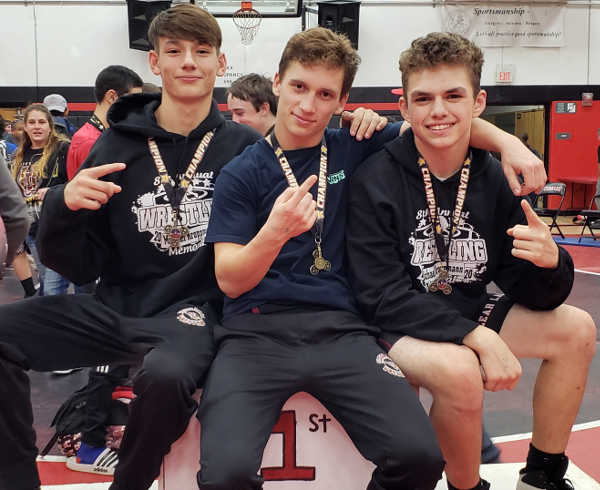
Clear Lake Champions were Elijah Alverez who showed great control in his matches, Nick Williamson who had an epic nail-biting match with a dominant pin to finish and Anthony Gersalia who was an explosive force.
Gold medalists:
Boys – Nicholas Williamson (135 lbs.) went 4-0 with four pins. Elijah Alvarez (141 lbs.) was 3-0 with two pins. Anthony Gersalia (170 lbs.) went 2-0 with one pin.
Silver medalists:
Boys – Nathan “Bubba” Pyorre (109 lbs.) went 4-1 with four pins. Axel Alvarez (185 lbs.) was 1-1 with one pin.
Girls – Mavis Pyorre (123 lbs.) was 3-1 with two pins. Tara Wong (104 lbs.).
Bronze medalists:
Boys – Hernan Romero (129 lbs.) was 4-1 with four pins. Hayden Fowler (135 lbs.) and Vicente Ortega (141 lbs.) each went 3-1 with one pin. Christopher Krack (198 lbs.) went 2-1 with one pin. Raymond Gonzales-Shoaf (223 lbs.) went 2-2 with one pin.
Girls – Ashley Pyorre (109 lbs.) was 1-2 with one pin.
Fourth place medalists:
Asher Reese (116 lbs.) was 2-2 with two pins. Dominic Legendre (288 lbs.) was 3-2 with two pins.
Girls – Ximena Soto (123 lbs.) went 1-3 with one pin.
Fifth place medalists:
Boys – Luis Aguilar (116 lbs.) was 1-2. Mohammad Akbari (123 lbs.) and Ayden Williamson (129 lbs.) each went 2-2 with two pins.
Sixth place medalists:
Boys –Victor Romero (109 lbs.) and Liam Davis (148 lbs.) won his first match by Tech Fall and then was pulled from the tournament due to injury.
Also competing for the Cardinals was Quinnlan Frick (129 lbs.) who went 1-2 with one pin, along with Mujtaba Akbari (123 lbs.), Samuel Vanoven (135 lbs.), Austin Montiel (141 lbs.) and Zachary Wilcox (141 lbs.).
“What a long and exciting day of wrestling at our home tourney. Overall second place team! It’s always a great time with this team. They always give it all they’ve got and leave it all on the mat. We know we made Michael proud!” said Coach Powers.
- Details
- Written by: California Department of Fish and Wildlife
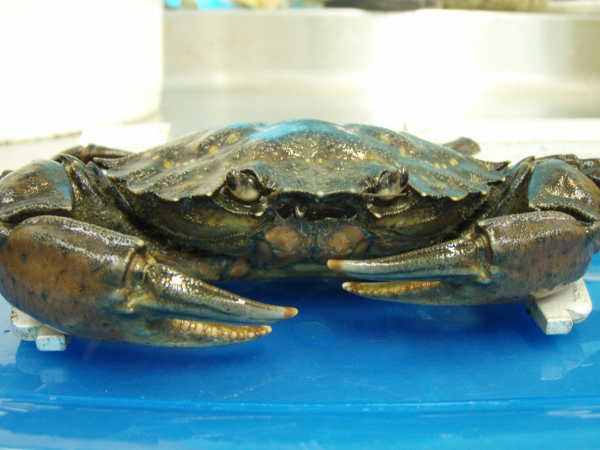
Catching European green crabs
Question: Are there any regulations regarding crabbing for European green crabs in the San Francisco Bay Area? I understand that they are an invasive species but could not find any more information on whether we can keep them. I would also like to know if they are safe to eat and if they are tested for domoic acid. (Toan H.)
Answer: There are no regulations that prohibit the take of European green crabs (Carcinus maenas). They would fall under California Code of Regulations Title 14, section 29.05, which covers general invertebrates, and gear restrictions for crustaceans, section 29.80. Please note that in San Francisco Bay, invertebrates may not be taken at night, except from the shore. The daily limit for general invertebrates is 35.
That said, European green crabs are not tested for domoic acid, so it's unknown whether they are safe to eat. The California Department of Public Health's Marine Biotoxin Monitoring Program only tests for commercial fisheries. Since there is no commercial fishery for European green crabs, there is no testing for this species.
Is it legal to take roadkill now?
Question: I read that California passed a law making it legal to take home a deer or other animal if you accidentally hit it with your vehicle. This makes a lot of sense since a large animal could feed an entire family, and might otherwise go to waste. But now I'm hearing that the California Department of Fish and Wildlife hasn't implemented the law yet. Which is it? (Bud)
Answer: Thank you for asking for clarification. SB 395, known as the Wildlife Traffic Safety Act, did indeed pass in 2019. The intent of the law is to eventually make it legal for individuals to utilize the meat of four wildlife species: deer, elk, wild pig, and pronghorn antelope, killed on the road, if they so choose. Unfortunately, there's been some misinformation circulating regarding what the law actually does, and when it goes into effect.
Specifically, the law authorizes the California Fish and Game Commission (not CDFW) to adopt regulations and establish a wild game meat utilization program after Jan. 1, 2020. This is a complicated process that will take time to implement responsibly. The program will be developed in conjunction with many other agencies, including the California Department of Transportation and the California Highway Patrol (both of whom will need to help develop the parameters of when and how roadkill could be collected) and the California Office of Environmental Health Hazard Assessment (which will need to evaluate potential safety hazards related to human consumption of roadkill).
There are other issues that still need to be worked out too, including the bill's directive to CDFW to create a roadkill reporting database. CDFW does not currently have such a database, but the University of California, Davis, has something similar. The California Roadkill Observation System is currently operational, and any citizen can contribute roadkill data and photos.
As previously mentioned, the ball is currently in the court of the Fish and Game Commission. CDFW will keep the public apprised as the development of the program moves forward, but at this time, there is no program in place, and therefore the option of taking your roadkill home remains off the table (so to speak).
Night vision scopes
Question: Are Californians allowed to own a night vision scope for non-hunting purposes? (Jackson)
Answer: Assuming you are referring to a scope used on a firearm, it is illegal to buy, sell, receive or be in possession of a sniperscope. A sniperscope is defined as any attachment or device designed for or adaptable to use on a firearm which, through the use of projected infrared light and an electronic telescope, allows the user to locate the presence of objects at night (California Penal Code, section 468). Possession of other types of night vision scopes (other than a sniperscope) is not prohibited.
In addition, it is unlawful to use or possess night vision equipment to assist in the taking of a bird, mammal, amphibian, reptile or fish (Fish and Game Code, section 2005).
Duck hunting over flooded fields?
Question: Can you hunt ducks over flooded corn? (Jackson)
Answer: Regulations about migratory birds are covered by both state and federal law. It's not illegal to hunt over standing crops that have been flooded or fields that were flooded after crops are harvested (California Code of Regulations Title14, section 509 and Code of Federal Regulations Title 50, part 20). There are some exceptions. Hunting waterfowl over a crop that has not been harvested but that has been manipulated (rolled/disked) is considered baiting under current regulations and therefore unlawful. The U.S. Fish and Wildlife Service has their own version of a Q&A to provide a more detailed answer to this question.
If you have a question for the California Department of Fish and Wildlife, email