 How to resolve AdBlock issue?
Recreation
- Details
- Written by: California Department of Fish and Wildlife
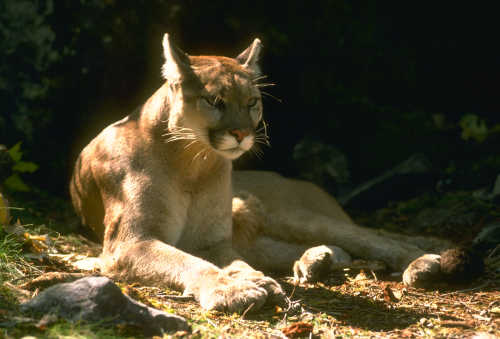
Mountain lion safety
Question: I read in the paper about a recent fatal mountain lion attack in Washington state. The article said that the two mountain bikers "did everything they were supposed to do" when they saw the lion, but it still attacked. That worries me, because I hike and camp in mountain lion country frequently.
What is the best course of action to take in a situation like that? (Kay)
Answer: The mountain lion attack that occurred in Washington was a very unfortunate – and very unusual – incident. Our thoughts are with the victims and their families.
Human/wildlife encounters can be unpredictable and very much situational. There is no single strategy guaranteed to be successful one hundred percent of the time.
However, based on research, wildlife managers and scientists have developed general guidelines and best practices that help keep humans safe in lion country and reduce potential injurious or fatal encounters with mountain lions.
These best practices include hiking/biking/jogging with others (rather than alone) and avoiding recreational activities in remote areas at dawn and dusk, when lions are most active.
If you do encounter an aggressive lion, do not run. Make yourself look larger by opening your jacket or swinging a stick. Make noise.
Research on mountain lion attacks suggests that many potential victims have fought back successfully with rocks, sticks, garden tools, even an ink pen or bare hands.
Try to stay on your feet. If you are knocked down, try to protect your head and neck.
We emphasize that lion attacks are extremely rare. Please visit our Keep Me Wild webpage, www.wildlife.ca.gov/keepmewild/lion, for detailed safety information.
Releasing an injured fish
Question: What is the rule on a fish that swallowed the hook, and therefore is bleeding badly, on catch and release waters, such as the Upper Owens? Should the fish be released back into the water, even though it probably won't make it? (Loren)
Answer: First, regarding gear, waterways that have either a minimum or maximum size limit, or a zero take limit, usually have gear restrictions.
Most of the Upper Owens River requires the use of barbless artificial lures. Scented baits such as power bait mouse tails are not legal to use in this area.
Baits or scented products are typically swallowed by the fish (gut hooked) and have a higher mortality rate if released.
Typically barbless artificial lures or flies hook the fish in the jaw or lip area. Barbless hooks allow for quick and easy release of the fish back into the water.
Some areas have size restrictions or zero take of fish. Please always refer to area specific regulations found in the California Code of Regulations Title 14, section 7.50.
To answer your question, all fish caught that do not meet the size restrictions, or where no take is allowed, must be immediately released back into the water in which they were caught.
Anglers can further reduce the stress on the fish while the hook is removed by keeping the fish in the water and handling the fish as little as possible. If the fish swallows the hook it is best to cut the line close to the mouth and then release the fish to give it the greatest chance of survival. (Fortunately, hooks that are not gold plated will eventually dissolve.)
Can I buy a lifetime license for a baby?
Question: I have some questions about the lifetime hunting and fishing licenses. I see on the Web site it says from age 0 so does this mean I can purchase a lifetime hunting license for my newborn baby? Even though he will not take the hunters education course until around age 8-10?
Also how do these lifetime licenses work if I was to move out of state? Would I have to pay non-resident tag fees? (Shawn)
Answer: Congratulations on your new addition, Shawn! Yes, you can purchase a lifetime license for your baby. Age 0-9 is the age bracket for purchasing, but the customer or parent will receive a receipt, not an actual license, at the time of purchase.
Once your child is older and completes a Hunter Education course, his profile will be updated with his Hunter Education Certificate number and he can then redeem his license.
You should also know that if your son holds a California lifetime license and he someday moves out of state, his license will still be valid.
However, if the Lifetime Hunting privilege packet is not purchased, he will need to purchase tags at the non-resident cost. Packages may be added on anytime.
If you have a question for the California Department of Fish and Wildlife, please feel free to ask us via email at
- Details
- Written by: BoatUS
Boat Owners Association of The United States (BoatUS) has these five ways to celebrate:
– The next time you head out on the water, take someone boating, fishing or sailing who has never done it before. Let them experience the same fun you have aboard your boat.
– Find the time to teach someone how to run a powerboat, how to sail, or how to catch a fish. It’s an activity that can last a lifetime and keeps families together.
– If you don’t have a boat, www.TakeMeFishing.org offers some ways to celebrate the week and to get out on the water, as well as free fishing days (days you can fish without a license) offered by many states.
– Learn to Fish: Watch instructional videos and read tips from pros on how to cast, tie knots, and make fishing rigs at the www.takemefishing.org “How to Fish” section.
– If you are new to boating, BoatUS has all the information you need on how to select and find a boat that’s right for you and be safe on the water at www.BoatUS.com/NewToBoating. Or visit www.Youtube.com/BoatUS to learn basic boat-handling and fishing skills.
- Details
- Written by: BoatUS Foundation
Here are three common mistakes boat owners make with DSC-VHF radios and some simple ways to improve safety aboard your boat.
Mistake No. 1: Relying on an old VHF radio to signal that you are in distress
If you are using a VHF radio that was manufactured more than 15 years ago, you’re relying on old technology. There’s probably not a person around that regularly uses a 15-year-old phone, television set or computer.
Today’s DSC-VHF radios have new lifesaving features, most importantly a distress button that can hail a mayday and relay your position to rescue authorities — all at the push of one little red (distress) button on the face of the radio.
BoatUS has some help to set up your new DSC-VHF radio at www.BoatUS.com/SettingUpDSCRadio.
Mistake No. 2: Thinking you don’t need to bother to register a DSC-VHF and get an MMSI number
A Maritime Mobile Service Identity (MMSI) number is a unique registration number that is assigned to your vessel to be used with the vessel’s DSC-VHF radio. MMSI numbers are issued by organizations including BoatUS which offer the service at no cost to members or for a nominal $25 fee for non-members.
The MMSI must be entered into the radio in order to harness all of its power and lifesaving technology. Registering your radio gives potential rescuers important information about you, your boat and whom to contact in an emergency.
Mistake No. 3: Not reading the owner’s manual that came with your radio and familiarizing yourself with your radio’s features
Your DSC-VHF radio manual contains a ton of great information about the features of your radio and how to install it. If your radio is not properly installed or not connected to your boat’s GPS or chartplotter, you’re shortchanging yourself and perhaps unknowingly putting yourself and your crew in danger if there is a delay in transmission and emergency response.
Digital Selective Calling technology can also make your everyday boating better. In addition to being able to send a distress signal with the press of a button, a DSC-VHF radio can privately hail other DSC-VHF-equipped vessels or groups of boats without tying up VHF channel 16, the distress, safety and calling frequency. It also allows you to ‘ring’ (hail) others if you know their MMSI numbers without them having to monitor a particular channel.
If you haven’t yet purchased a DSC-VHF radio, make it one of your safety-gear equipment priorities this season.
To learn more DSC-VHF radios, take a free online DSC-VHF radio tutorial at www.BoatUS.org/DSC. The course is provided by the 501(c)(3) BoatUS Foundation for Boating Safety and Clean Water and funded by BoatUS members.
- Details
- Written by: BoatUS Foundation
But sometimes, it’s not easy to borrow a right-sized life jacket when an infant or young teen comes aboard.
Marinas, boat and fishing clubs, waterfront businesses, organizations or other groups that serve boaters can help by becoming a BoatUS Foundation Life Jacket Loaner site.
Becoming a loaner site is easy by applying at www.BoatUS.org/Life-Jacket-Loaner. There is no cost to set up a loaner site, and there is never a charge to borrow a life jacket.
Approved locations will receive a kit containing 12 child-sized life jackets with sizes from infant to youth, as well as signage and a local publicity kit.
The nonprofit BoatUS Foundation, funded by donations from the more than half-million members of BoatUS, replenishes the supply of jackets as wear and tear takes its toll.
The only task loaner sites have is to track life jacket usage with an easy clipboard sign-out system and provide the foundation with periodic feedback to help keep the life jacket supply in good condition.
The program currently has more than 550 life jacket loaner sites across the US that collectively loan out children’s life jackets more than 140,000 times each year. Since 1997, three children’s lives have been saved by a BoatUS Foundation loaner life jacket.
To learn more, go to www.BoatUS.org/Life-Jacket-Loaner. A short video on how to select a right-sized kid’s life jacket at www.BoatUS.org/Life-Jacket-Loaner/Fit-Video.