 How to resolve AdBlock issue?
Recreation
- Details
- Written by: Editor
The workshop will take place at the Grange Community Center, 9355 Government St. in Upper Lake.
Participants are requested to RSVP by using the following link: https://www.surveymonkey.com/r/5PM7ZMV.
The BLM and Mendocino National Forest co-manage the national monument and believe partnerships and inclusion are vital to managing sustainable, working public lands.
The workshop will have similar agendas and format, but discussions may focus on areas of the monument closest to the workshop venue.
As stewards of the land, the BLM and Mendocino NF manage public lands for the benefit of current and future generations.
The workshop will help network past, current and future volunteers to engage in collaborative discussions about resource stewardship, share expertise and lessons learned, refine knowledge about agency processes and create successful partnerships for a thriving monument.
For more information, please contact Cici Vu at 415-391-7900 or email
- Details
- Written by: California Department of Fish and Wildlife
Question: I saw a notice in the newspaper that there is a high level of E. coli in the lower American River at the confluence of the Sacramento River in Sacramento County.
I am planning on going striper fishing with my son there. Is it safe to eat the fish if we catch some stripers? Where can I find more information? (Fernando, West Sacramento)
Answer: The California Department of Fish and Wildlife (CDFW) does not issue health advisories, but relies upon public health experts who do - in particular, the California Department of Public Health, the Office of Environmental Health Hazard Assessment (OEHHA), the California State Water Resources Control Board and local public health departments. Health advisories can be issued for bodies of water based upon possible contamination of the fish or of the water itself.
At the confluence of the American River and Sacramento River, there are two different health warnings in effect right now: One for E.coli, and one for high mercury levels.
Sacramento Department of Regional Parks issued the recent notice regarding E. coli bacteria found in the lower American River. High levels of E. coli can cause anyone coming in contact with the water to get sick from the pathogens.
The healthy water habits below are recommended when a "Use Caution" status is placed on a waterway with possible E. coli contamination:
– Actively supervise children and pets in or near water;
– Avoid algae blooms (brightly colored water) and trash in the water;
– Wash hands/shower after swimming.
Do not:
– Drink river water;
– Cook or wash dishes with river/lake water;
– Change diapers in or near water;
– Swim when you are sick;
– Enter the water if you have cuts or open sores. These are pathways for bacteria to enter your body.
– Enter the water for several days after a significant rainstorm. Storm flows spike bacteria levels, which decrease with time.
People with immune-suppressive diseases should avoid direct contact with the river altogether.
Other areas in Sacramento County with historically high E. coli readings include Discovery Park Boat Launch, Tiscornia Beach and the Howe Avenue River Access. The Central Valley Water Board is planning a study this summer to help better understand the problem.
OEHHA has issued another independent advisory regarding mercury toxicity levels in fish for the Sacramento River and Northern Delta, which includes the area you want to fish and all waterbodies in the Delta north of Highway 12. Mercury is a chemical that bioaccumulates in the fish tissues themselves, as opposed to contaminating the water.
The last five pages of the Freshwater Fishing Regulations booklet addresses safe preparation guidelines and consumption advice for those of us who regularly eat our sport-caught fish. Here you will find OEHHA advisories on mercury, including an advisory flyer specific to the Lower American River.
At the confluence of the American and Sacramento Rivers, experts advise the following: striped bass should not be consumed by women between the ages of 18-45 or by children between the ages of 1-17. Unborn babies and children are more likely to have health problems from chemicals in the fish.
Women 46 years and older and men 18 years and older are advised to only eat two servings a week of striped bass. (The flyer also contains information about other fish.)
OEHHA recommends limited consumption of different types of fish depending on their mercury level for women and men in this age group:
– Low: Two servings a week OR seven servings a week of clams: American shad, rainbow trout, steelhead trout, chinook (king) salmon or Asiatic clam.
– Medium: One serving per week: carp or goldfish, crappie, sucker, bluegill or other sunfish, catfish, hardhead, crayfish or hitch.
– High: Do not eat: striped bass, bass, pikeminnow or white sturgeon.
Understanding the difference between the American River E. coli contamination and Sacramento River mercury levels can help you make informed decisions about what fish to eat from different fishing destinations. Using these referenced advisories from public health professionals will help you stay up to date on current conditions and stay safe while enjoying time outdoors!
Helpful links:
Sacramento County Regional Parks E. coli Information
OEHHA Fish Advisories
Lower American River Fish Eating Guide Based on mercury contamination
Sacramento River and Northern Delta Fish Eating Guide
If you have a question for the California Department of Fish and Wildlife, email
- Details
- Written by: Editor
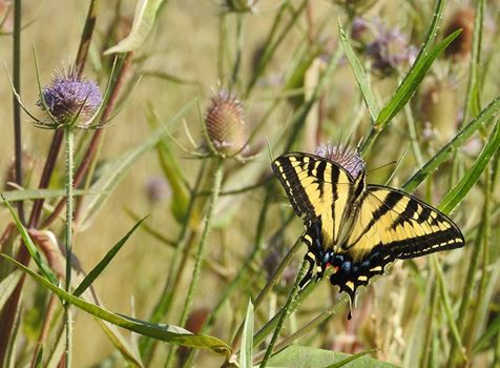
LOWER LAKE, Calif. – Anderson Marsh State Historic Park continues to hold monthly guided nature walks.
The next walk is scheduled for Saturday, May 12, at 8:30 a.m.
Meet in the parking lot at 8:15 a.m. to have time to experience the early morning wildlife to be found in the Ranch House and Barn complex yard.
The walk will begin at 8:30 a.m. and should last between one-and-a-half and two hours.
There will be a ranch house tour after this month’s nature walk.
Come join California Naturalist and park docent Henry Bornstein on Saturday, May 12, as he leads the monthly walk at Anderson Marsh State Historic Park.
This is a great time to visit the park as we move into the spring weather, with the trees leafing out, flowers blooming and birds, dragonflies and other insects becoming more active.
There is no charge for the walk and parking is free for those attending this event. Rain will cancel the walk. If the walk is canceled, the ranch house tour will begin at 8:30 a.m.
Anderson Marsh State Historic Park is located on Highway 53, between Lower Lake and Clearlake.
For more information about the nature walk, email
For information about how you can help support AMIA’s campaign to keep the park open and thriving, please visit www.andersonmarsh.org, or contact the organization by telephone or email.
- Details
- Written by: California Department of Fish and Wildlife
In the Klamath Management Zone, which is the area between the Oregon/California state line and Horse Mountain (40° 05’ 00” N. latitude), the season will open June 1 and continue through Sept. 3, 2018.
The Fort Bragg and San Francisco areas, which extend from Horse Mountain to Point Arena (38° 57’ 30” N. latitude) and Point Arena to Pigeon Point (37° 11’ 00” N. latitude), respectively, will open June 17 and continue through Oct. 31, 2018.
The Monterey area between Pigeon Point and the U.S./Mexico Border opened on Apr. 7 and will continue through July 2, 2018.
Shorter recreational ocean seasons in 2018 are the result of two key California salmon stocks attaining ‘overfished’ status this year. Both Sacramento River fall Chinook and Klamath River fall Chinook have experienced three successive years of poor adult returns, in response to the drought and poor conditions for survival.
The minimum size limit is 20 inches total length in all areas north of Pigeon Point and 24 inches in all areas south of Pigeon Point. The daily bag limit is two Chinook salmon per day. No more than two daily bag limits may be possessed when on land. On a vessel in ocean waters, no person shall possess or bring ashore more than one daily bag limit. Retention of Coho Salmon (also known as Silver Salmon) is prohibited in all ocean fisheries off California.
In 2019, the recreational ocean salmon season will open Apr. 6 south of Horse Mountain. The minimum size limit will be 20 inches total length in the area from Horse Mountain to Point Arena and 24 inches total length in all areas south of Point Arena. The daily bag limit will be two Chinook salmon per day. The remainder of the 2019 ocean salmon season will be decided at the PFMC meeting in April 2019.
For the first time, state ocean salmon regulations will automatically conform to federal regulations using the new process described in the California Code of Regulations, Title 14, Section 1.95. Federal regulations for ocean salmon were published in the Federal Register (83 FR 19005) on May 1, 2018, and are effective as of May 1, 2018.
Public notification of any in-season change is made through the National Marine Fisheries Service Ocean Salmon Hotline. Before engaging in any fishing activity for ocean salmon, please check one of the following resources for the most up-to-date information:
– CDFW Web site, www.wildlife.ca.gov/oceansalmon;
– National Marine Fisheries Service Ocean Salmon Hotline, 800-662-9825;
– CDFW Ocean Salmon Hotline, 707-576-3429.