 How to resolve AdBlock issue?
Recreation
- Details
- Written by: Editor
KELSEYVILLE, Calif. – The Konocti Junior Tennis League meets every Saturday from 11 a.m. to 12 noon.
The league is open to all junior players who would like to receive instruction and play with others.
Racquets are provided and players should bring their own water.
The courts are located on Gard Street, one block north of Main street in Kelseyville.
For more information please call 707-279-9652.
- Details
- Written by: Carrie Wilson
Are abalone report cards used to set new quotas?
Question: I was just filing my abalone harvest report, which rather than being due the end of January like before, is now not due until April 1.
While I appreciate the extra time and opportunity to still fill out my report when I go to buy new tags for the season opener, I am wondering if this means my harvest data from last year is not being used to set quotas and limits for the following season.
Specifically, is the impact of the Fort Ross closure and potential rebound or the north/south split of the last few years not being accounted for? (Darren M., Folsom)
Answer: I’m afraid you are mistaken about the deadline changing. Abalone report cards are still due Jan. 31.
Beginning this year our online reporting system will accept late reports because they still contain valuable information even after the Jan. 31 deadline.
In the future, late reporting may result in a mandatory late fee or temporary suspension of the privilege to harvest abalone.
According to California Department of Fish and Wildlife (CDFW) Marine Environmental Scientist Jerry Kashiwada, data from all cards returned to the Fort Bragg office are now being entered and it takes additional time beyond the deadline for that to be completed.
These data are very valuable in helping us determine the effects of the current set of regulations but it will take several years to sort out the regulation effects from year to year variations.
We had already been noting shifts in fishing effort to Mendocino County before the Fort Ross closure and catch reduction in Sonoma and Marin counties.
Our current management of abalone does not change from year to year in response to report card data. Instead, it is based on the density of abalone monitored by dive surveys at eight index sites. But the card data does provide valuable indications of abalone status at the many sites not covered by index site surveys.
The card data helps us determine the effects of the latest regulations, while the surveys show the effects on abalone populations and will largely determine future regulatory changes.
We are currently working on a new abalone management plan and will have public meetings in the near future to discuss details of the plan.
For more information, please go to www.wildlife.ca.gov/conservation/marine/red-abalone-fmp .
Hunting chipmunks
Question: I was recently in a conversation about hunting chipmunks and we are curious if it's legal to do? I do not plan on hunting them, just want to know. (Michael C.)
Answer: Chipmunks are classified as nongame mammals, which generally would mean they may not be taken.
However, chipmunks may be taken because California Code of Regulations Title 14, section 472(a) authorizes take of nongame rodents except for tree and flying squirrels, rodents that are designated as furbearers, and endangered or threatened species.
Shark fin prohibition
Question: According to the shark fin regulations, skate wings cannot be possessed as they are the expanded pectoral fins of an elasmobranch. I don’t understand this because the skates are still legal to catch and the only part of a skate that is eatable as far as I know is the wing.
How do I prepare the skate if it’s illegal to possess the wing? (Joel)
Answer: “Shark fins” are defined to mean the raw, dried or otherwise processed detached fin or tail of an elasmobranch (Fish and Game Code, section 2021). Since skates are elasmobranchs, the law applies to detached skate wings.
The shark fin law was adopted in part to conserve state resources, prevent animal cruelty by prohibiting shark fin removal of live fish and to protect wildlife and public health due to high levels of mercury in shark fins. Many people do eat the body and tail of the skate.
The harvest of skates for personal consumption is permissible under current law as long as the entire animal is harvested and not just the wings. You should transport the whole skate to where you are going to prepare it for immediate consumption.
Hunting on rental property
Question: I am renting some land and would like to hunt on it.
Do I need hunting permission written into the lease agreement? Do I need to carry written permission from the landowner on my person? Do I need verbal permission? Or does my renting the land give me permission to hunt? (Jennifer)
Answer: It is unlawful to enter certain lands for hunting purposes “without having first obtained written permission from the owner, the owner’s agent, or the person in lawful possession of that land” (FGC section 2016).
But as the renter of the land, you are the person in lawful possession of the land, so you are not required to carry written permission from the landowner.
However, prior to hunting on the land, you should make sure there are no restrictions in your lease or rental agreement that prohibits you from hunting on the property.
Carrie Wilson is a marine environmental scientist with the California Department of Fish and Wildlife. While she cannot personally answer everyone’s questions, she will select a few to answer each week in this column. Please contact her at
- Details
- Written by: Editor
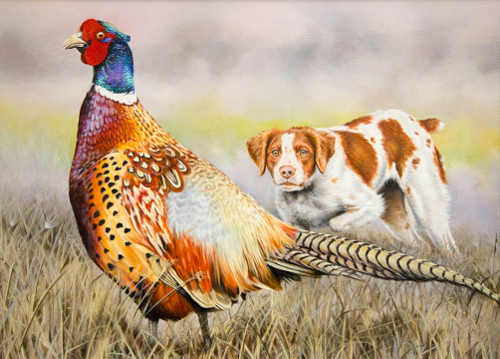
A painting of a male ring-necked pheasant and a Brittany hunting dog has been chosen by a panel of judges as the winning entry in the 2015-2016 California Upland Game Bird Stamp Art Contest.
The painting was created by Roberta “Roby” Baer of Redding, the first California artist to win the honor since the 2011-2012 contest.
Tim Turenne of Richfield, Minn., placed second and Diane Ford of Bethesda, Md., placed third.
Sponsored by the California Department of Fish and Wildlife (CDFW), the annual contest is held to determine the official design for the upcoming year's California Upland Game Bird Stamp.
Artists submitted their own original depiction of a ring-necked pheasant. The setting and details were determined by the individual artists, but entries had to include at least one adult ring-necked pheasant and be representative of the species' natural habitat in California if a background was included.
The entries were judged Thursday by a panel of experts who were selected for their knowledge in the fields of ornithology, conservation, art and printing.
Designs were judged on originality, artistic composition, anatomical accuracy and suitability for reproduction as a stamp and print.
The judges praised the acute realism of the winning entry and one noted the “remarkable level of detail” evident in Baer's rendering of the pheasant.
The realism that impressed the judging panel was inspired by Baer's fond memories of youthful adventures in the outdoors.
“When the species for this contest was announced, it brought up old memories of hiking when I was a kid growing up in the country,” said Baer, a wildlife artist who was raised in Palo Cedro (Shasta County). “I remember seeing those stunning pheasants all the time and hearing their distinctive sound. For me, it was like going back home when I was painting.”
An upland game bird validation is required for hunting migratory and resident upland game birds in California.
The validation replaces the stamp through CDFW's Automated License Data System, but the stamp is still produced and available to hunters upon request.
Money generated from upland game bird validation sales are dedicated solely to upland game bird-related conservation projects, hunting opportunities and outreach and education.
CDFW annually sells about 175,000 upland game bird validations and distributes approximately 17,000 stamps.
Any individual who purchases an upland game bird validation may request their free collectible stamp by visiting www.wildlife.ca.gov/licensing/collector-stamps .
An order form is also available on the website for collectors who do not purchase a hunting license or upland game bird validation or for hunters who wish to purchase additional collectible stamps.
The ring-necked pheasant was chosen this year due to CDFW's recent efforts to fund projects to address pheasant population declines in California.
For more information, please visit www.wildlife.ca.gov/conservation/birds/pheasant .
- Details
- Written by: Editor
NORTHERN CALIFORNIA – Tuleyome is happy to announce that it recently hired Nathan “Nate” Lillige as its new Home Place Adventures Activities Leader.
Lillige's entire professional career has been spent working with children and young adults in various aspects of outdoor education and conservation.
In addition to his work as a camp counselor and outdoor educator, he was the recycling program manager for the Sacramento Regional Conservation Corps. At the Corps, he worked with young adults on conservation efforts throughout the region.
“It is an exciting time to be joining Tuleyome,” Lillige said. “I am looking forward to joining others on the new trails of the Berryessa Snow Mountain National Monument. It's a treat to be a short drive from this wonderful natural area.”
Lillige grew up outside of Milwaukee, Wisc., and spent 12 summers as a camper and counselor at a summer camp surrounded by the Sleeping Bear Dunes National Lakeshore on Lake Michigan.
He received his Bachelor's of Science in natural science from the University of Wisconsin-Stevens Point, where he studied everything from the Point Reyes conglomerate to chemistry to glacial geomorphology.
His adventuring has taken him to Pictured Rocks National Lakeshore, rafting down the Yukon River, mountain biking in Denali National Park and exploring the Grand Canyon, Yellowstone and Yosemite.
When he is not working, Lillige enjoys photography, playing soccer, and spending his time with his wife and their two young children.
With Tuleyome, Lillige is returning to his first passion: getting people out in nature, where they can explore, learn and grow.
“Nature is an incredible classroom,” Lillige said. “It's one thing to look at pictures or videos of plants and animals, however seeing them with your own eyes and seeing how they interact with one another provides a unique learning experience.”
He will be sharing his love and enthusiasm for nature with the general public through Tuleyome’s upcoming events which include:
· Saturday, March 12: Tour the Silver Spur Ranch with Andrew Fulks.
· Saturday, March 19: The Berryessa Snow Mountain National Monument dedication celebration.
· Saturday, March 26: Trail building with Eric “Bam Bam” Barnett.
· Thursday, April 7: Lecture, the best trails and floats in the Berryessa Snow Mountain National Monument with Andrew Fulks.
· Saturday, April 9: Wildflower auto-tour with Glen Holstein.
· Saturday, April 16: Picnic day restoration work at Stebbins Cold Canyon.
For more details about each event, see Tuleyome’s Meet Up site at http://www.meetup.com/Tuleyome-Home-Place-Adventures/ .
Tuleyome is 501(c)(3) nonprofit conservation organization based in Woodland, Calif.
For more information about Tuleyome and the Home Place Adventures program, visit www.tuleyome.org .