 How to resolve AdBlock issue?
Recreation
- Details
- Written by: Carrie Wilson
How to get to shore when boat fishing is closed?
Question: I'm aware that during the non-boat rockfish season (i.e., winter/spring), anglers are required to either fish from shore or spearfish for these species.
My question is in regard to whether using a boat to access an on-shore fishing spot is acceptable.
Specifically, can I use my boat or kayak to reach a good shore fishing location, fish from shore and catch my fish, then get back in the boat for the ride home?
I wouldn't be fishing from the boat, but instead using it to transport me to my shore fishing location.
Thanks for your help. (Rick R.)
Answer: No, I’m afraid you will need to strap on your hiking boots and walk in to your favorite fishing spots along the coast during the boat-based fishing closures.
Arriving by boat would not be legal as each of the groundfish management areas have a specific section stating, “No vessel or watercraft (motorized or non-motorized) may be used to assist in taking or possessing these species while angling from shore under this provision.”
Depending upon which groundfish management area you plan to fish in (Northern [27.25], Mendocino [27.30], San Francisco [27.35], Central [27.40] or Southern [27.45]), this regulation can be found under section (c)(3).
Luring fish with licorice for bait?
Question: My brother and I have two burning questions we have been wondering about.
Is it legal to fish with licorice as bait?
Also, we observed a man with a syringe injecting air into his bait worms so they would float off the bottom. What do you think the purpose was and is this legal to do? (Marcus O.)
Answer: Processed foods, such as licorice, are legal under bait regulations for inland waters (found beginning in California Code of Regulations Title 14, section 4.00).
It is also legal to inject air into a fishing worm and many such kits are found at sporting goods outlets. This method can be a very effective way to keep a worm off the bottom of lakes with heavy bottom vegetation.
Are black mussels from Bodega Bay under quarantine?
Question: While we were fishing from the shore in Bodega Bay last weekend I noticed a lot of beautiful black mussels on the rocks.
I believe the limit is 10 pounds per person but wanted to make sure it was the safe season to eat them.
Are they under quarantine for domoic acid, too?
Thank you for your help!!! (Ben L.)
Answer: You are correct that the limit is 10 pounds (in the shell) for California sea mussels and bay mussels in combination (CCR Title 14, section 29.55).
Mussels are not currently under quarantine.
The California Department of Public Health (CDPH) monitors for natural toxins that occur along the coast that may affect wild mussels. Mussels are regularly quarantined on an annual basis, usually from May through October, because mussels are a particularly high risk species because they have the ability to concentrate toxins very quickly.
When dangerous levels of toxin are detected in mussels, CDPH will begin testing other shellfish species as well for these toxins, if samples are readily available.
If samples are not easily obtained, or if toxin levels are increasing rapidly, CDPH will issue a press release announcing a special health advisory for the potentially toxic seafood species in the affected area.
To check for real time advisories, go to www.dfg.ca.gov/marine/healthadvisory.asp .To check for an advisory or quarantine in advance of any mussel-collecting trip, you can also call the CDPH Biotoxin Information Line at 800-553-4133.
For more information about the annual mussel quarantine, please visit the CDPH Web site at www.cdph.ca.gov/Pages/MusselQuarantineFAQ.aspx .
Can pesky squirrels be relocated?
Question: Is it permissible to relocate pesky squirrels that are destroying or damaging private property? (Fred, Redding)
Answer: No. Small nuisance mammals that are damaging property may be taken by the owner but may not be released alive except in the immediate area.
Relocating nuisance wildlife not only relocates the problem but also places the critter into an area where it has no established shelter or food and water source, and could potentially spread disease.
A depredation permit may be issued for tree (gray) squirrels, unless it is the gray squirrel season when hunters are allowed a four squirrel bag and possession limit.
Must fishing license be carried while spearfishing?
Question: If I am spearfishing from the shore and return with my take, do I need to have my fishing license on my person or can it be in my car? (William H.)
Answer: Persons diving from a boat or shore may have their license on the boat or within 500 yards on the shore, respectively (Fish and Game Code, section 7145).
Carrie Wilson is a marine environmental scientist with the California Department of Fish and Wildlife. While she cannot personally answer everyone’s questions, she will select a few to answer each week in this column. Please contact her at
- Details
- Written by: Editor
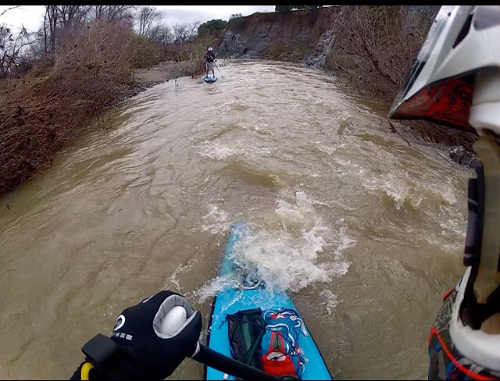
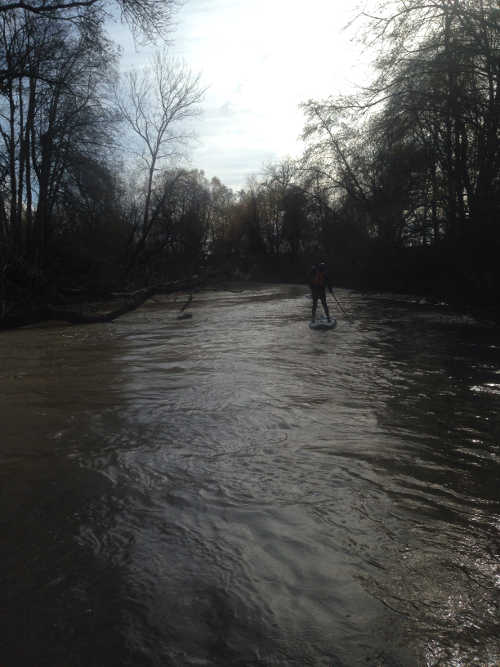
NORTH COAST, Calif. – On Sunday, Jan. 31, three Lake County men will be embarking on the second Stand Up Paddleboard scouting trip of a 9-mile section of the Russian River, between Redwood Valley and Talmage Road in Ukiah.
This trip can only be accomplished during the winter season after heavy rains, which swell the river and make it possible to Stand Up Paddleboard through the swift currents, jetties, small rapids and other obstacles.
The goal of the previous trip last year was to make the trip all the way down to Hopland from just South of Coyote Valley Casino in Redwood Valley.
Completing the trip were Mike Conser, owner of Mendo-Lake Stand Up Paddleboard, or SUP; Chris King, co-owner of King Designs and Carve Pilates in Lakeport; and Brian Robertson of Steel Winery.
Due to a few obstacles and barriers along the trip, they had to cut it short after several hours and exit the Russian River at Talmage Road in Ukiah.
Traveling along this stretch of the Russian River allows for many breathtaking views that wouldn’t normally be seen by even the residents of the area.
In some dangerous, unnavigable areas, the athletes would have to pick up their boards and find a safe way around on foot, but never more than a quick few steps.
It’s not surprising to have a 10-foot-log floating down the river beside you at any given time during a high water state.
The boarders have all the safety equipment required, besides the necessary full wetsuits and booties. Most importantly, they wear life jackets and helmets, carry whistles and knives, and they even use leashes to stay attached to the inflatable paddleboards and paddles, although they can quickly be released in an emergency situation, such as being pulled under by the current.
This Sunday they are doing it again for the first time of the season, with the addition of Chris Hudgins, the SeaDooDr., from Lucerne.
They plan to navigate the river, in even higher water than last year, to assess the route’s navigability in order to offer the adventure trip to clients through the 2016 season.
Paddleboarding in Lake and Mendocino counties is not new to the area. Mendo-Lake SUP has been providing lessons, rentals, group trips and coreboarding exercise classes each summer throughout Lake and Mendocino counties for the past two summers.
While most think of winter as the off season for stand up paddleboarding, it is quite the contrary, winter is when some of the more exciting fun happens on a paddleboard, especially on the river or on the lake on a windy day, thus proving to be a new challenge for the hardy adventurer.
Stay tuned for the stand up paddleboard adventure report, pictures and video next week. For more information on paddleboard excursions and exercise opportunities, visit Mendo-LakeSUP on Facebook or at http://www.carvepilates.com .
- Details
- Written by: Editor
The California Department of Fish and Wildlife (CDFW) reminds anglers, divers and hunters that Jan. 31, 2016, is the due date for turning in steelhead, sturgeon, abalone and north coast salmon report card data, as well as unfulfilled deer tag report cards (a new requirement for this year).
Information collected from sport fishing report cards provides CDFW biologists with important data necessary to monitor and manage California’s diverse recreational fisheries, including preparing recommendations for sport fishing seasons and limits that allow for sustainable levels of take.
This science-based management helps to ensure healthy populations of fish for future generations.
Any person who fails to return or report a salmon, steelhead, sturgeon or abalone report card to the department by the deadline may be restricted from obtaining the same card in a subsequent license year or may be subject to an additional fee for the issuance of the same card in a subsequent license year.
There are two ways to meet the mandatory angler reporting requirement. Online reporting ( www.wildlife.ca.gov/reportcards ) is easy, fast and free. Online reporting includes instant confirmation that the report has been received and accepted.
Please note that license sales agents cannot accept report cards. More information about report cards is available at www.wildlife.ca.gov/licensing/fishing .
Sport fishing report cards may also be returned by mail to the addresses listed below:
– North Coast Salmon Report Cards CDFW – Klamath River Project 5341 Ericson Way Arcata, CA 95521-9269.
– Abalone Report Cards CDFW – Abalone Report Card 32330 N. Harbor Drive Fort Bragg, CA 95437-5554.
– Steelhead Report Cards CDFW – Steelhead Report Card P.O. Box 944209 Sacramento, CA 94244-2090.
– Sturgeon Report Cards CDFW – Sturgeon Report Card P.O. Box 944209 Sacramento, CA 94244-2090.
– Anglers and divers are required to report even if the report card was lost or they did not fish. Cards should be reviewed carefully for accuracy before submission.
Also, every purchaser of a deer tag must now report their harvest, even if they were unsuccessful or did not hunt. CDFW uses this data to understand harvest rates and to build population estimates and future hunt quota recommendations for the state’s deer herds.
For successful hunters, the report must be made within 30 days of harvesting a deer or by Jan. 31, whichever date is first.
Unsuccessful hunters or those who did not hunt must report no harvest or did not hunt, respectively, by Jan. 31.
Starting with the upcoming 2016 deer season, tag holders who do not report will be charged a non-reporting fee of $20, which will be added to hunting license purchases beginning with the 2017 season.
Harvest reports can be submitted online at www.wildlife.ca.gov/licensing/hunting#9941260-tag-reporting or by mail to the address printed on the tag.
- Details
- Written by: Editor
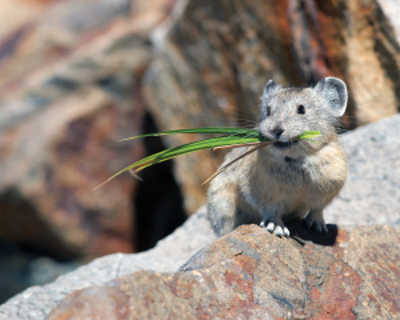
Berkeley resident Jennifer Joynt’s image of an American pika in Yosemite National Park earned the 2015 grand prize in the California Wildlife Photo of the Year contest.
The image of the furry, diminutive critter was chosen as the winner of the yearlong contest presented by Outdoor California magazine and California Watchable Wildlife Inc., and sponsored by the Sierra Nevada Conservancy and the State Coastal Conservancy.
Joynt’s picture captures the animal as it crests a rock formation along a trail near Gaylor Lake.
The shot was the winner for the November/December issue of Outdoor California magazine, and in early January, California Department of Fish and Wildlife Director Charlton H. Bonham selected it as the year’s top wildlife photo.
“The image of this pocket-sized American pika holding blades of grass that are nearly longer than its body length captures the imagination immediately,” Director Bonham said. “You can’t deny the ‘aww-factor’ that comes from the facial expression, but I see a pika on a mission to build its hay pile, its nest, its future. Such is the indomitable way of nature.”
Beginning Monday, the top eight images (including a second photo of Joynt’s) from the contest will hang as part of a week-long display at the Capitol outside the Governor’s Office. The photographs include all of the year’s top finishers and honorable mentions selected by the contest sponsors.
In addition to Joynt’s pika photograph, the photos on display include:
– Gray kit fox (Jennifer Joynt);
– American Rubyspot Damselfly (Phil Robertson, Lincoln);
– Northern river otter (Beth Savidge, Davis);
– Great Egret at marsh (Sandrine Biziaux Scherson, Irvine);
– Ferruginous hawk (Gary Kunkel, Visalia);
– Black bear cub (Brent Paull, Tulare);
– Summer tanagers (Brent Paull).
On Thursday morning, Joynt will join Senator Loni Hancock (D-Oakland) on the floor of the Senate, where she will receive a proclamation honoring her work.
This is not the first time Joynt has been recognized for her photographic skills.
Two years ago, her photo of a marmot pair near Tuolumne Meadows was selected as the honorable mention winner for the contest.
Her work has appeared in the San Francisco Chronicle, Bay Nature Magazine and Berkeleyside. She has also contributed multiple photographs to the East Bay Regional Park District for use in park signs, brochures and calendars.
Her favorite Bay Area wildlife photography locations include the East Bay Regional Parks and Point Reyes National Seashore.
In 2011, Outdoor California teamed with California Watchable Wildlife to launch an annual contest to acknowledge photographs that illustrate the state’s diverse wildlife and the viewing experiences found throughout its natural and wild lands.
California Watchable Wildlife celebrates the state’s wildlife and diverse habitats by promoting the value of wildlife viewing to individuals, families, communities and industries while fostering awareness of and support for conservation and protection efforts.
After a successful first year, the Sierra Nevada Conservancy joined as a contest sponsor to encourage more representation from a region rich with a diversity of wildlife.
The State Coastal Conservancy joined last year as a sponsor.