 How to resolve AdBlock issue?
Veterans
- Details
- Written by: Elizabeth Larson
The realignment closes the North Atlantic District Office in Philadelphia, Pennsylvania, and shifts states into more geographically similar areas.
The District Office located in St. Louis, Missouri, will now be responsible for the newly realigned Northeast District.
“The VBA district realignment is part of our effort to modernize the organization and become more efficient,” said VA Secretary Robert Wilkie. “This transition affects the management oversight and reporting structure for regional office directors, but will not affect day-to-day operations for employees or impact beneficiaries.”
The realignment does not affect the daily operations of any regional office.
After the restructuring, the four district offices will be:
– Northeast District: St. Louis;
– Southeast District: Nashville, Tennessee;
– Continental District: Denver, Colorado;
– Pacific District: Phoenix, Arizona.
More information on the VBA district structure is available at https://www.benefits.va.gov/benefits/offices.asp.
- Details
- Written by: Department of Veterans Affairs
Specifically, VA will support CDC’s Modernizing Death Reporting project by integrating patient mortality data from VA’s Electronic Health Record, or EHR, system.
A component of vital statistics, mortality data provides a critical view of the overall health of the nation. Moreover, mortality data identifies important variables for those dying in the U.S., assisting with the modeling of population life expectancy and cross-comparisons for health factors.
VA’s collaboration with CDC’s National Center for Health Statistics marks a shift in the way that mortality data has traditionally been provided, increasing the speed of data transmission and mitigating any loss of data value due to decreased interoperability.
VA believes that open, Fast Healthcare Interoperability Resources-based Application Programming Interfaces (APIs) form an essential component of a modern interoperability strategy.
To that end, VA is committed to working collaboratively to expand available Fast Healthcare Interoperability Resources, or FHIR, and their utilization.
CDC has been hard at work to increase the speed, quality and interoperability of mortality data captured and reported, and this new collaboration with VA further enables the advancement of this important work.
“Delivering data directly to CDC’s systems in this manner underscores VA’s commitment to a modern interoperability strategy,” said VA Secretary Robert Wilkie. “We look forward to future opportunities to enhance our partnerships and champion interoperability across the federal government.”
Using FHIR-based standards increases the value of this mortality data, as data is provided more quickly, enabling faster analysis and the delivery of more timely healthcare interventions.
For more information on VA’s partnership with CDC, visit https://www.cdc.gov/nchs/nvss/modernization/index.htm.
- Details
- Written by: Department of Veterans Affairs
Through video technology, VA health care providers are increasing access to care – diagnosing and managing care remotely for enrolled Veterans across the country.
“VA’s telehealth capabilities are bridging the care gap for many veterans,” said VA Secretary Robert Wilkie. “This technology gives veterans access to the timely, quality care they deserve, without having to travel great distances to a VA facility. Time spent traveling is time away from veterans’ jobs and families.”
Video technologies make it possible for veterans residing in remote or rural areas to come to many of VA's community-based outpatient clinics and interact in real-time, through video telehealth, with a specialist physician or another practitioner who may be hundreds or thousands of miles away.
From October 2017 through September 2018, veterans received VA quality care during approximately 2.3 million episodes of telehealth care.
– About half (1,074,400) were video telehealth encounters, which allows real-time interaction between VA care teams and their veterans in a clinic or at home.
– The other half of VA telehealth encounters were not real-time, interactive visits; instead, VA staff monitored, screened, assessed veteran data (e.g., vital signs, sleep studies, etc.) or images (e.g., skin rash, eye disease, etc.) sent by other VA staff in another VA clinic, or sent by a veteran or caregiver from home.
More than half (582,000) of those video encounters supported Veterans located in rural areas. Additionally, 105,300 of those 1 million-plus video visits were conducted using the VA Video Connect application on veterans’ mobile devices or personal computers from their homes or locations of choice.
At more than 900 community-based outpatient facilities, clinicians and veterans meet through these virtual, real-time visits, providing veterans care in more than 50 specialties, ranging from mental health to rehabilitation.
For more information on VA’s telehealth programs, visit www.telehealth.va.gov.
- Details
- Written by: San Francisco VA Health Care System
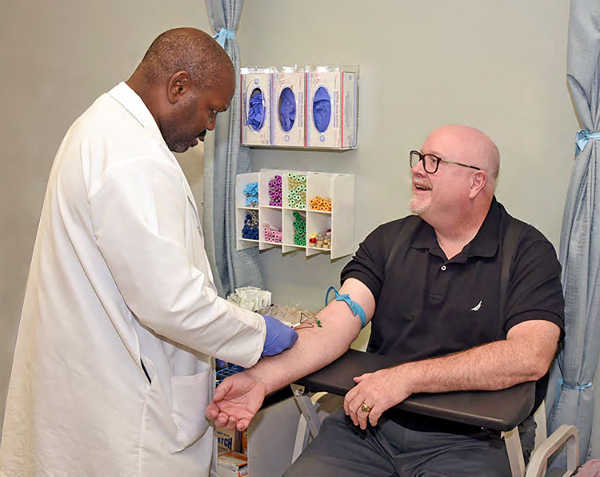
SAN FRANCISCO – The San Francisco VA Health Care System enrolled its 5,000th volunteer research participant on Jan. 31 in the national VA Million Veteran Program, or MVP, which is building a genetic database to help research and develop new treatments for veterans and non-veterans alike.
“This is a momentous occasion at the San Francisco VA and represents a remarkable collaboration between the research service and our clinical laboratory staff,” said Dr. Mary Whooley, site principal investigator for MVP at the San Francisco VA Health Care System. “We invite all veteran employees and patients to join us in this historic endeavor by enrolling in MVP. It’s quick and simple.”
The San Francisco VA Health Care System is one of 139 VA sites across the country where veterans can enroll in MVP.
Launched nationally in 2011, MVP is a landmark research effort aimed at better understanding how genes affect health.
Data and genetic samples collected through the study are stored securely and made available for studies by authorized researchers, with stringent safeguards in place to protect veterans’ private health information.
While the program is exciting from a research standpoint, veterans like Matt Parsons see it as a way to help other veterans.
“I know how valuable research can be in the long run,” said Parsons, an Air Force veteran and San Francisco VA employee. “Participating in this program gives me a chance to help other veterans get the best health care.”
With more than 700,000 enrollees to date nationally, MVP is now the largest database of its kind in the world – an integrated health and genomic database tied to a health care system.
MVP provides researchers with a rich resource of genetic, health, lifestyle, and military-exposure data collected from questionnaires, medical records and genetic analyses.
By combining this information into a single database, MVP promises to advance knowledge about the complex links between genes and health.
Authorized researchers can use MVP data to help answer important questions on a wide range of health conditions affecting veterans, from military-related conditions such as post-traumatic stress and traumatic brain injury, to common chronic illnesses such as diabetes and heart disease.
MVP-related discoveries also promise to advance the field of personalized medicine, which aims to tailor medical care based on people’s individual genetic profiles. Personalized medicine is expected to yield more effective treatments and reduce costs, given its emphasis on prevention.
How to enroll
Veterans interested in enrolling in MVP at the San Francisco VA Health Care System can visit the Outpatient Laboratory (room 2B-117 and 2B-118) located on the second floor of building 200 at the San Francisco VA Medical Center. The lab is open for MVP enrollments from 8 a.m. to 3 p.m. every Monday through Thursday and from 8 a.m. to 2 p.m. on Fridays. The medical center address is 4150 Clement St., San Francisco.
Veterans in the Santa Rosa area can enroll at the Santa Rosa VA Clinic Lab from 8 a.m. to 12 p.m. every second Thursday of the month. The address is 3841 Brickway Blvd., Santa Rosa.
To learn about the national MVP, visit www.research.va.gov/mvp, or call the MVP information center at 866-441-6075.
- Details
- Written by: Department of Veterans Affairs
Effective January, the American Foundation for Suicide Prevention, or AFSP, began collaborating with VA to advance and improve the quality of life for Veterans to prevent suicides.
Through this partnership, VA and AFSP have been exchanging research on suicide and prevention efforts. AFSP has also begun sharing VA suicide-prevention messaging.
Effective last November, the National Shooting Sports Foundation, or NSSF, began working with VA to develop a program that will empower communities to engage in safe firearm-storage practices.
The program will include information to help communities create coalitions around promoting and sustaining firearm safety with an emphasis on service members, veterans and their families.
“We want all Americans to know that suicide is preventable.” said VA Secretary Robert Wilkie. “By working with local organizations and community partners, we’re confident that we can make a meaningful difference to reduce suicide among veterans.”
These innovative partnerships highlight the shared mission between the VA, nonprofit organizations and local communities to end suicide among those who have served or are currently serving.
Research shows there is no single cause for suicide: It is the outcome of multiple contributing factors and events. However, environmental factors, such as access to lethal means, increase the risk for suicide.
Firearms are one of the most deadly and common methods for suicide among Americans – particularly for service members and Veterans.
Veterans in crisis or having thoughts of suicide, and those who know a Veteran in crisis, can call the Veterans Crisis Line for confidential support 24 hours a day, seven days a week, 365 days a year. Call 800-273-8255 and press 1, chat online at www.VeteransCrisisLine.net/Chat or text to 838255.
- Details
- Written by: Elizabeth Larson
Aguiar-Curry issued the following statement about the situation on Wednesday:
“I am deeply troubled by the results of the audit detailing the mismanagement of the state’s Veterans Home properties. I can only speak for the Yountville Home in my Fourth Assembly District, but I have consistently expressed my concerns about the management of the home and conditions for veterans,” she said.
“The findings in the report that DGS and CalVet did NOT assure lease revenue generated on Veterans Home properties were returned back to the Homes is shocking. The conditions at the Yountville Home must be improved after years of underinvestment and deferred maintenance. The planning and construction of the Skilled Nursing Facility included in last year’s budget will improve care for the residents and other veterans in Northern California, but this audit confirms that vital resources intended to benefit veterans have been wasted or diverted.
“I am working with Assemblymember Jacqui Irwin (D-Thousand Oaks), Chair of the Assembly Veterans Committee, to ensure necessary reforms are implemented and legislation is passed to fix our laws and protect our veterans. It is critical that we continue legislative oversight and return any misappropriated revenues to the Veterans Homes where they belong.
“There are two issues to which our local leaders and policymakers must pay careful attention. First, every use of property at the home must benefit the veterans. However, there is an important distinction between exploitative property uses and judicious shared use of the Veterans Home. Any suggestion that community events in general do not benefit veterans ignores the community’s historic support for the veterans and charitable activities that benefit them. About one-third of Yountville’s total population resides at the Veterans Home. We want to integrate veterans into our lives, not isolate them.
“Second, any suggestion that employee housing at the home must be “market rate” ignores the critical need for affordable housing in Napa County. There is a mutual benefit to both the veterans and the employees when there is staff housing available on-campus. While rental rates should reflect what is appropriate for working families, and benefits should not be given inappropriately, consideration should be given to the well-being of the employees at the home and to facilitation of their ability to care for the residents.
“I stand ready to work with the new Administration to address the issues identified in the Auditor’s report, and finally work to restore conditions at the Yountville Home to make life better for those who’ve risked their lives to defend our nation.”
You can view the Auditor’s report here.
Aguiar-Curry represents the Fourth Assembly District, which includes all of Lake and Napa Counties, parts of Colusa, Solano and Sonoma counties, and all of Yolo County except West Sacramento.
- Details
- Written by: Elizabeth Larson
Garamendi co-authored the legislation with Congressman Trent Kelly (R-MS), and identical legislation was introduced in the Senate by Senators Steve Daines (R-MT) and Joe Manchin (D-WV).
TRICARE Reserve Select is a premium-based health insurance plan for National Guard and Armed Forces Reserve service members that provides a comparable level of care as their active duty counterparts, at an affordable cost.
The military services leverage TRICARE Reserve Select as an incentive to recruit new service members, as well as retain others who are leaving active duty with valuable, high-demand skillsets – such as aircraft maintenance.
These service members are top candidates for the National Guard’s dual-status technician program, which allows an individual to continue serving an on a part-time basis, and help maintain military aircraft as a federal civilian.
Under current law federal employees who serve in the National Guard or Armed Forces Reserve are prohibited from participating in TRICARE Reserve Select.
This disparity creates a financial incentive for transitioning service members to take their skillset and credentials away from the federal government and penalizes those who choose to serve their country in a civilian capacity. It also limits the effectiveness of TRS as a recruiting tool within the public sector.
“I’m proud to work with Congressman Trent Kelly and Senators Steve Daines and Joe Manchin to ensure our servicemembers have access to quality, affordable healthcare,” Garamendi said. “Under current law, National Guardsmen and Reservists who are federal employees are only eligible to enroll in the FEHB Program and are restricted from participating in TRICARE Reserve Select. This legislation would remove that restriction to provide continuity of care and a more affordable option for these servicemembers and their families. I’ve heard from reservists in my district at Travis and Beale Air Force Bases about this issue and how it’s impacted their quality of life, and it’s time for Congress to finally act on this common-sense piece of legislation.”
"Our federal technicians in the National Guard and Reserves and their families deserve the same affordable access to healthcare coverage plans," Rep. Kelly said. "I look forward to working with my colleagues in both the House and Senate to advance this legislation to make a simple fix to an unfair bureaucratic restriction. This bill will allow dual-status military technicians in the National Guard and Reserves the choice to select TRICARE Reserve Select coverage instead of the Federal Employee Benefit option.
“Current law denies a valuable benefit to thousands of Guardsmen and Reservist,” said retired Brig. Gen. Roy Robinson, NGAUS president. “This important legislation would help them save thousands of dollars a year in health care premiums while ensuring their families have continuity of care when they are deployed. Our soldiers and airmen greatly appreciate the leadership by Senator Daines and Senator Manchin as well as Congressman Kelly and Congressman Garamendi in the House of Representatives.”
Sgt Maj (Ret) Frank Yoakum, executive director of EANGUS, said, “TRICARE Reserve Select continues to be a top priority for our Association. Continuity of health care is a persistent complaint and we applaud Congress for their willingness to remove this impediment to service for National Guard members and their families.”
- Details
- Written by: Elizabeth Larson
The Readiness Subcommittee oversees defense programs that enable the military services to be prepared to fight. Military units that have sufficient equipment, trained personnel, and supplies are considered “ready.”
“I look forward to working with House Armed Services Committee Chair, Adam Smith, to support our military as it continues to adapt to 21st century threats. I will work diligently with my colleagues on the Readiness Subcommittee to ensure the United States military remains the strongest, most capable, and wisest military on earth,” Garamendi said.
The Readiness Subcommittee oversees one-third of the Department of Defense’s budget – the largest of any subcommittee on the Armed Services Committee.
The subcommittee has jurisdiction over programs related to training, logistics, equipment maintenance, the management of over 1,000 military installations and bases worldwide, and efforts to improve energy resiliency, including climate change adaptation, and environmental health issues.
- Details
- Written by: Department of Veterans Affairs
The annual clinic, hosted by the Department of Veterans Affairs and Disabled American Veterans, or DAV, serves as a world leader in adaptive winter sports instruction for injured Veterans, and promotes sports therapy and rehabilitation through adaptive Alpine and Nordic skiing, rock climbing, sled hockey, scuba diving and other adaptive sports and activities.
“Adaptive sports therapy gives freedom to those heroes who have fought for our freedom,” VA Secretary Robert Wilkie said. “This clinic empowers veterans to move past perceived limitations, reach their own personal victories and prove the impossible is possible.”
For many of the hundreds of veterans who participate in the clinic, the adaptive sports journey is just beginning. For others, it becomes a way of life in Snowmass and is a passion they take back home. The hope is veterans will build upon this experience and continue to lead active, healthy lives. Nearly 390 veterans participated in the event in 2018.
“For those of us who were seriously injured in military service and have spent years being told our abilities are now limited, there is nothing more empowering than coming to this clinic and being able to prove how much we really can do,” said DAV National Commander Dennis Nixon, a Vietnam veteran and amputee. “It’s a dose of confidence and self-reliance that can – and does – truly change lives.”
Hundreds of volunteers, strategic corporate partnerships, nonprofit organizations and individual donors make this life-changing clinic possible.