 How to resolve AdBlock issue?
Veterans
- Details
- Written by: Department of Veterans Affairs
The department is changing its procedures for electronic health information sharing in accordance with Section 132 of the VA Maintaining Internal Systems and Strengthening Integrated Outside Networks Act of 2018, known as the MISSION Act.
“The MISSION Act gives Veterans greater access to care, whether at VA facilities or in the community,” said VA Secretary Robert Wilkie. “We are providing seamless access to care, improving efficiency and helping to ensure Veterans get the care they need, where and when they need it.”
The change moves VA from an ‘opt-in’ to an ‘opt-out’ model of electronic health information sharing.
Veterans will no longer be required to provide signed, written authorization for VA to release electronic health information to community providers for the purposes of receiving medical treatment.
VA shares health information with community providers using a secure and safe electronic system called the Veterans Health Information Exchange. This electronic exchange of information improves patient safety — particularly during emergency situations — and allows for improved care coordination for Veterans receiving care in the community.
Veterans who do not want their health information shared electronically can opt out by submitting VA Form 10-10164 (opt out of sharing) to the Release of Information Office at the nearest VA medical center now or at any time going forward.
Veterans who previously opted out on VA Form 10-0484 prior to Sept. 30, do not need to submit new forms.
However, veterans who restricted what information VA shared by submitting VA Form 10-0525 (restriction request) will need to opt out entirely by submitting Form 10-10164.
VA is committed to protecting Veteran privacy. Only community health care providers and organizations that have partnership agreements with VA and are part of VA’s approved, trusted network may receive VA health information.
For information about VA’s health information exchange visit www.va.gov/vler.
- Details
- Written by: Department of Veterans Affairs
Each veteran will have their own memorial page on the Veterans Legacy Memorial, or VLM, a secure, web-based platform that creates a perpetual memorial extending beyond the physical border of the national cemetery.
"Veterans Legacy Memorial ensures ‘no Veteran ever dies’ by honoring the legacy of our nation’s veterans, not just in our cemeteries, but in a new and innovative digital setting," said VA Secretary Robert Wilkie. “It enhances the onsite national cemetery experience and extends the experience to those who otherwise are unable to physically visit the cemetery.”
The National Cemetery Administration, or NCA, in conjunction with VA's Office of Information and Technology, built the architecture for the site starting with the information contained on every veteran's headstone.
In the initial rollout, the public will be able to search the site for veterans, find out where they are buried and read the basic details of their lives and service.
Future capabilities may be expanded to allow families, survivors, fellow veterans and others to add historic photos and share memories to a deceased Veteran’s memorial page.
Such capabilities will include provisions that allows NCA to manage the site in a manner that maintains the same level of decorum our customers experience in our national cemeteries.
For more information about the Veterans Legacy Memorial, visit https://www.va.gov/remember, or contact Dr. Bryce Carpenter, Veterans Legacy Program manager, at
Have questions about Veterans Legacy Memorial? Find what you're looking for at VLM FAQ.
- Details
- Written by: Elizabeth Larson
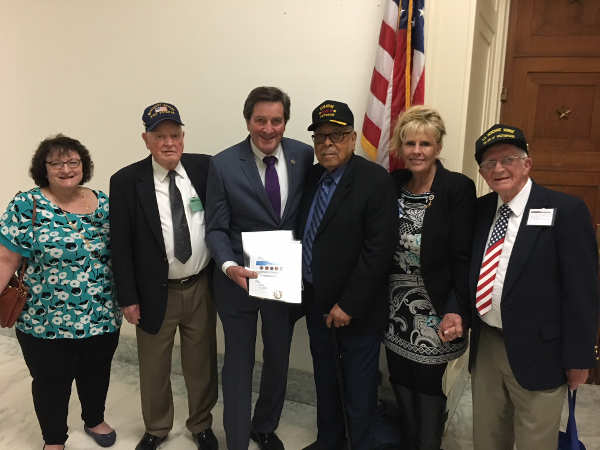
WASHINGTON, DC – Congressman John Garamendi (D-Fairfield, Davis, Yuba City), announced that his bipartisan Merchant Mariners of World War II Congressional Gold Medal Act of 2019 passed the House of Representatives unanimously.
“Throughout the Second World War, our armed forces relied on the Merchant Marine to ferry supplies, cargo and personnel into both theaters of operation, and they paid a heavy price in service to their country. The Merchant Marine suffered the highest per capita casualty rate in the U.S. Armed Forces during World War II. An estimated 8,300 mariners lost their lives, and another 12,000 were wounded, to make sure our service members could keep fighting. Yet, these Mariners who put their lives on the line were not even given veteran status until 1988,” Garamendi said.
“Last year, I got the chance to meet with three World War II Merchant Mariners: Charles Mills of Texas, age 97; Eugene Barner from Kansas, age 92; and Robert Weagant from Illinois, age 92,” Garamendi continued. “These mariners put their lives on the line for this country, braving German and Japanese submarines in their Liberty Ships as they delivered critical supplies to our servicemembers in the European and Pacific theaters. Unfortunately, their sacrifice is commonly overlooked. A Congressional Gold Medal would give them the recognition they deserve, and that’s why I introduced this bill: to give these veterans and their families the honor and respect they are owed. I’m pleased that this bill has passed the House and I will work to ensure it passes the Senate and becomes law,” Garamendi concluded.
“The time has come for our nation to provide a well-deserved thank you and honor the remaining Merchant Marine Veterans of WWII with a Congressional Gold Medal. This group of unsung heroes nobly served our country by operating the ships that transported critical supplies to front lines of the war, and in doing so suffered a casualty rate higher than any other branch of the military. In fact, one out of every 26 casualties during WWII was a volunteer Merchant Mariner. America would not be the great nation it is today without their valiant service of yesterday. I urge Congress to support this important bill and recognize this dwindling group of Merchant Marine Veterans from WWII that have served our nation so admirably,” said Christian Yuhas, Vice President of American Merchant Marine Veterans and a Chief Engineer Merchant Marine.
The Merchant Mariners of World War II Congressional Gold Medal Act was introduced in the Senate simultaneously by Senator Lisa Murkowski (R-AK). Reps. Don Young (R-AK) and Susan Brooks (R-IN) are the original cosponsors in the House of Representatives.
- Details
- Written by: Elizabeth Larson
“I’m pleased to once again serve as a member of the National Defense Authorization Act conference committee,” Garamendi said. “As chairman of the Readiness Subcommittee, I oversee one-third of the Department of Defense’s programs. The Readiness Subcommittee took bold steps in its subcommittee mark to address the climate crisis and prohibit the President from usurping Congress’ power of the purse by raiding vital military construction projects to pay for his border wall. We also acted to address the privatized military housing crisis and provide relief to veterans and service members experiencing health issues from exposure to Agent Orange, PFAS, and other toxins.
“I will fight to ensure that the strong language we secured in the House-passed NDAA remains in the final bill. I will also ensure that the support I helped secure for the missions at Travis and Beale Air Force Bases in my district are supported in the final version of the legislation that reaches the president’s desk,” he said.
Garamendi’s district includes the northern half of Lake County, Calif.
- Details
- Written by: Department of Veterans Affairs
The week-long rehabilitation sports and recreation clinic for Veterans with disabilities features instruction in adaptive CrossFit, cycling, kayaking, sailing and surfing.
“There is no finer place than the Summer Sports Clinic to see the incredible heart and courage of our warrior Veterans,” said VA Secretary Robert Wilkie. “More than camaraderie and sportsmanship, this clinic helps our Veterans thrive through adaptive sports and other activities. I’m proud of our dedicated staff and all the community supporters who make this possible.”
The clinic kicks off with opening ceremonies at the Wyndham San Diego Bayside Hotel on Sept. 15 at 6 p.m. Sports activities take place Sept.16 to 20.
The National Veterans Summer Sports Clinic is hosted by the VA San Diego Healthcare System and the San Diego community.
For more information, visit National Veterans Summer Sports Clinic and follow VA Adaptive Sports Programs @Sports4Vets on Facebook Instagram and Twitter.
- Details
- Written by: Department of Veterans Affairs
This follows the department’s June 10 announcement of a new policy restricting smoking by patients, visitors, volunteers, contractors and vendors at its health care facilities.
The integration of these two efforts guarantees a fully smoke-free environment for veterans.
“This policy change is consistent with our mission to promote a healthy environment for patients, visitors and employees at our facilities and is an important element of improving our health care system,” said VA Secretary Robert Wilkie. “It will reduce the harmful effects of smoking, including exposure to second and third-hand smoke, as well as increase safety and reduce fire hazards caused by smoking.”
The VA has collaborated with key stakeholders to update and recertify the employee policy to be consistent with department’s commitment to veterans and the community. Implementation of the employee smoke-free policy will be completed no later than January 2020 based on employee union-negotiated timelines.
The Veterans Health Administration’s smoke-free policy applies to cigarettes, cigars, pipes, any other combustion of tobacco and non-Federal Drug Administration approved electronic nicotine delivery systems, including but not limited to electronic or e-cigarettes, vape pens or e-cigars.
To learn more about health risks associated with smoking, visit the Surgeon General’s website at https://www.hhs.gov/surgeongeneral/reports-and-publications/tobacco/index.html or https://smokefree.gov/ .
The Veterans Health Administration has resources and programs to assist employees in their smoke free journey and these can be found at https://www.mentalhealth.va.gov/quit-tobacco/ .
For additional information about the policy visit https://www.va.gov/health/smokefree/ .
- Details
- Written by: Department of Veterans Affairs
As part of this approach, VA is working closely with The White House and other partners to implement the President’s Roadmap to Empower Veterans and End a National Tragedy of Suicide or PREVENTS.
“This September, and all year, I encourage everyone to take a moment to be there for veterans in need,” said VA Secretary Robert Wilkie. “One act of thoughtfulness can make a big difference and may even save a life. That’s why, VA is proud to work on initiatives like PREVENTS, to prevent suicide and find innovative ways to deliver support and care to all 20 million U.S. veterans whenever and wherever they need it,”
The PREVENTS roadmap, initiated by an executive order signed by President Trump in March 2019, will serve as an important tool for promoting research, community engagement – and collaboration in the public and private sector – and ultimately, for ending veteran suicide.
Suicide is a complex, national public health issue that affects communities nationwide, with more than 45,000 Americans, including more than 6,000 Veterans, dying by suicide every year.
Suicide is preventable, and special training is not needed to prevent suicide. Everyone can play a role by learning to recognize warning signs, showing compassion to veterans in need and offering support.
Listed are actions anyone can take to Be There:
– Reach out to veterans to show them you care. Send a check-in text, cook them dinner or simply ask, “How are you?”
– Learn the warning signs of suicide, found on the Veterans Crisis Line website.
– Watch the free S.A.V.E. training video to equip yourself to respond with care and compassion if someone you know indicates they are having thoughts of suicide.
– Check out VA’s Social Media Safety Toolkit to learn how to recognize and respond to social media posts that may indicate emotional distress, feelings of crisis or thoughts of suicide.
– Contact VA’s Coaching Into Care program when worried about a veteran or loved one. A licensed psychologist or social worker will provide guidance on motivating your loved one to seek support.
– Learn more about the #BeThere campaign and access resources to help support veterans at http://BeThereForVeterans.com.
Veterans who are in crisis or having thoughts of suicide, and those who know a veteran in crisis, can call the Veterans Crisis Line for confidential support available 24 hours a day, seven days a week, 365 days a year. Call 800-273-8255 and Press 1, text to 838255 or chat online at http://VeteransCrisisLine.net/Chat.
- Details
- Written by: Department of Veterans Affairs
“America lost a true patriot last week who never stopped fighting for veterans,” said VA Secretary Robert Wilkie.
Walters, a West Point graduate who served in the Army from 1959 to 1963, led the VA from 1983 to 1986, and once said his leadership of the VA gave him an even deeper appreciation for our nation’s heroes.
He was later able to show that appreciation as president of the Desert Storm Homecoming Foundation in 1991, which organized a parade in Washington, D.C. to celebrate the U.S. victory in the Gulf War.
“Harry liked to note that motivating spirit behind the foundation was, ‘of the troops, by the troops, for the troops,’ which showed his love for those who have worn the uniform,” Wilkie said. “His service will never be forgotten, nor will his clear-eyed view of this nation’s debt to our soldiers and veterans.”
- Details
- Written by: Office of the Governor
The governor and first partner extend their deepest condolences to his family and friends at this difficult time.
In memorial, Gov. Newsom ordered that flags be flown at half-staff over the State Capitol. Master Sgt. Gonzalez's family will receive a letter of condolence from the governor.
Master Sgt. Jose J. Gonzalez, 35, of La Puente, CA, died Aug. 21 in Faryab Province, Afghanistan, as a result of wounds sustained from small arms fire while engaged in combat operations. The incident is under investigation.
He was assigned to 1st Battalion, 7th Special Forces Group (Airborne), Eglin Air Force Base, Florida.
Master Sgt. Gonzalez was supporting Operation Freedom's Sentinel.