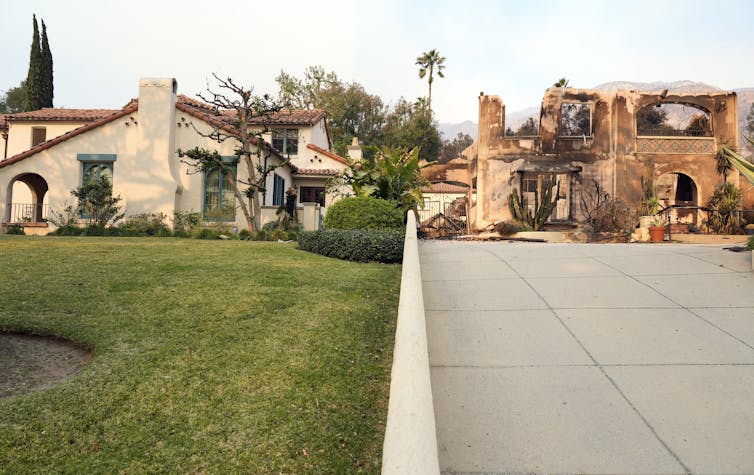
Photos after the Los Angeles fires in January 2025 show many yards where vegetation didn’t burn while neighboring houses did. AP Photo/Chris Pizzello
One of the most striking patterns in the aftermath of many urban fires is how much unburned green vegetation remains amid the wreckage of burned neighborhoods.
In some cases, a row of shrubs may be all that separates a surviving house from one that burned just a few feet away.
As scientists who study how vegetation ignites and burns, we recognize that well-maintained plants and trees can actually help protect homes from wind-blown embers and slow the spread of fire in some cases. So, we are concerned about new wildfire protection regulations being developed by the state of California that would prohibit almost all plants and other combustible material within 5 feet of homes, an area known as “Zone 0.”
Photos before and after the 2025 Palisades Fire show thick green vegetation between two closely spaced homes. The arrow shows the direction of the fire’s spread.Max Moritz; CAL FIRE Damage Inspection photos, CC BY
Wildfire safety guidelines have long encouraged homeowners to avoid having flammable materials next to their homes. But the state’s plan for an “ember-resistant zone,” being expedited under an executive order from Gov. Gavin Newsom, goes further by also prohibiting grass, shrubs and many trees in that area.
If that prohibition remains in the final regulation, it’s likely to be met with public resistance. Getting these rules right also matters beyond California, because regulations that originate in California often ripple outward to other fire-prone regions.
Lessons from the devastation
Research into how vegetation can reduce fire risk is a relatively new area of study. However, the findings from plant flammability studies and examination of patterns of where vegetation and homes survive large urban fires highlight its importance.
When surviving plants do appear scorched after these fires, it is often on the side of the plant facing a nearby structure that burned. That suggests that wind-blown embers ignited houses first: The houses were then the fuel as the fire spread through the neighborhood.
We saw this repeatedly in the Los Angeles area after wildfires destroyed thousands of homes in January 2025. The pattern suggests a need to focus on the many factors that can influence home losses.
Shrubs in Zone 0 of a home did not ignite during the Eaton Fire, despite the home burning.Max Moritz
For example, installing rain gutter covers to keep dead leaves from accumulating, avoiding flammable siding and ensuring that vents have screens to prevent embers from getting into the attic or crawl space can lower the risk of the home catching fire.
However, guidance related to landscaping plants varies greatly and can even be incorrect.
For example, some “fire-safe” plant lists contain species that are drought tolerant but not necessarily fire resistant. What matters more for keeping plants from becoming fuel for fires is how well they’re maintained and whether they’re properly watered.
In many cases, high moisture can actually keep a plant from igniting. We’ve seen this in some of our experimental work and in other studies that test the flammability of ornamental landscaping.
With enough heat, dried leaves and stems can break down and volatilize into gases. And, at that point, a nearby spark or flame can ignite these gases and set the plant on fire.
Plant flammability testing shows how quickly twigs, grasses, plants and leaves will burn at different moisture levels. The images on the right are from an experiment at the University of California’s South Coast Research and Extension Center to test flammability of a living but overly dry plant.Max Moritz (left); Luca Carmignani (right)
Even when the plant does burn, however, its moisture content can limit other aspects of flammability, such as how hot it burns.
Up to the point that they actually burn, green, well-maintained plants can slow the spread of a fire by serving as “heat sinks,” absorbing energy and even blocking embers. This apparent protective role has been observed in both Australia and California studies of home losses.
How often vegetation buffers homes from igniting during urban conflagrations is still unclear, but this capability has implications for regulations.
California’s ‘Zone 0’ regulations
The Zone 0 regulations California’s State Board of Forestry is developing are part of broader efforts to reduce fire risk around homes and communities. They would apply in regions considered at high risk of wildfires or defended by CAL FIRE, the state’s firefighting agency.
Many of the latest Zone 0 recommendations, such as prohibiting mulch and attached fences made of materials that can burn, stem from large-scale tests conducted by the National Institute of Standards and Technology and the Insurance Institute for Business and Home Safety. These features can be systematically analyzed.
But vegetation is far harder to model. The state’s proposed Zone 0 regulations oversimplify complex conditions in real neighborhoods and go beyond what is currently known from scientific research regarding plant flammability.
Green lawns, trees and shrubs were still visible after the Eaton Fire burned homes in Altadena, Calif., in January 2025.Mario Tama/Getty Images
A mature, well-pruned shrub or tree with a high crown may pose little risk of burning and can even reduce exposure to fires by blocking wind and heat and intercepting embers. Aspen trees, for example, have been recommended to reduce fire risk near structures or other high-value assets.
In contrast, dry, unmanaged plants under windows or near fences may ignite rapidly and make it more likely that the house itself will catch fire.
As California and other states develop new wildfire regulations, they need to recognize the protective role that well-managed plants can play, along with many other benefits of urban vegetation.
We believe the California proposal’s current emphasis on highly prescriptive vegetation removal, instead of on maintenance, is overly simplistic. Without complementary requirements for hardening the homes themselves, widespread clearing of landscaping immediately around homes could do little to reduce risk and have unintended consequences.
Andrew Robert, 14, of Clearlake, California, was found dead after an hourslong search on Sunday, June 8, 2025. Photo courtesy of the Lake County Sheriff’s Office.
LAKE COUNTY, Calif. — A teenager reported missing from a Hidden Valley Lake beach on Sunday afternoon was found dead hours later by the North Shore Dive Team.
Andrew Robert, 14, of Clearlake was the subject of a search for much of Sunday afternoon and evening, leading to his discovery at about 10:40 p.m. Sunday, the Lake County Sheriff’s Office said.
Robert was reported missing from the Big Beach area of Hidden Valley Lake, where he was last seen around 4:15 p.m., the Lake County Sheriff’s Office reported.
Authorities said the teen was on a group trip and when he was last seen, he was telling others he was going to the pool.
The sheriff’s office released a Nixle about the missing boy just before 6 p.m.
At 6:30 p.m., the Lake County Search & Rescue Team, along with K9 Sadie, was deployed to begin the search, the sheriff’s office said.
Multiple agencies joined the search effort, including KCORP, Cal Fire, the North Shore Dive Team, South Lake Fire and Hidden Valley Security.
The sheriff’s office said the teams searched both on land and in the water.
The operations continued into the night, and in an update issued just after 9:30 p.m., authorities said the search was still underway.
It was about an hour later that the dive team members found his body, the sheriff’s office said in a report issued shortly before 11:30 p.m. Authorities did not specify exactly where they located him.
“The Lake County Sheriff’s Office extends our heartfelt condolences to Andrew’s family, friends, and the entire community during this difficult time,” the agency said in its report on the teen’s death.
The sheriff’s office also thanked the other agencies and organizations that assisted with the search.
“Thank you also to the community for your support and concern throughout the search efforts,” the sheriff’s office said.
Editor’s note: The victim’s last name previously was reported by authorities as “Roberts.” The articles about this case have been updated to reflect his correct last name, which is “Robert.”
LAKE COUNTY, Calif. — The Board of Supervisors this week will consider adoption of a new fire hazard map, review an analysis of options to improve election operations and discuss a list of road projects to be funded by a $3.8 million state grant.
The board will meet beginning at 9 a.m. Tuesday, June 10, in the board chambers on the first floor of the Lake County Courthouse, 255 N. Forbes St., Lakeport.
The meeting ID is 865 3354 4962, pass code 726865. The meeting also can be accessed via one tap mobile at +16694449171,,86533544962#,,,,*726865#. The meeting can also be accessed via phone at 669 900 6833.
At 9:05 a.m., the board will consider a presentation by the California State Association of Counties on housing, homelessness, the stage budget and federal funding uncertainty.
At 9:30 a.m., the board will hold a public hearing on the state’s new fire hazard severity zone map in the unincorporated lands that fall under the Local Responsibility Areas, or the LRA.
The new map, released in February, marks the first update to the LRA designations since 2011 and adds 14,000 acres in Lake County to the “very high” zone — an 878% expansion in acreage classified as the most hazardous.
Unincorporated areas under county jurisdiction see a dramatic jump in the “very high” category from just 5 acres to 10,881 acres.
Local jurisdictions are required by state law to adopt the map by ordinance as is or with a higher hazard zone rating; they are not allowed to lower it.
At 10 a.m., the board will sit as the Lake County Air Quality Management District Board of Directors to hold a public hearing for a proposal on new fee rules.
“The district has not increased fees since 1996, other than implementation of the burn permit fee in 2003 and CPI [Consumer Price Index] adjustments,” the staff memo wrote. “The costs of operation and requirements placed on the District have increased significantly more than CPI since then.”
Other rule updates include the lifting of the burn ban, changes to the burn rules, repealing rules no longer required by the Environmental Protection Agency, according to the staff memo.
Then at 11 a.m., the board will hear a presentation from the Registrar of Voters Office analyzing options to help improve workforce and infrastructure at the election office.
At the board’s May 13 meeting, Registrar of Voters Maria Valadez proposed investing in staffing, infrastructure and technology to support the election office.
Valadez emphasized that the delays in counting and certifying the November election results were not due to inefficiency, but rather a lack of capacity, indicating the need for greater resources.
She highlighted four priorities: expanding staffing, improving staffing structure, upgrading infrastructure for faster and more accurate ballot processing, and acquiring a department-owned elections van along with long-term planning.
The board did not give Valadez the green light to move forward with her proposal at the May meeting. Instead, as the staff memo noted, the board provided “alternate solutions.”
Now, the Valadez is returning with an analysis of those alternatives and how they would impact election operations and the department’s budget.
In the untimed items, the board will consider a proposed list of road projects for fiscal year 2025-2026 funded by Senate Bill 1, or SB1 — The Road Repair and Accountability Act of 2017.
The Department of Public Works anticipates receiving $3,757,495 for the fiscal year and is required to submit a list of projects before receiving the funding.
The proposed list includes rehabilitation of the Nice-Lucerne Cutoff and Bottle Rock Road — which the staff memo describes as roads of "regional significance” due to their connection to state routes — a factor that may improve the county’s chances of securing grant funds.
Also included in the proposed list are roads in Nice and Lucerne — roads in the county that have the lowest pavement condition index, or PCI.
The staff memo explained that rehabilitating roads of the lowest PCI will “likely raise the county’s overall PCI average faster.”
The list also includes work at several bridges — out of the 120 bridges that the county maintains: Thompson Creek Bridge, Hill Creek Bridge and Morrison Creek Bridges.
The SB1 funds will be used for all work on short span bridges of less than 20 feet and regular maintenance on long span bridges of more than 20 feet.
The staff memo noted that the county “must” use SB1 funds for bridges, although these funds are often thought for pavement rehabilitation. “Because few grants are available for this bridge work,” the memo explained.
The full agenda follows.
CONSENT AGENDA
5.1: Approve letter of support for the Lake County Historical Society application for grant funding.
5.2: Approve travel exceeding 1,500 miles for District 2 and District 5 supervisors to attend the National Association of Counties Annual Conference in Philadelphia, Pennsylvania from July 10 through July 14, 2025.
5.3: Approve travel exceeding 1,500 miles for Deputy County Administrative Officer Casey Moreno to attend the Government Finance Officers Association Annual Conference in Washington, D.C. from June 28 to July 3, 2025.
5.4: Approve request to waive 900-hour limit for Animal Control extra-help employees Lela Hallman and Katlyn Rosales.
5.5: Adopt resolution establishing 2025–2026 appropriations limit for the County of Lake and special districts governed by the Board of Supervisors.
5.6: Approve Amendment No. 1 to the agreement between County of Lake and Fremont Hospital for acute inpatient psychiatric hospital services and associated professional services for fiscal year 2024–25, increasing total compensation by $100,000 for a new maximum of $200,000, and authorize the chair to sign.
5.7: Approve Board of Supervisors meeting minutes for May 6, 2025.
5.8: Adopt resolution rescinding Resolution 2025-23 and adopting amendments to the Health and Safety Element of the Lake County General Plan (GPA 25-01).
5.9: Approve Amendment No. 2 to the agreement between County of Lake and 360 Junk Removal & Hauling to increase annual compensation by $100,000 for a total not to exceed $250,000 for abatement services, and authorize the chair to sign.
5.10: (a) Waive the competitive bidding process pursuant to Lake County Code Section 2-38.4 as a cooperative purchase; and (b) approve contract between Lake County District Attorney’s Office and Karpel Solutions for Prosecutor by Karpel case management system in the amount of $133,315, and authorize the chair to sign.
5.11: Approve Amendment No. 2 to the agreement with California Forensic Medical Group, Inc. for medical services in the Lake County Detention Facility, increasing the base sum by 6.5% to $4,401,513.50 for the period of January 1 to December 31, 2025, and authorize the chair to sign.
5.12: (a) Waive competitive bidding procedures pursuant to Lake County Code Section 2-38.4; and (b) approve purchase of one vehicle from Downtown Ford through the state contract in the amount of $63,969.81, and authorize the Probation Chief to issue a purchase order.
5.13: Adopt a resolution approving the mileage in the County Maintained Road System.
5.14: Adopt a resolution authorizing an increase in appropriations in the amount of $40,020 for payments to Seigler Valley Wetland Mitigation Bank for FMAG HMGP Culverts No. 1 and No. 2 projects.
5.15: Adopt resolution expressing support for the Middletown Days Parade and events, and temporarily authorizing a road closure, prohibiting parking, authorizing removal of vehicles, and ordering the Department of Public Works to post signs.
5.16: Approve the qualified list of on-call grant writing and support services consultants for a period of three years with the option for two one-year extensions.
5.17: (Sitting as the Lake County Sanitation District Board of Directors) (a) Waive the formal bidding process pursuant to Lake County Code Section 38.2 due to the unique nature of goods or services; and (b) approve purchase of three Sewer Line Rapid Assessment Tools (SL-RAT) from InfoSense, Inc. in the amount of $107,705 plus tax.
TIMED ITEMS
6.1, 9:02 a.m.: Public input.
6.2, 9:03 a.m.: Pet of the Week.
6.3, 9:05 a.m.: Consideration of presentation by California State Association of Counties (CSAC).
6.4, 9:30 a.m.: Public hearing – Consideration of proposed ordinance to designate Fire Hazard Severity Zones in the Local Responsibility Areas in the unincorporated lands of Lake County (continued from June 3, 2025).
6.5, 10 a.m.: (Sitting as the Lake County Air Quality Management District Board of Directors) Workshop and hearing for the draft replacement fee schedule (Rules 660–662), updates to District Rules 208.2, 226.5, 433.5, 1002, and 1105, and repeal of District Rules 631, 12.450, and 12.640.
6.6, 11 a.m.: Consideration of presentation of analysis for workforce and infrastructure options.
NON-TIMED ITEMS
7.1: Supervisors’ weekly calendar, travel, and reports.
7.2: Consideration of letter of support for the City of Clearlake’s Lakeshore Drive Safety Enhancement Project Safe Streets and Roads for All (SS4A) Implementation Grant Program.
7.3: (a) Consideration and discussion of the Public Defender Oversight Committee membership; and (b) consideration of appointment of committee members.
7.4: Consideration of letter of support and authorization to submit Proposition 47 Cohort 5 grant application.
7.5: Consideration of resolution adopting a list of projects for fiscal year 2025–26 funded by SB1: The Road Repair and Accountability Act of 2017 and the Short-Term Pavement Rehabilitation and Infrastructure Plan.
7.6: Consideration of Change Order No. 1 to the construction contract with Weeks Drilling & Pump Co. for the Spring Valley Test Wells in the amount of $133,400 and authorize the administrator to sign.
7.7: Consideration of resolution granting authority to waive transient occupancy tax interest and penalties on appeal by an operator.
CLOSED SESSION
8.1, 1:00 p.m.: Public employee evaluation – Title: Public Works Director.
8.2, 3:00 p.m.: Public employee appointment pursuant to Gov. Code Section 54957(b)(1): Interviews for Animal Control Director; appointment of Animal Control Director.
8.3: Conference with legal counsel: Significant exposure to litigation pursuant to Gov. Code Section 54956.9(d)(2), (e)(1) – Two potential cases.
8.4: Conference with labor negotiator: (a) Chief negotiator: S. Parker; county negotiators: S. Carter, C. Moreno, P. Samac and D. Rico; and (b) employee organizations: LCDDAA, LCDSA, LCCOA, LCEA, LCSEA and LCSMA.
Community members also can participate via Zoom. To register, visit this link. After registering, you will receive a confirmation email containing information about joining the webinar.
To give the planning commission adequate time to review your questions and comments, please submit written comments before 4 p.m. Tuesday, June 10.
On the agenda are two public hearings.
The first is to consider a conditional use permit and categorical exemption to allow a tattoo parlor within an existing commercial building at 15140 Lakeshore Drive.
The second hearing is for consideration of a conditional use permit and categorical exemption to allow tobacco sales within an existing commercial building, formerly Clear Lake Electronics, located at 14270 Lakeshore Drive.
At Tuesday’s meeting there also will be reports from the city manager and commissioners, and discussion of future agenda items.
The meeting ID is 842 2886 1335, pass code is 594383 or join by phone, 1 669 900 6833.
The meeting is open to the public.
On the agenda are economic development updates from Ben Rickelman, Lake County deputy county administrative officer for economic development, and Nicole Flora, executive director of the Lake County Economic Development Corp.
Chair Wilda Shock said city staff will lead the discussion about next steps in engaging LEDAC members and volunteers in the Business Outreach Working Group.
There also will be updates about the city’s projects and budget, Shock said.
LEDAC also will discuss expansion of its membership.
The committee will next meet on Aug. 13.
LEDAC advocates for a strong and positive Lakeport business community and acts as a conduit between the city and the community for communicating the goals, activities and progress of Lakeport’s economic and business programs.
Members are Chair Wilda Shock, Bonnie Darling, Candy De Los Santos, Pam Harpster, Lissette Hayes, Amanda Martin, Euline Olinger, Carl Porter, JoAnn Saccato, Laura McAndrews Sammel, Marie Schrader and Tim Stephens. City staff who are members include City Manager Kevin Ingram and Community Development Department Director Joey Hejnowicz, Associate Planner Victor Fernandez and Chief Building Officer Bethany Moss Childers.
The Scott Dam at Lake Pillsbury in Lake County, California. File photo/courtesy of Pacific Gas and Electric Co.
LAKEPORT, Calif. — The vastly different viewpoints around whether or not the Potter Valley Project should be decommissioned — and dismantled — took center stage at a special event in Lakeport at the end of May.
The Potter Valley Project includes the Potter Valley powerhouse, Cape Horn Dam and Van Arsdale Reservoir, Scott Dam and Lake Pillsbury.
Pacific Gas and Electric Co. has operated the project for decades but in 2019 the corporation abandoned its license for the hydroelectric facility after determining it was “uneconomic” for its customers to maintain.
The negotiations about the future of the project, and in particular Lake Pillsbury — located in northern Lake County — have seen Lake County largely sidelined by larger regional and political interests.
However, in recent months, town halls in other areas including Sonoma County made clear that many communities around the region stand to lose resources and are in alignment with the opposition by Lake County leaders to the project’s decommissioning.
At the May 28 meeting, the chamber hosted a cross section of panelists who offered their perspectives in timed increments for the first two hours.
Panelists were Lake County supervisors E.J. Crandell and Bruno Sabatier; Carol Cinquini and Frank Lynch of the Lake Pillsbury Alliance; water activist Nikcole Whipple; Cloverdale Mayor Todd Lands; and Lake Pillsbury Fire Chief Larry Thompson.
Close to 100 people in attendance in the theater and more watching on the livestream.
Supervisors present their case
Crandell, who represents the Northshore, and Sabatier, whose district includes the city of Clearlake, spoke together, explaining that they’ve been giving their presentation at different meetings.
“I’ve never been so passionate about something not in my district,” said Sabatier, explaining that what is happening around Lake Pillsbury is “horrific.”
He said PG&E has given a Cliff Notes version of its surrender plan, with the final plans to be done after the surrender is approved. He said they still don’t know how restoration or fire mitigation will be handled.
On the topic of fish, Crandell said, “The dam right now currently helps the fish survive,” with the cool water flow what’s ensuring they live. He said in 2022 Cal Trout asked the Federal Energy Regulatory Commission, or FERC, to tell PG&E to keep the water flowing by raising the dam’s gates because the fish were being burned.
On the economic side, the lake and its surrounding communities bring $40 million in property value and Lake County’s government receives $850,000 in tax revenue. That is a significant potential loss for one of the poorest counties in the state, Crandell said.
Likewise, Sabatier said if the lake goes away, it won’t just take away higher property values but also there will be no public utility to ensure water supply to residents.
The two supervisors and others panelists urging saving Lake Pillsbury emphasized that it’s one of the best water sources to fight fires in one of highest fire areas in California.
During the effort to suppress the Mendocino and August complexes, two of the largest fires in state history, Lake Pillsbury was a key source for the water used for fighting them. Sabatier also said that they don’t talk about the number of smaller fires put out with the lake’s water. Without it, Lake Mendocino would be the closest major water source.
Crandell said everyone needs to be able to get something out of the process. At this time, he said there is no way that Lake County ends up with anything, and tearing down a billion-dollar dam and building another doesn’t make sense.
Sabatier also pointed out that water from Lake County is what helps farmlands down through southern Marin County. “We care about what’s happening at Lake Pillsbury.”
He said that of the 81 dams in California are in “fair” status, while 41 are in “poor” status and only one is satisfactory. It’s an issue of economics for PG&E, which just wants to get rid of their asset.
Crandell said Lake County has always stood by keeping the Scott Dam where it’s at, adding they would love to see FERC stop PG&E from abandoning critical facilities without study, because it doesn’t serve the community’s safety or needs.
While California talks about climate change all the time, in the conversation about Lake Pillsbury, it never gets mentioned, Sabatier said. He questioned why there is an effort to get rid of Lake Pillsbury, a known quantity of water, when there are drought impacts all around.
He said the dam is also a flood barrier, and asked everyone to think about what the great flood of 1964 would have been like without it. On Highway 101, the flood levels — about 15 feet above cars — can still be seen.
Crandell said the cost analysis is $100 million for fish passage and $300 for seismic retrofit, while decommissioning could cost $500 million and will increase PG&E rates. “They’re forcing us and you to pay for the decommissioning costs.”
Costs to upgrade or construct a diversion is estimated at $50 million, while expanding Lake Mendocino is expected to cost another $300 million.
Sabatier said the plan includes building another dam or expanding other existing dams. He said PG&E has already increased rates to start saving for this dam decommissioning, and they want to destroy a lake that makes life possible in so many communities without a plan.
“Save Lake Pillsbury,” Sabatier said as he walked off the stage.
Following the presentation by the two supervisors a short video was presented from Congressman Mike Thompson, who said he’s been working to make sure Lake County has a seat at the table in the matter.
He said he’s sent out numerous letters raising serious concerns, especially around wildfires, economic opportunities and the impact on our environment.
Thompson noted that Lake County’s assessor estimates that Lake Pillsbury contributes $850,000 to Lake County in tax revenue, a number which PG&E disputes, putting it at closer to $100,000.
Noting the economic impact of the lake is significant, Thompson said he also has raised issues with the lack of details in PG&E’s surrender plan.
“If the dams were to be removed, the process would not happen overnight,” he said.
Decisions of this magnitude cannot be made without the people most affected, said Thompson, who held a roundtable with Lake County officials and government agencies.
He said he knows there is a lot of fear around the issue.
“The stakes are very high, for our environment, for our economy, and for our ability to respond to wildfire,” Thompson said.
Lake Pillsbury Alliance shares residents' experiences
Carol Cinquini and Frank Lynch, longtime Lake Pillsbury residents and members of the Lake Pillsbury Alliance Board of Directors, joined together to give a presentation following Thompson’s video.
Both are “generational users” who have been a part of that community all of their lives and whose families have had a presence at the lake for decades. They also have been notable voices for the Lake Pillsbury community, and Cinquini said Lake Pillsbury is the hub and heart of their area.
Lynch spoke to the lake’s regional benefits — water supply and protection, wildlife cosystems and recreational use. He said the area’s recreational residences have a lot of positive economic impact, noting thousands of people visit on holidays. Cinquini put that benefit at a value of about $10 million.
Lynch said the lake is not well known and “you have to work to get there.” But when you do, it’s the anchor of the Mendocino National Forest, with about 300 recreational residences and a PG&E campground with 80 leased spaces.
There are four communities around the lake, Lynch explained: the Lake Pillsbury homesite tract, Lake Pillsbury Ranch, Rice Fork and Westshore. There is also the Gravelly Valley Airport and the community is supported by a volunteer fire department.
Lynch also explained that the Lake Pillsbury basin is home to a lot of wildlife.
Cinquini said the impacts of dam removal include loss of fire protection. During the August Complex in 2020, water from Lake Pillsbury was used in four counties — Lake, Colusa, Glenn and Mendocino.
“That water is critical to our well being in that basin,” she said.
They also showed video of a “super scooper” plane taking water out of the lake during the August Complex.
Cinquini went on to discuss the impact of recreational loss, explaining that it will harm people and wildlife in the Eel and Russian River watersheds.
She estimated the true cost of decommissioning the Potter Valley Project’s dams isn’t $500 million but closer to $2 billion.
Cinquini said the Eel River runs 200 miles, with only about 35 of those miles above the Scott Dam. The dam’s removal won’t guarantee the fishery’s recovery.
Lake County’s interests have never been addressed, said Cinquini, who said her organization wants a full evaluation of the feasibility of modernizing the Scott Dam for seismic concerns and fish health. They also want fish mitigation impacts and enhancements below Scott Dam evaluated, along with a full regional analysis.
Water protector supports dam removal
Nikcole Whipple, a member of the Round Valley tribe who said she is a water protector and policy advocate, is against the Scott Dam and water diversion, although she supports water diversion for a minimum time until the counties to the south become self-sufficient.
She said tribal people haven’t had access to the river’s water, and the water they have has very poor water quality. The many tribes in the basin have been let out for over 100 years.
Referring to the “first in time, first in right” legal principle about water, Whipple said tribal water rights are senior rights and cannot be destroyed by state water law.
Lake Pillsbury sits on a Yuki tribal site. “For over 100 years we have not had a say,” she said. “We were moved.”
Noting that Lake County is one of the poorest in the state, Whipple asked if it would be more viable for the county to have a long flowing river as a resource. “This lake is not saving us,” she said.
Whipple said tribal beneficial uses of water are important to people. “This has been a 30-year process for my tribe,” regarding the fight for restoring the river, she said.
Concerns in Sonoma County
Cloverdale Mayor Todd Lands thanked the organizers for the invitation to the town hall, crediting Crandell and Sabatier for doing a good job presenting their case at a town hall held in Cloverdale earlier this year.
Lands said Cloverdale has been getting water from the Potter Valley Project for about 100 years.
He said he’s heard statements about the project’s removal being “a done deal,” adding, “They wanted you to believe that.”
Lands said Lake County has been left out of the discussion, and he also faulted the transparency of the process.
He raised concerns about fire mitigation, as well as its importance for his community’s residents. “Water is life,” he said. “Well guess what? Our lives matter as well.”
He added, “It’s not about anything other than survival at this point.”
Lands said 90 species of animal will go extinct in the area. Lake Mendocino won’t be able to fill and will go dry two out of 10 years; then, he said, you need to add in additional drought years.
“This isn’t a good plan. They kept you away from the table for a reason. They kept us away from the table for a reason. We’re at the end of the hose. There’s no water in it anymore,” Lands said.
Sierra Club Lake Group supports dam removal
Deb Sally, chair of the Sierra Club Lake Group, also spoke in support of the Potter Valley Project’s removal.
Sally, who said she understands what it feels like to not feel included, said it’s important that all stakeholders get to be involved in what is going on. She said she hasn’t heard yet how they will convince PG&E to take back a dam which isn’t viable and also referred to seismic issues that are said to be a problem for the dam.
She said she doesn’t see a way out of the situation and that the community needs to be prepared for the possibility and inevitability that the Scott Dam will come down.
The best outcomes will come with local cooperation, and Sally said fighting the inevitable makes no sense to her.
Noting that ecosystems are very resilient, Sally talked about how other dams that have been removed resulted in improvements for fisheries and benefits for tribal culture.
July 29 is the due date for the surrender plan and the decommissioning would start in 2028. Sally said it’s important for people to get ready for that.
Sally said she’s been to Lake Pillsbury four times, enjoyed camping there and knows it’s a much beloved resource that has a huge impact on fire resilience. All of that needs to be taken into consideration.
No lake, no buffer
Chief Larry Thompson of the Lake Pillsbury Fire Protection District was the panel’s last speaker.
He’s been a Lake Pillsbury resident since he was 6 months old and his father, Ken “Splash” Thompson, was involved in improving the community. Both father and son were involved in forming the fire district in 1996.
Larry Thompson is a retired firefighter and paramedic of 40 years with the Marin County Fire Department who has served as the Lake Pillsbury FIre volunteer chief for the last 20 years.
He said he came to the town hall not just as a fire chief but as someone who has stood on the front lines of some of California’s worst fires. “I’m here to speak about the need for Lake Pillsbury as a water supply source.”
Thompson said water is the first and last line of defense in a fire. “If the lake is gone and the water tanks go empty, we cannot defend any of our neighborhoods,” he said. “We must maintain our lake water supply for resiliency.”
Thompson said if there is no dam, there is no lake. “If there is no lake, there is no buffer.”
During the August Complex, which he called California’s first “gigafire,” Thompson said very large air tankers held the line at the Eel River and saved Pillsbury’s communities. Lake Pillsbury Fire also provided local knowledge and a 24-hour water filling station, which ran for 28 days straight.
Most of the area around Lake Pillsbury has burned from 2012 to 2021, Thompson said.
“Let me be clear, when the next fire comes, and it will, we need every gallon we can get,” he said.
Taking away a great long-term water source is short-sighted and dangerous, said Thompson, adding that they need to fight for a water system that protects us all.
The audience weighs in
Following the two hours of panelists, another hour was devoted to questions, answers and comments from the audience.
Ray Todt, a Lake Pillsbury resident, thanked the panelists. “It’s because of you that we’re being heard.”
Middletown resident Dave Rosenthal pointed out that the Scott Dam was built in 1922 but the salmon numbers at Van Arsdale didn’t crash until the 1950s, so he said the dam wasn’t what’s killing the fish, nor is it drying up the Eel River in the fall and spring. Rather, it’s capturing heavy flows in the winter months, and catching stormwater is what reservoirs are meant to do. Ultimately, there will be less water if the Scott Dam is gone.
Rosenthal said PG&E wants to abandon the project because they aren’t making money, and he said that’s because activist groups and tribes have been fighting to restrict the flows. He said the seismic study’s timing seems suspicious, and he’s heard that no one has seen what it says. Rosenthal also questioned how many of the other dams in the project have communities downstream that would be affected.
Sabatier confirmed that PG&E won’t let the county see the report. “We have been asking for that report for a while.”
Cinquini said the seismic report is a red herring, explaining that almost all dams in the state are in some kind of hazard area. Being a high hazard dam, she said, means at least one person downstream could be killed.
Lands said the dam isn’t seismically unsafe. “They’re finding a way to get the solutions they want.”
Whipple said the process required actual reporting. If the dam is faulty, it would flood all the way to Benbow, she added.
The group also heard about past feasibility studies on projects to support the project and Middle Creek, as well as Cache Creek and delta desalination.
There also were questions about whether the Army Corps could take over operating the project, with Sabatier noting that the Army Corps does run dams in the state.
Clearlake Oaks resident Angela Amaral asked Whipple if her stance about removing the dam would change if it weren’t for the fact that the Round Valley tribe was set to receive $1 million a year for 50 years.
“We’re not about it for the money,” said Whipple. She said they haven’t seen reparations but they are asking for restoration funding in order to build capacity, fire resilience and a workforce in the area.
Lands said it’s actually $1.7 million, not $1 million, annually that the tribe will be paid out of Sonoma County.
Lynch said some government entity needs to take over, adding that California has never learned to monetize water. The lake is a regional asset and it should be thought of that way.
As the event drew to a close, Crandell — noting that they were an hour beyond the scheduled end time because the matter is so important — gave Whipple and Sally credit for coming and speaking in a difficult situation.
“Afterwards let’s respect each other,” Crandell said.
LAKE COUNTY, Calif. — Blue Zones Project Lake County announced that the city of Clearlake has been officially approved as a Blue Zones Project Worksite, recognizing its commitment to supporting employee well-being and fostering a healthier work environment.
To achieve this approval, the city of Clearlake implemented a range of supportive environmental changes, including flexible workstations, an employee garden, fresh fruit in the break room, and a Blue Zones Project book library to encourage ongoing learning and personal growth.
These efforts build on the city’s broader commitment to employee well-being, reflected in its human resources policies that prioritize a healthy, balanced, and engaged workplace culture.
"The city of Clearlake has shown genuine commitment to creating a thriving workplace that empowers employees to make healthier choices, feel more connected, and bring their best selves to work each day," said Kelly Yandell, organization and well-being lead for Blue Zones Project Lake County, who led the worksite approval process.
City leaders celebrated the designation as a meaningful step in their organizational wellness Journey.
“The city of Clearlake is thrilled to announce its official approval as a Blue Zones organization, a testament to our unwavering commitment to well-being and a healthier, more vibrant community,” said Melissa Swanson, Administrative Services director for the city of Clearlake.
Swanson added, “This significant achievement marks a pivotal moment in our journey, and we couldn't be prouder. This approval is the culmination of dedicated effort from our entire team, our partners, and the community members who embraced this vision with us. We are incredibly excited about the positive impact this will continue to have on the health and happiness of everyone involved.”
Blue Zones Project is a community-led well-being improvement initiative designed to make healthy choices easier in all the places people live, work, and play. Based on research of the world’s longest-lived cultures, the project focuses on permanent and sustainable changes to environment, policy, and social networks.
With this new approval, the city of Clearlake joins a growing number of worksites across Lake County working to make the healthy choice the easy choice for employees.

 How to resolve AdBlock issue?