
 How to resolve AdBlock issue?
 News
LAKEPORT, Calif. — The Lakeport Planning Commission will meet to consider projects for the Lake Family Resource Center and Safeway.
The commission will meet at 5:30 p.m. Wednesday, June 11, in the council chambers at Lakeport City Hall, 225 Park St.
The agenda is available here.
To speak on an agenda item, access the meeting remotely here; the meeting ID is 814 1135 4347, pass code is 847985.
To join by phone, dial 1-669-444-9171; for one tap mobile, +16694449171,,81411354347#,,,,*847985#.
Comments can be submitted by email to
On the agenda is Lake Family Resource Center’s application to temporarily relocate its Early Head Start child development center to Clear Lake Baptist Church, located at 555 N. Forbes St.
Late last year, Lake Family Resource Center moved its Lakeport offices and administrative staff from the Vista Point Shopping Center to its new facility at the former Ruzicka Associates building on Parallel Drive.
However, Early Head Start has remained at Vista Point while a temporary location has been set up for it.
“The temporary relocation is necessary to ensure uninterrupted early childhood education and family support services while the organization works toward securing a permanent site,” Associate Planner Victor Fernandez explained in his report.
Fernandez said the site will continue to function as a place of worship for Clear Lake Baptist Church. “However, there will be no operational overlap, as child care activities will occur exclusively on weekdays, while church services and functions are limited to weekends.”
Lake Family Resource Center anticipates minimal impacts on traffic or the surrounding neighborhood and will implement structured drop-off and pick-up procedures to manage circulation, Fernandez said.
In other business, the commission is set to discuss the application from Safeway Inc. for a tentative parcel map to divide a lot at the Willow Tree Shopping Center into two separate legal lots located at 1071 and 979 11th St.
Fernandez’s report said the proposed tentative parcel map will subdivide the existing 12.15-acre developed commercial property currently occupied by the Willow Tree Shopping Center into two legal parcels.
He said the subdivision will create parcel one, approximately 4.63 acres, and parcel two, approximately 7.52 acres, with each parcel containing a portion of the existing shopping center.
“The property is fully developed, and the request does not involve any new development, construction, or intensification of use. Both parcels will continue to share access via the existing driveways from Eleventh Street, and no changes are proposed to the current circulation pattern or site configuration. In addition, the shared infrastructure, including drive aisles, parking areas, drainage systems, and utilities, will remain in place and continue to serve the entire development,” Fernandez wrote.
“This subdivision is being pursued solely for administrative and operational purposes, such as facilitating financial restructuring, enabling the potential future leasing or sale of individual buildings, and allowing for greater flexibility in the long-term property management strategy,” Fernandez’s report said.
The commission also will consider Jonathan Turner’s application to allow a fence in excess of the 3 foot height limitation within the front setback area located at 849 Central Park Ave.
The commission will next meet on July 9.
Email Elizabeth Larson at
- Details
- Written by: Elizabeth Larson
LAKEPORT, Calif. — A Clearlake woman died on Saturday afternoon after authorities said she was found unresponsive in the water at Highland Springs Reservoir.
The woman was identified by the Lake County Sheriff’s Office as Kimberly Kay Hill, 42.
Lakeport Fire Protection District units were dispatched to a possible drowning at Highland Springs just before 2 p.m. Sunday.
Dispatch said a female had been found face down in the water at the reservoir’s south end and she was being brought to shore as firefighters responded.
Radio traffic indicated that bystanders were giving Hill cardiopulmonary resuscitation while fire units were on the way, arriving a few minutes later.
Lake County Sheriff’s Office spokesperson Lauren Berlinn said firefighters transported Hill to Sutter Lakeside Hospital.
Berlinn said deputies responded to the hospital for a coroner's investigation of a possible drowning.
“The official cause of death will be determined after the autopsy,” Berlinn said.
Hill’s death was the first of two water-related fatalities over the weekend.
On Sunday afternoon, another Clearlake resident, 14-year-old Andrew Robert, who was on a group trip, went missing from the Big Beach area of Hidden Valley Lake shortly after 4 p.m. after telling others he was going to the pool.
A multiagency search followed, and his body was found by the North Shore Dive Team shortly after 10:30 p.m. Sunday.
Email Elizabeth Larson at
- Details
- Written by: Elizabeth Larson
LAKE COUNTY, Calif. — The Lake County Planning Commission is set to discuss cannabis policy at its upcoming meeting.
The meeting will begin at 9 a.m. Thursday, June 12, in the board chambers on the first floor of the Lake County Courthouse, 255 N. Forbes St., Lakeport.
The agenda is here.
To participate in real-time, join the Zoom meeting by clicking this link.
The webinar ID is 994 1760 2765, the pass code is 155982.
Access the meeting via one tap mobile at +16699006833,,99417602765#,,,,*155982# or dial in at 669-900-6833.
The meeting also can be viewed on the county’s website or Facebook page.
The main item on the agenda is the consideration of a summary of cannabis policy recommendations and a request for Planning Commission recommendations.
“Regulations for cannabis-related businesses have been in place since 2014. The Board of Supervisors has updated these regulations periodically to address changes in state law, and lessons learned through existing processes,” said Community Development Director Mireya Turner in her report to the commission.
She will present the latest recommendations to the commission to update current local regulations for cannabis-related businesses.
“This update has benefited from over two years of input from the Cannabis Ordinance Task Force, stakeholder departments, and the public,” Turner wrote.
Email Elizabeth Larson at
- Details
- Written by: Elizabeth Larson
The California Department of Forestry and Fire Protection has awarded nearly $72 million to support landscape-scale, regionally based land management projects that will restore forest health and resilience throughout California, while enhancing long-term carbon storage.
Through its Forest Health Program, Cal Fire has awarded 12 grants to local and regional partners carrying out projects on state, local, tribal, federal, and private lands.
Designed to address critical forest health needs, these initiatives will reduce wildfire risk, improve ecosystem resilience, and enhance carbon sequestration across California’s diverse landscapes.
Forest Health grant projects must focus on large, landscape-scale forestlands that are composed of one or more landowners and may cover multiple jurisdictions. Landscape-scale forestlands are no less than 800 acres in size and usually include watersheds, firesheds, or larger logical management units. Grant-funded activities must be applied across large landscapes to achieve regional forest resilience, and projects that implement a mix of activities with multiple, experienced partners are given priority.
In Lake County, the Clear Lake Environmental Research Center, or CLERC, received $4,612,722.
Its project will include proposed treatments such as fuels reduction, prescribed fire, pest management and reforestation on 800 acres of very high fire-risk forestland.
The grant announcement said CLERC’s treatment areas are being maintained and expanded from previously funded projects to ensure the sustainability of the initial investment.
“Cal Fire is proud to award Forest Health grants that will increase the wildfire resilience of California’s landscapes and communities and help restore ecosystems following wildfire," said Alan Talhelm, Assistant Deputy Director of Climate and Energy at Cal Fire. "These grants will provide our partners around the state with funds to complete projects that support local economies, protect watersheds, increase public safety, and sequester carbon.”
The projects will employ a wide array of forest management strategies, with goals of wildfire resilience, watershed protection, habitat conservation for endangered species, recovery of fire-scarred and drought-impacted forests, and the reintroduction of fire as a natural ecological process.
Several of the funded projects also include community outreach and long-term strategic planning through the California Vegetation Treatment Program, or CalVTP.
CalVTP enables efficiencies in the CEQA process that can reduce review timelines from multiple years to just months, reducing redundancies without sacrificing environmental quality by allowing project sponsors to build on known and verified environmental analysis as they begin their site-specific environmental review for individual projects.
Cal Fire said these efforts are designed to promote lasting forest health, provide support for disadvantaged communities, and build on previous treatment efforts to ensure continuity and long-term effectiveness.
Three-fourths of the awarded projects will benefit disadvantaged or low-income communities. In addition to the environmental and safety benefits of forest management, such as reducing the threat of catastrophic wildfires, protecting nearby communities, improving water quality and wildlife habitat, and contributing to climate change mitigation, these projects also present valuable economic opportunities.
Another awardee in the region is the Northern Mendocino County Forest Health Collaborative - Phase II project with the Redwood Forest Foundation Inc.
At 867 acres of forest fuel treatment, this project will provide over 80 forestry jobs for local community members, including jobs for thinning crews, equipment operators, fire crews, cultural management crews and reforestation crews.
Trail work with the California Conservation Corps will provide additional jobs and learning opportunities for large crews of young adults.
The majority of Cal Fire’s Forest Health grants are funded through the Timber Regulation and Forest Restoration Fund, with additional support provided by California Climate Investments, a statewide initiative that directs billions of cap-and-trade dollars toward achieving the state’s climate goals.
California Climate Investments prioritizes investments that strengthen the economy, improve public health, and enhance the environment — especially in California’s most vulnerable communities.
- Details
- Written by: Editor
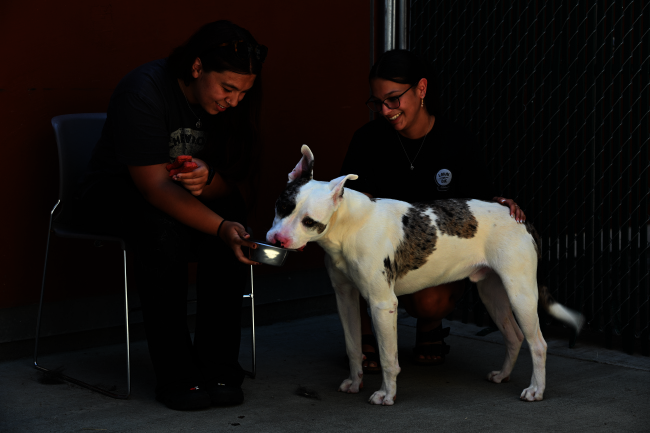
Ysabella Ruiz, left, and a friend hang out with “Carlo” at Lake County Animal Care and Control in Lakeport, California, on Saturday, June 7, 2025. Photo by Yitian Tong.
LAKEPORT, Calif. — A free adoption event on Saturday emptied half of the shelter at Lake County Animal Care and Control.
Animal Control Officer Wenceslao Rojas told Lake County News on Monday afternoon that 25 animals — 15 dogs and 10 cats — were adopted at the event, among about 50 animals available at the start.
“It’s been a fantastic time,” said Rojas. “I really do appreciate the county community for doing their part and showing up, and actually helping out and adopting a lot of the animals we have here.”
A Monday morning post on the department’s Facebook page indicated a slightly different final number — that “27 animals were sent to their forever homes.”
This was the second year that Animal Care and Control took part in the free adoption day. Last year’s event sent 21 animals to new homes.
The event was sponsored by the American Society for Prevention and Cruelty of Animals — or the ASPCA — along with the San Francisco SPCA and Cal-Animals.
Adoptions included spay and neuter, microchip, rabies vaccination, a heartworm test and a license.
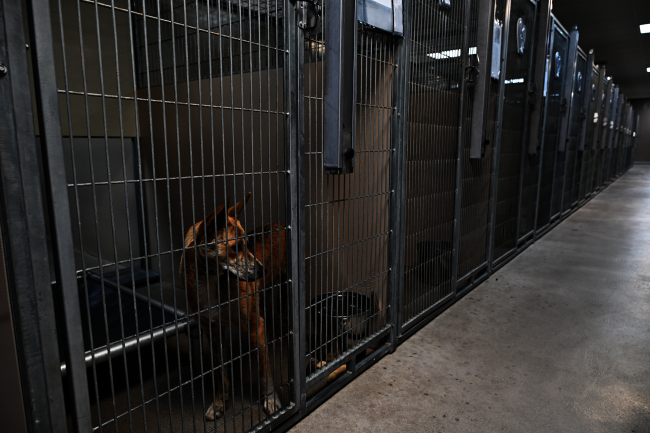
A dog at Lake County Animal Care and Control in Lakeport, California, waits to meet potential adopters on Saturday, June 7, 2025. Photo by Yitian Tong.
Emptied shelter space, high community interest
The event took place on Saturday from 11 a.m. to 3 p.m. at the shelter located in Lakeport. Rojas said it drew waves of potential adopters from the very start.
Visitors stopped by to see the animals. At their request, they could have the chance to play with those they liked for a while in a large fenced space right outside the kennel hall. Some decided to take one home on the spot.
As Rojas showed Lake County News around the kennels, Frank — a German shepherd — and Carlo were out in the play area with visitors who seemed interested in them.
Ysabella Ruiz, who was playing with Carlo, said she recently bought a new home and had been coming to the shelter for the past three months to look for adopting a dog.
For latecomers, choice became limited.
By around 2:30 p.m., 14 dogs and 10 cats had been adopted, leaving no cats in the shelter, Rojas said.
“All the cats have been adopted,” Rojas said, standing beside where the dogs played with potential adopters, while the chorus of barking rose and fell at the back from the kennels.
The turnout and adoption count, Rojas said, were “very, very good.”
“It actually helps us out now that we have a lot more open spaces here at the shelter,” he said, adding that the shelter has a total of 34 kennels to host dogs.
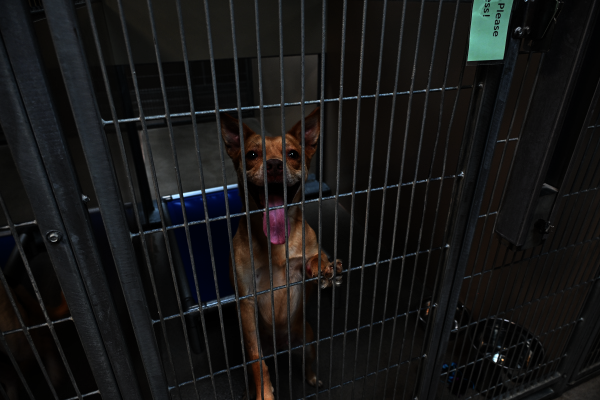
A dog shows off his smile to a visitor at Lake County Animal Care and Control in Lakeport, California, on Saturday, June 7, 2025. Photo by Yitian Tong.
Animal care concerns
Rojas said the department right now has four animal control officers on staff, patrolling and answering calls, setting up appointments to check on animals.
Speaking of the issue of animal mistreatment, Rojas emphasized the role of communities being alert, talking with pet owners, and “trying to figure something out” prior to calling Animal Care and Control.
“So if I get a call and I'm in Upper Lake, it's going to take me at least 30 minutes to get from Upper Lake all the way to Clearlake, because I still have to make that drive,” Rojas said, giving an example to highlight the importance of community action that can address concerns more quickly.
“My concern is owners actually doing their job and taking care of their dogs and cats,” Rojas said. “If they are taking care of their dogs and cats, there's no reason for us to go out there.”
Email staff reporter Lingzi Chen at
- Details
- Written by: LINGZI CHEN
On Monday, Senate President pro Tempore Mike McGuire (D-North Coast) announced that the Senate Democratic Caucus convened and determined that Sen. Monique Limón (D-Santa Barbara) will be the Pro Tem Designee, with a transition to be held early in 2026.
“Serving as the Leader of the State Senate is the honor of a lifetime,” Senate Leader Mike McGuire said Monday. “And today, the Senate unanimously elected Senator Limón as the Pro Tem Designee. Sen. Limón always puts people first, she’s a bridge builder and never stops fighting for progress. We are going to be well served under her leadership and the Golden State will be stronger thanks to Sen. Limón’s commitment to the communities of this great state.”
“I am grateful to have the support of my colleagues to be the next President pro Tempore of the California State Senate. At this critical time in our state, I am committed to working with my colleagues and remain dedicated to defending our California values and uplifting all of our communities,” said Senator Monique Limón (D-Santa Barbara). “Together, we will build diverse coalitions and develop solutions to the most pressing issues of our time. I want to thank President pro Tempore Mike McGuire for his continuous steady leadership and unwavering commitment to Californians.”
Mike McGuire is President pro Tempore of the California Senate. He represents the North Coast of California, which stretches from the Golden Gate Bridge to the Oregon border, including Del Norte, Trinity, Humboldt, Lake, Mendocino, Sonoma, and Marin counties.
Monique Limón represents the 21st Senate District, which includes Santa Barbara, Ventura, Goleta, Buellton, Carpinteria, Guadalupe, Lompoc, Santa Maria, Solvang, Camarillo, Fillmore, Ojai, Oxnard, Santa Paula, Port Hueneme, Blacklake, Callender, Grover Beach, Los Berros, Nipomo, Oceano, Woodlands. She currently serves as the Chair of the Senate Democratic Caucus, Chair of the Senate Natural Resources and Water Committee, Vice Chair of the California Legislative Women’s Caucus and Vice Chair of the Central Coast Caucus, and Chair of the Senate Select Committee on the Nonprofit Sector.
- Details
- Written by: LAKE COUNTY NEWS REPORTS

A collared wolf in California. Photo courtesy of UC Berkeley, California Wolf Project.
The California Department of Fish and Wildlife, or CDFW, announced Monday that it is launching a summer strike team in partnership with federal and local agencies to combat livestock depredations by gray wolves in Siskiyou County and the Sierra Valley (spanning both Sierra and Plumas counties).
With landowner permission, the task force will provide round-the-clock CDFW staff support seven days a week for livestock producers experiencing frequent conflicts with wolves, among other program benefits.
“Today’s announcement showcases the power of collaboration in effectively and safely managing California’s growing gray wolf population,” CDFW Director Charlton H. Bonham said Monday. “This strike force allows CDFW to work more closely with our key partners and impacted ranchers and provide new tools to protect cattle and other livestock from harm. Together, we are doing everything we can to keep both livestock and wolves safe. Thank you to our partners in this effort for making this strike team possible.”
Recent depredation of livestock in the Sierra Valley and Siskiyou County signals the need for additional and increased support for livestock producers during the summer and fall of 2025. Interested producers are encouraged to participate in the program. The summer strike team will take a multifaceted approach to combat livestock depredations, including through:
In-person, on-the-ground support from CDFW staff. Working both day and night seven days a week, CDFW staff will be available to support ranchers facing livestock depredations. The strike team will use a combination of radio telemetry and real-time information from local ranchers to locate wolves (collared and uncollared) to proactively push them away from livestock.
Developing conflict risk management plans for participating ranchers. Livestock producers who volunteer to participate in the program and take any necessary training will have a plan tailored to their unique property and livestock needs to help mitigate future conflict through nonlethal methods. These plans may include a variety of tools, including livestock management, additional barriers, predator aversion devices or injurious harassment
Outreach, education and training. In partnership with experts in livestock production and management like the University of California Cooperative Extension, training and outreach events will be held in Sierra Valley to help provide producers techniques and strategies ranchers can take to reduce wolf-livestock conflicts through nonlethal practices.
CDFW is also working in conjunction with Sierra and Plumas counties to create a county agricultural protection position that will support depredation investigations and capture and collar methods, as well as develop carcass removal programs to mitigate wolf attraction to ranch properties.
The task force will be led by CDFW’s law enforcement and scientific staff and will increase CDFW presence in communities to effectively implement these measures. The program began Monday, June 9, d is anticipated to run through the summer.
“This program is still in its early stages, so there will be a need to learn by doing together. More details will be shared as it progresses. But this is a good start, and I appreciate that,” said Plumas County Supervisor Dwight Ceresola.
Sierra Valley, which spans both Plumas and Sierra counties, has had higher-than-normal levels of livestock depredations by gray wolves in the Beyem Seyo pack over the past year. As ranchers move their cattle to the valley floor for summer grazing, additional support from this pilot program will be needed to protect livestock from wolves.
“I am thankful the state and county can do something together. We are hopeful that this additional presence will reduce the immediate losses and provide CDFW with a clear understanding of the day-to-day challenges ranchers have faced for months,” said Sierra County Supervisor Paul Roen.
Siskiyou County also has a higher level of livestock depredations compared to other counties, in relation to the Whaleback pack in particular. The county has made significant efforts in slowing depredations and working collaboratively with CDFW staff, including the hiring of a county wolf liaison, but the need for additional support remains. As part of this task force, CDFW will be providing enhanced information on wolf data to Siskiyou County staff, and Siskiyou will assist the department in investigating and collecting additional data.
"This pilot effort in all three counties is made possible through sustained coordination between county supervisors, county sheriffs, local ranchers and state and federal agencies. Importantly, it also reflects the growing calls from local sheriffs calling for CDFW to step up and help,” said Director Bonham. “I thank Sheriffs Mike Fisher, Todd Johns and Jeremiah LaRue for their help to get going on our efforts this summer. I also thank all the Northern California sheriffs and county supervisors who have been key voices for their communities.”
If you are a livestock producer in Plumas, Sierra or Siskiyou counties and are interested in learning more about the program or how to participate, please contact Morgan Kilgour, Region 2 Manager, CDFW, at
- Details
- Written by: LAKE COUNTY NEWS REPORTS




