How to resolve AdBlock issue?
Refresh this page
How to resolve AdBlock issue?
Refresh this page
Lake County News,California
  • Home
    • Registration Form
  • News
    • Education
    • Veterans
    • Community
      • Obituaries
      • Letters
      • Commentary
    • Police Logs
    • Business
    • Recreation
    • Health
    • Religion
    • Legals
    • Arts & Life
    • Regional
  • Calendar
  • Contact us
    • FAQs
    • Phones, E-Mail
    • Subscribe
  • Advertise Here
  • Login
How to resolve AdBlock issue?
Refresh this page

News

Russian earthquake triggers tsunami concerns along West Coast

Details
Written by: Elizabeth Larson
Published: 30 July 2025
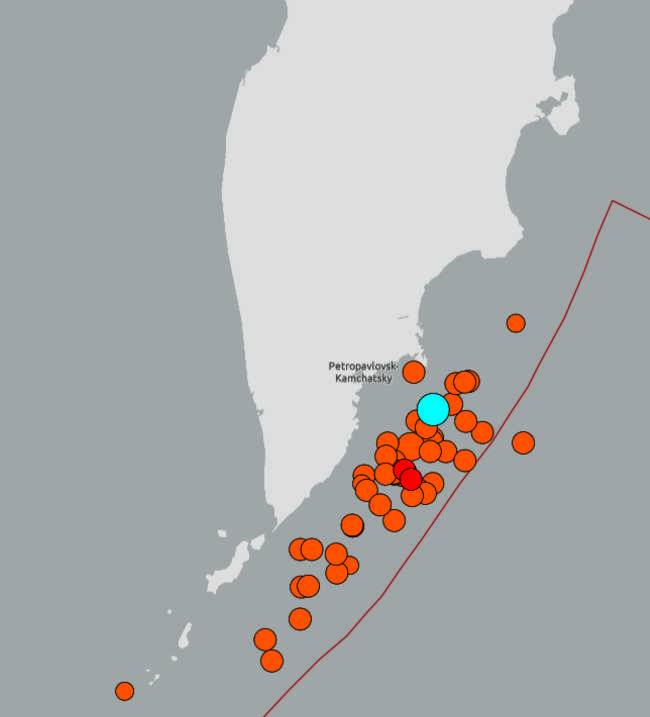
The 8.8 earthquake that happened off the eastern coast of Russia on Tuesday, July 29, 2025, shown in blue, followed by a cluster of other smaller, but still significant, earthquakes. Image courtesy of the United States Geological Survey.


NORTHERN CALIFORNIA — A Tuesday afternoon earthquake off the Russian coast triggered a tsunami advisory for much of the West Coast, and a warning for the Hawaii Islands and a portion of the North Coast of California.

The United States Geological Survey said the 8.8-magnitude earthquake occurred just before 4:30 p.m. Pacific Time off the Kamchatka Peninsula on the eastern coast of Russia.

That initial quake was followed by dozens of quakes in the same area, some as large at 6.5 magnitude.

The quake’s 8.8-magnitude earned it a tie for the sixth-largest recorded earthquake, according to seismic historical records.

The National Tsunami Warning Center began issuing updates on the potential for a tsunami shortly after it occurred.

At around 10 p.m. Tuesday night, “a tsunami is occurring in the Pacific Ocean tonight,” the center posted on its Facebook page.

“This is the most significant event we've seen in some time. It is _not_ the same thing as recent alerts near California in December, or Alaska a few weeks ago,” the center said in its post.

At that time, a tsunami warning was in effect for the Western Aleutians and Pribilof Islands in the Bering Sea, which later was downgraded to an advisory.

A warning was in effect for the Hawaiian Islands, and a stretch of the Northern California coast that included northern Humboldt County and southern Del Norte County. A tsunami advisory was in place for the rest of the West Coast.  

Late Tuesday, the Sonoma County Sheriff’s Office said the Sonoma coast was under a tsunami warning until 3:30 a.m. 

The public was urged to stay out of coastal waters, off the beach, harbor docks and piers as strong currents and dangerous waves were expected. 

Tsunami start times for the North Coast were:

• Fort Bragg: 11:50 p.m. July 29.
• Crescent City: 11:50 p.m. July 29.
• Monterey: 12:15 a.m. July 30.
• San Francisco: 12:40 a.m. July 30.

The Sonoma County Sheriff’s office said tsunamis often arrive as a series of waves or surges which could be dangerous for many hours after the first wave arrives. The first tsunami wave or surge may not be the highest in the series. 

The forecast peak tsunami wave heights along much of the North Coast were expected to be less than one foot high.

The Del Norte Office of Emergency Services said late Tuesday that tsunami waves from 2.7 to 5 feet would begin to arrive shortly before midnight and may last for approximately 30 hours. 

In a late Tuesday night video, Eric Wier, Crescent City’s city manager, said the tsunami would not be like that of 1964. 

He said some city residents in an inundation area had been asked to evacuate. A temporary evacuation point was set up at the Veteran's Memorial Building in Crescent City.

Ryan Aylward of the National Weather Service said that when high tide arrives around 3 a.m., there could be waves that are higher than the normal high tide, with the surge into the 5 foot range. There is the possibility of some minor flooding close to the bay.

State Sen. Mike McGuire, who was on the video with Del Norte officials, noted that the worst case scenario could have been much worse.

Email Elizabeth Larson at This email address is being protected from spambots. You need JavaScript enabled to view it.. Follow her on Twitter, @ERLarson, and on Bluesky, @erlarson.bsky.social. Find Lake County News on the following platforms: Facebook, @LakeCoNews; X, @LakeCoNews; Threads, @lakeconews, and on Bluesky, @lakeconews.bsky.social. 

Clearlake churches partner for school backpack giveaway

Details
Written by: LAKE COUNTY NEWS REPORTS
Published: 30 July 2025

CLEARLAKE, Calif. — Praises of Zion Baptist Church and the Church of the Nazarene in Clearlake are partnering to present a community backpack giveaway for all local children attending schools in the area.

The churches’ inaugural backpack giveaway will take place from 11 a.m. to 2 p.m. Saturday, Aug. 2, at the Church of the Nazarene, 15917 Olympic Drive.  

The two churches are distributing 150 backpacks filled with school supplies.

The children — from kindergarten through high school — must be present to receive a backpack, while supplies last.

In addition to the backpacks, there will be agencies present to provide health and safety information for parents and children as the children prepare to go back to school starting in August.  

For more information, call the Church of the Nazarene at 707-994-4008.

Revoking EPA’s endangerment finding – the keystone of US climate policies – isn’t simple and could have unintended consequences

Details
Written by: Patrick Parenteau, Vermont Law & Graduate School
Published: 30 July 2025

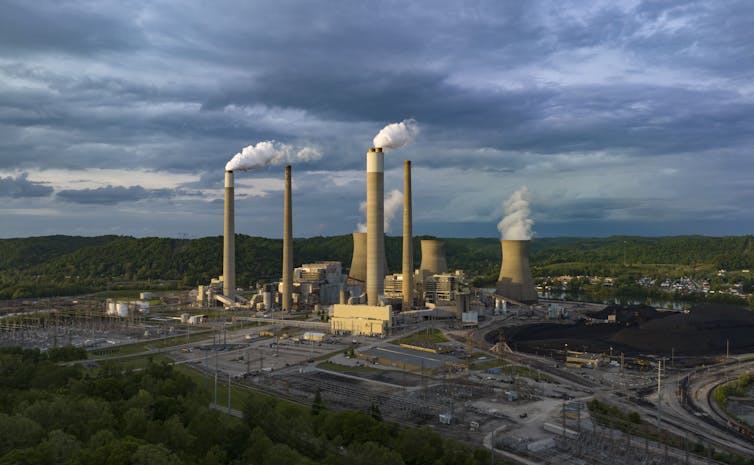
Several U.S. climate regulations aim to reduce burning of fossil fuels, a driver of climate change. Visions of America/Joseph Sohm/Universal Images Group via Getty Images

Most of the United States’ major climate regulations are underpinned by one important document: It’s called the endangerment finding, and it concludes that greenhouse gas emissions are a threat to human health and welfare.

The Trump administration is trying to eliminate it.

Environmental Protection Agency Administrator Lee Zeldin announced on July 29, 2025, that the EPA would soon publish a rule to rescind the endangerment finding and allow 45 days for public comment.

A draft released by the EPA of the proposal argues that the agency didn’t have the authority to issue the endangerment finding in 2009 or regulations based on it. The draft also argues that U.S. vehicle emissions are not significant in terms of global emissions of greenhouse gases and that the costs to consumers outweigh the benefits.

These are dubious factual and legal propositions that will require deeper analysis once the proposal is officially published in the Federal Register.

Revoking the endangerment finding isn’t a simple task. If the rule is finalized, it will also trigger an onslaught of lawsuits. And revoking the finding could have unintended consequences for the very industries President Donald Trump is trying to help.

EPA Administrator Lee Zeldin announces plans in March 2025 to reconsider more than 30 climate regulations.

As a law professor, I have tracked federal climate regulations and the lawsuits and court rulings that have followed them over the past 25 years. To understand the challenges, let’s look at the endangerment finding’s origins and Zeldin’s options.

Origin and limits of the endangerment finding

In 2007, the U.S. Supreme Court ruled in Massachusetts v. EPA that six greenhouse gases are pollutants under the Clean Air Act and that the EPA has a duty under the same law to determine whether they pose a danger to public health or welfare.

The court also ruled that once the EPA made an endangerment finding, the agency would have a mandatory duty under the Clean Air Act to regulate all sources that contribute to the danger.

The court emphasized that the endangerment finding was a scientific determination and rejected a laundry list of policy arguments made by the George W. Bush administration for why the government preferred to use nonregulatory approaches to reduce emissions. The court said the only question was whether sufficient scientific evidence exists to determine whether greenhouse gases are harmful.

The endangerment finding was the EPA’s response.

The finding was challenged and upheld in 2012 by the U.S. Court of Appeals for the D.C. Circuit. In that case, Coalition for Responsible Regulation v. EPA, the court found that the “body of scientific evidence marshaled by the EPA in support of the endangerment finding is substantial.” The Supreme Court declined to review the decision. The endangerment finding was updated and confirmed by the EPA in 2015 and 2016.

Challenging the endangerment finding

The scientific basis for the endangerment finding is stronger today than it was in 2009.

The Intergovernmental Panel on Climate Change’s latest assessment report, involving hundreds of scientists and thousands of studies from around the world, concluded that the scientific evidence for warming of the climate system is “unequivocal” and that greenhouse gases from human activities are causing it.

According to the National Climate Assessment released in 2023, the effects of human-caused climate change are already “far-reaching and worsening across every region of the United States.”

Maps show most of the US, especially the West, getting hotter, and the West getting drier.
Summer temperatures have climbed in much of the U.S. and the world as greenhouse gas emissions have risen. Fifth National Climate Assessment

During Trump’s first term, then-EPA Administrator Scott Pruitt considered repealing the endangerment finding but ultimately decided against it. In fact, he relied on it in proposing the Affordable Clean Energy Rule to replace President Barack Obama’s Clean Power Plan for regulating emissions for coal-fired power plants.

Zeldin’s cost argument

Zeldin had previewed some of his arguments for rescinding the endangerment finding in a news release on March 12.

His first argument then was that the 2009 endangerment finding did not consider costs. However, that argument was rejected by the District of Columbia Circuit Court in Coalition for Responsible Regulation v. EPA in 2012. Cost becomes relevant once the EPA considers new regulations – after the endangerment finding.

Moreover, in a unanimous 2001 decision, the Supreme Court in Whitman v. American Trucking Associations held that the EPA cannot consider cost in setting air quality standards.

What happens if the EPA revokes the endangerment finding?

Even if Zeldin is able to revoke the endangerment finding, that does not automatically repeal all the rules that rely on it. Each of those rules must go through separate rulemaking processes that will also take months. The agency will also face lawsuits.

Zeldin could simply refuse to enforce the rules on the books.

However, a blanket policy abdicating any enforcement responsibility could be challenged in lawsuits as arbitrary and capricious. Further, the regulated industries would be taking a chance if they delay complying with regulations, only to find the endangerment finding and climate laws still in place.

A repeal could backfire

Repealing the endangerment finding could also backfire on the fossil fuel industry.

States and cities have filed dozens of lawsuits against the major oil companies. The industry’s strongest argument has been that these cases are preempted by federal law. In AEP v. Connecticut in 2011, the Supreme Court ruled that the Clean Air Act “displaced” federal common law, barring state claims for remedies related to damages from climate change.

However, if the endangerment finding is repealed, then there is arguably no basis for federal preemption, and these state lawsuits would have legal grounds. Prominent industry lawyers have warned the EPA about this and urged it to focus instead on changing individual regulations. The industry is concerned enough that it may try to get Congress to grant it immunity from climate lawsuits.

To the extent that Zeldin is counting on the conservative Supreme Court to back him up, he may be disappointed.

In 2024, the court overturned the Chevron doctrine, which required courts to defer to agencies’ reasonable interpretations when laws were ambiguous. That means Zeldin’s reinterpretation of the statute is not entitled to deference. Nor can he count on the court overturning its Massachusetts v. EPA ruling to free him to disregard science for policy reasons.

This article, originally published March 19, 2025, has been updated with the EPA’s announcement to rescind the endangerment finding.The Conversation

Patrick Parenteau, Professor of Law Emeritus, Vermont Law & Graduate School

This article is republished from The Conversation under a Creative Commons license. Read the original article.

Unemployment in Lake County and across the state rises in June

Details
Written by: Elizabeth Larson
Published: 29 July 2025

LAKE COUNTY, Calif. — The state’s latest report on the jobless rate showed a one-point jump for Lake County’s unemployment, while the state rate also edged up.

The California Employment Development Department’s report said Lake County’s rate rose from 6.3% in May to 7.3% in June. The June 2024 rate was 6.6%.

California’s June unemployment rate changed slightly, rising to 5.4% from 5.3% in May. The state’s June 2024 rate was 5.3%.

The federal Bureau of Labor Statistics said the nationwide unemployment rate was 4.1% in June, down from 4.2 percent in May. The June 2024 jobless rate also was 4.1%.

The report said that the number of Californians employed in June was 18,770,800, an increase of 21,700 persons from May’s total of 18,749,100 and up 153,100 from the employment total in June 2024.

At the same time, the number of unemployed Californians was 1,070,000 in June, an increase of 11,700 over the month and up 28,800 in comparison to June 2024.

California payroll jobs fell from 18,017,200 in May 2025 to 18,011,100 in June 2025. On a year-to-year basis, payroll jobs increased to 18,011,100 from 17,910,000, according to the report.

California has gained 3,091,300 jobs since April 2020, an average of 49,860 per month, the report said. Although the State did post a month-over loss of 6,100 jobs for June 2025, California has a net gain of 101,100 nonfarm jobs since June 2024.

Four of California's 11 industry sectors gained jobs in June, with private education and health services (+9,900) posting a gain for the 41st consecutive month, according to the report.

The largest gains were in health care and social assistance (+2,700). This includes jobs in continuing care retirement communities and assisted living facilities, and nursing and residential care facilities, partly attributed to California’s aging population.

Leisure and hospitality (+4,300) also posted a month-over job gain as the arrival of the summer season spurs growth in California’s recreation-focused businesses such as arts and entertainment, spectator sports, and amusement parks.

Professional and business services (-9,900) posted the state’s largest month-over loss as jobs declined in administrative and support services and temporary employment services. Losses also occurred in accounting, tax preparation, bookkeeping and payroll services, and computer systems design.

In Lake County, the transportation, warehousing and utilities sector grew by 12.3%; federal government, 6.7%; the total farm category, 4.5%; and manufacturing, 3%.

Categories showing losses included professional and business services, down 6.6%; goods producing, down 2.2%; and service producing, down -0.7%.

In the July report, Lake County’s jobless rate ranked it 46 out of California’s 58 countries. Lake’s neighboring county jobless rates and ranks last month were: Colusa, 12.2%, No. 57; Glenn, 7.8%, No. 48; Mendocino, 5.8%, No. 27; Napa, 4.2%, No. 3; Sonoma, 4.6%, No. 8; and Yolo, 6.1%, No. 32.

In related data that figures into the state’s unemployment rate, there were 387,555 people certifying for Unemployment Insurance benefits during the June 2025 sample week. 

The Employment Development Department said that this compares to 384,749 people in May and 381,123 people in June 2024. 

Concurrently, 46,629 initial claims were processed in the June 2025 sample week, which was a month-over increase of 5,393 claims from May, but a year-over increase of 1,467 claims from June 2024.

Email Elizabeth Larson at This email address is being protected from spambots. You need JavaScript enabled to view it.. Follow her on Twitter, @ERLarson, and on Bluesky, @erlarson.bsky.social. Find Lake County News on the following platforms: Facebook, @LakeCoNews; X, @LakeCoNews; Threads, @lakeconews, and on Bluesky, @lakeconews.bsky.social. 

  1. Upcoming event to continue focus on Lake County’s challenges with homelessness
  2. Yuba College awarded $300,000 grant to expand fire and forestry career training
  3. California farmers identify a hot new cash crop: Solar power
  • 274
  • 275
  • 276
  • 277
  • 278
  • 279
  • 280
  • 281
  • 282
  • 283
How to resolve AdBlock issue?
Refresh this page