 How to resolve AdBlock issue?
News
- Details
- Written by: Elizabeth Larson
The council will meet at 6 p.m. Thursday, April 3, in the council chambers at Clearlake City Hall, 14050 Olympic Drive.
The agenda can be found here.
The meeting will be broadcast live on the city's YouTube channel or the Lake County PEGTV YouTube Channel.
Community members also can participate via Zoom. The webinar ID is 827 7105 3751, the pass code is 715698. One tap mobile is available at +16694449171,,82771053751#, or join by phone at 669-444-9171 or 646-931-3860.
On Thursday, the council will hold the first reading of an ordinance authorizing bingo games for charitable purposes only, and set the second reading and adoption for the next council meeting.
The council also will hold a public hearing to discuss the closeout package to the California Department of Housing and Community Development for the Community Development Block Grant Storm Drain Master Plan. Council members will consider adopting Resolution 2025-14 to authorize the city manager to submit the closeout package, confirming successful project completion and financial reconciliation.
Also on Thursday, the council also will offer a proclamation declaring April 2025 as Child Abuse Awareness Month, receive a presentation by North Coast Opportunities on the BUILD Program and receive the annual animal control report by North Bay Animal Services.
On the meeting's consent agenda — items that are considered routine in nature and usually adopted on a single vote — are warrants; review of the 2024 Annual Housing Element Progress Report; continuation of the local emergency proclamation for the Boyles Fire; continuation of the local emergency proclamation for the winter storms; and authorization of fee structure changed to special events applications, authorizing the city manager to implement special event fees and
deposits based on an hourly rate.
The council also will hold a closed session to discuss a liability claim filed by Anthony Oldfield.
Email Elizabeth Larson at
- Details
- Written by: Department of Alcoholic Beverage Control
According to the U.S. Centers for Disease Control and Prevention, excessive alcohol use is a leading preventable cause of death, and these deaths are on the rise.
Between 2016 to 2017, 138,000 deaths were alcohol related — between 2020 to 2021, that increased to 178,000.
Additionally, the National Highway Traffic Safety Administration, or NHTSA, says 13,524 people died in alcohol-impaired vehicle collisions in 2022.
"This month serves as an important reminder that customers and licensees need to do their part to limit alcohol-related harm,” said ABC Director Joseph McCullough. “Whether you’re drinking alcohol or serving it, you have to do so responsibly because it can help save lives.”
ABC encourages patrons to always plan for a sober ride home after drinking and to never binge drink. Licensees are encouraged to stringently check IDs to prevent underage drinking and to never serve obviously intoxicated patrons.
Licensees and bystanders are also encouraged to report any signs of excessive or underage drinking to local authorities.
The effects of alcohol misuse are both deadly and expensive. Alcohol is the fourth-leading cause of preventable death in the United States, according to the National Institute on Alcohol Abuse and Alcoholism, and has a role in at least 7.1% of all emergency room visits.
The financial burden of alcohol misuse cost the U.S. an estimated $249 billion per year. NHTSA estimates that drunk driving crashes cost the U.S. $68.9 billion annually.
- Details
- Written by: Elizabeth Larson
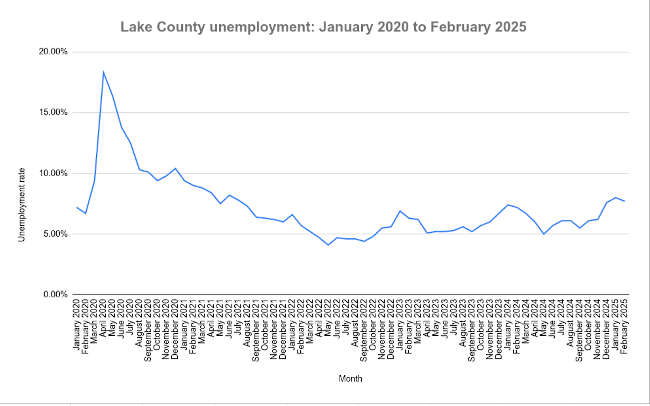
LAKE COUNTY, Calif. — The latest report on California’s jobless rate shows the state numbers holding relatively steady with slight improvement for Lake County.
The Employment Development Department’s report for February said California’s overall unemployment rate remained the same as in January, 5.4%, while there was a 0.1% increase nationally. The state’s February 2024 rate was reported to be 5.3%.
The Bureau of Labor Statistics said the national rate was 4.1% for February, up from 4% in January and 3.9% in a year-over comparison.
In Lake County, the unemployment rate was 7.7% in February, down from 8% in January. Lake County’s February 2024 rate was 7.2%.
Lake County ranked No. 45 for its February rate, according to the report.
Lake’s neighboring county jobless rates and ranks in February were: Colusa, 18.5%, No. 58; Glenn, 7.5%, No. 43; Mendocino, 6.2%, No. 30; Napa and Sonoma, tied at No. 8 with 4.3%; and Yolo, 5.9%, No. 25.
Statewide, the Employment Development Department said the job market expansion reached 58 months in February 2025. California has gained 3,083,700 jobs since April 2020, averaging 53,167 jobs per month.
The number of Californians employed in February was 18,645,700, an increase of 10,900 persons from January’s total of 18,634,800 and up 81,000 from the employment total in February 2024.
In Lake County, there were 24,780 employed individuals and 2,050 people out of work in February.
The number of unemployed Californians was 1,061,000 in February, a decrease of 8,200 over the month but up 60,600 in comparison to February 2024.
Year-over, California’s total nonfarm jobs increased by 78,200 between February 2024 and February 2025, according to the report.
Additionally, February 2025 marked the fourth consecutive month-over decline (-8,200) in unemployed people.
The number of jobs in the agriculture industry decreased from January by 200 to a total of 423,100 jobs in February. The agriculture industry had 16,700 more farm jobs in February 2025 than it did in February of last year.
In Lake County, the number of farm jobs was down by 6.9%, from 1,020 jobs in January to 950 jobs in February. However, farm jobs are up by 15.9% over February 2024.
A look at specific job sectors
The report said three of California's 11 industry sectors gained jobs in February with private education and health services (+18,400) showing gains for the 37th straight month with above average gains in private elementary and secondary schools, and large gains in outpatient care services on the health services side.
In Lake County, private education and health services rose by 1.85% over the month, or 100 jobs, and 9% over the year.
Government (+3,600) also showed a month-over job gain with the largest gains in local government (+5,000), according to the report.
In Lake County, total government jobs rose by 0.4% over the month and 2.2% over the year, with local government jobs growing by 0.5% over the month and 3.1% over the year.
Both the federal (-1,200) and state (-200) government sectors posted job losses. This was the largest loss in federal government since February 2021, according to the report.
Lake County’s numbers showed a loss of 6.7% of federal jobs in February and a year-over loss of 12.5%. State government showed no change over the month but 5.6% since February last year.
Professional and business services (-7,700) posted the state’s largest month-over loss with most of the losses coming from computer systems design and related services as well as with legal services and management, scientific, and technical consulting.
In Lake County, the professional and business services category was down 1.3% over the month but up by 5.7% compared to last year.
In other employment news, the Employment Development Department said there were 407,881 people certifying for Unemployment Insurance benefits during the February 2025 sample week. That compares to 394,387 people in January and 425,760 people in February 2024.
Concurrently, 42,655 initial claims were processed in the February 2025 sample week, which was a month-over decrease of 3,454 claims from January, but a year-over increase of 1,395 claims from February 2024, the state reported.
Email Elizabeth Larson at
- Details
- Written by: LAKE COUNTY NEWS REPORTS
Starting on Tuesday, April 1, road access to Boggs Mountain Demonstration State Forest will be closed to facilitate essential road improvements.
Cal Fire reported that road access is anticipated to reopen on May 1.
The project will focus on restoring roadside drainage and grading the road surfaces, aiming to enhance environmental conditions and improve emergency access that has been impacted by winter weather.
During this period, vehicle access will be limited to the main parking area below the heliport.
For safety reasons, visitors are advised to avoid areas with heavy equipment while work is underway.
“We apologize for any inconvenience this may cause and appreciate your understanding as we complete these necessary upgrades,” Cal Fire said.
For more information, please contact the forest office at 707-928-4378.