 How to resolve AdBlock issue?
News
- Details
- Written by: LAKE COUNTY NEWS REPORTS
The meeting will take place beginning at 4 p.m. Wednesday, April 2, at the Moose Lodge, located at 15900 Moose Lodge Lane in Clearlake Oaks.
The meeting will be available via Zoom. The meeting ID is 813 6295 6146, pass code is 917658.
The guest speaker for the event will be John Speka, senior transportation planner for the Lake Area Planning Council.
Speka will discuss the Regional Transportation Plan and Active Transportation Plan which
identifies needs and priority projects over the next 20 years for all modes of transportation including streets and roads, highways, bicycle and pedestrian facilities, and public transit.
Also on the agenda is an update on the development of John T. Klaus Park east of Clearlake Oaks. A county meeting was held last week to give updates on the concept design.
In other business, ERTH will discuss updates to its bylaws and website, and a proposed community mailer.
There also will be updates on the Commercial Cannabis Report and Cannabis Ordinance Task Force, General Plan and Shoreline Area Plan, and code enforcement-related matters regarding abandoned RVs, trash and a new county reporting system.
ERTH also will consider a letter of support for the Clearlake Oaks/Schindler Creek Initiative as well as a letter to Public Works regarding High Valley Road.
District 3 Supervisor EJ Crandell also is scheduled to give his monthly report.
ERTH’s next meeting will take place on May 7.
Members are Denise Loustalot, Angela Amaral, Jim Burton, Holly Harris and Maria Kann.
For more information visit the group’s Facebook page.
- Details
- Written by: Elizabeth Larson
The National Weather Service said Lake County can expect rainfall, wind and overnight frost through the middle of the week.
The forecast calls for rainy conditions through Tuesday night, with up to 2 inches of rain during that time frame.
Rainfall totals in inches for the 48-hour period ending at 1:30 a.m. Monday are as follows:
— High Glade Lookout (above Upper Lake): 0.80.
— Kelseyville: 0.58.
— Knoxville Creek: 0.42.
— Lake Pillsbury: 1.32.
— Lyons Valley: 1.16.
— Middletown: 0.72.
— Upper Lake: 0.64.
Through midweek, windy conditions also are in the forecast, with wind speeds topping 30 miles per hour.
On Monday, temperatures are expected to hover in the 40s during the day and at night, with daytime temperatures continuing in the 40s on Tuesday, dropping into the 30s that night.
Early Wednesday, the National Weather Service said areas of frost are expected, with temperatures forecast to remain in the 30s that night.
From Thursday through Sunday, temperatures will begin to warm up. By Sunday, daytime conditions are expected to reach the low 70s, with nighttime temperatures in the high 40s.
While Lake County can expect more rain and colder temperatures, to the east, areas around Sierras are forecast to see heavy snow this week.
Email Elizabeth Larson at
- Details
- Written by: LINGZI CHEN
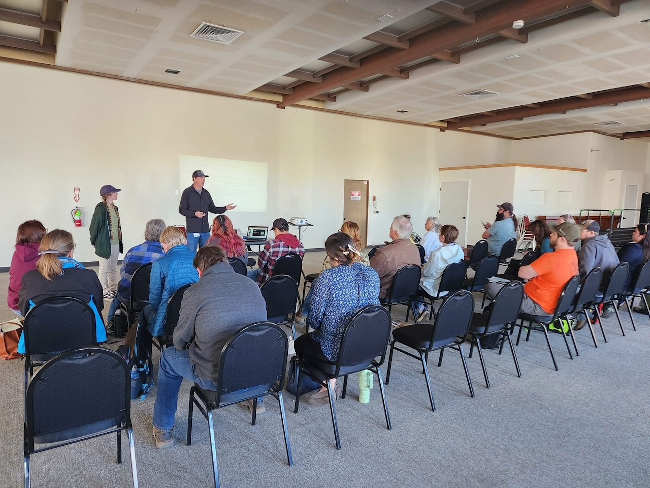
LAKE COUNTY, Calif. — As the weather warms and the Clear Lake hitch begins its annual spawn, trained community members are heading to local creeks to observe the threatened species and collect data as part of a community science program.
This year, 31 residents have volunteered to be part of the Community Science Hitch Spawner Observation Survey organized by the Lake County Watershed Protection District, in collaboration with California Department of Fish and Wildlife, or the CDFW.
Each volunteer has adopted at least one preselected observation site and is committed to monitoring the site every week on a chosen day for 10 consecutive weeks, starting the week of March 9.
The observation points are spread throughout the county, from Burns Valley Creek to Schindler Creek, Clayton Creek to Scotts Creek, totaling 33 public sites and two private property-sponsored sites, covering a wide range of local tributaries.
The volunteers have attended mandatory training sessions, including in-class and on-field components. They learned how to identify hitch — distinguishing them from other fish in the local streams such as the Sacramento sucker — as well as how to observe environmental factors and use the Survey 123 system to report their findings.
This program of community science is “a form of research that provides everyone, regardless of their background, an opportunity to contribute meaningful data to further our scientific understanding of key issues,” said Chris Childers of Lake County Water Resources — who is one of the hitch program coordinators — during a public presentation on March 13.
Childers noted that the volunteers this year came all from “over the board” in terms of their backgrounds, including a district supervisor, a park ranger, tribal members and agricultural community members
Such community outreach and involvement play a crucial part in hitch preservation, Childers said.
“The more we can get the community involved, and the more we can educate them about these fish, the better the restoration is going to go in the future,” he said. “If nobody knows about this fish, then nobody’s going to care, right?”
Childers said this is the program’s first year and that it will continue annually.
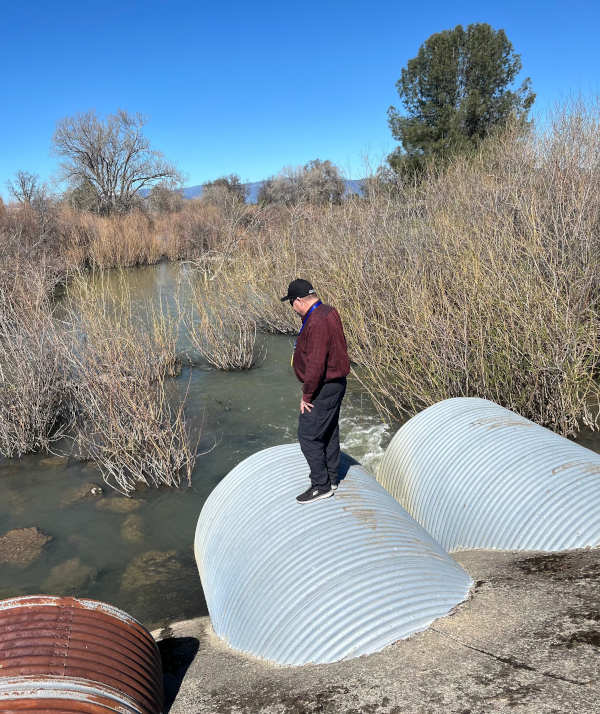
Reporting hitch activity, scientifically
State and local agencies such as the CDFW, Lake County Water Resources, Habematolel Pomo of Upper Lake and Robinson Rancheria all have their own hitch monitoring and surveying programs. Most of them are conducted by hitch experts.
The community observation survey, however, is designed for public participation.
“Theirs is much simpler. I just want 10 weeks of data collection; I just want to know if hitches are present and how many of them are there. So I made it very, very easy for them,” Childers explained in a phone call, adding that the expert version of hitch survey is “more technical.”
“We collect water quality, which means, dissolved oxygen and temperature and pH — these kinds of parameters,” he said. “But for the community scientists, a water quality probe can be anywhere from $5,000 to $30,000 right? I'm not gonna expect people to purchase that kind of equipment.”
Yet, the community scientists make meaningful contributions to monitoring relative hitch population trends over time that will help with “long term management decisions” related to the hitch, Childers said in his presentation.
Such monitoring is beneficial because “we want to see [hitch] presence/absence before and after creek restoration projects and barrier removal efforts,” he said.
Data collected from the volunteers across the sites will also help answer key questions such as: When do hitch enter specific creeks? How long do they remain in each creek?
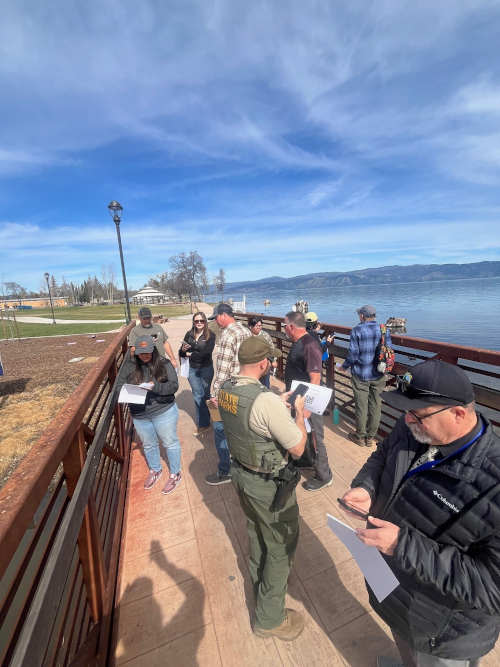
Observations from the field
“The first two weeks, I didn’t see any hitch,” said District 4 Supervisor Brad Rasmussen, who is also a volunteer. “And then this week, on Monday, I observed 25 hitches from the observation point.”
Rasmussen’s site is Adobe Creek at Bill Hill Road. He has chosen Sunday as his observation day and usually arrives at noon. But it is OK to deviate by a day, he mentioned, recalling from the training he received.
Childers said that reporting from a day before or after the chosen day is “not a problem.” But going to the site on the same day is the ideal.
“To keep it standardized, the same day is what we’re asking for,” said Childers. “That’s how you eliminate bias from a survey.”
Rasmussen also learned that it is recommended to go to the site between 10 a.m and 4 p.m. because “the sun’s higher and it’s easier to see on the water.”
The observers have been trained to be precise in their reporting.
“I did see more hitch up above the observation point,” said Rasmussen. “But when you’re doing the data entry, you know you have to just report what is from the survey point that you’re assigned.”
So he reported 25 hitches for his site last week with pictures of the fish and the environment. As required, he also uploaded pictures he took of the downstream and upstream from where he stood.
When it comes to identifying hitch in the creek, Rasmussen said he was very confident.
“So that's part of the training to learn what the difference is. And once you learn that, you can easily identify,” he said.
“I’m interested in the hitch and what’s happening with them,” said Rasmussen of why he volunteered. “And also, just to help support the program.”
In fact, the community scientists are asked to report information more than just the number of hitches they see.
They can report mortalities — if they see dead fish, or anything alarming such as trash or oil on the water, Childers explained.
Childers said he was “amazed” and “impressed” by the data quality from the first few weeks’ reporting.
“Just everything that came in the reports were very similar to what I have been seeing in the creeks right now,” he said.
“It could go south or it could go well,” Childers said, referring to the uncertainties surrounding this first-time program. “And it’s going well. So our department is really, really happy about everything that’s going on.”
Email staff reporter Lingzi Chen at
Hitch video by Rebecca Harper of the Lake County Farm Bureau.
- Details
- Written by: Elizabeth Larson
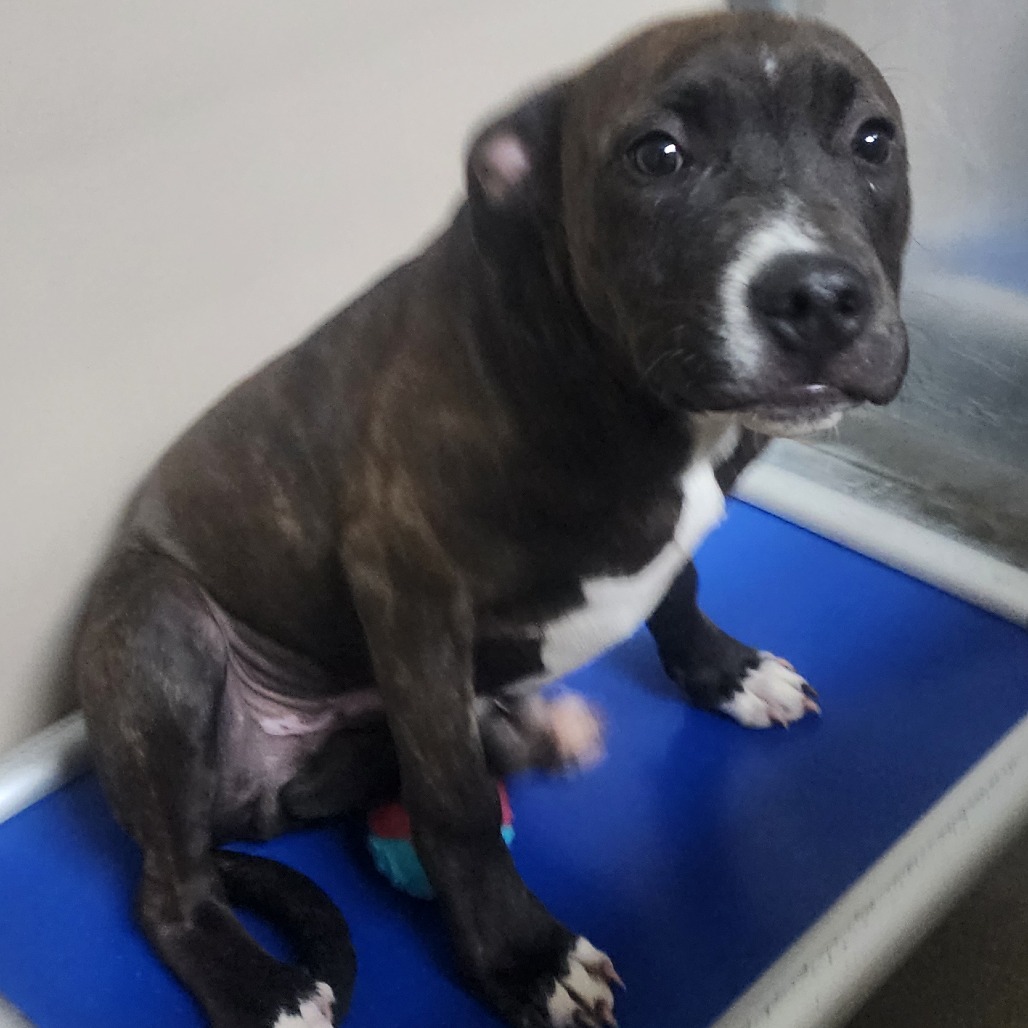
The dogs available for adoption this week include mixes of Akita, American blue heeler, Australian shepherd, border collie, Catahoula leopard dog, cattle dog, German shepherd, husky, Labrador Retriever, pit bull terrier, Rottweiler and Siberian husky.
Dogs that are adopted from Lake County Animal Care and Control are either neutered or spayed, microchipped and, if old enough, given a rabies shot and county license before being released to their new owner. License fees do not apply to residents of the cities of Lakeport or Clearlake.
Those dogs and the others shown on this page at the Lake County Animal Care and Control shelter have been cleared for adoption.
Call Lake County Animal Care and Control at 707-263-0278 or visit the shelter online for information on visiting or adopting.
The shelter is located at 4949 Helbush in Lakeport.
Email Elizabeth Larson at
Jet

Hamilton

Scout

Sable

Shepp

Oscar(Brutus)

Dolly

Annie

Sephire

Oliver
Rocco

Honey

Alma

Makita

Hariett

Mila

Beau

Queenie

Charles

Toby

Timmy

Mister

Koda

Leia

O'Reiley

Billy

Wheezy

Blizzard

Tony

Dottie

Kennel#30a

Kennel#30b

Kennel #15

Kennel#11a(Puppy)

Kennel#11b

Kennel#16a

Kennel#16b

Chia

Kennel#7

Kennel#19

Kennel#18

Kennel#24