How to resolve AdBlock issue?
Refresh this page
How to resolve AdBlock issue?
Refresh this page
Lake County News,California
  • Home
    • Registration Form
  • News
    • Education
    • Veterans
    • Community
      • Obituaries
      • Letters
      • Commentary
    • Police Logs
    • Business
    • Recreation
    • Health
    • Religion
    • Legals
    • Arts & Life
    • Regional
  • Calendar
  • Contact us
    • FAQs
    • Phones, E-Mail
    • Subscribe
  • Advertise Here
  • Login
How to resolve AdBlock issue?
Refresh this page

News

Atmospheric river winter storms to bring heavy rain

Details
Written by: Elizabeth Larson
Published: 30 January 2025
LAKE COUNTY, Calif. — A series of inbound winter atmospheric river storms are forecast to bring several inches of rain and — in the higher elevations — snow into early next week.

The National Weather Service’s Eureka office said rain will arrive late on Thursday, with as much as 4 inches expected to fall across Lake County over the course of several days.

The Lake County forecast anticipates daytime conditions on Thursday to include temperatures in the high 50s and mild winds from the southeast.

There will be up to a quarter of an inch of rain on Thursday night, when temperatures will dip into the high 30s, with light winds of just under 10 miles per hour.

The rain will continue on Friday, with light winds continuing and about an inch and three quarters of rain. Daytime temperatures will be in the high 40s, dropping to the low 40s at night.

Another one to two inches of rain is forecast to fall during the day on Saturday and up to three quarters of an inch on Saturday night. Temperatures will be in the low 50s during the day and the low 40s at night, with mild southwest winds.

The California Nevada River Forecast Center said the storms are expected to cause Cache Creek’s flow to double and for the level of Clear Lake to climb from just over 6 feet Rumsey — the special measure for the lake — to nearly 6.8 feet Rumsey.

The National Weather Service said another atmospheric river is expected to arrive on Sunday.

“This system has more moisture and the potential to bring at least localized flooding if rain falls on the same areas that receive the rain Thursday night through Friday night,” the National Weather Service reported.

Forecasters said it’s uncertain of where that second storm system will hit and how much rain it might bring.

That rain will combine with temperatures in the high 40s to low 50s during the day and the low 30s to low 40s at night, based on the forecast.

Email Elizabeth Larson at This email address is being protected from spambots. You need JavaScript enabled to view it.. Follow her on Twitter, @ERLarson, and on Bluesky, @erlarson.bsky.social. Find Lake County News on the following platforms: Facebook, @LakeCoNews; X, @LakeCoNews; Threads, @lakeconews, and on Bluesky, @lakeconews.bsky.social.

Thompson joins 153 colleagues to urge Trump Administration to clarify list of frozen Investing in America projects

Details
Written by: LAKE COUNTY NEWS REPORTS
Published: 30 January 2025
On Wednesday, Rep. Mike Thompson (CA-04) announced he joined 153 colleagues in sending a letter to the Trump Administration after President Trump issued an executive order on his first day in office that could pause all disbursements of Inflation Reduction Act and Bipartisan Infrastructure Law funding immediately.

The administration has not yet clarified which projects, programs and activities are frozen.

The letter urges the Trump Administration to disclose a full list of these frozen initiatives.

This order is separate from Monday evening’s grant funding freeze issued by the Office of Management and Budget.

"This executive order is a source of great anxiety for communities and businesses across the country that use this funding to build new roads, fix bridges, replace lead pipes, expand broadband access, strengthen infrastructure against natural disasters, and much more," Rep. Thompson wrote in the letter. "Work is already underway on tens of thousands of projects in both the public and private sector, but their completion depends on these funds, which were already approved by Congress and enacted into law."

California’s Fourth District has been awarded critical federal funding through the IRA and BIL to carry out local infrastructure projects. Pausing the receipt of funds that have not yet been delivered would be detrimental to those projects.

The full text of the letter can be found below.

Dear Directors Vaeth and Hassett,

We write to request an itemized list of programs, projects, and activities that have been put on hold because of President Trump’s January 20, 2025, executive order pausing the disbursement of funds included in the Inflation Reduction Act of 2022 (IRA) and the Infrastructure Investment and Jobs Act (IIJA).

Section 7 of the order states that this pause goes into effect “immediately” for these two laws, “including but not limited to funds for electric vehicle charging stations made available through the National Electric Vehicle Infrastructure Formula Program and the Charging and Fueling Infrastructure Discretionary Grant Program...” This vague language has sweeping implications, potentially pausing everything from active highway and bridge construction projects to broadband and water infrastructure expansions that received IIJA funding.

A day after President Trump issued the executive order, you followed up with a memorandum that did little to clarify exactly which projects and programs the executive order paused. In the memorandum, you wrote, “this pause only applies to funds supporting programs, projects, or activities that may be implicated by the policy established in Section 2 of the order.” Section 2 of the order, however, provides only a series of broad, subjective policy objectives, rather than detailed guidelines specifying which projects ought to be frozen. Additionally, your memorandum states that “agency heads may disburse funds as they deem necessary after consulting with the Office of Management and Budget.”

Given the “immediate” nature of this pause and OMB’s role in overseeing further disbursements, OMB must have a list of which programs are currently receiving disbursements and which are frozen. We ask that you be transparent with the American people and make this information available immediately.

This executive order is a source of great anxiety for communities and businesses across the country that use this funding to build new roads, fix bridges, replace lead pipes, expand broadband access, strengthen infrastructure against natural disasters, and much more. Work is already underway on tens of thousands of projects in both the public and private sector, but their completion depends on these funds, which were already approved by Congress and enacted into law.

As a businessman, President Trump ought to know that delaying an ongoing construction project comes at an immense dollar price. As a president, he ought to know that delaying these projects needlessly makes our government less efficient.

We urge you to clarify what specific funds this Administration is withholding unconstitutionally – funds that our laws require be invested in American communities. The American people deserve an answer, and if President Trump’s repeated claims that he cares about government transparency were honest, you will provide them with one.

Friday Night Live Youth Empowerment Program takes stand against underage drinking in Lake County

Details
Written by: LAKE COUNTY NEWS REPORTS
Published: 30 January 2025
LAKE COUNTY, Calif. — This fall, young people in Lower Lake High School’s Friday Night Live club launched a campaign to tackle underage drinking in Lake County in partnership with Lake County Behavioral Health Services.

Friday Night Live, or FNL, is a youth-led program facilitated by Lake County Behavioral Health Services that builds partnerships for positive and healthy youth development, engages youth as active community leaders, and generates resources to create positive changes on issues that matter to them.

Although underage drinking rates continue to decline, the 2023 California Healthy Kids Survey found young people in seventh, ninth and 11th grades had engaged in alcohol use at least once in the past month at rates of 4%, 10% and 14%, respectively.

Research from the National Institute on Alcohol Abuse and Alcoholism has shown underage alcohol consumption can lead to a variety of risks and dangerous consequences for consumers, including impaired judgment, risky behaviors, interference with brain development, and increased risk of developing substance use disorders in adulthood.

California youth in Lower Lake High School are taking a stand with retail partners to promote healthy alternatives to underage drinking and support in creating safer communities.

As part of this year-long prevention campaign, Lower Lake High School’s FNL chapter members will drive initiatives to engage alcohol retailers to conduct store assessments and provide merchant education on preventative safety measures to reduce youth access to alcohol products.

Youth leaders will also work with retailers to inform customers of the consequences of providing alcohol products to minors.

Throughout the campaign, young people will receive training on data collection, public speaking, creating public service announcements, and leadership and advocacy skills.

Friday Night Live is a statewide initiative and includes forty-five FNL chapters from across California.

Each receives support from the California Friday Night Live Partnership, with funding provided by the California Office of Traffic Safety through the National Highway Traffic Safety Administration.

FNL’s efforts will utilize environmental prevention strategies through youth-led initiatives to educate their peers, neighbors, and local leaders on ways to reduce underage drinking access and mitigate damage to communities resulting from underage drinking.

Locally, Lake County Behavioral Health Services plays a key role in facilitating these efforts, ensuring young people have the resources and support needed to drive meaningful change.

For more information about FNL, visit fridaynightlive.org or Instagram (llhs_fridaynightlive).

How does raw water compare to tap water? A microbiologist explains why the risks outweigh the benefits

Details
Written by: Bill Sullivan, Indiana University
Published: 30 January 2025


Water that comes straight from natural sources, dubbed “raw water,” is gaining popularity. Raw water advocates reject public water supplies, including tap water, because they don’t enjoy the taste or believe it’s unsafe and depleted of vital minerals.

On the surface, raw water might seem alluring – the natural surroundings may look beautiful, and the water may look clean and taste refreshing. But unlike tap or commercially bottled water, raw water is not evaluated for safety. This leaves the people who drink it vulnerable to infectious microbes or potentially other toxic contaminants.

I’m a microbiology researcher studying infectious diseases. From a public health perspective, clarifying misconceptions about tap water and the health hazards of raw water can protect consumers and curtail the spread of infectious diseases.

A short history of public drinking water

Archaeological evidence suggests that humans have long associated dirty water with negative health outcomes. As early as 1500 BCE, ancient Egyptians added a binding agent to their water to clump contaminants together for easy removal.

Two major developments in the mid-1800s showed why impure water is dangerous. First, physician John Snow traced a deadly cholera outbreak to contaminated water from London’s Broad Street pump. Second, Louis Pasteur advanced the germ theory of disease, which postulated that microbes can cause illness. Pasteur established that consumable liquids like raw water and milk can harbor disease-causing pathogens.

Scanned page of neighborhood map, with stacked black rectangles in various streets
Physician John Snow’s 1854 map of cholera cases in London, highlighted in black, clustered around a contaminated pump. John Snow/Wellcome Collection

These discoveries paved the way for large-scale infrastructure projects in the 20th century to ensure the public water supply is safe.

Today, the process of cleaning water begins with the same steps employed by the ancient Egyptians, followed by extensive filtration to get rid of debris as well as most germs and chemicals. Chlorine is added to kill lingering pathogens, including those that may reside in the service pipes carrying the water to the faucet. Beginning in the 1940s, a small amount of fluoride was added as an inexpensive, safe and effective means to improve dental health.

The cleanliness and fluoridation of the water supply has dramatically reduced infectious disease and cavities, and has been heralded as one of the 20th century’s greatest public health achievements.

Is raw water healthier than tap water?

People who champion raw water claim it has health benefits, such as essential minerals and beneficial bacteria called probiotics, that are stripped from tap water. Let’s unpack each of these claims.

Water dissolves bits of soil and rock at its source; therefore, its mineral content depends on the local geology. Areas with a lot of limestone, like the Midwest, have water that is higher in calcium. Water from deeper in the ground may have higher mineral content since it passes through more rock on its way to the surface.

Stream of water flowing from a shelf of rocks
The mineral content of water largely depends on its source and location. Sergii Zyskо/iStock via Getty Images Plus

The idea that tap water is depleted of essential minerals is not true, as these nutrients are too small to be excluded by the filtration process. Test kits can determine the mineral content of your water, and if you find it lacking, mineral supplements can be added. Experts suggest, however, that most minerals you need come from your diet, not water.

Some also claim that raw water contains probiotics that are removed from tap water. The amount of probiotics in water would also vary by location, and the notion that health-promoting bacteria reside in raw water has not been proved.

There are no studies associating raw water with any health benefit. Anecdotal claims about smoother skin or increased energy are likely to be placebo effects. Even the idea that raw water tastes better might be more psychological than physiological – a 2018 study showed that most people preferred tap water over bottled water in a blind taste test.

Risks of drinking raw water

Raw water carries the risk of serious gastrointestinal infection from a wide variety of pathogens.

Water-borne viruses include rotavirus and norovirus, which cause rapid-onset diarrhea and vomiting, and hepatitis A, which infects the liver. Bacteria such as E. coli and Salmonella, or parasites like Cryptosporidium and Giardia, also cause severe diarrhea that can lead to dangerous levels of dehydration. Toxoplasma gondii can also lurk in raw water and can cause miscarriage or birth defects if consumed during pregnancy.
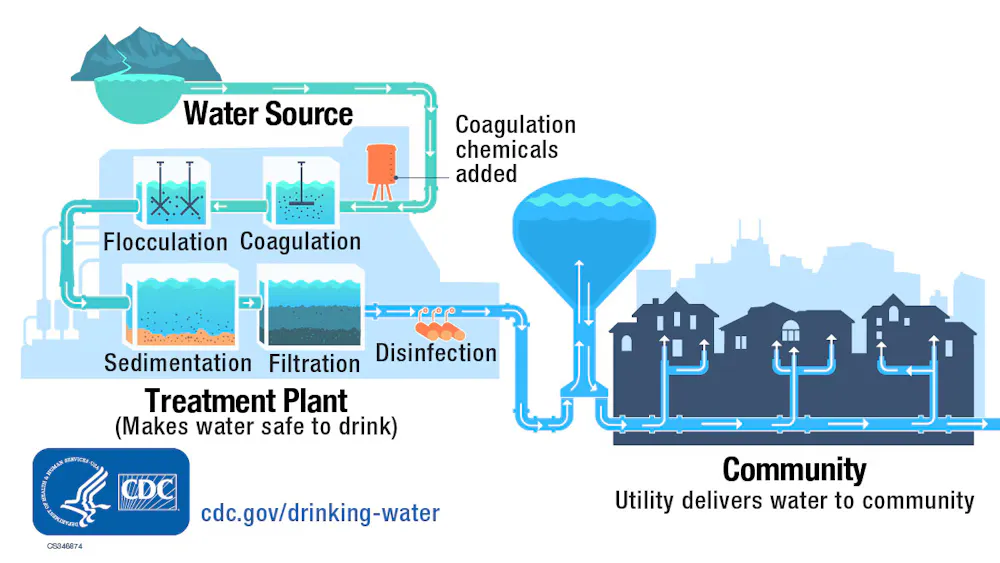
Diagram of water treatment process, moving from water source to treatment plant to community
Tap water undergoes several treatment steps before it reaches your faucet. CDC

Carriers of diarrheal infections can transmit them to others if they swim in public pools or fail to properly wash their hands before touching others or preparing food. Norovirus is particularly durable and can survive on surfaces for days, increasing chances of it infecting someone else.

Raw water can also contain algae that release toxins causing abdominal issues and damage to the brain and nervous system.

Cholera, dysentery and typhoid fever are no longer health burdens in the U.S. thanks to a robust water treatment system. But areas of the world lacking this privilege suffer high child mortality and widespread diarrheal diseases.

How safe is tap water in the US?

Tap water in the U.S. is among the safest to drink in the world. The Biden administration took steps to further improve it, including funding to replace lead pipes and new rules to monitor forever chemicals like perfluoroalkyl and polyfluoroalkyl substances, or PFAS, which have been linked to cancer and developmental disorders.

Importantly, raw water is not necessarily free from lead, arsenic, pesticides or industrial contaminants. Raw water sources are not reliably monitored by experts, so it is difficult to say which ones pose less risk. In addition, the water may be acceptably safe one day, but not on another. For example, soil runoff from a storm could introduce new germs or pollutants into the area.

The Environmental Protection Agency routinely screens for nearly 100 contaminants to ensure tap water is safe. In contrast, raw water remains untested, unregulated and untreated, leaving its safety to drink in question. In terms of risks and benefits, there are no demonstrated health benefits from drinking raw water, but clear evidence that you may be exposing yourself to harmful infectious and toxic contaminants.The Conversation

Bill Sullivan, Professor of Microbiology and Immunology, Indiana University

This article is republished from The Conversation under a Creative Commons license. Read the original article.

  1. California joins coalition challenging federal funding freeze
  2. Full-length warning siren test planned Feb. 3
  3. Medical research depends on government money – even a day’s delay in the intricate funding process throws science off-kilter
  • 464
  • 465
  • 466
  • 467
  • 468
  • 469
  • 470
  • 471
  • 472
  • 473
How to resolve AdBlock issue?
Refresh this page
