 How to resolve AdBlock issue?
News
- Details
- Written by: LAKE COUNTY NEWS REPORTS
The report analyzes 4.7 million vehicle and pedestrian stops conducted in 2023 by 539 law enforcement agencies in California under the Racial and Identity Profiling Act, or RIPA.
Overall, the report shows disparities consistent with those observed in prior years’ data with respect to perceived race, age and disability status.
The report finds, for example, that the disparity between the proportion of stops and the proportion of residential population was greatest for individuals perceived to be Black, who were stopped 126% more frequently than expected, followed by individuals perceived to be Latino, who were stopped 44% more frequently than expected.
In addition to providing an in-depth look into policing in 2023, the report contains a wide array of best practice recommendations related to policing, with a particular focus this year on the policing of youth and its impacts.
"Like those before it, the 2025 RIPA report provides actionable information to address bias in policing. This year’s report is particularly important with its focus on young Californians. The racial disparities of policing stops, searches and use of force of youth is alarming,” said Andrea Guerrero, co-chair of the RIPA Board and Executive Director of Alliance San Diego. “Young Californians who are driving, biking, and walking and perceived to be Black or Brown are regularly stopped, asked to consent to a search, handcuffed, sat on the curb, put in a police car, and questioned for information that is recorded on a field interview card before being released. This is California’s version of stop and frisk that causes immeasurable harm to the community and erodes trust in law enforcement from a young age. In this report, the board makes a number of recommendations that we encourage policy makers, law enforcement agencies and community advocates to consider to eliminate bias in policing and enhance public safety."
“The annual collection of RIPA stop data is one part of our broader effort to increase public safety for all Californians. Through the analysis of stop data and recommendations for thoughtful reforms, we’re continuing to strengthen trust between local law enforcement and the communities they serve,” said Attorney General Rob Bonta. “This year’s report takes a close look at the policing of youth and the lasting impact interactions with police can have at a young age. I’m grateful to the RIPA Board and staff at the California Department of Justice for continuing to shine a light on disparities in police stops at every age and provide recommendations for targeted data-driven reforms.”
The information collected under RIPA includes data on peace officers’ perceptions of the demographics of stopped individuals, such as race or ethnicity, gender identity, sexual orientation, age and disability.
The board uses several well-established methodologies to analyze the data and determine whether disparities can be found across demographic groups and whether bias exists.
Some of the key findings from the Board’s report related to youth include:
• Actions taken: Overall, Native American, Black, Latino, and Multiracial individuals had more actions taken per average stop than other racial and ethnic groups. For youth ages 1-17, officers reported the highest average of actions taken during a stop for Black youth. And for those perceived to be 18-24, officers reported the highest average number of actions taken for Black and Latino youth. Youth perceived to be 12-14 were more likely to be searched, handcuffed, and detained during a stop than any other age group, while youth perceived to be 15-17 were the most likely to be ordered to exit a vehicle during a stop.
Search rates: Native American and Black individuals were searched at higher rates than those who are White, and officers were less likely to discover contraband or evidence during searches of those individuals than they were during searches of individuals perceived to be White. Officers reported the highest rates of searches in stops involving Black, Native American, Multiracial, and Latino youth across all age categories for youth ages 12–24.
Use of force: For youth ages 12–24, officers were more likely to use force in stops of youth perceived to be Black and Native American compared to other racial and ethnic groups. Black and Native American youth also had the highest rates of handcuffing and the highest rates of a firearm pointed at them during a stop. Youth with a perceived disability were more likely to be handcuffed as part of a stop than youth without a perceived disability.
Results of stop: Officers were also more likely to report no action taken for stops of individuals perceived as Native American and Black. Individuals perceived as transgender were arrested at approximately double the rate of those perceived as cisgender or gender nonconforming.
The board’s report also contains a wide array of policy recommendations related to policing, with a particular focus on the impact of police interactions with youth, civilian complaint processes, accountability, officer decertification, and training, on racial and identity profiling.
Through this data analysis and these recommendations, the board said it reaffirms its commitment to improving public safety and achieving the legal mandate to eliminate the racial and identity profiling of all Californians.
For more on RIPA, members of the public are encouraged to visit OpenJustice, a data-driven initiative that works to increase access to data and support the development of public policy.
A copy of the report is available here. More information about the Board is available here.
Learn more about the 2025 RIPA Report: On Tuesday, Jan. 21, at 11 a.m., the California Department of Justice’s Office of Community Awareness, Response, and Engagement, or CARE, will host a community briefing to discuss the RIPA Board’s report. Register for this free webinar at the link here.
- Details
- Written by: Elizabeth Larson
The shooting left one person with injuries, as Lake County News has reported. No update has been offered about the individual’s status.
The incident occurred on Friday, Dec. 27, in the 3600 block of Highway 20 in Nice.
In a Tuesday update, the sheriff’s office said that its deputies responded at 2:45 a.m. that day to a business for an alarm call.
As they were concluding the call at about 3 a.m., Deputy Adrian Alexander was approached by a subject wielding multiple knives, the sheriff’s office said.
“The subject was erratic and displayed aggressive actions. Deputy Alexander made multiple attempts to diffuse and de-escalate the situation; however, the subject refused to comply and moved to attack the deputy. Deputy Alexander was forced to discharge his service weapon, striking the subject,” the sheriff’s office said.
The report said deputies immediately began taking life-saving measures while medics responded.
“Medics arrived on scene and transported the subject to a local hospital, where they received treatment before being transferred to an out-of-county hospital,” the sheriff’s office said.
The sheriff’s office said the footage from the responding deputies' body worn cameras will be released within 45 days, in accordance with the requirements of SB 1421, a bill approved in 2018 setting guidelines for the release of records “relating to specified incidents, complaints, and investigations involving peace officers and custodial officers to be made available for public inspection pursuant to the California Public Records Act.”
As a result of the incident, the Lake County Critical Incident Protocol was activated, and a parallel investigation is being conducted by the Lake County District Attorney’s Office, which is the lead investigating agency, officials said.
Since the shooting, the sheriff’s office said Alexander has been placed on administrative leave, which is common in such circumstances based on previous incidents.
The sheriff’s office said the latest information it has provided “is based on a preliminary and ongoing investigation, which continues to evolve as investigators interview witnesses, review physical and electronic records, and analyze forensic evidence. The Department’s understanding of the facts and circumstances may change as additional evidence is collected and analyzed.”
Email Elizabeth Larson at
- Details
- Written by: Diana M. Rodriguez
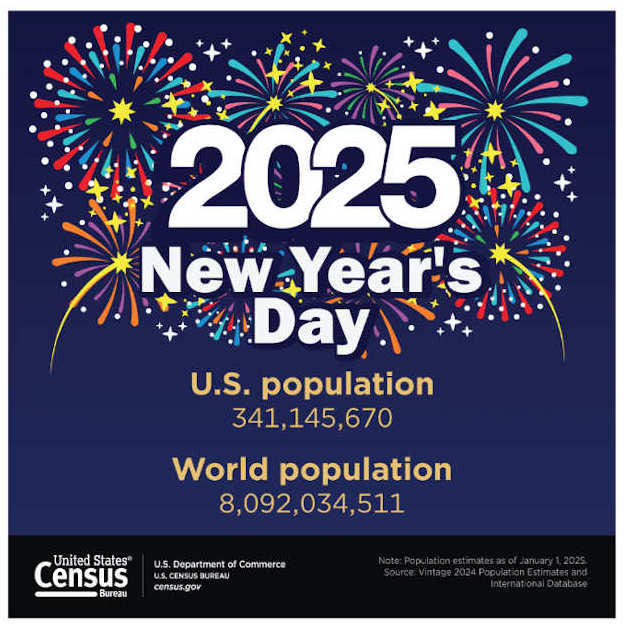
As 2024 came to a close, the U.S. Census Bureau projected the U.S. population would be 341,145,670 on New Year’s Day, an annual increase of 2,640,171 or 0.78%.
By comparison, just before the nation’s independence nearly 250 years ago, the 13 colonies had about 2.5 million residents.
The projected world population on Jan. 1, 2025, is 8,092,034,511, up 71,178,087 (0.89%) from New Year’s Day 2024.
During January 2025, 4.2 births and 2.0 deaths are expected worldwide every second.
Population estimates from U.S. and world population clocks
The Census Bureau’s Population Clock displays simulated real-time growth of the U.S. and world populations.
The U.S. Population Clock shows the population by age (0 to 100+) and sex, as well as the highest-density states, counties and cities.
In January 2025, the United States is expected to experience one birth every 9.0 seconds and one death every 9.4 seconds. Net international migration is expected to add one person to the U.S. population every 23.2 seconds.
The combination of births, deaths and net international migration increases the U.S. population by one person every 21.2 seconds.
The World Population Clock shows the most populous countries and the top U.S. export and import partners.
How does the Census Bureau population clock work?
At the end of each year, the Census Bureau uses a revised series of population estimates to update the short-term projections for the population clock.
Once the updated monthly projections are completed, daily population clock values are derived by interpolation.
Within each calendar month, the daily numerical population change is assumed to be constant, subject to negligible differences caused by rounding.
World population projections
The Census Bureau’s International Database, or IDB, created in the 1960s now produces population projections for 227 countries and equivalent areas, plus 16,919 subnational areas.
Population size (by single year of age and sex) and components of change (fertility, mortality and migration) are available for each calendar year through 2100.
The IDB was last updated in November and is set to be updated again next November. The United States is expected to remain the world’s third most populous country in 2025.
As of July 2024, the top 10 most populous countries were India (1,409,128,296); China (1,407,929,929); the United States (336,673,595); Indonesia (281,562,465); Pakistan (252,363,571); Nigeria (236,747,130); Brazil (220,051,512); Bangladesh (168,697,184); Russia (140,820,810); and Mexico (130,739,927).
Diana M. Rodriguez is a senior communications specialist in the Census Bureau’s Communications Directorate.
- Details
- Written by: LAKE COUNTY NEWS REPORTS
“California's new laws tackle today's biggest emerging challenges head-on. Through partnership with the Legislature, we’re strengthening public safety, building more housing, and providing more resources for our communities. These practical reforms protect what matters most while creating more opportunities for all Californians,” said Gov. Gavin Newsom.
New laws in 2025: Protecting consumers
California is enacting new laws to protect consumers from unfair financial practices and provide greater control over their money.
• Eliminating extra fees for declined transactions: Under AB 2017 by Assemblymember, now senator, Timothy Grayson (D-Concord) state-chartered banks and credit unions can no longer charge you a fee for declined transactions. This means if a purchase is declined because someone’s account balance is too low, they won't face additional penalties that make financial challenges even harder.
• Protecting credit scores from medical debt: SB 1061 by Sen. Monique Limón (D-Santa Barbara) makes sure Californians’ credit scores aren’t harmed by medical debt. This law stops credit agencies from including medical debt on an individual’s credit report and prevents lenders from considering it in credit decisions, ensuring no one’s credit suffers simply because they needed health care.
• Click to cancel – no more subscription traps: AB 2863 by Assemblymember Pilar Schiavo (D-Santa Clarita Valley) will strengthen consumer rights around subscription services and free trials. Starting July 1, 2025, companies must get clear consent before charging customers after a free trial ends, send annual reminders about recurring charges, and make cancellation just as simple as signing up. Customers will receive advance notice of any price changes, allowing time to decide whether to continue the subscription.
• Stronger protections for renters: Starting in 2025, new laws strengthen tenant protections in California. Landlords must document unit conditions with photos for security deposits (AB 2801 by Assemblymember Friedman), give tenants the option to report on-time rent payments to boost credit (AB 2747 by Assemblymember Haney), and are banned from charging unnecessary fees or higher security deposits for military tenants (SB 611 by Sen. Menjivar).
• Fairer deals for restaurants and consumers: SB 1490 by Sen. María Elena Durazo (D-Los Angeles) ensures food delivery platforms can’t misrepresent fees or keep a restaurant on their app without permission. It also requires a straightforward way for a restaurant to be removed from the platform if they choose. This means local businesses have more control, and there will be more honest pricing and disclosures when ordering food or beverages online.
Newsom’s office said these laws protect Californians from unfair financial practices – whether it's unexpected fees, medical debt affecting credit scores, or subscription charges they never meant to approve. They put more control back in consumers’ hands for managing personal finances.