How to resolve AdBlock issue?
Refresh this page
How to resolve AdBlock issue?
Refresh this page
Lake County News,California
  • Home
    • Registration Form
  • News
    • Education
    • Veterans
    • Community
      • Obituaries
      • Letters
      • Commentary
    • Police Logs
    • Business
    • Recreation
    • Health
    • Religion
    • Legals
    • Arts & Life
    • Regional
  • Calendar
  • Contact us
    • FAQs
    • Phones, E-Mail
    • Subscribe
  • Advertise Here
  • Login
How to resolve AdBlock issue?
Refresh this page

News

City of Lakeport extends application deadlines for committees and commissions

Details
Written by: City of Lakeport
Published: 14 November 2024
LAKEPORT, Calif. — The city of Lakeport has extended the deadline for community members to apply for opportunities to become involved in local government by serving on local commissions and committees.

If you have an interest in serving your community, applying for a position on a city commission or committee is a great place to start, city officials said.

The city invites applications for the following committees and boards: the Measure Z Advisory Committee, the Planning Commission and the Lakeport Economic Development Advisory Committee.

These appointments would be effective as of Jan. 1, 2025.

Membership on these commissions and committees is voluntary. If you are interested in serving on a committee, applications are available on the city’s website here.

For additional information regarding the mission and meeting dates of each commission, please see the Maddy Act notice.

Applications are due by 5:30 p.m. on Tuesday, Nov. 19, 2024. Appointments will be made at a special meeting of the Lakeport City Council in early December; that meeting date is yet to be determined.

For additional information, please contact Deputy City Clerk Hilary Britton at 707-263‑5615, Extension 102, or by e-mail at This email address is being protected from spambots. You need JavaScript enabled to view it..

CHP secures $2.6 million federal grant to address speeding and aggressive driving on California roads

Details
Written by: Lake County News reports
Published: 14 November 2024
Speeding and aggressive driving are ongoing challenges on California roadways.

The California Highway Patrol has been awarded $2.6 million in federal funding for the Speed Prevention, Education, and Enforcement Deterrence, or SPEED III, grant to implement safety measures to reduce dangerous driving behaviors statewide.

Speeding and aggressive driving behaviors are a significant danger to people traveling on California roads.

In the federal fiscal year of 2022-2023, speed was a factor in approximately 39% of all fatal and injury crashes in California.

During this period, there were 28,781 speed-related crashes, over 390 deaths, and 28,383 injuries to others.

“Securing this federal grant is a vital step in our commitment to making California’s roads safer for everyone,” said CHP Commissioner Sean Duryee. “With these funds, we can implement targeted safety measures to reduce dangerous driving behaviors like speeding and aggressive driving, which put countless lives at risk.”

The CHP will leverage these funds to enhance enforcement and public awareness campaigns statewide to decrease fatal and injury-related crashes associated with speeding, as well as lower the number of victims killed and injured in such incidents.

From Jan. 1, 2023, to July 31, 2024, the CHP used federal funding to enhance speed enforcement on state routes with rising speed-related incidents.

Officers issued over 30,508 citations for speeds over 100 mph and partnered with law enforcement agencies to post anti-speeding and aggressive driving messages on social media.

Funding for this program was provided by a grant from the California Office of Traffic Safety through the National Highway Traffic Safety Administration.

Political bickering and policy uncertainty take a toll on business investment, research shows

Details
Written by: Charles Sims, University of Tennessee
Published: 14 November 2024


Factionalism isn’t great for the bottom line. Sefa Ozel/E+ via Getty Images

Partisan squabbling isn’t just annoying – it’s also bad for business.

That’s what my colleagues and I found in a recent study on how uncertainty in environmental policy affects business investment.

First, we analyzed more than 300 million newspaper articles, looking for keywords related to environmental policy uncertainty. We found that this uncertainty spikes around election seasons and has nearly doubled over the past decade.

Then we looked at business investment rates – a common way to gauge a company’s financial health – at companies in affected sectors, such as those in the agriculture, mining, energy and automotive industries. We found that environmental policy uncertainty lowered those companies’ business investment rates by 0.010%.

That might not sound like a lot, but as economists like me know, small sums add up over time.

For example, the rise in environmental policy uncertainty in the run-up to the 2008 presidential election was linked with a one-time drop of the investment rate of 25% for companies affected by environmental policy, we found. This effect was larger than the uncertainty associated with defense, health and finance policy.

But my team also found a silver lining. Policy uncertainty had much less of an effect on business investment when control of Congress was divided and policy changes required bipartisan support, we discovered.

When the same political party controlled both chambers of Congress, environmental policy uncertainty was associated with a 0.013% decrease in investment rates. But when Congress was split, this decrease shrank to a much smaller 0.002%.

Why it matters

Because policy uncertainty tends to spike around elections, our results suggest that the current political environment is creating headwinds for business investment.

Our study also suggests that policies designed to spur business investment may be less effective than previously thought, because of the uncertainty they introduce.

Take, for example, the Inflation Reduction Act, passed in 2021, and the bipartisan infrastructure law of 2022. Both were crafted to encourage investment in clean-energy technologies.

But uncertainty over whether these packages would pass in the first place – and, if so, what these policies would include – may have deterred investment before they went into effect. And uncertainty about what aspects of the laws will continue after the election could also depress business investment.

A degree of uncertainty may be built into the democratic process. After all, the faster and more secretive a government is, the less accountable it is to the public. If you think of it that way, some uncertainty is an unavoidable cost of a healthy policymaking process.

Our study puts a price tag on these costs and reminds policymakers that political infighting is a drag on the economy. Our results do suggest one promising path forward: bipartisanship.

What’s next

Because there’s so much variety in environmental policies, our team is now doing research to see whether businesses respond differently to uncertainty in “carrot” policies – such as subsidies or tax breaks – versus “stick” policies, such as fines or other punishments.

Answering this question will help policymakers minimize the effects of uncertainty.

It’s also an open question whether newspaper articles convey information to business leaders or simply reflect the information they already have. If it’s the latter, media coverage may not be a great measure of the uncertainty businesses face.

To address this concern, we’re working to develop ways to measure uncertainty based on earnings call transcripts instead of newspaper articles. These could be a more direct way to gauge the uncertainties influencing business decisions.

The Research Brief is a short take about interesting academic work.The Conversation

Charles Sims, Professor of Economics, University of Tennessee

This article is republished from The Conversation under a Creative Commons license. Read the original article.
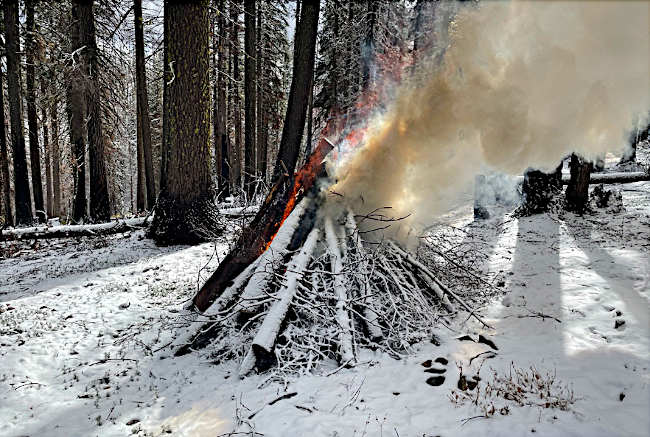
Mendocino National Forest prepares for prescribed burning

Details
Written by: LAKE COUNTY NEWS REPORTS
Published: 13 November 2024
A burn pile at Snow Basin in the Mendocino National Forest. Photo courtesy of the Mendocino National Forest.

MENDOCINO NATIONAL FOREST, Calif. — Forest personnel are planning several prescribed fire operations at campgrounds and administrative sites this fall, winter and spring, as weather patterns shift to cooler temperatures and wetter conditions.

Grindstone District fire personnel are starting with pile burning in higher elevations and will be moving down to lower elevations as weather conditions permit.

On Wednesday, Nov. 13 and throughout the week, firefighters will be attempting to burn piles at Board Camp and Snow Basin. Pile burning may also occur at Letts Lake, Log Springs, Ides Cove, Paskenta station and Red Bluff Recreation Area.

In the coming weeks, Upper Lake and Covelo Ranger District fire personnel are planning to burn piles located along roadsides in various locations, including Bartlett Mountain, M1 Road, Pine Mountain, Horse Mountain and Packsaddle.

Pile burning may also occur at administrative sites, including Hammerhorn, Little Doe and Deer Valley campgrounds. Potential understory burning operations include Howard Mill, Westshore, Pillsbury Homesites and possible North Shore project.

Fire managers conduct prescribed fire activities during the safest possible “burn windows” in the coming months. Numerous factors including wind, humidity, air quality, fuel moisture and availability of fire crew personnel must be met before crews are authorized to move forward with burning.

Residents and visitors are asked to avoid areas where prescribed fires are being conducted. Some smoke may be visible. Fires are carefully monitored. Local fire and government authorities are notified prior to burn days and kept informed throughout operations.

Prescribed fire is a tool that uses fire under planned ignitions to mimic the natural role of fire in the environment. Without fire, hazardous fuels can build up and carry wildfire from the forest floor to tree canopies, creating extreme fire behavior that poses risk to firefighters, surrounding communities and natural resources.

All burning activities are weather dependent. Maps, locations, photos and updates on planned prescribed burn activities will be available on Inciweb.
  1. Highlands Senior Center renovations complete; operations return to Bowers Avenue
  2. CHP secures federal grant to help boost child passenger safety campaign
  3. Countries spend huge sums on fossil fuel subsidies – why they’re so hard to eliminate
  • 546
  • 547
  • 548
  • 549
  • 550
  • 551
  • 552
  • 553
  • 554
  • 555
How to resolve AdBlock issue?
Refresh this page
