How to resolve AdBlock issue?
Refresh this page
How to resolve AdBlock issue?
Refresh this page
Lake County News,California
  • Home
    • Registration Form
  • News
    • Education
    • Veterans
    • Community
      • Obituaries
      • Letters
      • Commentary
    • Police Logs
    • Business
    • Recreation
    • Health
    • Religion
    • Legals
    • Arts & Life
    • Regional
  • Calendar
  • Contact us
    • FAQs
    • Phones, E-Mail
    • Subscribe
  • Advertise Here
  • Login
How to resolve AdBlock issue?
Refresh this page

News

Military veterans are disproportionately affected by suicide, but targeted prevention can help reverse the tide

Details
Written by: Jordan Batchelor, Arizona State University; Charles Max Katz, Arizona State University, and Taylor Cox, Arizona State University
Published: 12 November 2024


Mounting evidence shows that veterans need targeted suicide prevention services. adamkaz/E+ via Getty Images

America’s military veterans make up about 6% of the adult population but account for about 20% of all suicides. That means that each day, about 18 veterans will die by suicide.

In the U.S., the overall rate of suicide has largely increased since the start of the millennium, but veterans are disproportionately represented among this tragic trend.

Each of these losses affects not only the individual but also their families, friends and co-workers. Thus, working to prevent suicide and its underlying causes is important not only to protect our loved ones but also to foster happier, safer communities.

We are a team of researchers at Arizona State University’s Center for Violence Prevention and Community Safety. We manage the Arizona Violent Death Reporting System, a surveillance system sponsored by the Centers for Disease Control and Prevention and part of the larger national surveillance system that operates in all U.S. states, Puerto Rico and Washington. We gather information on suicides through agreements with the Arizona Department of Health Services, medical examiners and law enforcement.

Solder in uniform walks hand in hand with two young girls, one on each side, looking up at him.
Individual statistics do not capture the true extent of loss that ripples through a person’s entire family and social network. Peathegee Inc/Tetra Images via Getty Images

Assessing risk amid uncertainty

Military veterans range from 18 years of age to more than 100, include both men and women, and represent diverse races and ethnicities. As of 2018, the largest veteran cohort were those who served during the Vietnam War, followed by those who served during peacetime only, the Gulf War and post-9/11 conflicts.

Identifying the true risk of veteran suicide, especially relative to the general population, is a surprisingly difficult task. In past decades, researchers and stakeholders debated about which figures were most accurate, those showing veterans at increased risk or those showing the opposite. Such debates often stemmed from methodological factors.

However, mounting evidence shows that veterans need targeted suicide prevention services, and our data backs this up. From 2015 to 2022, the age-adjusted suicide rates among male veterans in Arizona outpaced those of nonveterans by a factor of 1.49 to 1.88. Put another way, while veterans in Arizona made up only 8.4% of the population in 2022, they represented 20.3% of the state’s suicides, meaning veterans were 2.5 times more likely to die by suicide.

While these numbers stem from Arizona, they also reflect the national trends showing greater and growing rates of suicide among veterans.

Why are veterans at greater risk?

One reason is that, compared to nonveterans, a greater proportion of veterans are white, male and older – demographic categories with elevated rates of suicide in the general population. For example, in Arizona, about 97% of veteran suicides between 2015 and 2022 were men, compared with 75% in the comparable nonveteran population.

Other explanations relate to veteran-specific factors. Some argue that military training and combat exposure can reduce a person’s fear of pain or death, putting suicidal veterans at greater risk of completing suicide. Military training also familiarizes a person with the use of firearms, a particularly lethal means of suicide. Statistics show that veterans, including female veterans, die by suicide using firearms more so than the general population. This tendency to use firearms as the method of suicide leads to more fatal suicide attempts.

At the Arizona Violent Death Reporting System, we collect data on circumstances that precede and may have contributed to suicide, which can help identify risk factors. While we’ve found that veterans often exhibit fewer such factors overall, certain demographic categories do display risk factors.

For example, a higher proportion of veterans ages 18 to 54 had a diagnosed mental health problem – primarily post-traumatic stress disorder, or PTSD. In addition, more male veterans ages 65 and older had physical health problems that contributed to their suicide compared with similar nonveterans.

This highlights the need to encourage veterans to share their mental or physical health struggles with others, which will prevent veterans from struggling alone. Large-scale initiatives are trying to tackle this issue, but we can also raise awareness and reduce stigma around suicide on a local level.

Shining a light on the problem

In 1999, then-Surgeon General Dr. David Satcher highlighted suicide as a serious public health crisis, paving the way for tackling the monumental issue on a national scale.

Now, 25 years later, the U.S. government continues to emphasize the increasingly dire situation. Most recently, the Biden administration released a 2024 national strategy aimed at establishing strategic directions for improving mental health treatment and reducing suicide.

Historically, health care facilities operated by the Veterans Health Administration have been a central resource for veterans experiencing mental or physical problems. This continues to be true: While the overall population of veterans is decreasing, the number of veterans who seek resources from the organization has increased. Encounters between veterans and the Veterans Health Administration offer opportunities to screen for suicide risk and offer resources for those in need.

Crisis lines are a potentially effective means of prevention. For example, the Veterans Crisis Line has been shown to reduce a caller’s immediate distress and suicidality. Many callers have found the crisis line helpful, with responders providing both effective intervention and compassionate support.

Education and policy provide another means of suicide prevention. As firearms are a particularly lethal means of suicide, a great deal of research funding has gone toward understanding their role in suicide. Studies generally find that reducing access to guns is associated with reduced suicide rates. As a result, both general and veteran-specific suicide prevention efforts highlight the importance of handling guns safely and storing them securely.

If you know a military veteran, keep an eye out for warning signs of mental distress, which may display in a person’s words, feelings or behavior.

For example, they may display intense anxiety, agitation or desperation, or express a sense of hopelessness. Veterans diagnosed with depressive syndrome, PTSD or both may be at greater risk.

For a person who is considering suicide, even the slightest hope can mean the difference between life and death.

If you or someone you know is experiencing signs of crisis, the free and confidential 988 Suicide and Crisis Lifeline is available to call, text or chat.

If you are a veteran and would like to speak with responders trained to understand your unique circumstances, call 988 and then press 1.The Conversation

Jordan Batchelor, Research Analyst at the Center for Violence Prevention and Community Safety, Arizona State University; Charles Max Katz, Director of the Center for Violence Prevention and Community Safety, Arizona State University, and Taylor Cox, Program Coordinator, School of Criminology & Criminal Justice, Arizona State University

This article is republished from The Conversation under a Creative Commons license. Read the original article.
Middletown Area Town Hall to meet Nov. 14

Details
Written by: Elizabeth Larson
Published: 12 November 2024
MIDDLETOWN, Calif. — The Middletown Area Town Hall, or MATH, will get project updates and continue accepting board nominations this week.

MATH will meet at 7 p.m. Thursday, Nov. 14, in the Middletown Community Meeting Room/Library at 21256 Washington St., Middletown. The meeting is open to the public.

Zoom will not be available. Viewers can participate via PEG TV.

On the agenda is an update on the county general plan and Middletown Area Plan, and discussion about the current progress of both the General Plan Advisory Committee and the Middletown Local Area Plan Advisory Committee, or LAPAC, including meeting schedule and how you can participate.

The LAPAC meeting schedule can be found here.

There also will be updates on the Cannabis Ordinance Task Force update and new accelerated meeting schedule, the Lake County Economic Development Eat, Drink, Shop LOCAL campaign and the Guenoc MAHA Valley Project.

Also on Thursday, MATH will continue receiving board nominations. Two seats are available.

Nominations opened in October and will continue at the December meeting.

Candidates nominated must be a registered voter in Lake County; must have attended at least three meetings in the year prior to the election, and must reside within the South Lake County Fire Protection District boundaries as defined in MATH Bylaws.

MATH — established by resolution of the Lake County Board of Supervisors on Dec. 12, 2006 — is a municipal advisory council serving the residents of Anderson Springs, Cobb, Coyote Valley (including Hidden Valley Lake), Long Valley and Middletown.

For more information email This email address is being protected from spambots. You need JavaScript enabled to view it..

Email Elizabeth Larson at This email address is being protected from spambots. You need JavaScript enabled to view it.. Follow her on Twitter, @ERLarson, or Lake County News, @LakeCoNews.

Lakeport Economic Development Advisory Committee to hold final meeting of the year

Details
Written by: Elizabeth Larson
Published: 12 November 2024
LAKEPORT, Calif. — The Lakeport Economic Development Advisory Committee is set to hold its final meeting of the year with updates on important committee and city projects.

The committee, or LEDAC, will meet via Zoom from 7:30 to 9 a.m. Wednesday, Nov. 13, in the council chambers at Lakeport City Hall, 225 Park St.

The meeting also will be available via Zoom.

The meeting ID is 842 2886 1335, pass code is 594383 or join by phone, 1 669 900 6833.

The meeting is open to the public.

On the agenda are economic development updates from Ben Rickelman, Lake County deputy county administrative officer for economic development, and Nicole Flora, executive director for the Lake County Economic Development Corp.

There also will be reports on the Economic Development Strategic Plan and Business Walk 2024.

In other business, there will be updates on city projects, activities and the budget.

LEDAC’s next meeting will be Jan. 8.

LEDAC advocates for a strong and positive Lakeport business community and acts as a conduit between the city and the community for communicating the goals, activities and progress of Lakeport’s economic and business programs.

Members are Chair Wilda Shock, Vice Chair Denise Combs and Secretary JoAnn Saccato, along with Bonnie Darling, Jeff Davis, Candy De Los Santos, Bill Eaton, Monica Flores, Pam Harpster, Laura McAndrews Sammel, Bob Santana and Tim Stephens. City staff who are members include City Manager Kevin Ingram and Community Development Department representatives.

Email Elizabeth Larson at This email address is being protected from spambots. You need JavaScript enabled to view it.. Follow her on Twitter, @ERLarson, or Lake County News, @LakeCoNews.

Honoring veterans: Veterans Day event planned and a look at the holiday’s history

Details
Written by: Elizabeth Larson
Published: 11 November 2024


LAKE COUNTY, Calif. — On Monday, Americans will have the opportunity to honor those who have served in the Armed Forces during our nation’s history.

The Lake County United Veterans Council invites the community to a Veterans Day celebration in the Konocti Vista Casino Banquet Hall on Monday.

Doors open at 10 a.m., with the ceremony beginning at 11 a.m. There will be speakers, a performance by the Clear Lake High School jazz band and a three-volley gun salute.

Veterans Day has its roots in World War I’s Armistice Day. The U.S. Department of Veterans Affairs said that in November 1919, President Woodrow Wilson proclaimed Nov. 11 of that year as the first commemoration of Armistice Day.

In May of 1938, Congress made Nov. 11 a legal holiday. It was then known as “Armistice Day,” and its focus was World War I veterans.

It was just three and a half years later that the United States entered World War II, which the VA said “required the greatest mobilization of soldiers, sailors, Marines and airmen in the Nation’s history.”

In 1954, in response to requests from veterans organizations, Congress amended the act that had created Armistice Day to change Nov. 11 to Veterans Day, in order to honor veterans of all wars.

On Oct. 8, 1954, President Dwight D. Eisenhower — one of the great heroes of World War II — issued the first Veterans Day Proclamation.

In it, he said this: “On that day, let us solemnly remember the sacrifices of all those who fought so valiantly, on the seas, in the air, and on foreign shores, to preserve our heritage of freedom, and let us reconsecrate ourselves to the task of promoting an enduring peace so that their efforts shall not have been in vain.”

In 1968, there was legislation to move several holidays, including Veterans Day, to specific Mondays. Veterans Day was intended to be moved from Nov. 11 to the fourth Monday in October.

It didn’t work, and in 1975, President Gerald Ford signed another bill that returned the annual observance of Veterans Day to Nov. 11, beginning in 1978. It has remained on that date to this day.

There have been many more wars since the effort began to establish a dedicated Veterans Day. Korea, Vietnam, the Gulf Wars and the war in Afghanistan have left their mark on people and lives.

Veterans make up a significant group in Lake County.

The latest U.S. Census Bureau data shows that they make up nearly 8% of Lake County’s population, and that’s reported to be one of the highest per-capita veteran population rates in California.

That was a reason that helped get a VA Clinic in Clearlake in 2010, thanks to the efforts of many people, among them, Congressman Mike Thompson, himself a Vietnam veteran.

In Lake County, the veterans population includes 12.5% who are women. More than half are 65 and older.

Thirty-seven percent of them have a disability and 16% of them are in poverty, the Census Bureau reported.

The following are additional statistics about veterans provided by the U.S. Census Bureau.

Did You Know?

15.8 million
The number of military veterans in the United States in 2023, representing 6.1% of the total civilian population age 18 and over.

1.7 million
The number of female veterans in the United States in 2023, representing 10.9% of the total veteran population.

0.6%
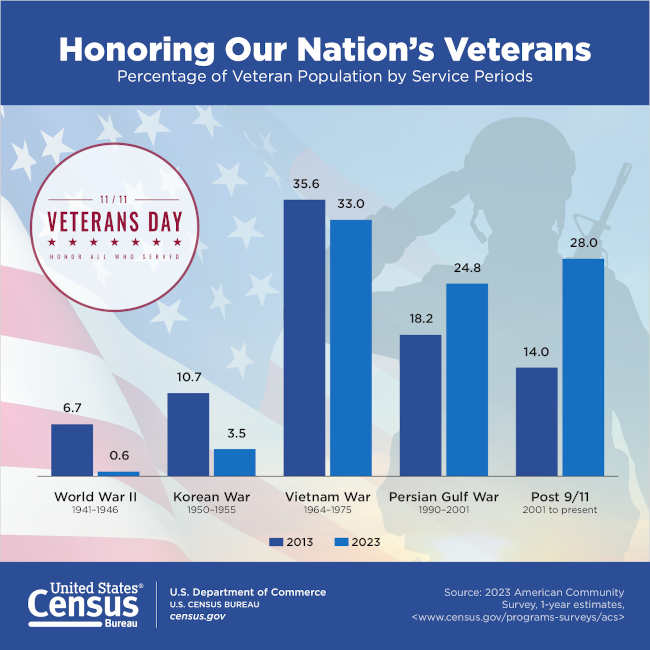
The share of veterans in 2023 who served during World War II. Additionally, 3.5% of veterans served during the Korean War; 33.0% during the Vietnam War; 24.8% during the Persian Gulf War; and 28.0% during the Post-9/11 period (September 2001 to present).

8.6%
The percentage of veterans in 2023 who were Hispanic or Latino (of any race). Additionally, 72.2% of veterans were White alone (not Hispanic or Latino); 12.6% Black or African American alone; 2.0% Asian American alone; 0.8% American Indian or Alaska Native alone; 0.2% Native Hawaiian or Other Pacific Islander alone; and 2.8% Some Other Race alone. The percentages include only those who reported a single race.

27.9%
The share of veterans 75 and older in 2023. At the other end of the age spectrum, 8.3% of veterans were younger than age 35.

Email Elizabeth Larson at This email address is being protected from spambots. You need JavaScript enabled to view it.. Follow her on Twitter, @ERLarson, or Lake County News, @LakeCoNews.
  1. Wreaths Across America commemoration planned for Dec. 14; fundraising for annual effort underway
  2. Rain, frost, cooler weather in this week’s forecast
  3. Purrfect Pals: This week’s new cats
  • 548
  • 549
  • 550
  • 551
  • 552
  • 553
  • 554
  • 555
  • 556
  • 557
How to resolve AdBlock issue?
Refresh this page