
 How to resolve AdBlock issue?
 News
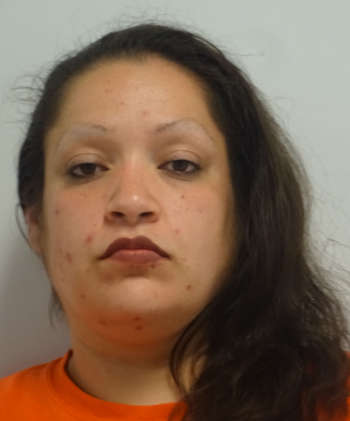
LAKE COUNTY, Calif. — A Clearlake woman arrested last month for what authorities said was a premeditated killing appeared in court this week to enter a plea in the case.
Dominique Irene Molina-Dominguez, 33, appeared in Lake County Superior Court on Tuesday morning for the July 10 killing of 38-year-old DeAndre Grinner.
She is charged with first-degree murder and special allegations of personal and intentional use of a firearm, and special aggravating circumstances that include a crime that involved great violence and involved a weapon.
Chief Deputy District Attorney Rich Watson said that during her Tuesday court appearance, Molina-Dominguez pleaded not guilty to all counts and denied all of the special allegations.
He said she also waived her right to a speedy preliminary hearing within 10 court days but did not waive her right to a preliminary hearing within 60 calendar days.
Molina-Dominguez’s preliminary hearing is set for Sep. 11, Watson said.
Authorities say Molina-Dominguez laid in wait for Grinner at a home they shared in Clearlake on July 10, fatally shooting him and then calling police.
She’d previously been scheduled to enter her plea on July 16, but the matter was continued at the defense request, as Lake County News has reported.
Watson said he expects to know more about a motive in the case, which remains under active investigation, by the time of the September preliminary hearing.
Until then, Molina-Dominguez remains in custody at the Lake County Jail on $1 million bail, according to jail records.
Email Elizabeth Larson at
- Details
- Written by: Elizabeth Larson
State Controller Malia M. Cohen has published the 2023 self-reported payroll data for state departments, superior courts, and California State University institutions on the Government Compensation in California website.
The data covers more than 399,000 positions and approximately $28.87 billion in total wages.
The newly published data were reported by:
• 24 CSU institutions (116,235 employees);
• 56 superior courts (20,884 employees); and
• 157 state departments (262,097 employees).
The data showed that the Lake County Superior Court has 45 employees, with a total of $3,364,732 in wages and $602,804 in health and retirement contributions.
The top five jobs include the four judges’ positions, ranging in pay annually from $219,046 to $233,901, and in retirement and health contributions from $1,073 to $23,376, and the court executive officer, which makes $214,882 in annual pay and $39,610 in retirement and health contributions.
Among state department jobs, the highest paid position is the chief investment officer of the California State Teachers' Retirement System, who receives $1,739,709 annually, followed in the top five by the following:
• Chief investment officer, Public Employees' Retirement System: $1,604,690.
• Deputy chief investment officer, California State Teachers' Retirement System: $1,143,143.
• Deputy chief investment officer, California State Teachers' Retirement System: $1,031,286.
• Chief executive officer, State Teachers' Retirement: $984,623.
Users of the site can view compensation levels on maps and search by region, narrow results by name of the entity or by job title, and export raw data or custom reports.
California law requires cities, counties, and special districts to annually report compensation data to the State Controller’s Office.
The State Controller’s Office also maintains and publishes state and CSU salary data. However, no such statutory requirement exists for the University of California, California community colleges, superior courts, fairs and expositions, First 5 commissions, or K-12 education providers; their reporting is voluntary.
Two superior courts — Alameda and Tuolumne — either did not file or filed a report that was noncompliant.
The site contains pay and benefit information on more than two million government jobs in California, as reported annually by each entity.
As the chief fiscal officer of California, Controller Cohen is responsible for accountability and disbursement of the state’s financial resources. The controller has independent auditing authority over government agencies that spend state funds.
The data covers more than 399,000 positions and approximately $28.87 billion in total wages.
The newly published data were reported by:
• 24 CSU institutions (116,235 employees);
• 56 superior courts (20,884 employees); and
• 157 state departments (262,097 employees).
The data showed that the Lake County Superior Court has 45 employees, with a total of $3,364,732 in wages and $602,804 in health and retirement contributions.
The top five jobs include the four judges’ positions, ranging in pay annually from $219,046 to $233,901, and in retirement and health contributions from $1,073 to $23,376, and the court executive officer, which makes $214,882 in annual pay and $39,610 in retirement and health contributions.
Among state department jobs, the highest paid position is the chief investment officer of the California State Teachers' Retirement System, who receives $1,739,709 annually, followed in the top five by the following:
• Chief investment officer, Public Employees' Retirement System: $1,604,690.
• Deputy chief investment officer, California State Teachers' Retirement System: $1,143,143.
• Deputy chief investment officer, California State Teachers' Retirement System: $1,031,286.
• Chief executive officer, State Teachers' Retirement: $984,623.
Users of the site can view compensation levels on maps and search by region, narrow results by name of the entity or by job title, and export raw data or custom reports.
California law requires cities, counties, and special districts to annually report compensation data to the State Controller’s Office.
The State Controller’s Office also maintains and publishes state and CSU salary data. However, no such statutory requirement exists for the University of California, California community colleges, superior courts, fairs and expositions, First 5 commissions, or K-12 education providers; their reporting is voluntary.
Two superior courts — Alameda and Tuolumne — either did not file or filed a report that was noncompliant.
The site contains pay and benefit information on more than two million government jobs in California, as reported annually by each entity.
As the chief fiscal officer of California, Controller Cohen is responsible for accountability and disbursement of the state’s financial resources. The controller has independent auditing authority over government agencies that spend state funds.
- Details
- Written by: Lake County News reports
Continuing to lead the country in emergency management and disaster preparedness, California’s first-in-the-nation Earthquake Early Warning System has provided advance notification to millions of Californians.
This alert came ahead of the 5.2 magnitude earthquake's shaking that was felt late Tuesday night throughout Central and Southern California.
The epicenter of Tuesday’s earthquake was in the community of Lamont, and was felt across large portions of Central and Southern California.
The Governor’s Office of Emergency Services, or Cal OES, which oversees California’s earthquake warning system, continues to coordinate closely with local officials in the impacted region to evaluate any issues or unmet needs.
Phones in the affected areas received notifications thanks to the state’s MyShake app, which sent 517,354 alerts, and even more Californians received alerts thanks to the public-private partnership between the state and Google, which has integrated the alert software into their Android cell phone operating systems.
“Our investments in cutting edge, innovative technologies are paying off. Efforts like these have allowed us to gain vital seconds between when alerts arrive on Californians’ mobile phones and when the ground starts shaking. Californians, I encourage you to download the app, it can save lives,” said Gov. Gavin Newsom.
Following Tuesday’s earthquake, there were more than 46,692 new downloads of the MyShake App in just 12 hours.
In addition to the emergency alerts sent to individuals through MyShake and smartphones, California is also using the technology to automate protective actions such as opening firehouse doors, recalling elevators, shutting off water and gas valves as well as closing bridges gates and notifying personnel in school and medical settings. Because of this capability, Metrolink’s train system automatically generated a notice that an earthquake had occurred.
Download app to get earthquake warnings
“The system performed Tuesday — giving Californians many seconds of advance warning,” said Cal OES Director Nancy Ward. “This demonstrates that Californians are now more protected in the moments before the devastation of major earthquake hits.”
In 2019, on the 30th anniversary of the deadly Loma Prieta earthquake, Gov. Newsom announced the launch of the nation’s first statewide Earthquake Early Warning System.
Building on this success of the2019 launch, in 2020 Gov. Newsom announced a partnership with Google to incorporate California’s earthquake early warning technology into all Android smartphones.
Warnings delivered through the California Earthquake Early Warning System are powered by ShakeAlert, a computerized program operated by the United States Geological Survey, or USGS, in partnership with Cal OES that analyzes data from seismic networks in California, calculates preliminary magnitudes, and then estimates which areas will feel shaking.
Seismic networks partners include the California Geological Survey, University of California, Berkeley Seismological Laboratory and California Institute of Technology Seismological Laboratory.
The California Earthquake Early Warning System marries a smartphone application with traditional alert and warning delivery methods such as Wireless Emergency Alerts, or WEA.
With the recent integration of early warning technology within the most popular smartphones in California, the system can deliver alerts to most Californians. The system uses ground motion sensors from across the state to detect earthquakes before humans can feel them.
Under the state’s leadership, 50% more sensors have been installed since the program launched making the system more accurate and able to deliver alerts faster.
How to receive alerts
To receive earthquake warnings, there are three ways for individuals and families to get alerts through the Earthquake Warning California system.
MyShake App: Free smartphone app that provides iPhone users with audio and visual warnings, available in both English and Spanish.
Smartphones: The majority of smartphones with updated operating systems are automatically subscribed to earthquake early warning which uses the same technology as the MyShake App; and
Wireless Emergency Alerts, or WEAs: No-cost text messages for emergency situations sent through the nation-wide system providing lifesaving information for the State of California
To learn more about earthquake preparedness and download the earthquake early warning application, visit: www.earthquake.ca.gov.
This alert came ahead of the 5.2 magnitude earthquake's shaking that was felt late Tuesday night throughout Central and Southern California.
The epicenter of Tuesday’s earthquake was in the community of Lamont, and was felt across large portions of Central and Southern California.
The Governor’s Office of Emergency Services, or Cal OES, which oversees California’s earthquake warning system, continues to coordinate closely with local officials in the impacted region to evaluate any issues or unmet needs.
Phones in the affected areas received notifications thanks to the state’s MyShake app, which sent 517,354 alerts, and even more Californians received alerts thanks to the public-private partnership between the state and Google, which has integrated the alert software into their Android cell phone operating systems.
“Our investments in cutting edge, innovative technologies are paying off. Efforts like these have allowed us to gain vital seconds between when alerts arrive on Californians’ mobile phones and when the ground starts shaking. Californians, I encourage you to download the app, it can save lives,” said Gov. Gavin Newsom.
Following Tuesday’s earthquake, there were more than 46,692 new downloads of the MyShake App in just 12 hours.
In addition to the emergency alerts sent to individuals through MyShake and smartphones, California is also using the technology to automate protective actions such as opening firehouse doors, recalling elevators, shutting off water and gas valves as well as closing bridges gates and notifying personnel in school and medical settings. Because of this capability, Metrolink’s train system automatically generated a notice that an earthquake had occurred.
Download app to get earthquake warnings
“The system performed Tuesday — giving Californians many seconds of advance warning,” said Cal OES Director Nancy Ward. “This demonstrates that Californians are now more protected in the moments before the devastation of major earthquake hits.”
In 2019, on the 30th anniversary of the deadly Loma Prieta earthquake, Gov. Newsom announced the launch of the nation’s first statewide Earthquake Early Warning System.
Building on this success of the2019 launch, in 2020 Gov. Newsom announced a partnership with Google to incorporate California’s earthquake early warning technology into all Android smartphones.
Warnings delivered through the California Earthquake Early Warning System are powered by ShakeAlert, a computerized program operated by the United States Geological Survey, or USGS, in partnership with Cal OES that analyzes data from seismic networks in California, calculates preliminary magnitudes, and then estimates which areas will feel shaking.
Seismic networks partners include the California Geological Survey, University of California, Berkeley Seismological Laboratory and California Institute of Technology Seismological Laboratory.
The California Earthquake Early Warning System marries a smartphone application with traditional alert and warning delivery methods such as Wireless Emergency Alerts, or WEA.
With the recent integration of early warning technology within the most popular smartphones in California, the system can deliver alerts to most Californians. The system uses ground motion sensors from across the state to detect earthquakes before humans can feel them.
Under the state’s leadership, 50% more sensors have been installed since the program launched making the system more accurate and able to deliver alerts faster.
How to receive alerts
To receive earthquake warnings, there are three ways for individuals and families to get alerts through the Earthquake Warning California system.
MyShake App: Free smartphone app that provides iPhone users with audio and visual warnings, available in both English and Spanish.
Smartphones: The majority of smartphones with updated operating systems are automatically subscribed to earthquake early warning which uses the same technology as the MyShake App; and
Wireless Emergency Alerts, or WEAs: No-cost text messages for emergency situations sent through the nation-wide system providing lifesaving information for the State of California
To learn more about earthquake preparedness and download the earthquake early warning application, visit: www.earthquake.ca.gov.
- Details
- Written by: Lake County News reports
With the public debut of two giant pandas at the San Diego Zoo on Thursday, Gov. Gavin Newsom has proclaimed August 8, 2024, as California Panda Day.
Yun Chuan and Xin Bao arrived at the San Diego Zoo earlier this summer and are the first giant pandas to enter the U.S. in 21 years.
The San Diego Zoo will celebrate the opening of Panda Ridge to visitors on Thursday.
The text of the proclamation and a copy can be found below:
The bear has long held pride of place in California as a symbol of our state’s spirit and strength, from our state flag and seal to its enduring significance for Native American tribes across the state. This week, California is proud to celebrate another iconic bear as a pair of giant pandas make their public debut at the San Diego Zoo.
Yun Chuan and Xin Bao are the first giant pandas to enter the U.S. in more than two decades. San Diego Zoo Wildlife Alliance was the first organization in the country to establish a cooperative panda conservation program, and their innovative conservation science has advanced efforts to protect and care for giant pandas around the world. A testament to their success, five-year-old Yun Chuan is the son of Zhen Zhen, a female panda born at the San Diego Zoo in 2007.
This conservation collaboration is part of California and China’s long history of working together towards shared goals. Building on our strong foundation of partnership and deep cultural and economic ties, I traveled to China last year to advance priority issues including climate action and economic development. We hope that the newly arrived panda “envoys of friendship” will lead to further exchanges and cooperation between California and China.
Giant pandas are beloved around the world and their conservation story is an inspiring example of strong partnerships and innovative strategies to protect the world’s natural heritage. As the San Diego Zoo welcomes visitors to Panda Ridge this week, I encourage Californians to take this unique opportunity to appreciate one of the most iconic wildlife species and recognize the important partnerships at work to help them thrive for generations to come.
NOW THEREFORE I, GAVIN NEWSOM, Governor of the State of California, do hereby proclaim August 8, 2024, as “California Panda Day.”
IN WITNESS WHEREOF I have hereunto set my hand and caused the Great Seal of the State of California to be affixed this 7th day of August 2024.
GAVIN NEWSOM
Governor of California
ATTEST:
SHIRLEY N. WEBER, Ph.D.
Secretary of State
Yun Chuan and Xin Bao arrived at the San Diego Zoo earlier this summer and are the first giant pandas to enter the U.S. in 21 years.
The San Diego Zoo will celebrate the opening of Panda Ridge to visitors on Thursday.
The text of the proclamation and a copy can be found below:
PROCLAMATION
The bear has long held pride of place in California as a symbol of our state’s spirit and strength, from our state flag and seal to its enduring significance for Native American tribes across the state. This week, California is proud to celebrate another iconic bear as a pair of giant pandas make their public debut at the San Diego Zoo.
Yun Chuan and Xin Bao are the first giant pandas to enter the U.S. in more than two decades. San Diego Zoo Wildlife Alliance was the first organization in the country to establish a cooperative panda conservation program, and their innovative conservation science has advanced efforts to protect and care for giant pandas around the world. A testament to their success, five-year-old Yun Chuan is the son of Zhen Zhen, a female panda born at the San Diego Zoo in 2007.
This conservation collaboration is part of California and China’s long history of working together towards shared goals. Building on our strong foundation of partnership and deep cultural and economic ties, I traveled to China last year to advance priority issues including climate action and economic development. We hope that the newly arrived panda “envoys of friendship” will lead to further exchanges and cooperation between California and China.
Giant pandas are beloved around the world and their conservation story is an inspiring example of strong partnerships and innovative strategies to protect the world’s natural heritage. As the San Diego Zoo welcomes visitors to Panda Ridge this week, I encourage Californians to take this unique opportunity to appreciate one of the most iconic wildlife species and recognize the important partnerships at work to help them thrive for generations to come.
NOW THEREFORE I, GAVIN NEWSOM, Governor of the State of California, do hereby proclaim August 8, 2024, as “California Panda Day.”
IN WITNESS WHEREOF I have hereunto set my hand and caused the Great Seal of the State of California to be affixed this 7th day of August 2024.
GAVIN NEWSOM
Governor of California
ATTEST:
SHIRLEY N. WEBER, Ph.D.
Secretary of State
- Details
- Written by: Lake County News reports
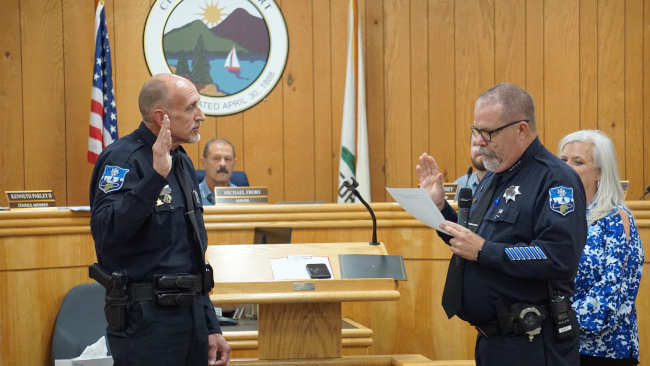
LAKEPORT, Calif. — Lakeport’s longtime police chief was celebrated by the Lakeport City Council, colleagues and community members on Tuesday night before formally handing over the reins to his successor.
After 35 years with the Lakeport Police Department — 14 of them as chief — Brad Rasmussen officially stepped into retirement on Tuesday during the Lakeport City Council meeting.
His successor will be department veteran Dale Stoebe, selected by City Manager Kevin Ingram this spring.
The standing room-only crowd that assembled for the meeting included dignitaries Sheriff Rob Howe, Undersheriff Luke Bingham — who also is Lake County’s sheriff-elect — along with Clearlake City Manager Alan Flora, Lt. Ryan Peterson and Lt. Martin Snyder of the Clearlake Police Department, retired Lake County Chief Deputy District Attorney Rich Hinchcliff, much of the Lakeport Police staff and Mendocino County Sheriff Matt Kendall.
While he’s ending his law enforcement career, Rasmussen isn’t leaving public service. Rather, he’s about to embark on a new career: That of the District 4 representative on the Lake County Board of Supervisors. He’ll take that seat in January.
At the supervisors’ meeting on Tuesday morning, Rasmussen also was lauded for his service by his near-future colleagues with the presentation of a proclamation.
During the Tuesday night meeting, Councilwoman Stacey Mattina read a proclamation outlining Rasmussen’s decades of service, and recognizing his leadership that extended beyond law enforcement to address issues such as homelessness and mental health issues, and advocating for community-oriented policing.
He also led the department in securing its new police department facility on South Main Street, he established the city’s National Night Out event and has been active in service organizations.
Rasmussen said he was proud to have been part of a team promoting positive change. He found both challenges and rewards in the many roles he filled over the years.
He added that it was an incredible honor to serve the community, and was proud to contribute to safety and improvements in Lakeport.
Council members offered their thanks, with Mattina noting that, while she would like to say she would miss him, “I think we’re going to be working together a lot.”
Councilwoman Kim Costa highlighted Rasmussen’s gentle spirit and kindness, and his responsiveness.
Mayor Michael Froio said Rasmussen is a visible presence in the community, a great listener and always willing to step up.
Froio said Rasmussen was the best candidate for the District 4 supervisor seat and he expects Rasmussen to excel in that position.
During public comment, Rasmussen was praised by fellow Kiwanis Club member Dennis Rollins, who said Rasmussen brought the club good ideas for service that made both the club and the community better.
Hinchcliff recounted working with Rasmussen for nearly 30 years, noting his hard work, common sense and diligence.
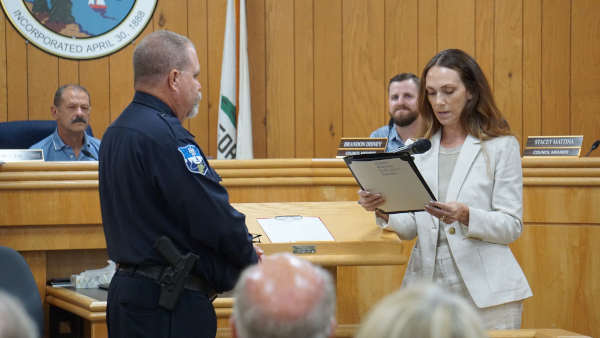
Sheriff Kendall — who had attended the police academy with Rasmussen and Sheriff Howe — joked that Rasmussen’s body doesn’t produce adrenaline. As a result, he said Rasmussen is a good listener and problem solver who remains calm.
Rasmussen’s wife of 32 years, Karyn, showed two badges he had just given her as a gift to commemorate being both a chief’s wife and an officer’s wife.
The city has been their family, she said. Karyn Rasmussen’s family moved to the city in 1978 and her father, Arlin Pischke, was elected to the Lakeport City Council and served as mayor.
She recalled how she had worked at Sprouse-Reitz along with his mother. He came in a lot, and she thought he was visiting his mother, but it was really to see her.
In recounting their lives together, she said, “I cannot believe we are at retirement stage.”
She added, “Happy retirement, husband,” before he rose to give her a hug.
As his last official act, Rasmussen had the opportunity to administer the oath of office to Stoebe, who has been his second in command. As Rasmussen explained, it’s an unusual situation for the outgoing chief to be able to swear in his successor, because there is usually an interval of time between retirements and new hires.
He said he’s confident in Stoebe’s ability to move the department forward, and said the community is in good hands.
In his comments after taking the oath, Stoebe noted, “It’s an interesting turn of events to find myself here.”
He credited Rasmussen with being one of the biggest reasons he is now in the job. He thanked Rasmussen for his patience, wisdom and tough love. “You endured a lot in your time as chief.”
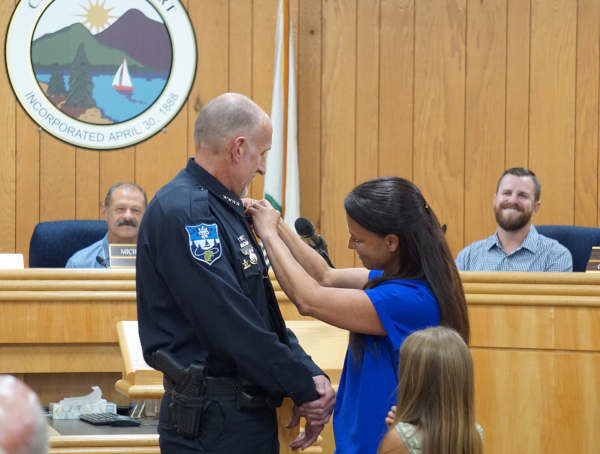
As part of the ceremony, Stoebe’s partner of nearly nine years, Kati Galvani, pinned on his new chief’s badge.
Email Elizabeth Larson at
- Details
- Written by: Elizabeth Larson
California has secured a $600 million federal grant to upgrade 100 miles of electric transmission lines with grid enhancing technologies to improve reliability and deliver clean, affordable electricity faster.
The Grid Resilience and Innovation Partnership, or GRIP, grant was awarded to a consortium that includes the California Energy Commission, the California Public Utilities Commission, the California Independent System Operator, Pacific Gas & Electric Company, and Southern California Edison.
The agencies, grid operator and utilities will partner on the California Harnessing Advanced Reliable Grid Enhancing Technologies for Transmission, or CHARGE 2T, program, which will expand transmission capacity and provide interconnection improvements to increase and accelerate equitable access to clean energy resources across the state.
“Once again, the Biden-Harris Administration is not just talking the talk, they’re walking the walk. This funding is critical to our efforts to build a power grid that ensures all Californians have access to cleaner, cheaper, more reliable electricity,” said Gov. Gavin Newsom.
The project will:
• Support more than 300 direct jobs.
• Enhance more than 100 miles of transmission lines with advanced conductor technologies that will help connect more clean energy resources than the existing grid can accommodate at this time.
• Deliver an estimated $200 million in energy savings from improved grid efficiency.
• Create economic and community benefits for disadvantaged communities.
• Invest in workforce training programs for the next generation of energy and utility workers.
• Develop a portal to improve transparency and efficiency in the interconnection process.
“As California grapples with increasingly extreme weather as a result of the climate crisis, bolstering our transmission network is essential for protecting public safety and ensuring a successful clean energy transition,” said U.S. Senator Alex Padilla. “To meet the challenges we face, we must modernize our grid, and there is no better way to achieve that than through reconductoring. Thanks to this historic investment in our state’s CHARGE 2T program through the Bipartisan Infrastructure Law, we’re updating our transmission lines to efficiently, reliably, and affordably deliver clean electricity while creating new green jobs.”
Tribal collaborations
A Northern California electrical grid project, led by the Blue Lake Rancheria Tribe, Hoopa Valley Tribe, Karuk Tribe, and Yurok Tribe, also received $88 million in GRIP funding, which — with matching funds from various sources — will ultimately total about $200 million.
The result of years of collaboration between California tribes, the state, and other public-private partnerships, this project will develop an innovative network of community microgrids to ultimately create a highly reliable, resilient, and decarbonized system.
The communities affected currently rely on the Hoopa 1101 circuit — one of the least reliable circuits in the PG&E service territory, seeing average outages twice the duration of most other circuits.
The project’s innovative approach — developed in collaboration with a new grid services laboratory at Cal Poly Humboldt — addresses the difficulties posed by rugged, rural, and wildfire-prone environments, and will allow communities to move away from relying on fossil fuels.
California’s clean energy leadership
The world’s fifth largest economy is being powered by more clean energy than ever before, breaking records and accelerating our progress towards 100% clean electricity by 2045.
At 10,379 megawatts (MW), the state has increased battery capacity by 1,250% since the beginning of the Newsom Administration — up from 770 MW in 2019.
California’s power grid has set a series of clean energy records this year. For at least 100 days this year, clean energy has exceeded grid demand consumed at some point during the day.
Thanks to new clean energy resources and the surge in battery storage, California’s power grid withstood this July’s record two-week heat wave – and even exported power to other states.
Find clean energy projects in your community at https://build.ca.gov/.
The Grid Resilience and Innovation Partnership, or GRIP, grant was awarded to a consortium that includes the California Energy Commission, the California Public Utilities Commission, the California Independent System Operator, Pacific Gas & Electric Company, and Southern California Edison.
The agencies, grid operator and utilities will partner on the California Harnessing Advanced Reliable Grid Enhancing Technologies for Transmission, or CHARGE 2T, program, which will expand transmission capacity and provide interconnection improvements to increase and accelerate equitable access to clean energy resources across the state.
“Once again, the Biden-Harris Administration is not just talking the talk, they’re walking the walk. This funding is critical to our efforts to build a power grid that ensures all Californians have access to cleaner, cheaper, more reliable electricity,” said Gov. Gavin Newsom.
The project will:
• Support more than 300 direct jobs.
• Enhance more than 100 miles of transmission lines with advanced conductor technologies that will help connect more clean energy resources than the existing grid can accommodate at this time.
• Deliver an estimated $200 million in energy savings from improved grid efficiency.
• Create economic and community benefits for disadvantaged communities.
• Invest in workforce training programs for the next generation of energy and utility workers.
• Develop a portal to improve transparency and efficiency in the interconnection process.
“As California grapples with increasingly extreme weather as a result of the climate crisis, bolstering our transmission network is essential for protecting public safety and ensuring a successful clean energy transition,” said U.S. Senator Alex Padilla. “To meet the challenges we face, we must modernize our grid, and there is no better way to achieve that than through reconductoring. Thanks to this historic investment in our state’s CHARGE 2T program through the Bipartisan Infrastructure Law, we’re updating our transmission lines to efficiently, reliably, and affordably deliver clean electricity while creating new green jobs.”
Tribal collaborations
A Northern California electrical grid project, led by the Blue Lake Rancheria Tribe, Hoopa Valley Tribe, Karuk Tribe, and Yurok Tribe, also received $88 million in GRIP funding, which — with matching funds from various sources — will ultimately total about $200 million.
The result of years of collaboration between California tribes, the state, and other public-private partnerships, this project will develop an innovative network of community microgrids to ultimately create a highly reliable, resilient, and decarbonized system.
The communities affected currently rely on the Hoopa 1101 circuit — one of the least reliable circuits in the PG&E service territory, seeing average outages twice the duration of most other circuits.
The project’s innovative approach — developed in collaboration with a new grid services laboratory at Cal Poly Humboldt — addresses the difficulties posed by rugged, rural, and wildfire-prone environments, and will allow communities to move away from relying on fossil fuels.
California’s clean energy leadership
The world’s fifth largest economy is being powered by more clean energy than ever before, breaking records and accelerating our progress towards 100% clean electricity by 2045.
At 10,379 megawatts (MW), the state has increased battery capacity by 1,250% since the beginning of the Newsom Administration — up from 770 MW in 2019.
California’s power grid has set a series of clean energy records this year. For at least 100 days this year, clean energy has exceeded grid demand consumed at some point during the day.
Thanks to new clean energy resources and the surge in battery storage, California’s power grid withstood this July’s record two-week heat wave – and even exported power to other states.
Find clean energy projects in your community at https://build.ca.gov/.
- Details
- Written by: Lake County News reports
Exasperated and impatient California tribal leaders and lawmakers on Tuesday listened to state university system leaders lay out the steps they are taking to meet the requirements of 1990 and 2001 federal and state laws to return Native American human remains and artifacts to the appropriate tribes.
The hearing follows three scathing state audits of the University of California and California State University systems since 2019.
California’s state auditor has conducted three audits: a UC audit undertaken in 2019, a second UC review in 2021, and a CSU survey and report in 2022.
The CSU audit revealed collections of more than 700,000, although not all campuses had undertaken required inventories.
UC also held sizable collections, particularly on the UC Berkeley campus, and auditors reported additional collections were found as campuses reviewed their inventories.
Governmental institutions and museums are bound to return Native American human remains and artifacts by the 1990 federal Native American Graves Protection and Repatriation Act, or NAGPRA, and its 2001 California counterpart, CalNAGPRA. Return of the items and human remains is described as repatriation.
The hearing was conducted by the Select Committee on Native American Affairs chaired by Assemblymember James C. Ramos and Assemblymember Gregg Hart, chair of the Joint Legislative Audit Committee.
“While I am pleased that at long last, the UC and CSU systems are beginning to establish policies to direct the return of our ancestors’ remains, both systems have significant work ahead of them to comply with their legal responsibilities,” said Ramos, who also chairs the California Native American Legislative Caucus. “The legislature will continue to aggressively monitor compliance and take steps to ensure the UC and CSU systems pursue compliance on a considerably quicker pace.”
He added that the remains and objects should not be treated as archeological or academic trophies because they are human remains of ancestors.
Redding Rancheria Chairman Jack Potter, who spoke at a news briefing on the subject, said, “If you want to study an Indian, I’m right here. It takes money to do a lot of things but it should just take your heart. You hear the heart of these people crying from these shelves,” referring to shelves where universities store remains in boxes.
Ramos noted that his bill, AB 226 requires additional audits of the UC system, and it strongly urges UC to make annual reports to the legislature about its NAGPRA compliance.
He also cited AB 389 that required the CSUs to undertake the recommendations proposed by the state auditor in their 2022 review of the system. Both measures were signed in 2023.
In addition to Potter, other tribal leaders testifying at the oversight hearing included Lynn Valbuena, San Manuel Band of Mission Indians Charles Martin from Morongo Band of Mission Indians; Leo Sisco, chair, Tachi Yokut Tribe; Councilmember Catalina Chacon, Pechanga Band of Indians; Lorelle Ross, vice chair emeritus, Federated Indians of Graton Rancheria and Tribal Governance and Indian Child Welfare Act consultant; and Buffy McQuillen, tribal heritage preservation officer, Federated Indians of Graton Rancheria.
UC and CSU witnesses included CSU Chancellor Mildred García; California State University, Chico President Steve Perez; UC Vice President for Research and Innovation Teresa Maldonado; UC Executive Director of Research, Policy Analysis & Coordination Deborah Motton; UC System-wide Repatriation Coordinator Glenys Echavarri; UC Berkeley Chancellor Richard Lyons and UC Berkeley Director of Repatriation Alex Lucas.
The hearing follows three scathing state audits of the University of California and California State University systems since 2019.
California’s state auditor has conducted three audits: a UC audit undertaken in 2019, a second UC review in 2021, and a CSU survey and report in 2022.
The CSU audit revealed collections of more than 700,000, although not all campuses had undertaken required inventories.
UC also held sizable collections, particularly on the UC Berkeley campus, and auditors reported additional collections were found as campuses reviewed their inventories.
Governmental institutions and museums are bound to return Native American human remains and artifacts by the 1990 federal Native American Graves Protection and Repatriation Act, or NAGPRA, and its 2001 California counterpart, CalNAGPRA. Return of the items and human remains is described as repatriation.
The hearing was conducted by the Select Committee on Native American Affairs chaired by Assemblymember James C. Ramos and Assemblymember Gregg Hart, chair of the Joint Legislative Audit Committee.
“While I am pleased that at long last, the UC and CSU systems are beginning to establish policies to direct the return of our ancestors’ remains, both systems have significant work ahead of them to comply with their legal responsibilities,” said Ramos, who also chairs the California Native American Legislative Caucus. “The legislature will continue to aggressively monitor compliance and take steps to ensure the UC and CSU systems pursue compliance on a considerably quicker pace.”
He added that the remains and objects should not be treated as archeological or academic trophies because they are human remains of ancestors.
Redding Rancheria Chairman Jack Potter, who spoke at a news briefing on the subject, said, “If you want to study an Indian, I’m right here. It takes money to do a lot of things but it should just take your heart. You hear the heart of these people crying from these shelves,” referring to shelves where universities store remains in boxes.
Ramos noted that his bill, AB 226 requires additional audits of the UC system, and it strongly urges UC to make annual reports to the legislature about its NAGPRA compliance.
He also cited AB 389 that required the CSUs to undertake the recommendations proposed by the state auditor in their 2022 review of the system. Both measures were signed in 2023.
In addition to Potter, other tribal leaders testifying at the oversight hearing included Lynn Valbuena, San Manuel Band of Mission Indians Charles Martin from Morongo Band of Mission Indians; Leo Sisco, chair, Tachi Yokut Tribe; Councilmember Catalina Chacon, Pechanga Band of Indians; Lorelle Ross, vice chair emeritus, Federated Indians of Graton Rancheria and Tribal Governance and Indian Child Welfare Act consultant; and Buffy McQuillen, tribal heritage preservation officer, Federated Indians of Graton Rancheria.
UC and CSU witnesses included CSU Chancellor Mildred García; California State University, Chico President Steve Perez; UC Vice President for Research and Innovation Teresa Maldonado; UC Executive Director of Research, Policy Analysis & Coordination Deborah Motton; UC System-wide Repatriation Coordinator Glenys Echavarri; UC Berkeley Chancellor Richard Lyons and UC Berkeley Director of Repatriation Alex Lucas.
- Details
- Written by: Lake County News reports




