 How to resolve AdBlock issue?
News
- Details
- Written by: Lake County News reports
The California Department of Fish and Game (DFG) will become the California Department of Fish and Wildlife (CDFW), effective Jan. 1.
The new name was mandated by AB 2402, which was signed Sept. 25 by Gov. Edmund G. Brown Jr. and is one of numerous provisions passed into law during 2012 that affect the department.
“The name of the department was changed to better reflect our evolving responsibilities,” said Department Director Charlton H. Bonham. “As our role has grown to meet 21st century expectations, we remain committed to our traditional responsibilities and to honoring our deep roots in California’s natural resources legacy.”
Traditionally known as game wardens, the department’s law enforcement staff will now be called wildlife officers.
Californians will notice new Internet ( www.wildlife.ca.gov ) and e-mail addresses for CDFW employees. The old URL and email addresses will continue to work indefinitely.
Many department materials will continue to bear the old name because AB 2402 reduced the cost associated with the name change by preventing CDFW from undergoing a wholesale turnover of materials, including signs, uniforms and supplies.
The mission of the department continues to be “to manage California's diverse fish, wildlife, and plant resources, and the habitats upon which they depend, for their ecological values and for their use and enjoyment by the public.”
In furtherance of that mission, the department carries out numerous responsibilities related to the commercial, recreational, educational and scientific use and enjoyment of California’s natural resources.
- Details
- Written by: Elizabeth Larson

UPPER LAKE, Calif. – Officials on Monday continued their efforts to locate a young Northshore woman who went missing last week.
The search remains under way for 23-year-old Kimberly Marie Hazelwood of Nice.
Lt. Steve Brooks of the Lake County Sheriff’s Office said Lake County Search and Rescue was performing a search in the Upper Lake area on Monday, with assistance from K-Corps, Willits Fire Swift Water Rescue Team and California Department of Fish and Game.
Brooks said a California Highway Patrol helicopter also was to assist with the search Monday afternoon.
Hazelwood, who has been undergoing cancer treatment, was last seen on the night of Dec. 23 when she left a home in the 10000 block of Rancheria Road near Upper Lake, according to an initial sheriff’s office report issued last week. She was reported missing after 9 p.m. that night.
A short time before deputies were dispatched to the Rancheria Road residence, fire officials responded to a report of a person who was in Middle Creek near the 9100 block of Bridge Arbor Road, about two miles south of where Hazelwood was last seen. Northshore Fire Chief Jay Beristianos said they were unable to locate anyone.
Hazelwood is 5 feet 3 inches tall, weighs 160 pounds, has brown eyes and long brown hair.
Anyone with information on her whereabouts is asked to call the Lake County Sheriff’s Office at 707-263-2690, or her family at 707-245-2772, 707-900-1401 or 707-900-1946.
John Jensen contributed to this report.
Email Elizabeth Larson at
- Details
- Written by: Elizabeth Larson

LAKE COUNTY, Calif. – A Cal Fire veteran has been tapped as the new chief of the agency’s Sonoma-Lake-Napa Unit.
Eric Hoffman, 51, who just finished his 30th firefighting season with Cal Fire, will start the new year in the unit chief’s position after serving since 2009 as chief of the unit’s west division, which covers Sonoma County.
If Hoffman’s name is familiar to Lake County readers, that’s because he spent time in the county this past summer as incident commander on the Wye and Walker fires, and the Scotts fire.
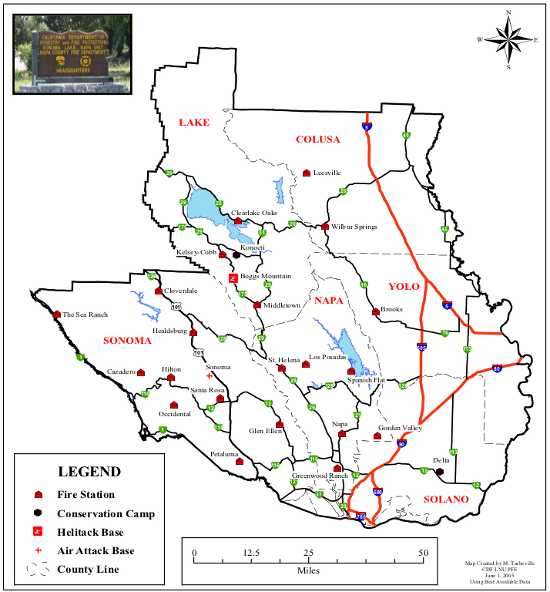
In his new role as unit chief, he will oversee four divisions – the north, which covers Lake County; the south, covering Napa County; the east, which includes Solano, Yolo and Colusa counties; and the west, the biggest division of the four, which covers Sonoma County, he explained.
The unit covers a total of six counties and, geographically, is the largest State Responsibility Area in California, Hoffman said.
The Sonoma-Lake-Napa Unit covers 10,000 square miles – or just over 2.1 million acres – and includes 20 state stations, 31 engines, 11 crews, five bulldozers, a helitack base at Boggs Mountain and an air attack base in Sonoma County, and 250 personnel, according to Hoffman.
“It’s huge,” Hoffman said.
The unit’s staffing increases in the summertime firefighting season, when Hoffman said personnel numbers top 400.
Yet, as big as it is, it runs well.
“The good news is, I’m not inheriting anything broken,” said Hoffman,
Since he started with Cal Fire in 1983, Hoffman has seen numerous changes in firefighting and how Cal Fire itself works.
One of the big changes has to do with training, he said.
When he began firefighting in his early 20s, Hoffman said it sounded like fun work. Back then, a young firefighter would get a week’s worth of training before they were assigned to an engine and setting out on the fire lines.
Firefighters today undergo far more intensive training, with Hoffman explaining that their level of professionalism has increased.
A firefighter now must have a minimum of 180 hours of training before they’re placed on an engine, said Hoffman, adding that most firefighters starting work now have “a pile of certificates” that he said is bigger than those he amassed.
Firefighters now are coming into the agency trained, educated and ready – they are certified in hazmat and as emergency medical technicians, and they’ve completed a six-month academy to receive a firefighter level one certificate.
“We give them the wildland experience,” said Hoffman.
In his time with Cal Fire, the other big change Hoffman has seen is in the area of technology and how it has affected firefighting.
Hoffman said firefighters used to draw topographical maps on fire scenes with grease pencils. Now they rely on high speed Internet for both mapping and weather data.
“The technology behind the scenes is incredible,” he said.
On some big Southern California fires they’ve used military and NASA drones to help map the fires. More commonly, they use helicopters with a GPS mapping program and infrared capability to fine tune perimeters.
Hoffman, acting as incident commander on the Wye and Scotts fires this summer, said those incidents illustrated how the California fire service works.
The cooperation between state and local agencies was seamless, he said.
Cal Fire had been short on resources at the time, but was able to get local government strike teams through its relationship with the California Emergency Management Agency, he said.
“Although there was a lot of fire, it worked pretty well,” he said.
With the Scotts and Wye fires within Lake County’s boundaries, as well as the nearby 16 and Sites fires in Colusa County, and the Mill Fire in the Mendocino National Forest, “Lake County just seemed to be at the eye of the storm this summer,” Hoffman said.
Altogether, all of those fires inside and outside of Lake County’s boundaries burned approximately 64,183 acres.
The Walker and Wye fires – managed as the Wye Fire incident – hit in the second week of August, spreading rapidly to thousands of acres, burning at least one residence as well as outbuildings before being fully contained at 7,934 acres.
The damage could have been worse, but Hoffman said Cal Fire was able to focus its efforts on hitting the fire from the air and keeping it out of New Long Valley.
Hoffman said a cause still hasn’t been determined for the Wye incident.
Less than a month later, the Scotts Fire hit west of Scotts Valley Road, burning a total of 4,618 acres. “The Scotts Fire was really challenging, just because it stayed there above Scotts Valley Road and kinda hung there,” he said.
The cause of the Scotts Fire also hasn’t been determined, Hoffman said.
A factor in the summer’s fires were the dry conditions. Hoffman said there were record levels of dryness in fuels – or vegetation – as well as a dry spring. “And we’re not in a prolonged drought.”
The first 20 days of the fire season was normal, and overall it wasn’t the fire season with the most acres burned. But Hoffman said firefighters were busy for a prolonged period of time, with 50 days of resource drawdown. That equaled many exhausted firefighters.
Beyond busy fire seasons, Hoffman will be occupied with longterm planning for the unit and its future leadership.
One of his areas of concentration will be on establishing the next generation of first level company officers for the unit.
There are a lot of people to hire. In the coming year, he said they will need to hire between five and seven battalion chiefs and a new division chief to succeed him.
“It’s a constant effort for success and planning,” Hoffman said.
Email Elizabeth Larson at
- Details
- Written by: Elizabeth Larson
LAKE COUNTY, Calif. – Hearings have been set for February in a case alleging that the California Department of Fish and Game is carrying out fish stocking programs around the North Coast, including Lake County, without the required permits.
In the suit, Del Norte County resident and outdoorsman Felice Pace and Missoula, Mont.-based Wilderness Watch challenge the Department of Fish and Game’s fish stocking practices in Lake, Del Norte and Humboldt counties.
The suit – which specifically names Department of Fish and Game Director Charlton H. Bonham and Stafford Lehr, Fish and Game’s fisheries division branch chief – was first filed in federal court in November, with an amended complaint filed Dec. 23, according to court records.
The state deputy attorney generals assigned to represent Bonham, Lehr and the Department of Fish and Game appeared in court on Dec. 21 in a hearing on the case.
A case management conference has been set for Feb. 8 in San Francisco, based on the most recent case filings.
The suit alleges that the Department of Fish and Game discharged, and continues to discharge, “fish by airplanes and canisters borne by packstock” into waters without first obtaining the required permits under the National Pollutant Discharge Elimination System of the Clean Water Act.
Court documents do not specifically state which water bodies in the three counties are affected.
“Plaintiffs seek declaratory relief that these discharges will continue to be illegal, and an injunction prohibiting such discharges unless and until Fish and Game possesses required permits,” the suit states.
Pace and Wilderness Watch also are seeking reasonable attorneys’ fees, costs, and other expenses under the Clean Water Act.
According to the suit, the plaintiffs notified the Department of Fish and Game in June of the alleged Clean Water Act violations.
“Fish stocking in these waters harms Mr. Pace by, among other things, altering the integrity of waters he enjoys, introducing fish that were historically not present, elevating fish populations to unnatural levels, and adversely affecting native wildlife,” court documents state.
Wilderness Watch has 1,050 members, some of whom reside in the affected counties, according to the suit.
The group’s members are harmed, the suit alleges, because of the fish stocking program “altering the integrity of waters they enjoy, introducing fish that were historically not present, elevating fish populations to unnatural levels, and adversely affecting native wildlife.”
Concerns about fish stocking cited in the suit including alteration of physical and biological integrity of lakes.
“Stocked fish alter nutrient cycling in lakes. Stocked fish alter algal production in lakes. Stocked fish consume tadpoles and other life stages of amphibians in lakes. Stocked fish may spread disease to amphibians,” the suit states. “Stocked fish attract snakes that then prey on amphibians. Stocked fish consume macroinvertebrates in lakes.”
In addition, “Stocked fish consume large-bodied zooplankton in lakes,” court documents state. “Diminished populations of large-bodied zooplankton affects the presence of phytoplankton in lakes. Stocked fish prey on or compete with populations of native fish. Collectively, these impacts result in major changes to lake food webs. The water used to release fish can harbor non-native species of aquatic plans, invertebrates, and fish that is introduced into the lake being stocked.”
Also on Dec. 21, the Attorney General’s Office, on behalf of Bonham, Lehr and the Department of Fish and Game, notified the court that several other similar actions about the fish stocking program – filed in Sacramento County Superior Court and in federal court – were under way.
Those cases involve the Center for Biological Diversity, Californians for Alternatives to Toxics – for which Wilderness Watch is a petitioner – and the California Association for Recreational Fishing.
The cases challenged the propriety of the Department of Fish and Game’s fish hatchery and stocking program as well as an environmental impact report prepared for the program.
The state court trial actions were decided in July and September, and in a September statement, the agency said that as a result of the ruling its stocking and hatchery programs had survived. However, appeals have since been filed in the cases.
“The complaint in this action alleges that a Clean Water Act permit is required for that activity,” the state’s Dec. 21 filing said.
It goes on to point out that Pace and Wilderness Watch have alleged that the department’s fish stocking program has adverse environmental impacts.
“To the extent that is at issue in this action, the Court should be mindful of the state court judgments on that issue. This may counsel this Court deferring any determination on that issue until those state court actions run their course,” the filing stated.
Email Elizabeth Larson at