 How to resolve AdBlock issue?
News
- Details
- Written by: Elizabeth Larson
LAKEPORT, Calif. – As the year winds down, the county’s animal shelter has another interesting variety of pooches awaiting homes.
Poodles, and mixes of American Bulldog, German Shepherd, Rottweiler and beagle are ready for adoption.
Dogs that are adopted from Lake County Animal Care and Control are either neutered or spayed, microchipped and, if old enough, given a rabies shot and county license before being released to their new owner. License fees do not apply to residents of the cities of Lakeport or Clearlake.
If you're looking for a new companion, visit the shelter. There are many great pets hoping you'll choose them.
The following dogs at the Lake County Animal Care and Control shelter have been cleared for adoption (additional dogs on the animal control Web site not listed are still “on hold”).

American bulldog mix puppy
This male American Bulldog puppy is 11 weeks old.
He weighs 14 pounds, has a short white and brown spotted coat and has been neutered.
He’s in kennel No. 8, ID No. 35087.

Male German Shepherd mix
This male German Shepherd mix is 4 years old.
He has a short black and tan coat, erect ears and has not been neutered.
He’s in kennel No. 14, ID No. 35152.

Mini poodle mix
This miniature poodle mix is 8 months old.
She has a long white and apricot coat. Shelter staff did not report if she was altered.
She’s in kennel No. 22, ID No. 35143.

Labrador Retriever-shepherd mix
This male Labrador Retriever-shepherd mix is 8 months old.
He has a short black coat, weighs nearly 32 pounds and has been neutered.
He’s in kennel No. 28, ID No. 35108.

Beagle-hound mix
This female beagle-hound mix is 5 months old.
She has a short tan coat, weighs 27 pounds and has been spayed.
You can find her in kennel No. 29, ID No. 35118.

Jack Russell Terrier mix
This female Jack Russell Terrier mix is a year and a half old.
She has a short black and white coat, weighs 18 pounds and has been spayed.
She’s in kennel No. 33, ID No. 34766.

Male Rottweiler mix
This male Rottweiler mix is 4 months old.
He has a short black and tan coat, and is of medium size. It was not reported if he was altered.
Find him in kennel No. 34, ID No. 35136.
Please note: Dogs listed at the shelter's Web page that are said to be “on hold” are not yet cleared for adoption.
To fill out an adoption application online visit http://www.co.lake.ca.us/Government/Directory/Animal_Care_And_Control/Adopt/Dog___Cat_Adoption_Application.htm .
Lake County Animal Care and Control is located at 4949 Helbush in Lakeport, next to the Hill Road Correctional Facility.
Office hours are Monday through Friday, 8 a.m. to 5 p.m., and 1 p.m. to 3 p.m., Saturday. The shelter is open from 10:30 a.m. to 4:30 p.m. Monday through Friday and on Saturday from 1 p.m. to 3 p.m.
Visit the shelter online at http://www.co.lake.ca.us/Government/Directory/Animal_Care_And_Control.htm .
For more information call Lake County Animal Care and Control at 707-263-0278.
Email Elizabeth Larson at
- Details
- Written by: Lake County News reports
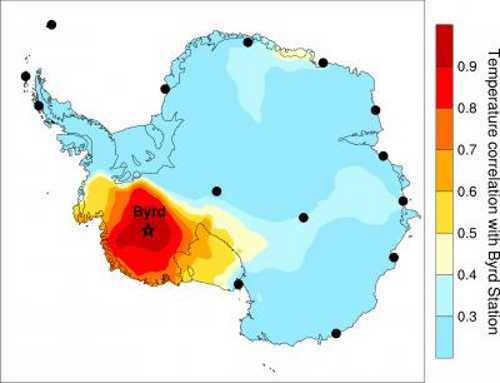
In a discovery that raises further concerns about the future contribution of Antarctica to sea level rise, a new study finds that the western part of the continent’s ice sheet is experiencing nearly twice as much warming as previously thought.
The temperature record from Byrd Station, a scientific outpost in the center of the West Antarctic Ice Sheet (WAIS), demonstrates a marked increase of 4.3 degrees Fahrenheit (2.4 degrees Celsius) in average annual temperature since 1958.
The rate of increase is three times faster than the average temperature rise around the globe for the same period.
The study will is published in the journal Nature Geoscience. It was conducted by scientists at Ohio State University (OSU), the National Center for Atmospheric Research (NCAR), and the University of Wisconsin-Madison, with funding coming from the National Science Foundation, which is NCAR’s sponsor.
“Our results indicate that temperature increases during the past half century have been almost twice what we previously thought, placing West Antarctica among the fastest warming regions on Earth,” said NCAR scientist Andrew Monaghan, a co-author. “A growing body of research shows that the West Antarctic Ice Sheet is changing at an alarming rate, with pressure coming from both a warming ocean and a warming atmosphere.”
This study reveals warming trends during the summer months of the Southern Hemisphere (December through February), notes co-author David Bromwich, professor of geography at OSU and senior research scientist at the Byrd Polar Research Center.
“Our record suggests that continued summer warming in West Antarctica could upset the surface mass balance of the ice sheet, so that the region could make an even bigger contribution to sea level rise than it already does,” Bromwich said. “Even without generating significant mass loss directly, surface melting on the WAIS could contribute to sea level indirectly by weakening the West Antarctic ice shelves that restrain the region’s natural ice flow into the ocean.”
Researchers consider the WAIS especially sensitive to climate change because the base of the ice sheet rests below sea level, making it vulnerable to direct contact with warm ocean water.
Its melting currently contributes 0.3 millimeters to sea level rise each year. This is second only to Greenland, whose contribution to sea level rise has been estimated as high as 0.7 mm per year.
Due to its location some 700 miles from the South Pole and near the center of the WAIS, conditions at Byrd Station are an important indicator of climate change throughout the region.
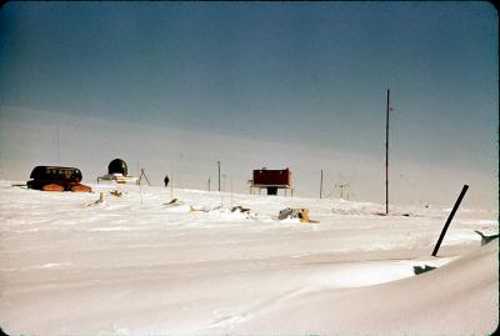
In the past, researchers haven’t been able to make much use of the Byrd Station measurements because of incomplete temperature observations.
Since its establishment in 1957, the station has not been occupied continuously. A year-round automated station was installed in 1980, but it has experienced frequent power outages, especially during the long polar night when its solar panels can’t recharge.
Monaghan and Bromwich realized the extent of the data gaps when they previously reconstructed the Antarctic-wide temperature record over the past half-century using station records from around the continent.
When the reconstruction was published in a 2008 paper, they noted that the incomplete Byrd record caused substantial uncertainty in their results.
The two scientists, working with colleagues at OSU and the University of Wisconsin-Madison, filled in the data gaps by using a powerful computer model of the atmosphere and a numerical analysis method.
In addition to offering a more complete picture of warming in West Antarctica, the new study shows for the first time that significant melt is occurring during summer.
Monaghan said the summertime warmth is particularly troubling because that is the season in which enhanced surface melting could most affect the WAIS and potentially weaken the ice shelves that buttress it.
“We’ve already seen enhanced surface melting contribute to the breakup of the Antarctic’s Larsen B ice shelf, where glaciers at the edge discharged massive sections of ice into the ocean that contributed to sea level rise,” he said. “The stakes would be much higher if a similar event occurred to an ice shelf restraining one of the enormous WAIS glaciers.”
“West Antarctica is one of the most rapidly changing regions on Earth, but it is also one of the least known,” said Bromwich. “Our study underscores the need for a reliable network of meteorological observations throughout West Antarctica, so that we can know what is happening – and why – with more certainty.”
- Details
- Written by: Lake County News reports
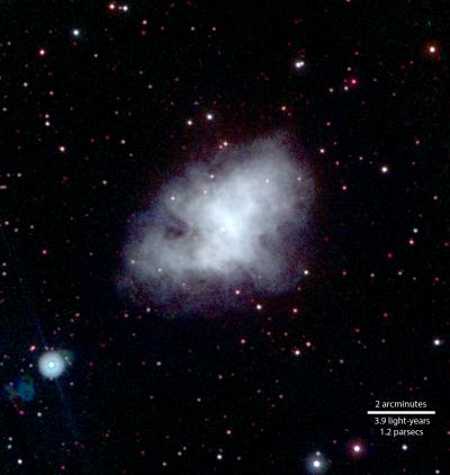
Of the three telescopes carried by NASA’s Swift satellite, only one captures cosmic light at energies similar to those seen by the human eye.
Although small by the standards of ground-based observatories, Swift’s Ultraviolet/Optical Telescope (UVOT) plays a critical role in rapidly pinpointing the locations of gamma-ray bursts (GRBs), the brightest explosions in the cosmos.
But as the proxy to the human eye aboard Swift, the UVOT takes some amazing pictures. The Swift team is celebrating eight years of UVOT operations by collecting more than 100 of the instrument’s best snapshots in a web-based photo gallery.
The images also can be viewed with the free Swift Explorer Mission iPhone app developed by the Swift Mission Operations Center (MOC), which is located in State College, Pa., and operated by Penn State.
Swift has detected an average of about 90 GRBs a year since its launch in 2004.
“When we aren’t studying GRBs, we use the satellite’s unique capabilities to engage in other scientific investigations, some of which produce beautiful images from the UVOT that we’re delighted to be able to share with the public,” said Michael Siegel, the lead scientist on the UVOT and a research associate in astronomy and astrophysics at the MOC.
The targets range from comets and star clusters to supernova remnants, nearby galaxies and active galaxies powered by supermassive black holes.
“One of our more challenging projects in the past was completing an ultraviolet mosaic of M31, the famous Andromeda galaxy,” said Stefan Immler, a member of the Swift team at NASA’s Goddard Space Flight Center in Greenbelt, Md. “Because the galaxy is so much larger than the UVOT field of view, we had to take dozens of pictures and blend them together to show the whole object.”
An ongoing mosaic project targets the Large and Small Magellanic Clouds, two small satellite galaxies orbiting our own, and makes the Andromeda effort look like child’s play.
Although the galaxies are much smaller than M31, they are both much closer to us and extend over much larger areas of the sky. The task involves acquiring and aligning hundreds of images and is far from complete.
With the UVOT’s wavelength range of 1,700 to 6,000 angstroms, Swift remains one of few missions that study ultraviolet light, much of which is blocked by Earth’s atmosphere.
The 6.5-foot-long (2 meter) UVOT is centered on an 11.8-inch (30 cm) primary mirror. Designed and built by the Mullard Space Science Laboratory in Surrey, England, the telescope module includes the primary and secondary mirrors, an external baffle to reduce scattered light, two redundant detectors – only one has been used to date – and a power supply.
Each detector lies behind an identical filter wheel. The wheel holds color filters that transmit a broad range of wavelengths as well as devices called grisms, which spread out incoming light in much the same way as a prism spreads sunlight into a rainbow of component colors.
The detectors retain information on the position and arrival time of each photon of light, an operating mode similar to typical X-ray telescopes.
Because most ultraviolet light never reaches the ground, Swift’s UVOT provides a unique perspective on the cosmos.
For example, it can measure the amount of water produced in passing comets by detecting the ultraviolet emission of hydroxyl (OH), one of the molecular fragments created when ultraviolet sunlight breaks up water molecules.
Other types of UVOT science include exploring emissions from the centers of active galaxies, studying regions undergoing star formation, and identifying some of the rarest and most exotic stars known.
Toward the end of its energy-producing life, a star like the sun will blow away its outer layers as its core transforms into a compact, Earth-sized remnant known as a white dwarf.
This chapter of stellar evolution, known to astronomers as the post-asymptotic giant branch phase, lasts only about 100,000 years – just an eye-blink in comparison to the star’s total lifetime. To better understand the process, astronomers need to study large numbers of these unusual stars.
“The UVOT’s capabilities give us a great tool for surveying stellar populations and cataloging rare types of ultraviolet-bright stars,” Siegel explained.
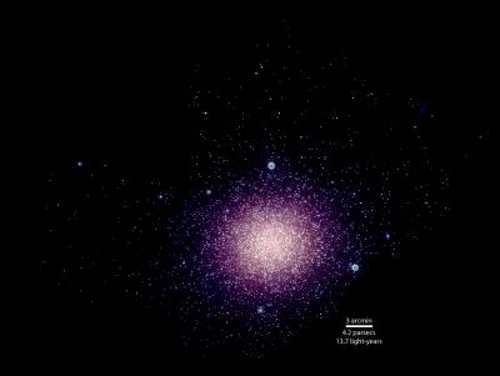
One of the first targets for the stellar survey was the giant cluster Omega Centauri, which hosts millions of stars and may be the remains of a small galaxy.
Thanks to Swift’s UVOT, astronomers at Goddard and Penn State have cataloged hundreds of rare stellar types in the cluster and are now comparing their properties and numbers to predictions from theoretical models describing how stars evolve.
- Details
- Written by: Elizabeth Larson
LUCERNE, Calif. – A water heater fire damaged a Lucerne home on Saturday night.
The fire, reported at about 6 p.m. Saturday, occurred in a singlewide mobile home in the 6400 block of 10th Avenue.
When Northshore Fire Protection District firefighters first arrived they reported seeing light smoke.
However, once they established there was an active fire at work, additional resources were called in from around the district, with Chief Jay Beristianos and Deputy Chief Pat Brown also responding.
Brown said the fire started in the water heater, then went under the home before running up into the attic.
Smoke was billowing out from under a secondary roof that had been built on the trailer. Firefighters had to use chainsaws and other tools to cut through that second roof roof in order to access the fire.
The home’s resident evacuated and was unhurt. Brown said Red Cross had been contacted to provide temporary housing.
Brown estimated damage in the range of around $20,000.
Email Elizabeth Larson at