 How to resolve AdBlock issue?
News
- Details
- Written by: Elizabeth Larson
LAKE COUNTY, Calif. – Forecasters are predicting that snow could fall in Lake County’s higher elevations on Wednesday.
On Christmas day the National Weather service issued a hazardous weather outlook for areas of Northern California including Lake County, warning of another winter storm moving over the region into Wednesday.
It is expected to bring more rain, along with mountain snow and gusty winds through Wednesday evening, with frost forecast for Thursday, chances of rain Friday and Saturday, and clear conditions for New Year’s Eve and New Year’s Day.
In the higher elevations in the northern part of Lake County, snow showers are forecast for Friday and Saturday, with clearing expected on Sunday, Monday and Tuesday.
Over the coming week, nighttime lows are anticipated to be in the mid 20s, with daytime highs in the mid 50s.
Email Elizabeth Larson at
- Details
- Written by: Elizabeth Larson
LAKEPORT, Calif. – This big sleek black cat, with some nifty stripes and big gold eyes, is waiting at Lake County Animal Care and Control for a new home.
During a recent visit he showed himself to be a friendly, attentive fellow. It’s been this writer’s experience that black cats are among the very nicest of felines, and make great pets.
He’s 3 years old, and has been neutered and vaccinated, so once an adoption application is approved he can head right out to his new home.
He is in cat room kennel No. 81, ID No. 35041.
To fill out an adoption application online visit http://www.co.lake.ca.us/Government/Directory/Animal_Care_And_Control/Adopt/Dog___Cat_Adoption_Application.htm .
Lake County Animal Care and Control is located at 4949 Helbush in Lakeport, next to the Hill Road Correctional Facility.
Office hours are Monday through Friday, 8 a.m. to 5 p.m., and 1 p.m. to 3 p.m., Saturday. The shelter is open from 10:30 a.m. to 4:30 p.m. Monday through Friday and on Saturday from 1 p.m. to 3 p.m.
Visit the shelter online at http://www.co.lake.ca.us/Government/Directory/Animal_Care_And_Control.htm .
For more information call Lake County Animal Care and Control at 707-263-0278.
Email Elizabeth Larson at
- Details
- Written by: Lake County News reports
A new report points to the need for continued efforts to prepare public health agencies across the nation to respond to public health emergencies, both natural and manmade.
In the 10th annual “Ready or Not? Protecting the Public from Diseases, Disasters, and Bioterrorism” report, 35 states and Washington, D.C. scored a six or lower on 10 key indicators of public health preparedness.
The report, issued by the Trust for America’s Health (TFAH) and Robert Wood Johnson Foundation (RWJF), showed that California scored a seven out of the 10 key indicators.
It found that while there has been significant progress toward improving public health preparedness over the past 10 years, particularly in core capabilities, there continue to be persistent gaps in the country’s ability to respond to health emergencies, ranging from bioterrorist threats to serious disease outbreaks to extreme weather events.
In the report, Kansas and Montana scored lowest – three out of 10 – and Maryland, Mississippi, North Carolina, Vermont and Wisconsin scored highest – eight out of 10.
“In the past decade, there have been a series of significant health emergencies, including extreme weather events, a flu pandemic and foodborne outbreaks,” said Jeffrey Levi, PhD, executive director of TFAH. “But, for some reason, as a country, we haven’t learned that we need to bolster and maintain a consistent level of health emergency preparedness. Investments made after Sept. 11, the anthrax attacks and Hurricane Katrina led to dramatic improvements, but now budget cuts and complacency are the biggest threats we face.”
The Ready or Not? report provides a snapshot of the nation’s public health emergency preparedness. Its indicators are developed in consultation with leading public health experts based on data from publicly available sources, or information provided by public officials. Some key findings from the report include:
- 29 states cut public health funding from fiscal years (FY) 2010-11 to 2011-12, with 23 of these states cutting funds for a second year in a row and 14 for three consecutive years. In addition, federal funds for state and local preparedness have decreased 38 percent from FY 2005-2012 (Centers for Disease Control and Prevention (CDC) funds, adjusted for inflation).
- States are reporting that gains in public health preparedness achieved in the past decade since September 11, 2001, are eroding, and since 2008, budget cuts have resulted in more than 45,700 job losses at state and local health departments;
- Only two states have met the national goal of vaccinating 90 percent of young children, ages 19-36 months, against whooping cough (pertussis). This year Washington state has seen one of the most significant whooping cough outbreaks in recent history;
- 35 states and Washington, D.C. do not currently have complete climate change adaptation plans, which include planning for health threats posed by extreme weather events;
- 20 states do not mandate all licensed child care facilities to have a multi-hazard written evacuation plan; and
- 13 state public health laboratories report they do not have sufficient capacity to work five, 12-hour days for six to eight weeks in response to an infectious disease outbreak, such as novel influenza A H1N1.
“Public health preparedness has improved leaps and bounds from where we were 10 years ago,” said Paul Kuehnert, MS RN Director of the Public Health Team at the Robert Wood Johnson Foundation. “But severe budget cuts at the federal, state and local levels threaten to undermine that progress. We must establish a baseline of ‘better safe than sorry’ preparedness that should not be crossed.”
The Ready or Not? report provides a series of recommendations that address many of the major gaps in emergency health preparedness, including:
- Reauthorize the Pandemic and All-Hazards Preparedness Act (PAHPA);
- Assure sufficient, dedicated funds for public health preparedness to ensure basic capabilities to respond to threats public health departments face every day and also to have the trained experts and systems in place to act quickly in the face of major, unexpected emergencies;
- Provide ongoing support to communities so they better cope and recover from emergencies;
- Modernize biosurveillance to a real-time, interoperable system to better detect and respond to problems;
- Seriously address antibiotic resistance;
- Improve research, development and manufacturing of medical countermeasures;
- Increase readiness for extreme weather events; and
- Update the nation’s food safety system.
For the state-by-state scoring, states received one point for achieving an indicator or zero points if they did not achieve the indicator. Zero is the lowest possible overall score, 10 is the highest. The data for the indicators are from publicly available sources or were provided from public officials.
- 8 out of 10: Maryland, Mississippi, North Carolina, Vermont and Wisconsin;
- 7 out of 10: Alabama, Arkansas, California, Delaware, Nebraska, New Hampshire, New Mexico, New York, North Dakota and Virginia;
- 6 out of 10: Connecticut, Idaho, Iowa, Kentucky, Louisiana, Maine, Massachusetts, Missouri, Ohio, Oklahoma, South Carolina, Tennessee, Utah, Washington and Wyoming;
- 5 out of 10: Alaska, Arizona, Washington, D.C., Florida, Illinois, Indiana, Michigan, Minnesota, Oregon, Pennsylvania, Rhode Island, South Dakota, Texas and West Virginia;
- 4 out of 10: Colorado, Georgia, Hawaii, Nevada and New Jersey;
- 3 out of 10: Kansas and Montana.
The full report can be seen below.
For more information, visit http://www.healthyamericans.org/ or http://www.rwjf.org/ .
December 2012 Ready or Not report- Details
- Written by: Glen Martin
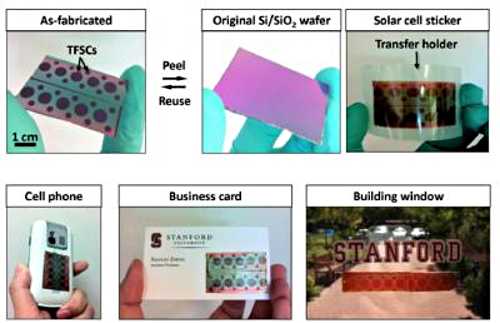
For all their promise, solar cells have frustrated scientists in one crucial regard – most are rigid. They must be deployed in stiff, often heavy, fixed panels, limiting their applications.
So researchers have been trying to get photovoltaics to loosen up. The ideal: flexible, decal-like solar panels that can be peeled off like band-aids and stuck to virtually any surface, from papers to window panes.
Now the ideal is real. Stanford researchers have succeeded in developing the world’s first peel-and-stick thin-film solar cells. The breakthrough is described in a paper in the December 20th issue of Scientific Reports.
Unlike standard thin-film solar cells, the peel-and-stick version from Stanford does not require any direct fabrication on the final carrier substrate.
This is a far more dramatic development than it may initially seem. All the challenges associated with putting solar cells on unconventional materials are avoided with the new process, vastly expanding the potential applications of solar technology.
Thin-film photovoltaic cells are traditionally fixed on rigid silicon and glass substrates, greatly limiting their uses, says Chi Hwan Lee, lead author of the paper and a PhD candidate in mechanical engineering.
And while the development of thin-film solar cells promised to inject some flexibility into the technology, explains Xiaolin Zheng, a Stanford assistant professor of mechanical engineering and senior author of the paper, scientists found that use of alternative substrates was problematic in the extreme.
“Nonconventional or ‘universal’ substrates are difficult to use for photovoltaics because they typically have irregular surfaces and they don’t do well with the thermal and chemical processing necessary to produce today’s solar cells,” Zheng observes. “We got around these problems by developing this peel-and-stick process, which gives thin-film solar cells flexibility and attachment potential we’ve never seen before, and also reduces their general cost and weight.”
Utilizing the process, Zheng continues, researchers attached their solar cells to paper, plastic and window glass among other materials.
“It’s significant that we didn’t lose any of the original cell efficiency,” Zheng said.
The new process involves a unique silicon, silicon dioxide and metal “sandwich.” First, a 300-nanometer film of nickel (Ni) is deposited on a silicon/silicon dioxide (Si/SiO2) wafer.
Thin-film solar cells are then deposited on the nickel layer utilizing standard fabrication techniques, and covered with a layer of protective polymer.
A thermal release tape is then attached to the top of the thin-film solar cells to augment their transfer off of the production wafer and onto a new substrate.
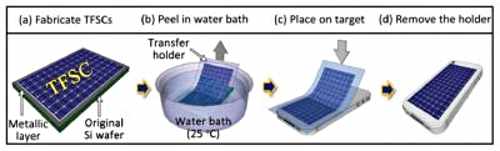
The solar cell is now ready to peel from the wafer. To remove it, the wafer is submerged in water at room temperature and the edge of the thermal release tape is peeled back slightly, allowing water to seep into and penetrate between the nickel and silicon dioxide interface. The solar cell is thus freed from the hard substrate but still attached to the thermal release tape.
Zheng and team then heat the tape and solar cell to 90°C for several seconds, then the cell can be applied to virtually any surface using double-sided tape or other adhesive. Finally, the thermal release tape is removed, leaving just the solar cell attached to the chosen substrate.
Tests have demonstrated that the peel-and-stick process reliably leaves the thin-film solar cells wholly intact and functional, Zheng said. “There’s also no waste. The silicon wafer is typically undamaged and clean after removal of the solar cells, and can be reused.”
While others have been successful in fabricating thin-film solar cells on flexible substrates before, those efforts have required modifications of existing processes or materials, noted Lee.
“The main contribution of our work is we have done so without modifying any existing processes, facilities or materials, making them viable commercially. And we have demonstrated our process on a more diverse array of substrates than ever before,” Lee said.
“Now you can put them on helmets, cell phones, convex windows, portable electronic devices, curved roofs, clothing – virtually anything,” said Zheng.
Moreover, peel-and-stick technology isn’t necessarily restricted to thin-film solar cells, Zheng said. The researchers believe the process can also be applied to thin-film electronics, including printed circuits and ultra thin transistors and LCDs.
“Obviously, a lot of new products – from ‘smart’ clothing to new aerospace systems – might be possible by combining both thin-film electronics and thin-film solar cells,” observed Zheng. “And for that matter, we may be just at the beginning of this technology. The peel-and-stick qualities we’re researching probably aren’t restricted to Ni/SiO2. It’s likely many other material interfaces demonstrate similar qualities, and they may have certain advantages for specific applications. We have a lot left to investigate.”
The authors of the Scientific Reports paper – “Peel-and-Stick: Fabricating Thin Film Solar Cell on Universal Substrates” – are Chi Hwan Lee, In Sun Cho and Xiaolin Zheng from Stanford’s Department of Mechanical Engineering, Dong Rip Kim from Hanyang University in Seoul, Korea, and Nemeth William and Qi Wang from the National Renewable Energy Laboratory in Denver, Colorado.
This article was written by Glen Martin, a freelance writer working for the Stanford University School of Engineering.