 How to resolve AdBlock issue?
News
- Details
- Written by: Lake County News reports
By combining the power of NASA’s Hubble and Spitzer space telescopes and one of nature’s own natural “zoom lenses” in space, astronomers have set a new record for finding the most distant galaxy seen in the universe.
The farthest galaxy appears as a diminutive blob that is only a tiny fraction of the size of our Milky Way galaxy. But it offers a peek back into a time when the universe was 3 percent of its present age of 13.7 billion years.
The newly discovered galaxy, named MACS0647-JD, was observed 420 million years after the big bang, the theorized beginning of the universe. Its light has traveled 13.3 billion years to reach Earth.
This find is the latest discovery from a program that uses natural zoom lenses to reveal distant galaxies in the early universe.
The Cluster Lensing And Supernova Survey with Hubble (CLASH), an international group led by Marc Postman of the Space Telescope Science Institute in Baltimore, Md., is using massive galaxy clusters as cosmic telescopes to magnify distant galaxies behind them. This effect is called gravitational lensing.
Along the way, 8 billion years into its journey, light from MACS0647-JD took a detour along multiple paths around the massive galaxy cluster MACS J0647+7015.
Without the cluster’s magnification powers, astronomers would not have seen this remote galaxy.Because of gravitational lensing, the CLASH research team was able to observe three magnified images of MACS0647-JD with the Hubble telescope.
The cluster’s gravity boosted the light from the faraway galaxy, making the images appear about eight, seven, and two times brighter than they otherwise would that enabled astronomers to detect the galaxy more efficiently and with greater confidence.
“This cluster does what no manmade telescope can do,” said Postman. “Without the magnification, it would require a Herculean effort to observe this galaxy.”
MACS0647-JD is so small it may be in the first steps of forming a larger galaxy. An analysis shows the galaxy is less than 600 light-years wide.
Based on observations of somewhat closer galaxies, astronomers estimate that a typical galaxy of a similar age should be about 2,000 light-years wide.
For comparison, the Large Magellanic Cloud, a dwarf galaxy companion to the Milky Way, is 14,000 light-years wide. Our Milky Way is 150,000 light-years across.
“This object may be one of many building blocks of a galaxy,”said the study’s lead author, Dan Coe of the Space Telescope Science Institute. “Over the next 13 billion years, it may have dozens, hundreds, or even thousands of merging events with other galaxies and galaxy fragments.”
The galaxy was observed with 17 filters,spanning near-ultraviolet to near-infrared wavelengths, using Hubble’s Wide Field Camera 3 (WFC3) and Advanced Camera for Surveys (ACS). Coe, a CLASH team member, discovered the galaxy in February while poring over a catalogue of thousands of gravitationally lensed objects found in Hubble observations of 17 clusters in the CLASH survey.But the galaxy appeared only in the two reddest filters.
“So either MACS0647-JD is a very red object, only shining at red wavelengths, or it is extremely distant and its light has been ‘redshifted’ to these wavelengths, or some combination of the two,” Coe said. “We considered this full range of possibilities.”
The CLASH team identified multiple images of eight galaxies lensed by the galaxy cluster. Their positions allowed the team to produce a map of the cluster’s mass, which is primarily composed of dark matter. Dark matter is an invisible form of matter that makes up the bulk of the universe’s mass.
“It’s like a big puzzle,” said Coe. “We have to arrange the mass in the cluster so that it deflects the light of each galaxy to the positions observed.”
The team’s analysis revealed that the cluster’s mass distribution produced three lensed images of MACS0647-JD at the positions and relative brightness observed in the Hubble image.
Coe and his collaborators spent months systematically ruling out these other alternative explanations for the object’s identity, including red stars, brown dwarfs, and red (old or dusty) galaxies at intermediate distances from Earth. They concluded that a very distant galaxy was the correct explanation.
The paper will appear in the Dec. 20 issue of The Astrophysical Journal.
Redshift is a consequence of the expansion of space over cosmic time. Astronomers study the distant universe in near-infrared light because the expansion of space stretches ultraviolet and visible light from galaxies into infrared wavelengths. Coe estimates MACS0647-JD has a redshift of 11, the highest yet observed.
Images of the galaxy at longer wavelengths obtained with the Spitzer Space Telescope played a key role in the analysis. If the object were intrinsically red, it would appear bright in the Spitzer images. Instead, the galaxy barely was detected, if at all, indicating its great distance. The research team plans to use Spitzer to obtain deeper observations of the galaxy, which should yield confident detections as well as estimates of the object’s age and dust content.
MACS0647-JD galaxy, however, may be too far away for any current telescope to confirm the distance based on spectroscopy, which spreads out an object’s light into thousands of colors.
Nevertheless, Coe is confident the fledgling galaxy is the new distance champion based on its unique colors and the research team’s extensive analysis.
“All three of the lensed galaxy images match fairly well and are in positions you would expect for a galaxy at that remote distance when you look at the predictions from our best lens models for this cluster,” Coe said.
The new distance champion is the second remote galaxy uncovered in the CLASH survey, a multi-wavelength census of 25 hefty galaxy clusters with Hubble’s ACS and WFC3.
Earlier this year, the CLASH team announced the discovery of a galaxy that existed when the universe was 490 million years old, 70 million years later than the new record-breaking galaxy. So far, the survey has completed observations for 20 of the 25 clusters.
The team hopes to use Hubble to search for more dwarf galaxies at these early epochs. If these infant galaxies are numerous, then they could have provided the energy to burn off the fog of hydrogen that blanketed the universe, a process called re-ionization. Re-ionization ultimately made the universe transparent to light.
- Details
- Written by: Elizabeth Larson
COBB, Calif. – A Friday night fire did significant damage to a Cobb home.
The fire at 9466 Pamela Drive was first reported at about 7:30 p.m., according to radio reports.
South Lake County Fire Battalion Chief Greg Bertelli said when firefighters with Cal Fire and South Lake County Fire arrived at the two and a half story home, it already was fully involved.
“There were exposure problems with other structures in the area,” he said.
The home was occupied but the residents were able to get out uninjured, Bertelli said.
Bertelli said firefighters did an interior attack to get the fire under control.
“It ran across the attic pretty quickly,” Bertelli said.
Altogether, it took about an hour to knock down the fire. Bertelli said the house sustained significant damage to the roof, half of which was burned off, and the upper stories.
Shortly after 10:30 p.m., Bertelli estimated firefighters would be involved in mop up for another three hours.
He said the fire’s cause is under investigation.
Firefighters were helping the home’s renters remove their personal belongings. Bertelli said the displaced residents had housing arrangements set up for the night.
Email Elizabeth Larson at
- Details
- Written by: Lake County News reports
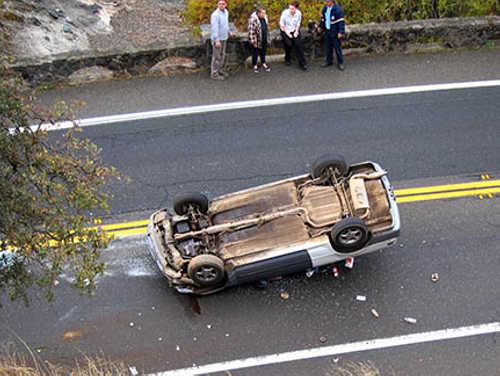
CLEARLAKE OAKS, Calif. – A vehicle overturned on Highway 20 on Friday morning, blocking a portion of the roadway.
The crash was reported at 8:46 a.m. on Highway 20 at Hillside Lane, according to witnesses and the California Highway Patrol.
The overturned vehicle was blocking the westbound lane, the CHP said.
A witness said the female driver was pulled from the wreck and appeared to be all right.
Information was not immediately available as to what injuries, if any, the driver suffered.
- Details
- Written by: Elizabeth Larson
LAKEPORT, Calif. – At the end of another full day of testimony in the double-homicide trial of a former Maine resident, the judge on Thursday afternoon denied a mistrial motion that had been pending since the proceedings began last week.
Defense attorney Stephen Carter filed the motion last week on behalf of his client, 32-year-old Robby Alan Beasley, accused of shooting to death Frank Maddox, 32, and his wife, Yvette, 40, of Augusta, Maine, along the side of Morgan Valley Road on Jan. 22, 2010.
Carter’s motion resulted from prejudicial statements made on the first day of trial Nov. 7 by 30-year-old Elijah Bae McKay, Beasley’s alleged accomplice.
Judge Andrew Blum had heard arguments last week both by Carter and prosecutor Art Grothe on the mistrial motion and then took time to review additional case law. He ruled Thursday that the trial could move forward.
Beasley allegedly believed the Maddoxes – who he had invited to California to work for him in his marijuana growing and trafficking business – had stolen marijuana from his apartment, which allegedly formed the motive to kill them.
Likewise, Beasley had been invited to California by McKay, who he had grown up with in Maine. McKay, who has not yet stood trial, is facing murder charges as well, and is accused of being Beasley’s accomplice, having provided him with the 9 millimeter handgun and ammunition allegedly used in the murders.
McKay, however, has testified to believing that Beasley was only going to get the couple to give him a ride to the airport, and intended to stop along the way, interrogate them and get them to admit the theft. Beasley would tell him that the situation changed and he shot both of the Maddoxes in the head after a confrontation.
During a rambling narrative on Nov. 7, McKay had stated, “and you know, I’ve known Robby for a long time and he’s talked about killing people before and he’s never done it,” according to the transcript of the statement Blum read Thursday afternoon.
Blum said there is the potential for prejudice from that statement, but the presumption under the law is that such prejudice can be cured in most cases.
“The statement by itself, if left alone, could be seen as very prejudicial,” Blum said, adding, “But we didn’t leave it at that.”
Jurors were admonished twice that McKay had improperly volunteered the information. “I think with that clarification made to the jury, they know that it’s not serious,” Blum said.
Blum said he hadn’t found a single published case that held such statements were incurable when their triviality was explained to a jury.
“I have no doubt whatsoever that they can set this aside,” said Blum, noting he also had asked the jury if they had understood his admonitions, and they said they they understood.
“For all those reasons the mistrial motion is denied,” he said.
McKay testimony continues Thursday
McKay has continued to testify intermittently since the trial began last week, with the prosecution having to interrupt his testimony in order to allow for the other witnesses who have been scheduled to come to the stand.
When McKay’s testimony resumed Thursday morning, Carter continued his questioning about the marijuana growing business that McKay and Beasley had been involved in at the time of the murders.
Beasley had worked for McKay at his marijuana garden on Morgan Valley Road and also had grown clones in an apartment in Lower Lake, the proceeds of which he split with McKay.
Carter also reviewed with him details of conversations he had with Beasley about trying to scare the Maddoxes in the days before the murder. Beasley was to tell the couple that his grandmother died and he needed to return to Maine, so he needed a ride to the airport, with McKay to pick him up after he confronted them.
“I didn’t think it would ever work,” said McKay, who recalled that Beasley had only talked of killing the couple during a conversation on Jan. 20, 2010. Beasley had marijuana stolen from the Lower Lake apartment sometime during the previous 10 days, McKay said.
A difficult witness
During the morning session, Ryan Gilman, who had been a neighbor of Beasley’s at the Lower Lake apartments, took the stand. He had lived at the apartments full-time and then part-time while he traveled to the Mt. Shasta area for work.
“We didn't get along too well,” Gilman said of he and Beasley.
He said he had been out of town at the time of the marijuana theft, and there was “no possible way” he could have been involved.
Gilman was asked by Carter to draw a diagram of the apartment complex after Gilman had pointed out that a diagram McKay had made on Wednesday was wrong.
Gilman proved at times a frustrated and frustrating witness, getting upset about questions about his past and if he had been conducting a marijuana business. He said he had grown six plants.
After the lunch break, with McKay back on the stand, Carter asked him to draw a diagram of Morgan Valley Road, and where his home was in relation to where Beasley shot the Maddoxes and left their bodies.
On the day of the murders, McKay was at his brother’s birthday party in Clearlake when he got a call from Beasley asking him to pick him up near a gate on Morgan Valley Road. When they spoke, Beasley made a point of saying that “it hadn’t gone as it should have.”
McKay said when he pulled over on Morgan Valley Road, Beasley came running toward his Range Rover. “He was very distressed looking and his eyes were big,” said McKay, adding that Beasley was “freaking out.”
Beasley told McKay that he had shot the couple and afterward, “He made the comment he was going to go to hell,” McKay said.
Considered a danger
Beasley refused to bury the bodies after seeing passing vehicles. McKay said it wasn’t until the next morning, when they moved the Maddoxes’ pickup down toward Middletown, that Beasley gave him the full story.
Carter asked him if he had been glad the couple was dead. “I wasn’t glad they were dead but I felt safer,” he replied. He felt they had become dangerous to his family, which included his circle of close friends – among them Beasley, who he said was like a brother to him.
McKay recalled driving Beasley home from dropping off the Maddoxes’ pickup. He told Beasley he was angry about how things had unfolded and wanted to know what happened.
“He basically tried to make his case on why it was all right that he shot them and why he had to,” McKay said.
Beasley told McKay that he shot the couple after he pulled them from the truck and they refused to answer his questions. He then shot Frank Maddox in the leg, Yvette Maddox fainted, and Frank Maddox told Beasley he would kill him if he didn’t finish him off.
According to McKay, Beasley then shot Frank Maddox in the head before shooting his wife. He drug them down a nearby embankment, and when he saw they were still alive, shot them both in the head one more time.
Beasley would offer McKay $20,000 to go back and bury them. “I don’t need money that bad,” said McKay.
In the days afterward, McKay would continue to ask Beasley if he buried the couple, but Beasley refused to go back.
Carter asked McKay if his life then proceeded as normal. “If you can call the life I live normal,” McKay said.
He recalled going into town in early March and seeing the newspaper, with the front page story about the Maddoxes’ bodies being discovered. He went to Beasley’s home to angrily show him the paper.
McKay also answered questions about the immunity agreement he has with the District Attorney’s Office to testify. Any new information he gives won’t be used against him, but he has not been promised a deal in exchange for his testimony.
“For all I know, I’m screwed,” he said.
After he was arrested in late 2010, McKay said he was told by his attorney at the time that his girlfriend was going to be arrested and their young son put into the care of Child Protective Services if he didn’t come clean.
Carter asked him if he killed the Maddoxes. “If I killed the Maddoxes we wouldn’t be here right now,” he said, adding that, no, he didn’t, nor did he take part in a conspiracy to murder them.
Late on Thursday, outside of the jury’s presence, testimony was given by jail staff about a drawing Beasley is alleged to have sent a couple he knew that Grothe said had threatening overtones. It suggested they were going to jail and said, “Don't lie … liar.”
Blum decided to exclude that evidence but agreed to wait until Friday morning to get more information from the prosecution in order to determine if he would allow testimony from a correctional officer who found the words, “Elijah McKay is a rat punk bitch snitch New England” scratched on the painted metal door of Beasley’s jail cell.
Blum released the jury shortly before 4 p.m. and asked jurors return at 9 a.m., when testimony is set to resume.
Email Elizabeth Larson at