How to resolve AdBlock issue?
Refresh this page
How to resolve AdBlock issue?
Refresh this page
Lake County News,California
  • Home
    • Registration Form
  • News
    • Community
      • Obituaries
      • Letters
      • Commentary
    • Education
    • Veterans
    • Police Logs
    • Business
    • Recreation
    • Health
    • Religion
    • Legals
    • Arts & Life
    • Regional
  • Calendar
  • Contact us
    • FAQs
    • Phones, E-Mail
    • Subscribe
  • Advertise Here
  • Login
How to resolve AdBlock issue?
Refresh this page
How to resolve AdBlock issue?
Refresh this page

News

California firefighters quickly respond to lightning storms

With the lightning storm that passed through the state July 13 to 15, California sustained 7,139 lightning strikes.

Anticipating the incoming storms, the USDA Forest Service had pre-positioned resources throughout the state.

These resources were able to quickly respond to initial attack fires, resulting in a successful response rate of 94%.

In this three-day period, the Forest Service and its cooperators responded to 97 fires on Forest Service lands. Only six new fires from this storm went into extended attack.

Given the extremely dry, record-setting fuel conditions where much of the lightning struck, fire officials said this success rate stands out as a significant achievement for California.

Initial attack response was also aided by readily available staff, quick detection technologies, and intermittent cloud cover with rain.

“Over the past few days, our firefighters have been able to aggressively respond to fires that resulted from this lightning storm. The ability to maintain readiness for emerging initial attack fires is critical, even when we have large ongoing fires in the state,” said Pacific Southwest Region Fire Director Jaime Gamboa.

An additional 412 resources were brought into the state to assist with California’s wildland fire response.

On the Mendocino National Forest, fire restrictions went into effect on July 3 and will remain in force through the end of this year’s fire season.

The Forest Service said it remains at the ready during these critical summer months, to respond to emerging wildland fires across the state.
Details
Written by: Lake County News reports
Published: 18 July 2024

California invests in apprenticeships for opportunity youth

Gov. Gavin Newsom on Wednesday announced that the Department of Industrial Relations awarded $31 million in California Opportunity Youth Apprenticeship, or COYA, grants to 51 projects across the state to increase pre-apprenticeships and apprenticeships in healthcare, education, advanced manufacturing, information technology, public sector, transportation and more.

“California is committed to helping disadvantaged youth prepare for high-quality careers. Through our nation-leading career education efforts, we’re boosting apprenticeships throughout the state and across industries to help young people launch into the right career for them,” said Gov. Newsom.

These apprenticeships will help break career barriers for opportunity youth across California, helping them launch into their future careers.

Opportunity youth include those aged 16 to 24, including young parents, former foster youth, people with disabilities, and young people who face educational achievement gaps, attend schools in communities struggling with high poverty, or are fully disconnected from the education system.

COYA will also ensure employers are supported and encouraged to hire young workers based on their talent and skills.

The state is working to ensure all Californians have the freedom to succeed through investments like this that help young people learn skills to obtain high-quality, fulfilling careers.

This program is in alignment with the Governor’s Master Plan for Career Education, which will include proposals to align and simplify the TK-12, university, and workforce systems in California to support greater access to education and jobs for all Californians.

Learn more about the COYA grants here.
Details
Written by: LAKE COUNTY NEWS REPORTS
Published: 18 July 2024

Let the forecasting games begin: International weather organizations collaborate to keep athletes safe and improve forecasts

As athletes worldwide prepare for the Paris 2024 Olympics, the best of the best in weather research are also gearing up for a friendly competition.

Several international weather research and forecasting organizations will collaborate to provide high-resolution forecast information for Olympics organizers as well as test the capabilities of experimental air quality and weather forecasting models.

The collective forecasts from the participating nations may guide the organizers’ decisions about when actions should be taken to protect athletes from conditions like extreme heat and/or air pollution.

A substantial number of weather data-collecting instruments will be deployed across Paris during the Olympics and Paralympics for these forecasts.

The extensive data collection also provides researchers with a unique opportunity to test the accuracy of models being developed to predict heat, thunderstorms and air quality in complex urban areas.

Researchers from the U.S. National Science Foundation National Center for Atmospheric Research, or NSF NCAR, will participate in this research demonstration project, which was proposed by Météo-France, France’s national weather service, and approved by the World Meteorological Organization, or WMO.

“All the different agencies will compare notes and learn from one another and maybe it will be a little competitive too,” said Scott Swerdlin, an NSF NCAR program director who is overseeing the organization’s role in the project. “People feel passionate about their models and there are fierce debates about whether different model attributes are superior to others, but in the end this will be a learning experience for everyone.”

Complexities of urban forecasting

Modeling and predicting weather in urban areas is complicated. Buildings interact with the natural environment to create microclimates.

For example, the way the sun hits a building can make it hotter on one side of a building, which in turn affects the flow of winds and air quality. Capturing the effects of all the structures in a heavily populated city is challenging.

To address this, NSF NCAR scientists will use an ensemble modeling approach, which averages multiple forecasts to provide predictions that are statistically more likely to represent the real world. The ensemble is computationally intensive, requiring the use of NSF NCAR’s supercomputer, Derecho. The scientists will utilize the Weather Research and Forecasting model coupled with Chemistry (WRF-Chem) for their weather and air quality predictions.

“We’re excited to be contributing to this international collaboration, and we’re definitely pushing ourselves beyond what is required for the model intercomparison exercise,” said NSF NCAR scientist Hailey Shin. “We are really curious about answering our own research questions on the prediction accuracy and uncertainty of our high-resolution coupled weather-air quality models as we test the sensitivity of our models to our algorithms that represent the real effects of urban buildings, air pollutant emissions, etc.”

For the project, each international organization will provide 36-hour weather forecasts modeled at a prescribed resolution of 100 meters so there is a common base for comparison of results. This means that, for every 100 meters, the participating agencies will provide a prediction for temperature, humidity, winds, and pressure.

For air quality forecasts, most of the participating groups will model at 3-kilometer resolution, but NSF NCAR scientists will zoom in to provide more detailed information. They will model primary fine particulate matter (PM2.5), which are tiny particles found in smoke and haze that can wreak havoc on the lungs and respiratory system, and carbon monoxide at 111-meter resolution, which is a very fine scale for running WRF.

“Air quality is an issue for elite athletes, especially since they are breathing the air at a faster rate when they compete. Hot and polluted air can lead to dehydration and there could also be combined effects of heat and humidity,” said NSF NCAR scientist Rajesh Kumar. “Beyond the Olympics, nearly 80 percent of the world's population will be living in urban areas by the 2050s. It is very important for us to have modeling capabilities that work well in these areas so that they can play a part in ensuring urban sustainability.”
Details
Written by: U.S. National Science Foundation National Center for Atmospheric Research
Published: 18 July 2024

Nutrition Facts labels have a complicated legacy – a historian explains the science and politics of translating food into information


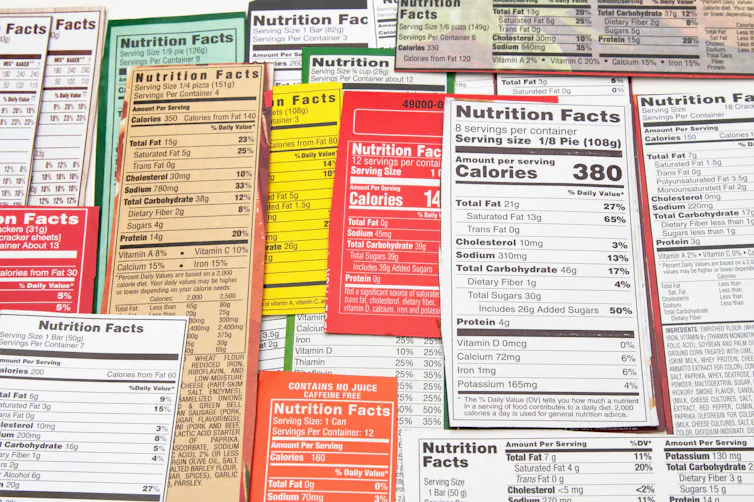
The Nutrition Facts label is designed to meet shifting dietary trends and public health goals. NoDerog/iStock via Getty Images Plus

The Nutrition Facts label, that black and white information box found on nearly every packaged food product in the U.S. since 1994, has recently become an icon for consumer transparency.

From Apple’s “Privacy Nutrition Labels” that disclose how smartphone apps handle user data, to a “Garment Facts” label that standardizes ethical disclosures on clothing, policy advocates across industries invoke “Nutrition Facts” as a model for empowering consumers and enabling socially responsible markets. They argue that intuitive information fixes could solve a wide range of market-driven social ills.

Yet this familiar, everyday product label actually has a complicated legacy.

I study food regulation and diet culture and became interested in the Nutrition Facts label while researching the history of Food and Drug Administration policies on food standards and labeling. In 1990, Congress passed the Nutrition Labeling and Education Act, mandating nutrition labels on all packaged foods to help address growing concerns about rising rates of chronic illnesses linked to unhealthy diets. The FDA introduced its “Nutrition Facts” panel in 1993 as a public health tool that empowered consumers to make healthier choices.

The most obvious purpose of the Nutrition Facts label is for consumers to learn the nutritional properties of a food. In practice, however, this label has done much more than simply inform shoppers. It also encodes a wide range of political and technical compromises about how to translate food into nutrients that meet the diverse needs of the American public.

Where do “% Daily Values” come from?

The daily value, or DV, percentages on the label don’t all come from the same source. This is a reflection of differing public health targets for the label.

Recommended values for micronutrients like vitamins are based on Recommended Dietary Allowances, or RDAs, from the National Academies of Sciences Engineering and Medicine. Vitamin RDAs were developed out of historical concerns with undernourishment and meeting minimum needs.

Daily value percentages for macronutrients – carbs, fats and proteins – are based on U.S. Department of Agriculture Dietary Guidelines. DVs for macronutrients registered a new concern about overeating and a focus on “negative nutrition” encouraging maximum intake levels.

DVs reflect two fundamentally different causes for concern. The numbers for micronutrients represent a floor: the basic minimum vitamin needs a child should meet to avoid malnutrition. The numbers for macronutrients, on the other hand, are a ceiling: a target maximum limit that adults should avoid surpassing if they want to prevent future health problems caused by eating too much high sodium or fatty food.

Annotated Nutrition Facts label, highlighing serving information, calories, nutrients and percent daily value
Each component of the Nutrition Facts label is based on data and decisions from various sources. Food and Drug Administration

Why 2,000 calories?

The FDA almost used 2,350 calories as the baseline for calculating daily values, because it was the recommended population-adjusted average caloric need for Americans ages four and older. But after pushback from health groups concerned the higher baseline would encourage overconsumption, the FDA settled on 2,000 calories.

FDA officials felt this figure was less likely to be “misconstrued as an individualized goal since a round number has less implied specificity.” This means 2,000 calories is not actually a target for most American consumers reading the label. Instead, it is an example of the public health preoccupation with collective risk – what one scientist called “treating sick populations not sick individuals.”

By choosing a round number that was easy to do math with, and a calorie count below the average American’s, FDA officials were favoring practicality and utility over accuracy and objectivity. Advocating for the lower 2,000 calorie baseline, they reasoned, would offset Americans’ tendency to overeat and do more good than harm for the population overall.

Who determines serving sizes?

According to the Nutrition Labeling and Education Act of 1990, serving sizes should reflect “an amount customarily used.”

In practice, this involves routine negotiations between the FDA, U.S. Department of Agriculture – which also sets serving sizes for dietary guidance tools like the MyPlate – and food manufacturers. Each conducts research on consumer expectations and food consumption data, taking into consideration how a food is prepared and “typically eaten.”

Serving sizes are also determined by product packaging. For example, a soda can is generally considered a single-serving container and therefore just one serving, regardless of how many fluid ounces it contains.
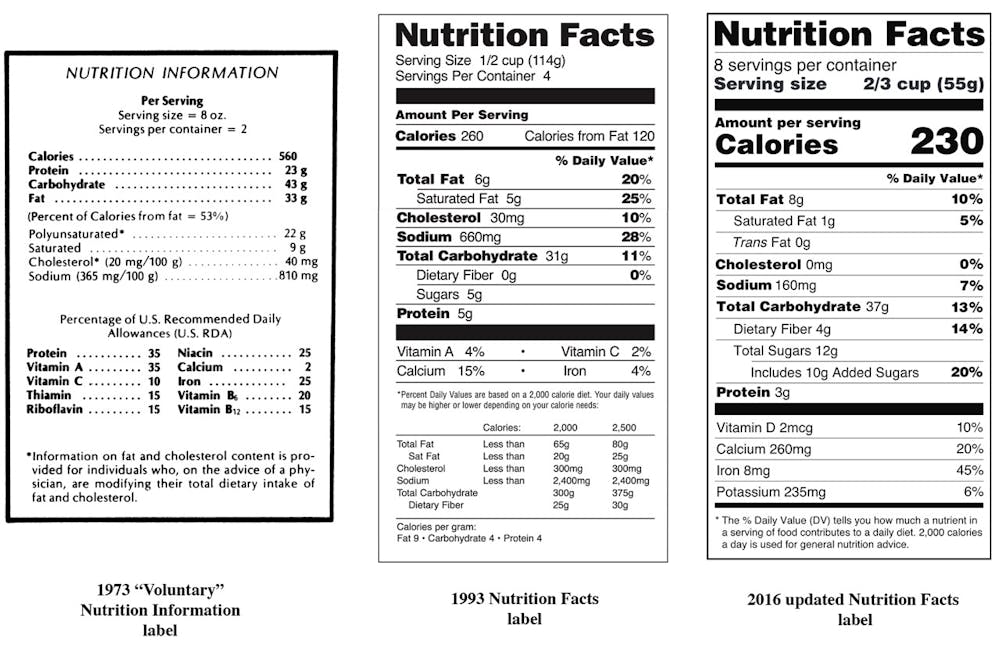
Comparison of the 1973, 1993 and 2016 versions of the Nutrition Facts label, each with slightly different design and information
Changing public health goals have shaped the Nutrition Facts label over time. In the 1970s, the FDA framed itself as a neutral information broker. The ‘war against heart disease’ in the 1980s placed an emphasis on saturated fat and cholesterol. And the 2010s saw increased focus on added sugars, ‘good fats’ and total calories. Xaq Frohlich

What’s in a name?

The label was almost called “Nutrition Values” or “Nutrition Guide” to highlight that Daily Values were recommendations. Then FDA Deputy Commissioner Mike Taylor proposed “Nutrition Facts” to sound more legally neutral and scientifically objective.

The new design – a staid, black Helvetica text against a white background, using indented subgroups and hairlines for readability – and the authoritative boldface title helped establish “Nutrition Facts” as an easily recognized government brand.

This led to imitators in other policy arenas: first “Drug Facts” for over-the-counter medicines, then consumer protection initiatives in various tech industries, such as Federal Communications Commission “Broadband Facts” and “AI Nutrition Facts.”

The Nutrition Facts panel has remained largely consistent since the 1990s, despite some updates like adding lines for trans fats in 2002 and for added sugars in 2016 to reflect evolving public health priorities.

New ways to calculate the facts

Establishing the Nutrition Facts label required building an entirely new technical infrastructure for nutrition information. Translating the diverse American diet into a consistent set of standardized nutrients necessitated new measures, testing procedures and standard references.

Triangle divided into nine smaller triangles, each labeled with an icon of food based on its nutrient content -- 100% fat at the apex, 100% carbohydrates on the left-most point, 100% protein at the right-most point
The AOAC organized food based on fat, protein and carbohydrate content. National Institute of Standards and Technology

A key player in developing that technical infrastructure was the Association of Official Analytical Chemists. In the early 1990s, an AOAC Task Force developed a food triangle matrix dividing foods into categories based on their proportions of carbs, fats and protein. The intention was to determine appropriate ways to measure nutritional properties like the amount of calories or sugars, as the food’s physical properties would affect how well each test worked.

Legacy of the Nutrition Facts label

Today, public-private collaborations have taken this translation of foods into simplified nutrient profiles further by making nutrition facts plug-and-play. The USDA FoodData Central provides a comprehensive database of nutrient profiles for individual ingredients that manufacturers use to calculate Nutrition Facts for new packaged foods. This database also powers many diet and nutrition apps.

The analytic tools developed for the Nutrition Facts label helped create the basic information infrastructure for today’s digital diet platforms. But critics argue these databases reinforce an overly reductionist view of food as simply the sum of its nutrients, ignoring how the different forms a food takes – such as its moisture, fibrous materials or porous structures – affect the way the body metabolizes nutrients.

Indeed, many nutrition researchers concerned about the negative health effects of ultra-processed foods now talk of a food matrix to emphasize precisely the opposite of what the AOAC sought with its food triangle: a need for a holistic understanding of how food shapes health.

Surprisingly, the Nutrition Facts label’s greatest impact may have been driving the food industry to reformulate products to achieve appealing nutrient profiles – even if consumers weren’t closely reading the labels. While envisioned as an education tool, I believe the Nutrition Facts label in practice has worked more like a market infrastructure, reshaping the food supply to meet shifting dietary trends and public health goals long before consumers find those foods at the supermarket.The Conversation

Xaq Frohlich, Associate Professor of History of Technology, Auburn University

This article is republished from The Conversation under a Creative Commons license. Read the original article.

Details
Written by: Xaq Frohlich, Auburn University
Published: 18 July 2024
  1. Clearlake woman charged with murder for July 10 shooting
  2. Victims of fatal crashes identified
  3. How to protect your home from wildfires – here’s what fire prevention experts say is most important

Subcategories

Community

  • 605
  • 606
  • 607
  • 608
  • 609
  • 610
  • 611
  • 612
  • 613
  • 614
How to resolve AdBlock issue?
Refresh this page