 How to resolve AdBlock issue?
News
- Details
- Written by: Elizabeth Larson
LAKE COUNTY, Calif. – The fields of candidates for fall city council races in Lakeport and Clearlake are starting to form.
The two city councils will each have three seats on the Nov. 6 ballot.
Clearlake City Clerk Melissa Swanson and Lakeport City Clerk Janel Chapman both reported on Friday that, because at least one incumbent in each of the races is not seeking reelection, the Friday deadline for filing was extended to 5 p.m. Wednesday, Aug. 15.
In Clearlake, Judy Thein and Curt Giambruno have said they will not run. In Lakeport, Roy Parmentier did not take out papers to seek reelection.
As of Friday, Swanson said five people had qualified for the November council race – incumbent Joyce Overton, business owners Denise Loustalot and Melinda Young, Bunnie Carter and Bruno Sabatier.
In Lakeport, Chapman said candidates who had qualified included incumbents Bob Rumfelt and Suzanne Lyons, businessman Kenny Parlet and former planning commissioner Marc Spillman.
City residents still wanting to get a place on the ballot can contact Swanson at 707-995-8201, Extension 106, or Chapman at 707-263-5615, Extension 12, for the appropriate documents and information.
Email Elizabeth Larson at
- Details
- Written by: Lake County News reports
LAKE COUNTY, Calif. – The role of assistance dogs in communities around the world has been the focus of a celebration this week.
International Assistance Dog Week began Sunday, Aug. 5, and ends Saturday, Aug. 11.
Marcie Davis, a paraplegic and author of “Working Like Dogs: The Service Dog Guidebook,” is credited with establishing the annual celebration, created to recognize of all the devoted, hardworking assistance dogs helping individuals mitigate their disability-related limitations.
“Assistance dogs transform the lives of their human partners with debilitating physical and mental disabilities by serving as their companion, helper, aide, best friend and close member of their family,” according to the event’s Web site, www.assistancedogweek.org .
International Assistance Dog Week not only honors the hardworking canines but is meant to increase public awareness about the dogs and those who raise and train them.
Canine Companions for Independence, based in Santa Rosa, is the largest assistance dog organization in the world, and has produced several assistance dogs that came to Lake County, including Nasa and Patch, who have made their homes with John and Katie Eels.
CCI’s most recent graduate to arrive in Lake County is Eddie. He and his handler, Mike Curran, celebrated their graduation from the program on May 18, as Lake County News has reported.
Since graduation, Curran and Eddie have been busy meeting community members and groups, taking part in followup training at CCI, attending training for pet therapy certification in local convalescent facilities, Sutter Lakeside and Hospice Services of Lake County, and participating in a hospice grief camp.
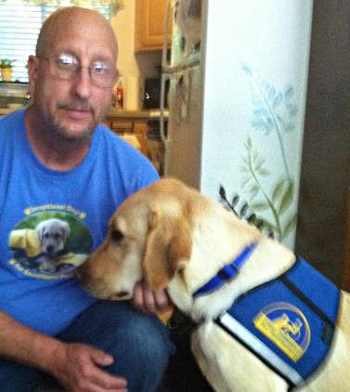
In June they participated in a California District Attorney's Association Training, with the Courthouse Dogs Program a topic of training and several CCI other dogs were in attendance.
“Eddie and I also helped with a presentation on Courthouse Dogs to the Napa County District Attorney's Office as they are pursuing a Facility Use Dog for interviewing kids and the elderly,” Curran said.
Curran, who retires Aug. 18 after 33 years with the Lake County Sheriff’s Office, will begin as a volunteer Lake County District Attorney’s Office reserve investigator on Sept. 4. He said Eddie will assist him in interviews being done with children and the elderly at the Children's Interviewing Center. They will work 20 hours a week will be spent at the District Attorney’s Office.
At the end of September, “Reading with Rover” – a special literacy program that encourages children to read to specially trained dogs – will be coming to Lakeport Elementary and starting Oct. 1 it will start at Kelseyville Elementary.
Eddie and Curran will spend 20 hours a week working in local schools in the Reading With Rover program as well as visiting special education and kindergarten classes. Curran said the children will get to help with Eddie's grooming by brushing his coat and his teeth.
Curran and his new partner also will work as ambassadors for CCI, and will do presentations or appearances for any organization that requests them.
For more information about CCI, visit http://www.cci.org . For more about Reading With Rover, www.readingwithrover.org/default.asp .
- Details
- Written by: Lake County News reports
Dr. Ron Chapman, director of the California Department of Public Health (CDPH), is warning Californians to protect themselves against heat-related illness as parts of the state are expected to experience some of the hottest weather since the extreme heat of 2006.
The National Weather Service predicts that California’s excessive heat wave will continue for the next several days.
Lake County’s daytime temperatures are predicted to be over 100 degrees through Monday, and rolling back slightly into the 90s the rest of the week.
“Illnesses due to prolonged exposure to extreme heat can be very serious, especially in the elderly and young,” Chapman said. “It's important to drink lots of water, keep cool and take other precautions when temperatures rise.”
Warning signs of heat exhaustion vary, but may include heavy sweating, muscle cramps, weakness, headache, nausea or vomiting, paleness, tiredness or dizziness.
Chapman said people can prevent heat-related illnesses by following these helpful tips to stay cool this summer.
- Reduce exposure to the sun from 10 a.m. to 4 p.m. when UV rays are strongest, and keep physical activities to a minimum during that time. When working outside, drink plenty of water or juice even if you are not thirsty, and take rest breaks in the shade.
- Wear a wide-brimmed hat to cover the face and neck, and wear loose-fitting clothing to keep cool and to protect your skin from the sun and mosquitoes.
- Wear sunglasses that provide 100 percent UVA and UVB protection. Chronic exposure to the sun can cause cataracts, which left untreated, can lead to blindness.
- Liberally apply sunscreen (at least SPF 15) 15 minutes before venturing outdoors and re-apply at least every two hours – sunscreen prevents skin cancer, the number one cancer affecting Californians. Sunscreen also prevents premature aging.
- Never leave infants, children or frail elderly unattended in a parked car – it can take as little as 10 minutes for the temperature inside a car to rise to levels that can kill.
- To prevent overheating, use cool compresses, misting, showers and baths. Get medical attention if you experience a rapid, strong pulse, feel delirious, or have a body temperature above 102.
For more information, go to CDPH’s Preventing Summer Heat Injuries page at www.cdph.ca.gov .
- Details
- Written by: Dr. Tony Phillips

Anyone who has ever seen a noctilucent cloud or “NLC” would agree: They look alien. The electric-blue ripples and pale tendrils of NLCs reaching across the night sky resemble something from another world.
Researchers say that’s not far off. A key ingredient for the mysterious clouds comes from outer space.
“We’ve detected bits of ‘meteor smoke’ embedded in noctilucent clouds,” said James Russell of Hampton University, principal investigator of NASA’s AIM mission to study the phenomenon. “This discovery supports the theory that meteor dust is the nucleating agent around which NLCs form.”
Noctilucent clouds are a mystery dating back to the late 19th century. Northern sky watchers first noticed them in 1885 about two years after the eruption of Krakatoa.
Ash from the Indonesian volcano caused such splendid sunsets that evening sky watching became a worldwide pastime.
One observer in particular, a German named T.W. Backhouse who is often credited with the discovery of NLCs, noticed something odd.
He stayed outside longer than most people, long enough for the twilight to fully darken, and on some nights he saw wispy filaments glowing electric blue against the black sky. Scientists of the day figured they were some manifestation of volcanic dust.
Eventually Krakatoa’s ash settled and the sunsets faded, but strangely the noctilucent clouds didn’t go away. They’re still present today, stronger than ever.
Researchers aren’t sure what role Krakatoa’s ash played in those early sightings. One thing is clear, however: The dust behind the clouds we see now is space dust.
Mark Hervig of the company GATS, Inc, led the team that found the extraterrestrial connection.
“Using AIM’s Solar Occultation for Ice Experiment (SOFIE), we found that about 3 percent of each ice crystal in a noctilucent cloud is meteoritic,” said Hervig.
The inner solar system is littered with meteoroids of all shapes and sizes – from asteroid-sized chunks of rock to microscopic specks of dust. Every day Earth scoops up tons of the material, mostly the small stuff. When meteoroids hit our atmosphere and burn up, they leave behind a haze of tiny particles suspended 70 kilometers to 100 kilometers above Earth’s surface.
It’s no coincidence that NLCs form 83 km high, squarely inside the meteor smoke zone.
Specks of meteor smoke act as gathering points where water molecules can assemble themselves into ice crystals. The process is called “nucleation.”
Nucleation happens all the time in the lower atmosphere. In ordinary clouds, airborne specks of dust and even living microbes can serve as nucleation sites. Tiny ice crystals, drops of water, and snowflakes grow around these particles, falling to Earth if and when they become heavy enough.
Nucleating agents are especially important in the ethereal realm of NLCs. The clouds form at the edge of space where the air pressure is little more than vacuum. The odds of two water molecules meeting is slim, and of sticking together slimmer still.
Meteor smoke helps beat the odds. According AIM data, ice crystals can grow around meteoritic dust to sizes ranging from 20 to 70 nanometers.
For comparison, cirrus clouds in the lower atmosphere where water is abundant contain crystals 10 to 100 times larger.
The small size of the ice crystals explains the clouds’ blue color. Small particles tend to scatter short wavelengths of light (blue) more strongly than long wavelengths (red). So when a beam of sunlight hits an NLC, blue is the color that gets scattered down to Earth.
Meteor smoke explains much about NLCs, but a key mystery remains: Why are the clouds brightening and spreading?
In the 19th century, NLCs were confined to high latitudes – places like Canada and Scandinavia. In recent times, however, they have been spotted as far south as Colorado, Utah and Nebraska.
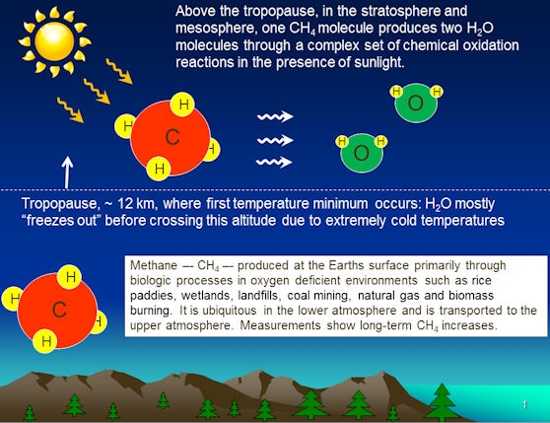
The reason, Russell believes, is climate change. One of the greenhouse gases that has become more abundant in Earth’s atmosphere since the 19th century is methane. It comes from landfills, natural gas and petroleum systems, agricultural activities and coal mining.
“When methane makes its way into the upper atmosphere, it is oxidized by a complex series of reactions to form water vapor,” Russell explained. “This extra water vapor is then available to grow ice crystals for NLCs.”
If this idea is correct, noctilucent clouds are a sort of “canary in a coal mine” for one of the most important greenhouse gases.
And that, said Russell, is a great reason to study them. “Noctilucent clouds might look alien, but they’re telling us something very important about our own planet.”
Dr. Tony Phillips works for the National Aeronautics and Space Administration.