 How to resolve AdBlock issue?
News
- Details
- Written by: Eileen Gieser
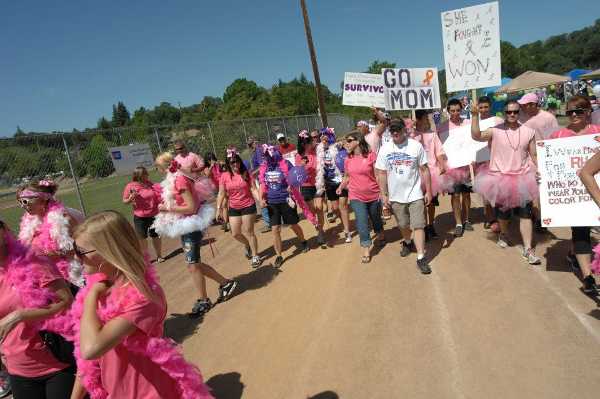
LAKE COUNTY, Calif. – With the final numbers now in, Lake County’s annual Relay for Life event passed its goals this year, gaining special recognition for its effort to recruit participants in the ongoing fight against cancer.
The 11th annual event – which began Saturday, May 19, and lasted until the following day at Clear Lake High School in Lakeport – raised nearly $106,000, passing its goal of $100,000, according to Lake County Relay for Life Co-Chair Racheal Harmon.
Harmon said the money is still coming in from the event.
“This year was such an amazing year for many reasons,” Harmon said.
Harmon said the relay had 764 participants this year, double that of the 2011 event.
In addition, there were 83 registered teams, 35 of them being newly recruited, she said.
Harmon said Lake County was recognized as being in the top three areas in all of California for newly recruited teams.
This year’s 83 teams raised funds for the American Cancer Society’s research, education, advocacy and service programs, Harmon said.
“This outstanding show of support proves that the people of Lake County are truly committed to the fight against cancer,” she said.
Lake County’s fundraising and participation numbers become all the more impressive when comparing the results to larger areas.
Harmon said the Studio City North Hollywood team raised $64,815, with 429 participants and 37 teams; West Sacramento brought in $27,020, with 305 participants and 37 teams; and South San Francisco had 155 participants and 24 teams, and raised $30,148.
Harmon said the event honored survivors and those who have died, and offered the opportunity to fight back against the disease by raising money.
She said it was a hit, and participants and the community enjoyed every moment of it.
Harmon said 118 cancer survivors took the relay’s first lap, officially kicking off the 2012 event.
“These survivors are the reason we continue the fight,” she said. “Their participation inspires hope in those currently battling cancer.”
Top individual participants were Jenny Bowen, $2,565; Angie DeMaria, $1,615; and Brenda Wesselhoff, $1,610, Harmon reported.

Top teams were Find a Penny, $8,660.75; Cell Smashers, $8,547.23; Pink Ladies, $8,223.55; Bella's Angels, $7,434; Envision a Cure, $6,677; Save the Tatas, $4.550; Super Suckers, $4,511.75; Angels Among Us, $3,978; St. Helena Hospital, $3,254; and PartyLite on Fire for a Cure, $3,046, according to Harmon.
Harmon said top youth teams were Middletown High School, $9,620.50; Kelseyville Cancer Kickers, $2,659; Cardinals For a Cure (Clear Lake High School), $2,363.75; and Team Cancer Kickers (Upper Lake High School), $1,914.
Three first time teams did exceptionally well, raising more money than is common for new groups entering the event, said Harmon. The top new 2012 teams were Bella's Angels, $7,434; Super Suckers, $4,475.75; and Angels Among Us, $3,978.
Harmon said Relay for Life would not be possible without its corporate sponsors.
Sponsors for this year’s relay included Reynolds Truck & Crane Inc.; Sutter Lakeside Hospital; St. Helena Hospital Clearlake; Meals on Wheels Thrift Store Inc.; Milan L. Hopkins M.D., A Medical Corporation; Early Lake Lions; Bottle Rock Power LLC; Patty Cake’s Preschool; Lake County Tribal Health Consortium Inc.; Quail Run Fitness Center; Hair Jordan Salon; The English Inn; Lakeview Super Market & Deli; Lake Events; PartyLite; Batter-Up Cupcakes; Perkos; Lakeport Disposal; Lake County Record-Bee; Ice Water; Upper Lake High School; RB Peters; Kelseyville Septic; Wine Country Gas; McDonald’s; The Party Store in Lakeport; Lake County News; Bruno’s Shop Smart; Lakeport Kiwanis; the Thompson Family; Hillside Honda; and the UPS Store in Lakeport.
Following the encouraging results from the fundraising portion of the event, the call for volunteers to participate in a Cancer Prevention Study has already received responses from 130,000 men and women across the country, with 15,000 from California.
This Cancer Prevention Study, known as CPS-3, will have the American Cancer Society asking for participants until December 2013. The final goal is 300,000 participants nationwide, from various racial/ethnic backgrounds.
They are looking for men and women between the ages of 30 and 65 who have no personal history of cancer.
For details on the program, contact the American Cancer Society at 1-888-604-5888 or email
While Relay for Life culminates in the May event, the effort to put it all together runs from September to August.
For information on how you can help in the fight against cancer, call 1-800-227-2345 or visit www.americancancerfund.org .
- Details
- Written by: Elizabeth Larson
LAKE COUNTY, Calif. – Want a cat or kitten to join your family this summer?
Lake County Animal Care and Control has numerous felines of all ages ready to leave their cages behind in favor of yards and couches of their own.
Cats that are adopted from Lake County Animal Care and Control are either neutered or spayed and microchipped before being released to their new owner. License fees do not apply to residents of the cities of Lakeport or Clearlake .
If you're looking for a new companion, visit the shelter. There are many great pets there, hoping you'll choose them.
The following cats at the Lake County Animal Care and Control shelter have been cleared for adoption (other cats pictured on the animal control Web site that are not listed here are still “on hold”).
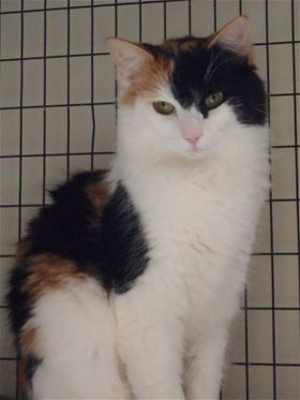
Female calico
This female calico is 1 year old.
She has gold eyes and a long, multicolored coat.
Find her in cat room kennel No. 4, ID No. 33123.

Orange and white tabby kitten
This male orange and white tabby kitten is 10 weeks old.
He has gold eyes and a long coat, weighs just over 2 pounds and has not yet been altered.
Find him in cat room kennel 23b, ID No. 33202.

Gray tabby kitten
This male gray tabby kitten is 10 weeks old.
He has a short coat and gold eyes, weighs 2 pounds and has not yet been neutered.
He's in cat room kennel No. 23c, ID No. 33203.
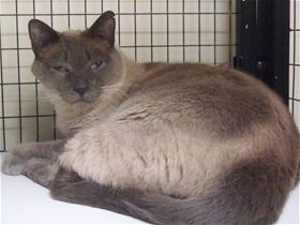
'Silver'
“Silver” is a 9-year-old male Siamese mix.
He has a short, multicolored coat, blue eyes and has been neutered.
Find Silver in cat room kennel No. 54, ID No. ID: 32995.
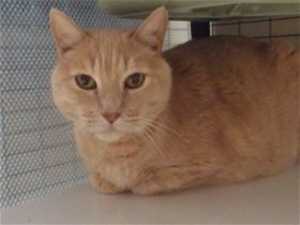
'Joey'
“Joey” is a 14-year-old male domestic short hair mix.
He has tan coloring, green eyes and a kinked tail. He has been neutered.
He's in cat room kennel No. 55, ID No. 32994.
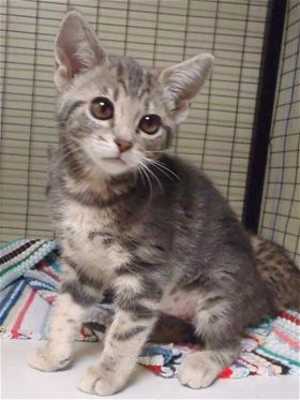
Gray tabby kitten
This female gray tabby kitten is 13 weeks old.
She has green eyes, a short coat and has been spayed.
Find her in cat room kennel No. 65a, ID No. 32839.
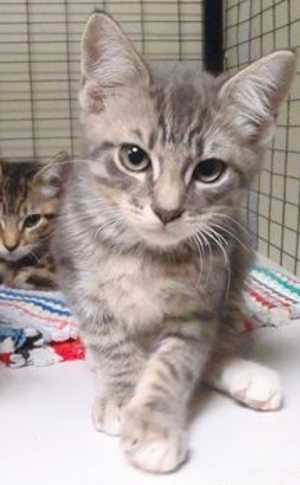
Gray tabby kitten
This male gray tabby kitten is 13 weeks old.
He has a short coat, green eyes and has been neutered.
Find him in cat room kennel No. 65b, ID No. 32840.

Male domestic short hair mix
This male domestic short hair mix kitten is 13 weeks old.
He has gray and black coloring and green eyes, and has been neutered.
He's in cat room kennel No. 65c, ID No. 32841.

Brown tabby kitten
This male brown tabby kitten is 13 weeks old.
He has a short coat and green eyes, and has been neutered.
Find him in cat room kennel No. 65d, ID No. 32842.
Adoptable cats also can be seen at http://www.co.lake.ca.us/Government/Directory/Animal_Care_And_Control/Adopt/Cats_and_Kittens.htm or at www.petfinder.com .
Please note: Cats listed at the shelter's Web page that are said to be “on hold” are not yet cleared for adoption.
To fill out an adoption application online visit http://www.co.lake.ca.us/Government/Directory/Animal_Care_And_Control/Adopt/Dog___Cat_Adoption_Application.htm .
Lake County Animal Care and Control is located at 4949 Helbush in Lakeport, next to the Hill Road Correctional Facility.
Office hours are Monday through Friday, 8 a.m. to 5 p.m., and 1 p.m. to 3 p.m., Saturday. The shelter is open from 10:30 a.m. to 4:30 p.m. Monday through Friday and on Saturday from 1 p.m. to 3 p.m.
Visit the shelter online at http://www.co.lake.ca.us/Government/Directory/Animal_Care_And_Control.htm .
For more information call Lake County Animal Care and Control at 707-263-0278.
- Details
- Written by: Lake County News reports
The U.S. Forest Service reported Sunday that it’s taking actions to continue to maintain adequate air tanker capability by mobilizing four Department of Defense C-130s equipped with Modular Airborne Firefighting Systems to assist with wildfire suppression efforts in Colorado and elsewhere in the Rocky Mountains and the Southwest.
MAFFS are portable fire retardant delivery systems that can be inserted into military C-130 aircraft to convert them into large airtankers when needed. Military C-130s equipped with MAFFS can drop up to 3,000 gallons of fire retardant on wildfires. They can discharge their entire load in under five seconds or make variable drops.
Two of the MAFFS will be provided by the 302nd Airlift Wing, Air Force Reserve, Peterson Air Force Base, Colo., and two of the MAFFS will be provided by the 153rd Airlift Wing, Wyoming Air National Guard, Cheyenne. They will be based at Peterson Air Force Base in Colorado Springs, Colo., and are expected to be available to fly wildfire suppression missions by no later than Tuesday, June 26.
“We are mobilizing MAFFS to ensure that we continue to have adequate air tanker capability as we experience very challenging wildfire conditions in Colorado and elsewhere in the Rocky Mountain and Southwest regions,” said U.S. Forest Service Chief Tom Tidwell. “Maintaining adequate aerial firefighting capability, with now 21 large air tankers and over 300 helicopters, is critical to provide support to, and enhance the safety of, the firefighters on the ground who are working so hard to suppress these wildfires.”
Airtankers are used in wildfire suppression to deliver fire retardant to reduce the intensity and slow the growth of wildfires so that firefighters on the ground can construct containment lines safely, which is how wildfires are suppressed. Fire retardant is not typically used to suppress wildfires directly.
Professional fire managers decide whether to use airtankers to deliver fire retardant, and where to use them, based on the objectives they have established to manage wildfires and the strategies they are using to achieve them. Airtankers are not requested for all wildfires.
The MAFFS program is a 40-year long joint effort between the U.S. Forest Service and Department of Defense. The U.S. Forest Service owns the MAFFS equipment and supplies the retardant, while the DoD provides the C-130 aircraft, pilots, and maintenance and support personnel to fly the missions.
The role of MAFFS, as outlined in an agreement between the DoD and the U.S. Forest Service, is to provide a surge capability that can be used to boost wildfire suppression efforts when commercial airtankers are fully committed or not readily available.
With the MAFFS mobilizations, the U.S. Forest Service will have 16 large airtankers and one very large airtanker available for wildfire suppression and will have the capability to mobilize an additional 9 large airtankers.
The U.S. Forest Service has a total of eight MAFFS systems ready for operational use, plus one spare.
Military installations in Wyoming, North Carolina, California, and Colorado provide C-130s to fly MAFFS missions.
Specifically, the 153rd Airlift Wing, Wyoming Air National Guard, Cheyenne; the 145th Airlift Wing, North Carolina Air National Guard, Charlotte; the 146th Airlift Wing, California Air National Guard, Port Hueneme; and the 302nd Airlift Wing, Air Force Reserve, Peterson Air Force Base, Colo.
In 2011, MAFFS were activated several times to support fires in Mexico, Texas, New Mexico and Arizona. This is the first time MAFFS have been activated in 2012. From 2002 to 2011, military C-130s with MAFFS systems dropped a total of approximately 7.7 million gallons of retardant on wildfires.
Each year, an average of more than 75,000 wildfires burn an average of about 7 million acres of land in the United States.
- Details
- Written by: Elizabeth Larson
CLEARLAKE, Calif. – A fire that broke out in Clearlake early Sunday afternoon was contained to four acres thanks to a quick response by firefighters.
The fire, reported at around 1 p.m., was located off of Eastlake Drive near Pomo Elementary School, according to Lake County Fire Protection District Chief Willie Sapeta.
Sapeta said the fire was attributed to someone mowing grass in the area.
Lake County Fire, Cal Fire and Northshore Fire responded, with a total of seven engines, a dozer, two crews, two water tenders, a Cal Fire helicopter and three battalion chiefs, according to Sapeta.
Once the helicopter began water drops, crews were able to quickly put a ring around the fire, Sapeta said.
He estimated it took only about 10 minutes to contain the fire, but an hour of overhaul and heavy mop up was required.
At one point a structure was threatened but ultimately it was not damaged, he said.
Email Elizabeth Larson at