How to resolve AdBlock issue?
Refresh this page
How to resolve AdBlock issue?

Refresh this page
Lake County News,California
  • Home
    • Registration Form
  • News
    • Community
      • Obituaries
      • Letters
      • Commentary
    • Education
    • Veterans
    • Police Logs
    • Business
    • Recreation
    • Health
    • Religion
    • Legals
    • Arts & Life
    • Regional
  • Calendar
  • Contact us
    • FAQs
    • Phones, E-Mail
    • Subscribe
  • Advertise Here
  • Login
How to resolve AdBlock issue?

Refresh this page
How to resolve AdBlock issue?

Refresh this page

News

Helping Paws: This week’s dogs

LAKE COUNTY, Calif. — Lake County Animal Care and Control has many deserving dogs waiting for their new homes.

Dogs available for adoption this week include mixes of Australian cattle dog, bulldog, Chihuahua, dachshund, German shepherd, Labrador Retriever, mastiff, pit bull terrier, Rottweiler and terrier.

Dogs that are adopted from Lake County Animal Care and Control are either neutered or spayed, microchipped and, if old enough, given a rabies shot and county license before being released to their new owner. License fees do not apply to residents of the cities of Lakeport or Clearlake.

Those dogs and the others shown on this page at the Lake County Animal Care and Control shelter have been cleared for adoption.

Call Lake County Animal Care and Control at 707-263-0278 or visit the shelter online for information on visiting or adopting.

The shelter is located at 4949 Helbush in Lakeport.

Email Elizabeth Larson at This email address is being protected from spambots. You need JavaScript enabled to view it.. Follow her on Twitter, @ERLarson, or Lake County News, @LakeCoNews.


Foster#7134(Crusty)'s preview photo
Foster#7134(Crusty)


Kennel#24(Rex)'s preview photo
Kennel#24(Rex)

Kennel#9's preview photo
Kennel#9

Kennel#10's preview photo
Kennel#10

Kennel#20(Piper)'s preview photo
Kennel#20(Piper)


Kennel#21(Coco)'s preview photo
Kennel#21(Coco)

Kennel#8's preview photo
Kennel#8

Kennel#29a's preview photo
Kennel#29a

Kennel#32's preview photo
Kennel#32

Kennel#29c's preview photo
Kennel#29c

Kennel#29d's preview photo
Kennel#29d

Kennel#33(Kora)'s preview photo
Kennel#33(Kora)

Kennel#34's preview photo
Kennel#34

Kennel#25's preview photo
Kennel#25

Kennel#30's preview photo
Kennel#30

Kennel#12's preview photo
Kennel#12

Kennel#13's preview photo
Kennel#13

Kennel#19's preview photo
Kennel#19

Kennel#7's preview photo
Kennel#7

Kennel#31(Domino)'s preview photo
Kennel#31(Domino)

Kennel#15's preview photo
Kennel#15

Kennel#17's preview photo
Kennel#17

Kennel#18's preview photo
Kennel#18

Kennel#23's preview photo
Kennel#23

Kennel#4's preview photo
Kennel#4

 
Kennel#11(Luna)'s preview photo
Kennel#11(Luna)


Kennel#27's preview photo
Kennel#27
 
Details
Written by: Elizabeth Larson
Published: 30 June 2024

Supreme Court rules cities can ban homeless people from sleeping outdoors – Sotomayor dissent summarizes opinion as ‘stay awake or be arrested’


Housing activists demonstrate outside the Supreme Court on April 22, 2024. Matt McClain/The Washington Post via Getty Images

The Supreme Court has ruled that the Eighth Amendment to the U.S. Constitution does not prohibit cities from criminalizing sleeping outdoors.

City of Grants Pass v. Johnson began when a small city in Oregon with just one homeless shelter began enforcing a local anti-camping law against people sleeping in public using a blanket or any other rudimentary protection against the elements – even if they had nowhere else to go.

The court confronted this question: Is it unconstitutional to punish homeless people for doing in public things that are necessary to survive, such as sleeping, when there is no option to do these acts in private?

In a 6-3 decision written by Justice Neil Gorsuch, the court said no. It rejected the claim that criminalizing sleeping in public by those with nowhere to go violates the Constitution’s prohibition on cruel and unusual punishment. In my view, the decision – which I see as disappointing but not surprising – will not lead to any reduction in homelessness, and will certainly result in more litigation.

As a specialist in poverty law, civil rights and access to justice who has litigated many cases in this area, I know that homelessness in the U.S. is a function of poverty, not criminality, and that criminalizing people experiencing homelessness in no way helps solve the problem.

Cities like Portland, Oregon, have struggled to find viable ways of managing homeless encampments while they work to generate more housing.

The Grants Pass case

Grants Pass v. Johnson culminated years of struggle over how far cities can go to discourage homeless people from residing within their borders, and whether or when criminal sanctions for actions such as sleeping in public are permissible.

In a 2019 case, Martin v. City of Boise, the 9th U.S. Circuit Court of Appeals held that the Eighth Amendment’s cruel and unusual punishment clause forbids criminalizing sleeping in public when a person has no private place to sleep. The decision was based on a 1962 Supreme Court case, Robinson v. California, which held that it is unconstitutional to criminalize being a drug addict. Robinson and a subsequent case, Powell v. Texas, have come to stand for distinguishing between status, which cannot constitutionally be punished, and conduct, which can.

In the Grants Pass ruling, the 9th Circuit went one step further than it had in the Boise case and held that the Constitution also banned criminalizing the act of public sleeping with rudimentary protection from the elements. The decision was contentious: Judges disagreed over whether the anti-camping ban regulated conduct or the status of being homeless, which inevitably leads to sleeping outside when there is no alternative.

Grants Pass urged the Supreme Court to abandon the Robinson precedent and its progeny as “moribund and misguided.” It argued that the Eighth Amendment forbids only certain cruel methods of punishment, which do not include fines and jail terms.

The homeless plaintiffs did not challenge reasonable regulation of the time and place of outdoor sleeping, the city’s ability to limit the size or location of homeless groups or encampments, or the legitimacy of punishing those who insist on remaining in public when shelter is available.

But they argued that broad anti-camping laws inflicted overly harsh punishments for “wholly innocent, universally unavoidable behavior” and that punishing people for “simply existing outside without access to shelter” would not reduce this activity.

A woman in a suit jacket stands at an outdoor podium
Helen Cruz, who once lived on the streets in Grants Pass, Oregon, speaks at a rally outside the Supreme Court on April 22, 2024. AP Photo/J. Scott Applewhite

In today’s decision, the court rejected the city’s invitation to overrule the 1962 Robinson decision and eliminate the prohibition on criminalizing status, but denied that being homeless is a status. Instead, the court agreed with the city that camping or sleeping in public are activities, not statuses, despite the plaintiffs’ evidence that for homeless people, there is no difference between criminalizing “being homeless” and criminalizing “sleeping in public.”

The decision is surprisingly thin on Eighth Amendment analysis. It declines to engage with plaintiffs’ arguments that criminalizing sleeping imposes disproportionate punishment or imposes punishment without a legitimate deterrent or rehabilitative goal.

Instead, the court returned over and over to the idea that the 9th Circuit’s decision required judges to make impermissible policy decisions about how to respond to homelessness. The court also extensively cited friend-of-the-court briefs from cities and others discussing the difficulties of addressing homelessness. Significantly, however, neither these briefs nor the court’s decision cite evidence that criminalization reduces homelessness in any way.

In a strong dissent beginning “Sleep is a biological necessity, not a crime,” Justice Sonia Sotomayor, joined by Justices Elena Kagan and Ketanji Brown Jackson, quoted extensively from the record in the case. The dissent included some shocking statements from the Grants Pass City Council, such as “Maybe [the homeless people] aren’t hungry enough or cold enough … to make a change in their behavior.”

Sotomayor noted that time, place and manner restrictions on sleeping in public are perfectly permissible under the Ninth Circuit’s analysis, and that the inevitable line-drawing problems upon which the majority dwells are a normal part of constitutional interpretation. She also observed that the majority’s contention that the Ninth Circuit’s rule is unworkable was belied by Oregon’s own actions: in 2021, the state legislature codified the Martin v. Boise ruling into law.

A national crisis

Homelessness is a massive problem in the U.S. The number of people without homes held steady during the COVID-19 pandemic largely because of eviction moratoriums and the temporary availability of expanded public benefits, but it has risen sharply since 2022.

Scholars and policymakers have spent many years analyzing the causes of homelessness. They include wage stagnation, shrinking public benefits, inadequate treatment for mental illness and addiction, and the politics of siting affordable housing. There is little disagreement, however, that the simple mismatch between the vast need for affordable housing and the limited supply is a central cause.

Crackdowns on the homeless

Increasing homelessness, especially its visible manifestations such as tent encampments, has frustrated city residents, businesses and policymakers across the U.S. and led to an increase in crackdowns against homeless people. Reports from the National Homelessness Law Center in 2019 and 2021 have tallied hundreds of laws restricting camping, sleeping, sitting, lying down, panhandling and loitering in public.

Under presidents Barack Obama and Joe Biden, the federal government has asserted that criminal sanctions are rarely useful. Instead it has emphasized alternatives, such as supportive services, specialty courts and coordinated systems of care, along with increased housing supply.

Some cities have had striking success with these measures. But not all communities are on board.

Pushing people out of town

I expect that this ruling will prompt some jurisdictions to continue or increase crackdowns on the homeless, despite the complete lack of evidence that such measures reduce homelessness. What such laws may well accomplish is to push the issue into other towns, as Grants Pass officials candidly admitted they sought to do.

The decision will likely put even more pressure on jurisdictions that choose not to criminalize homelessness, such as Los Angeles, whose mayor, Karen Bass, has condemned the ruling. While this ruling resolves the Eighth Amendment claims against sleeping bans, litigation over homeless policy is doubtless far from over.

This is an updated version of an article originally published April 17, 2024.The Conversation

Clare Pastore, Professor of the Practice of Law, University of Southern California

This article is republished from The Conversation under a Creative Commons license. Read the original article.

Details
Written by: Clare Pastore, University of Southern California
Published: 30 June 2024

Gov. Newsom signs 2024 state budget

Gov. Gavin Newsom on Saturday signed 2024 state budget legislation that his office said brings stability to state finances while preserving key investments in safety net programs, education, addressing homelessness, mental health care reform and more.

As outlined in the agreement announced by the governor and legislative leaders, the legislation balances the budget in both 2024-25 and 2025-26.

It also preserves budget resilience by maintaining $22.2 billion in total reserves at the end of the 2024-25 fiscal year.

The state has taken several measures to manage revenue volatility in recent budget cycles, including setting aside a record amount of reserves, focusing most of the surplus on one-time and near-term spending instead of potentially unsustainable long-term and ongoing obligations, and paying tens of billions of dollars toward the state's long-term debt.

“This is a responsible budget that prepares for the future while investing in foundational programs that benefit millions of Californians every day,” said Newsom. “Thanks to careful stewardship of the budget over the past few years, we’re able to meet this moment while protecting our progress on housing, homelessness, education, health care and other priorities that matter deeply to Californians. I thank the Legislature for their partnership in delivering this sound and balanced plan.”

The budget addresses a $46.8 billion shortfall through a balanced package of solutions, including spending reductions of $16 billion.

It avoids deep program cuts, maintaining service levels for several priority issues including Proposition 98 funding for education and investments in Medi-Cal expansion, encampment resolution grants, nonprofit security grants, summer food assistance, updated foster care rates and more. Additional details on the 2024 state budget can be found in this fact sheet.

California remains the 5th largest economy in the world and for the first time in years, the state’s population is increasing and tourism spending recently experienced a record high. California is #1 in the nation for new business starts, #1 for access to venture capital funding, and the #1 state for manufacturing, high-tech, and agriculture.

The governor on Saturday announced signing the following bills:

AB 160 by the Committee on Budget – Medi-Cal managed care organization provider tax.
AB 2927 by Assemblymember Kevin McCarty (D-Sacramento) – Pupil instruction: high school graduation requirements: personal finance.
SB 108 by Senator Scott Wiener (D-San Francisco) – Budget Act of 2024.
SB 109 by Senator Scott Wiener (D-San Francisco) – Budget Act of 2023.
SB 153 by the Committee on Budget and Fiscal Review – Education finance: education omnibus budget trailer bill.
SB 159 by the Committee on Budget and Fiscal Review – Health.
SB 164 by the Committee on Budget and Fiscal Review – State government.
SB 175 by the Committee on Budget and Fiscal Review – Taxation.
SB 1524 by Senator Bill Dodd (D-Napa) – Consumers Legal Remedies Act: advertisements: restaurant, bar, and other food services.

For full text of today’s bills, visit http://leginfo.legislature.ca.gov.
Details
Written by: LAKE COUNTY NEWS REPORTS
Published: 30 June 2024

Space News: NASA’s Mars Odyssey captures huge volcano, nears 100,000 orbits

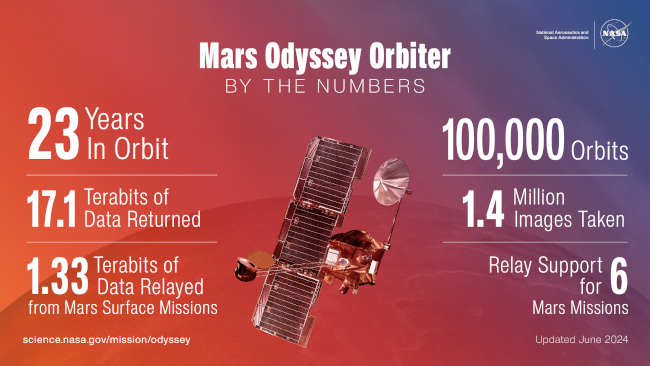
This infographic highlights just how much data and how many images NASA’s 2001 Mars Odyssey orbiter has collected in its 23 years of operation around the Red Planet. NASA/JPL-Caltech.


The 23-year-old orbiter is taking images that offer horizon-wide views of the Red Planet similar to what astronauts aboard the International Space Station see over Earth.

NASA’s longest-lived Mars robot is about to mark a new milestone on June 30: 100,000 trips around the Red Planet since launching 23 years ago.

During that time, the 2001 Mars Odyssey orbiter has been mapping minerals and ice across the Martian surface, identifying landing sites for future missions, and relaying data to Earth from NASA’s rovers and landers.

Scientists recently used the orbiter’s camera to take a stunning new image of Olympus Mons, the tallest volcano in the solar system. The image is part of a continuing effort by the Odyssey team to provide high-altitude views of the planet’s horizon. (The first of these views was published in late 2023.) Similar to the perspective of Earth astronauts get aboard the International Space Station, the view enables scientists to learn more about clouds and airborne dust at Mars.

Taken on March 11, the most recent horizon image captures Olympus Mons in all its glory. With a base that sprawls across 373 miles (600 kilometers), the shield volcano rises to a height of 17 miles (27 kilometers).

“Normally we see Olympus Mons in narrow strips from above, but by turning the spacecraft toward the horizon we can see in a single image how large it looms over the landscape,” said Odyssey’s project scientist, Jeffrey Plaut of NASA’s Jet Propulsion Laboratory in Southern California, which manages the mission. “Not only is the image spectacular, it also provides us with unique science data.”

In addition to offering a freeze frame of clouds and dust, such images, when taken across many seasons, can give scientists a more detailed understanding of the Martian atmosphere.

This infographic highlights just how much data and how many images NASA’s 2001 Mars Odyssey orbiter has collected in its 23 years of operation around the Red Planet.

A bluish-white band at the bottom of the atmosphere hints at how much dust was present at this location during early fall, a period when dust storms typically start kicking up. The purplish layer above that was likely due to a mixture of the planet’s red dust with some bluish water-ice clouds. Finally, toward the top of the image, a blue-green layer can be seen where water-ice clouds reach up about 31 miles (50 kilometers) into the sky.

How they took the picture

Named after Arthur C. Clarke’s classic science-fiction novel “2001: A Space Odyssey,” the orbiter captured the scene with a heat-sensitive camera called the Thermal Emission Imaging System, or THEMIS, which Arizona State University in Tempe built and operates. But because the camera is meant to look down at the surface, getting a horizon shot takes extra planning.

By firing thrusters located around the spacecraft, Odyssey can point THEMIS at different parts of the surface or even slowly roll over to view Mars’ tiny moons, Phobos and Deimos.

The recent horizon imaging was conceived as an experiment many years ago during the landings of NASA’s Phoenix mission in 2008 and Curiosity rover in 2012. As with other Mars landings before and after those missions touched down, Odyssey played an important role relaying data as the spacecraft barreled toward the surface.

To relay their vital engineering data to Earth, Odyssey’s antenna had to be aimed toward the newly arriving spacecraft and their landing ellipses. Scientists were intrigued when they noticed that positioning Odyssey’s antenna for the task meant that THEMIS would be pointed at the planet’s horizon.

“We just decided to turn the camera on and see how it looked,” said Odyssey’s mission operations spacecraft engineer, Steve Sanders of Lockheed Martin Space in Denver. Lockheed Martin built Odyssey and helps conduct day-to-day operations alongside the mission leads at JPL. “Based on those experiments, we designed a sequence that keeps THEMIS’ field-of-view centered on the horizon as we go around the planet.”

The secret to a long space odyssey

What’s Odyssey secret to being the longest continually active mission in orbit around a planet other than Earth?

“Physics does a lot of the hard work for us,” Sanders said. “But it’s the subtleties we have to manage again and again.”

These variables include fuel, solar power, and temperature. To ensure Odyssey uses its fuel (hydrazine gas) sparingly, engineers have to calculate how much is left since the spacecraft doesn’t have a fuel gauge. Odyssey relies on solar power to operate its instruments and electronics. This power varies when the spacecraft disappears behind Mars for about 15 minutes per orbit. And temperatures need to stay balanced for all of Odyssey’s instruments to work properly.

“It takes careful monitoring to keep a mission going this long while maintaining a historical timeline of scientific planning and execution — and innovative engineering practices,” said Odyssey’s project manager, Joseph Hunt of JPL. “We’re looking forward to collecting more great science in the years ahead.”

More about Odyssey can be found at https://science.nasa.gov/mission/odyssey/.

Details
Written by: NATIONAL AERONAUTICS AND SPACE ADMINISTRATION
Published: 30 June 2024
  1. Intense summer heat expected Independence Day week
  2. New pilot crop insurance program to help grape growers deal with smoke damage
  3. State attorney general releases 2023 Hate Crime Report

Subcategories

Community

  • 625
  • 626
  • 627
  • 628
  • 629
  • 630
  • 631
  • 632
  • 633
  • 634
How to resolve AdBlock issue?

Refresh this page