How to resolve AdBlock issue?
Refresh this page
How to resolve AdBlock issue?
Refresh this page
Lake County News,California
  • Home
    • Registration Form
  • News
    • Community
      • Obituaries
      • Letters
      • Commentary
    • Education
    • Veterans
    • Police Logs
    • Business
    • Recreation
    • Health
    • Religion
    • Legals
    • Arts & Life
    • Regional
  • Calendar
  • Contact us
    • FAQs
    • Phones, E-Mail
    • Subscribe
  • Advertise Here
  • Login
How to resolve AdBlock issue?
Refresh this page
How to resolve AdBlock issue?
Refresh this page

News

Community asked to participate in survey on heat waves and cyanobacterial blooms

LAKEPORT, Calif. — Lake County residents are invited to participate in a community survey to share their experiences on heat waves and cyanobacterial blooms.

Lake County has experienced an increasing number of high heat days in recent years, and cyanobacterial blooms are impacting Clear Lake with regularity; this effort aims to understand the needs of the community during these events.

Residents of Lake County age 18 or older who have lived in the county for at least 6 months can take the survey.

The survey is available online in English and Spanish at http://bit.ly/CHARM-survey.

Phone surveys can also be arranged. Anyone who completes a survey will be entered into a raffle to win a $100 MasterCard gift card, with weekly drawings happening through Labor Day.

Everyone is encouraged to complete their survey early to be eligible for all drawings.

The community survey is being conducted as part of the Climate Health Adaptation Resilience and Mitigation, or CHARM, Lake County Project, a collaboration between Big Valley Rancheria and the Public Health Institute’s Tracking California program and funded by the National Institutes of Health.

Survey results will be used to understand barriers that county residents face during heat waves and cyanobacterial blooms, which are increasing in frequency and intensity, and often co-occur.

“We know that some resources during heat waves, such as cooling centers, may not be accessible or viable for everyone who needs them. This may include people who rely on durable medical equipment, who have pets, or who have limited mobility or access to transportation.” said Susan Paulukonis, principal investigator. “Additionally, outdoor workers, those with limited mobility or with high risk health conditions can be especially impacted.”

Sarah Ryan, the environmental protection director at Big Valley Band of Pomo Indians and study co-investigator, emphasizes that the impacts of cyanobacterial blooms reach beyond those living near Clear Lake. “Cyanobacterial blooms can impact anyone who visits the lake for recreational or cultural activities, as well as people who eat fish or drink water from the lake.”

Survey findings will inform an action plan to be developed with a working group of local tribes, county agencies, and non-governmental and community-based organizations.

Learn more about the survey and study at www.charmlakecounty.org.

For more information, contact Paulukonis at This email address is being protected from spambots. You need JavaScript enabled to view it..
Details
Written by: Lake County News reports
Published: 28 June 2024

California to add financial literacy as a requirement to graduate high school

Gov. Gavin Newsom, Senate President pro Tempore Mike McGuire, Assembly Speaker Robert Rivas and a national financial literacy nonprofit — NGPF Mission 2030, an affiliate of Next Gen Personal Finance — on Thursday announced an agreement to make financial literacy required content to graduate high school.

“We need to help Californians prepare for their financial futures as early as possible. Saving for the future, making investments, and spending wisely are lifelong skills that young adults need to learn before they start their careers, not after,” said Gov. Newsom.

“Financial literacy is a critical tool that pays dividends for a lifetime,” said McGuire (D-North Coast). “There’s a wealth of data about the benefits of learning these valuable lessons in high school, from improving credit scores and reducing default rates to increasing the likelihood that our future generations will maintain three months of savings for emergencies and have at least one kind of retirement account.”

“Ensuring our students have the skills and knowledge to thrive is paramount to California’s continued success, and financial literacy is a key part of that educational mission,” said Rivas (D-Salinas). “Our agreement is the culmination of many robust and productive conversations with stakeholders across the state on how best to implement financial literacy into every student’s high school curriculum.”

Tim Ranzetta, co-founder of NGPF and lead proponent of the Californians for Financial Education initiative campaign: “We commend Gov. Newsom, Senate President pro Tem McGuire, Speaker Rivas, and the bill’s authors and supporters for their leadership and commitment to guaranteeing access to one semester personal finance education for every California student. We look forward to supporting the implementation of this essential course."

This agreement is reflected in AB 2927, sponsored by NGPF Mission 2030, which the Governor will sign.

The legislation will require a semester-long personal finance education course available for all California high school students by the 2027-28 school year and make personal finance a graduation requirement starting with the 2030-31 graduating class.

Once the Legislature passes this legislation, proponents of the California Personal Finance Education Act initiative eligible for the November 2024 ballot have agreed to withdraw their measure.

The financial literacy bill aligns with state efforts to prepare students early on for a healthier financial future.

California's CalKIDS program invests $1.9 billion into accounts for low-income school-age children in grades 1-12 and for newborn children born on or after July 1, 2022 — indicating the need for early financial literacy.

All families of low-income public school students — 3.4 million across the state — are able to access college savings accounts created in their children’s names.
Details
Written by: Lake County News reports
Published: 28 June 2024

Lightning season is here: Fast facts and how to stay safe, from a meteorologist


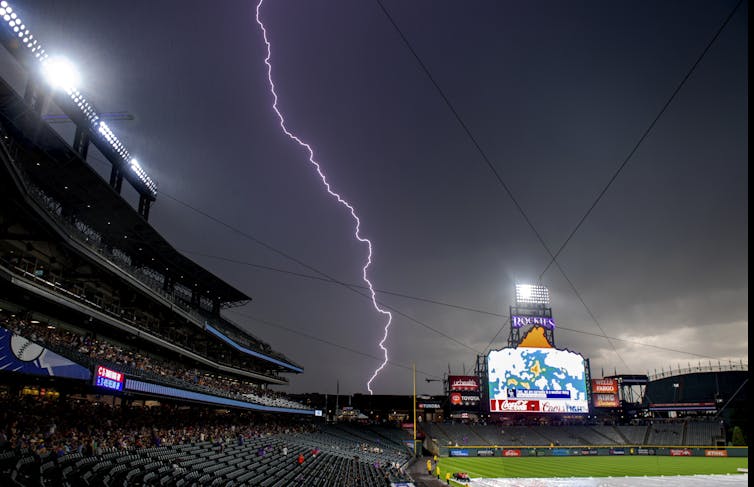
Baseball fans clear the stands as lightning strikes near the Colorado Rockies’ stadium in 2019. Julio Aguilar/Getty Images


Each year in the United States, lightning strikes around 37 million times. It kills 21 people a year in the U.S. on average.

For as often as lightning occurs – there are only a few days each year nationwide without lightning – there are still a lot of misunderstandings about nature’s largest spark. Because of this, a lot of people take unnecessary risks when thunderstorms are nearby.

I am a meteorologist who studies lightning and lightning safety, and a member of the National Lightning Safety Council. Here are some fast facts to keep your family and friends safe this summer.

What is lightning, and where does it come from?

Lightning is a giant electric spark in the atmosphere and is classified based on whether it hits the ground or not.

In-cloud lightning is any lightning that doesn’t hit ground, while cloud-to-ground – or, less commonly, ground-to-cloud – is any lightning that hits an object on the ground. Cloud-to-ground lightning accounts for only 10% to 50% of the lightning in a thunderstorm, but it can cause damage, including fires, injuries and fatalities, so it is important to know where it is striking.
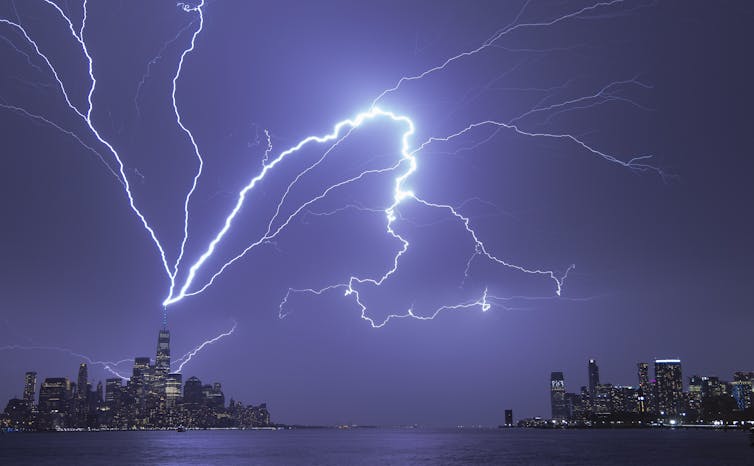
A vibrant display of lightning striking the tall tower and zigzagging through the sky.
Lightning strikes One World Trade Center in New York City and carries through clouds over the Hudson River in April 2023. Gary Hershorn/Getty Images

Lightning occurs when rain, ice crystals and a type of hail called graupel collide in a thunderstorm cloud.

When these precipitation particles collide, they exchange electrons, which creates an electric charge in the cloud. Because most of the electric charge exists in the clouds, most lightning happens in the clouds. When the electric charge in the cloud is strong, it can cause an opposite charge to build up on the ground, making cloud-to-ground lightning possible. Exactly what initiates a strike is still an open question.

When and where does lightning happen?

Lightning can happen any time the conditions for thunderstorms – moisture, atmospheric instability, and a way for air to rise – are present.

There is a seasonality to lightning: Most lightning in the United States strikes in June, July or August. In just those three months, more than 60% of the year’s lightning typically occurs. Lightning is least common in winter, but it can still happen. About 2% of yearly lightning occurs during winter.

No state is immune from lightning, but it is more common in some states than others.

Texas, Florida, Oklahoma, Louisiana and Mississippi are often among the leaders in total lightning strikes, but more than 30 states regularly see at least 1 million in-cloud and cloud-to-ground lightning events each year.

How to stay safe from lightning

Almost three-quarters of U.S. lightning fatalities occur between June and August. Luckily, staying safe from lightning is easy.

Keep an eye on the forecast and reconsider outdoor plans if thunderstorms are expected, especially if those plans take you near the water. Beaches are dangerous because lightning tends to strike the highest object, and water is a good conductor of electricity, so you don’t want to be in it.

Remember: No place outside is safe during a thunderstorm, so when thunder roars – go indoors. When you see the clouds building up, hear thunder or see a flash of lightning, it’s time to dash inside to a lightning-safe place.

What is a lightning-safe place?

There are two safe places to be during a thunderstorm: a substantial building or a fully enclosed metal vehicle.

A substantial building is a house, store, office building or other structure that has four walls and a roof, and where the electrical wiring and plumbing are protected inside the walls. If lightning strikes the building or near it, the electricity from the lightning travels through the walls and not through you. Dugouts, picnic shelters and gazebos are not safe places.

If you’re in a fully enclosed metal vehicle during a thunderstorm and lightning strikes, the electricity travels through the metal shell, which keeps you safe. It’s not the rubber tires that protect you – that’s a common myth. So, golf carts and convertibles won’t keep you safe if lightning strikes.

When you’re outdoors and lightning approaches, head to a lightning-safe place, even if it’s a distance away. Stay away from trees, especially tall and isolated ones, and don’t crouch in place – it doesn’t make you safer and just keeps you in the storm for longer.

Stay safe this summer

While you’re enjoying your summer plans, keep lightning safety in mind.

If someone nearby does get hit by lightning, lightning victims don’t hold the electric charge, so call 911 and begin first aid right away. About 90% of lightning victims survive, but they need immediate medical attention.The Conversation

Chris Vagasky, Meteorologist, University of Wisconsin-Madison

This article is republished from The Conversation under a Creative Commons license. Read the original article.

As the weather warms, people spend more time outdoors, going to barbecues, beaches and ballgames. But summer isn’t just the season of baseball and outdoor festivals – it’s also lightning season.


Details
Written by: Chris Vagasky, University of Wisconsin-Madison
Published: 28 June 2024

Clearlake Animal Control: ‘Ella,’ ‘Ninja’ and ‘Bugsy’

CLEARLAKE, Calif. — Clearlake Animal Control has dozens of adoptable dogs needing new homes.

The Clearlake Animal Control website lists 39 adoptable dogs.

“Ella.” Photo courtesy of Clearlake Animal Control.

The available dogs include “Ella,” a 2-year-old female miniature pinscher mix with a black and brown coat. She has been spayed.

There also is Ninja, who is one year and nine months old. He is a Labrador retriever with a black and white coat, and he’s been neutered.

“Ninja.” Photo courtesy of Clearlake Animal Control.

Another adoptable dog is “Bugsy,” a male Labrador retriever mix estimated to be a year and nine months old. Bugsy has a short black coat and has been neutered.

The shelter is located at 6820 Old Highway 53. It’s open from 9 a.m. to 6 p.m. Tuesday through Saturday.

“Bugsy.” Photo courtesy of Clearlake Animal Control.

For more information, call the shelter at 707-762-6227, email This email address is being protected from spambots. You need JavaScript enabled to view it., visit Clearlake Animal Control on Facebook or on the city’s website.

This week’s adoptable dogs are featured below.

Email Elizabeth Larson at This email address is being protected from spambots. You need JavaScript enabled to view it.. Follow her on Twitter, @ERLarson, or Lake County News, @LakeCoNews.

Details
Written by: Elizabeth Larson
Published: 28 June 2024
  1. Congressman Thompson to host veterans town hall
  2. Lake County youth in custody to be primarily housed in Mendocino County again
  3. California to expand funding for children’s hospitals, serve state’s sickest kids

Subcategories

Community

  • 627
  • 628
  • 629
  • 630
  • 631
  • 632
  • 633
  • 634
  • 635
  • 636
How to resolve AdBlock issue?
Refresh this page