 How to resolve AdBlock issue?
News
- Details
- Written by: Elizabeth Larson
LAKE COUNTY, Calif. – A state report issued this week shows that more schools than ever are experiencing budgetary difficulties as a result of California’s economic struggles.
This week California Superintendent of Public Instruction Tom Torlakson released the state’s Second Interim Status Report for the 2011-12 fiscal year, which lists school districts considered to be in financial jeopardy.
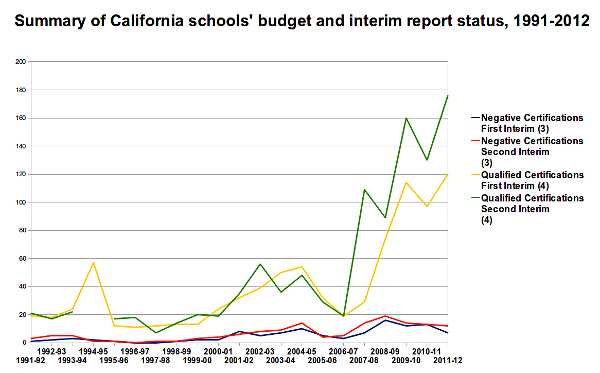
This latest report lists the highest number of financially troubled educational agencies in state history – 188 – up by 61 from the First Interim Status Report for 2011-12 issued in February, and up 45 from the Second Interim Report for 2010-11 issued a year ago.
Torlakson said the listed districts serve an estimated 2.6 million of California’s 6.2 million school students.
"The deep cuts this budget crisis has forced – and the uncertainties about what lies ahead – are taking an unprecedented and unacceptable toll on our schools,” Torlakson said.
Approximately 1,037 local educational agencies – which include school districts, county offices of education and joint powers agencies – are tracked in the twice a year reports, according to the California Department of Education.
The most recent report covered the financial and budgetary status of the districts for the period ending Jan. 31 and so predate Gov. Jerry Brown’s May Revision, which the state said may mean the agencies’ financial status has changed since the financial certifications were collected in April.
The list of financially struggling districts “is growing tremendously throughout the state and more and more districts are finding themselves in a tough situation,” said Lake County Superintendent of Schools Wally Holbrook.
Local educational agencies receive a positive certification if they meet their financial obligations for the current and two subsequent fiscal years, the California Department of Education explained.
Most Lake County districts appeared to have fallen within the positive certification category in this latest report.
However, Upper Lake Union Elementary, which has a $4.3 million budget, was among 176 districts and local educational agencies statewide given a “qualified” certification, because the state ruled that it may not meet its financial obligations for the current or two subsequent fiscal years.
Kelseyville Unified and Konocti Unified had been given qualified status in the First Interim Status Report in February, but were not listed in this week’s followup report.
No local districts were among the 12 educational agencies given the most serious classification, “negative,” which designates the inability to meet financial obligations for the remainder of the current year or for the subsequent fiscal year. In such cases, the local county office of education can intervene in the district's finances.
Snapshot in time
Tina Jung, a spokesperson for the California Department of Education, told Lake County News that the status report is a snapshot in time that gives both the state superintendent and the educational agencies a sense of their fiscal status. That allows districts the chance to begin making adjustments.
Holbrook said that’s the case with Upper Lake Elementary, which has submitted a third interim report that’s in the process of being reviewed.
Michelle Buell, Lake County Office of Education Fiscal Services director, said of Upper Lake Elementary, “They made reductions that leveled out their shortfall.”
Local school districts are now developing their 2012-13 budgets, which Buell said are due to the Lake County Office of Education by July 1.
Buell and Holbrook also have assisted Kelseyville Unified over the last few years when it appeared on three straight reports under the qualified status.
Holbrook said Kelseyville developed a fiscal stability plan. “We did provide some resources for them to help them do that,” he said. “The result of that has been pretty positive.”
A growing problem
California Department of Education data shows that the number of schools going into qualified or negative status has grown dramatically in recent years.
The state began tracking educational agencies’ financial certificates in the 1991-92 fiscal year.
Jung pointed out that the numbers of districts in financial jeopardy remained small for some time, other than a brief spike to 55 in 1994-95. Then, in 2002-03 – around the time of the dotcom crash – the numbers jumped up to 56.
The number of financially troubled districts then receded. In 2006-07, those districts totaled 19 statewide, but in the following 2007-08 fiscal year – at the same time the recession hit – the number jumped to 109.
Federal stimulus money making its way into the state’s school districts in 2008-09 saw a slight drip to 89 districts, said Jung. The number of districts in financial jeopardy nearly doubled to 160 the following year, the data showed.
“Obviously, it’s tied to the economy,” said Jung.
Holbrook said that even with districts that have been conservative and financially stable, the potential for slipping into qualified or negative status is increasing.
“It’s going to be a serious problem for all of us,” he said.
Jung said Torlakson issued a state of emergency immediately after entering office last year, and is encouraging voters to support the governor’s ballot initiative to raise taxes to help education this November.
Holbrook said the initiative won’t fix the situation, but it may help by allocating resources the way they were originally intended.
As for more dollars for classrooms, “we’re just not going to see them,” he said.
Holbrook said he had a chance to listen to the governor speak about the initiative on Monday. “He’s not totally satisfied with that initiative but he thinks it’s the best thing given the situation that we’re in at this point in time.”
Holbrook said there is the possibility that transportation funding will be restored to schools but that they can actually use the money for other needs.
“In our area it’s really tough for our districts not to provide transportation,” he said.
If that funding flexibility takes place, “that’s going to cause all kinds of debates,” said Holbrook, with some districts possibly having to choose between transportation or keeping an additional teacher in the classroom.
“Those are just really difficult choices,” Holbrook said.
LAKE COUNTY SCHOOL DISTRICTS IN QUALIFIED STATUS, 1998-2012
Second interim status report, 2011-12
Upper Lake Union Elementary; $4.3 million budget
First interim status report, 2011-12
Kelseyville Unified; $14.7 million budget
Konocti Unified; $28.3 million budget
Second interim status report, 2010-11
Kelseyville Unified; $14.5 million
First interim status report, 2010-11
Kelseyville Unified; $14.5 million
Second interim status report, 2009-10
Upper Lake Union Elementary; $3.31 million
First interim status report, 2009-10
Upper Lake Union Elementary; $4.53 million
Second interim status report, 2008-09
Lake County Office of Education; $18.85 million
First interim status report, 2008-09
Konocti Unified; $28.29 million
Lakeport Unified; $14.83 million
Upper Lake Union High; $4.90 million
Upper Lake Union Elementary; $4.98 million
Second interim status report, 2003-04
Upper Lake Union High; $3 million
First interim status report, 2003-04
Upper Lake Union High; $3 million
Second interim status report, 2002-03
Upper Lake Union High; $3 million
Second interim status report, 2001-02
Upper Lake Union High; $3 million
First interim status report, 2001-02
Upper Lake Union High; $3 million
Second interim status report, 2000-01
Upper Lake Union High; $3 million
First interim status report, 2000-01
Upper Lake Union High; $3 million
Second interim status report, 1998-99
Upper Lake Union High; $2 million
First interim status report, 1998-99
Upper Lake Union High; $2 million
Email Elizabeth Larson at
- Details
- Written by: Lake County News reports

LAKEPORT, Calif. – The fifth outing for the music and comedy show “Lake County Live!” will take place on Sunday, May 27, at 6 p.m. at the Soper-Reese Theatre in Lakeport.
The program is live in the theater and on the air, broadcast and streamed on Lake County Community Radio KPFZ 88.1 FM and www.kpfz.org .
Host and show creator Doug Rhoades advised this month's program will feature music by the Lake County group Blindspot, and native flute player Kevin Village Stone with classical guitarist Lindy Day.
The usual cast of characters, including “Ladies of the Lake,” will return as well.
“Those who have been in the theater or heard the show on the air know that we're live radio the way it used to be years ago,” said Rhoades, “which means lots of music, lots of laughs and an occasional goof here and there. But the audience has been very appreciative and supportive.”
The show is broadcast live the last Sunday of each month from the theater, and features talented musicians, performers and players from all around Lake County.
Tickets for the upcoming Sunday show are available at the Soper-Reese box office, 275 S. Main St.; the Travel Center at 1265 S. Main in Lakeport; or online at www.soperreesetheatre.com .
More information may be found at www.facebook.com/lakecountylive or at www.lakecountylive.com .
- Details
- Written by: Lake County News reports
On Wednesdsay Senate Budget Subcommittee No. 2 voted to approve and adopt the staff recommendation amendments of the “Sustainable Parks Proposal” that was introduced May 8 by State Senator Noreen Evans (D-Santa Rosa) and State Senator Joe Simitian (D-Palo Alto).
The budget proposal would keep open up to 50 state parks slated for closure this year while providing a stable and long-term funding solution that will keep all parks open.
As many as 70 state parks – including Anderson Marsh State Historic Park in Lower Lake – had been slated for closure beginning July 1, 2012.
The essence of the Sustainable Parks Proposal consists of providing assistance to nonprofit partners working for operating agreements for state parks and finding “new ways of working” in the parks, including allowing parks to become more entrepreneurial and allowing more personnel flexibility.
It also would access up to $173 million of existing funding sources over several years that may be appropriately used for park purposes.
Annually, funds can be up to $10 million a year of existing funds collected the Motor Vehicle Account, $21 million from the Local Assistance Program and $10 million annually from the Clean Water Revolving Loan Fund, and $10 million from bond money.
The Sustainable Parks Proposal now waits for the Assembly Budget Committee to move ahead with their measure.
“Closing our state parks will not save the state money,” said Evans. “However, if the administration continues to move in that direction, this proposal would prevent closures this year and develop a solution-oriented and sustainable long term funding plan to keep parks in the public trust for generations to come.”
“These are hard times, filled with hard budget choices,” said Simitian. “But I continue to think that putting a ‘closed’ sign on 70 state parks is unacceptable. It’s fundamentally ill-conceived. We can do better.”
The proposal also would give Californians voluntary opportunities to support the parks. Under the proposal, Californians could purchase a specialty parks license plate for a fee and give a voluntary donation at the time of their vehicle renewal.
“This continues to be a solid proposal that will set the financial foundation for saving our parks,” said Evans. “In the short term, we will be able to keep most of our parks open this year, and in the long run, it will help make our park system stronger and more creative.”
Last May, the Department of Parks and Recreation (DPR) announced that 70 parks would close due to budget cuts.
Since then, nonprofit organizations and the public, as well as local and federal agencies, have stepped up efforts to find ways to fund the parks – many signing operating agreements with the state – and the number of parks slated to shut dropped to 54 last month.
Anderson Marsh Interpretive Association also is engaged in negotiations to operate Anderson Marsh, as Lake County News has reported.
To help encourage these community efforts, the proposal would also include extending liability coverage to local and nonprofit agencies that work in partnership to manage the parks.
Evans is the author of two bills complimentary to the Sustainable Parks Proposal. SB 974 requires transparency and public involvement in future closures and a planning process to reopen parks, while SB 1078 helps focus DPR on innovative revenue generation projects.
A full copy of the eight-point ‘Sustainable Parks Proposal,’ may be found below or at http://sd02.senate.ca.gov/ .
Evans represents the Second Senatorial District, including all or portions of the Counties of Humboldt, Lake, Mendocino, Napa, Solano and Sonoma counties.
050812 Evans and Simitian Sustainable Parks Proposal- Details
- Written by: Lake County News reports
On Wednesday, the California Department of Fish and Game (DFG) sued the United States Army Corps of Engineers (Corps) over alleged environmental law violations relating to levee maintenance policies.
On Feb. 7 DFG had issued its intent to sue over the Corps' levee policies, as Lake County News has reported.
DFG claimed in its lawsuit that the Corps failed to comply with the federal Endangered Species Act, National Environmental Policy Act, and federal Administrative Procedure Act when it adopted a national policy requiring the removal of virtually all trees and shrubs on federal levees. The Corps developed its national levee vegetation removal policy in the wake of Hurricane Katrina.
The Corps’ national policy fails to account for regional variations among levees, DFG alleged. As early as 1955, the Corps encouraged and even required the planting of trees and shrubs on California levees.
Studies conducted in 1967, 1999 and 2008 by California confirm that native riparian vegetation are compatible with flood control and that such vegetation can often act to minimize damage during a flood event.
The Corps’ own studies from 1991 and 1999 also reportedly confirmed that post-damage flood rates for levees containing woody vegetation were lower than levees with no vegetation. DFG is confident that the Corps’ flood concerns can be met in a regional variation allowing this unique riparian habitat.
Only 5 percent of the Central Valley’s original riparian forest remains and the Corps’ new policy would eliminate it entirely.
In addition to providing scenic beauty and recreational enjoyment for people, riparian habitat is essential for several endangered species including Chinook salmon, Central Valley steelhead, Valley elderberry longhorn beetle, riparian brush rabbit, Western yellow-billed cuckoo and Swainson’s hawk.
Approximately 1,600 miles of federal project levees along the Sacramento and San Joaquin rivers and tributaries are likely to be affected by the Corps’ policy.
Several miles of federal levees in the Bay Area and Southern California would also be affected. Compliance with the new policy is estimated to cost the state up to $7.5 billion and divert funds from more significant levee deficiencies such as seepage and erosion.
Despite years of roundtable discussions between DFG, the Corps and other state, federal and local entities, DFG’s concerns over removing the riparian habitat remain unaddressed.
DFG’s mission is to manage California’s diverse fish, wildlife and plant resources, and the habitats upon which they depend, for their ecological values and for their use and enjoyment by the public.