 How to resolve AdBlock issue?
News
- Details
- Written by: Lake County News reports

LOWER LAKE, Calif. – The Anderson Marsh Interpretive Association has received a $5,450 grant from the California State Parks Foundation to aid the association's efforts to prevent the closure of Anderson Marsh State Historic Park.
The grant is part of CSPF’s Park Operations Challenge Grant Program.
“We are pleased to announce these grants as part of our integrated effort to help keep threatened parks open,” said CSPF President Elizabeth Goldstein. “The grantees that have come forward to assist parks need our help now, and more organizations will have similar needs in the future.”
“This is an example of the value of public-private partnerships,” said California Department of Parks and Recreation Director Ruth Coleman. “We thank CSPF for mobilizing donors and resources to assist our nonprofit partners to get through this budget crisis.”
“We look forward to the moment when the ink dries on the deals between these nonprofits and the state,” said Goldstein. “They are very much in the process at the moment, and we think these grant announcements are an important milestone toward their completion.”
“The Anderson Marsh Interpretive Association is grateful for this financial support,” said AMIA Treasurer Henry Bornstein. “This grant will help us to meet our fundraising goals and enable us to be ready to move ahead with confidence in negotiating an operating agreement with Department of Parks and Recreation. We appreciate everything that the California State Parks Foundation is doing to assist the nonprofits that are working to prevent park closures.”
For information about Anderson Marsh State Historic Park, AMIA and how you can help, go to www.andersonmarsh.org or contact AMIA at either
- Details
- Written by: Lake County News Reports
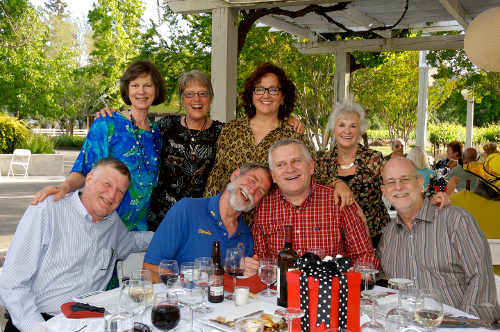
UKIAH, Calif. – This year’s “Gala on the Green,” Mendocino College Foundation’s annual fundraiser to benefit Mendocino College students and programs, will take place Saturday, June 23, at Campovida, 13601 Old River Road, Hopland.
The dinner will feature DK Catering and fine wines provided by Destination Hopland wineries.
The annual fundraiser includes appetizers and wine pairings, dinner, live and silent auctions, music by the George Husaruk Jazz Trio and dancing.
The gala begins at 5:30 p.m. and will be preceded by optional activities including an informational talk by Hubert Germain-Robin of Germain-Robin Distillery and a tour of the Campovida gardens between 4 p.m. and 5:30 p.m.
“This year’s line up of food pairings and fine wines prior to dinner, and the dinner itself, will not disappoint,” said Richard Cooper, foundation board member and chair of the Special Events Committee. “The entertainment also promises to be outstanding, and we look forward to having fantastic offerings in the live and silent auctions. Guests should also plan to arrive early to see Campovida’s gardens prior to the event. The garden tour is a real treat.”
Tickets for the event are $100 per person. Tables, with seating for eight people each, may be reserved for $700.
More than half the tables have sold, according to Katie Fairbairn, the foundation’s executive director; individuals wishing to attend should purchase their tickets soon, she said.
Additional information about tickets and table reservations is available on the foundation’s Web site, http://foundation.mendocino.edu .
Proceeds from the event are used to fund scholarships for students and provide support for college programs as recommended by the administrators.
Last year’s Gala on the Green raised more than $60,000 for scholarships and educational programs.
Expanding the “footprint” of the event by utilizing more of the Campovida grounds, the foundation’s Special Events Committee is planning for 400 guests this year for the largest gala ever.
“The Foundation is proud to be able to grow this event annually to help build awareness and raise funds to benefit the students of Mendocino College,” said Cooper.
DK Catering will prepare this year’s dinner. Event coordinator Travis Scott worked with the catering company’s husband and wife team, Dave and Patricia Huerls, to create “a wonderful menu of family-style dishes for the main dinner.” DK Catering also will produce four appetizer reception stations, Scott said.
The meal will consist of a Caesar salad, grilled chicken penne pasta with roasted mushrooms, red onions, sweet peppers and Chardonnay cream, plus Tuscan ravioli with tomatoes, herbs, Parmesan and light cream served with bread and butter. Dessert will be the chef’s choice.
The gala’s welcome reception is an added feature this year, according to the Mendocino County event planner and tour coordinator.
Eight wineries from Destination Hopland are scheduled to pour varietals during the wine and appetizers reception.
Participating wineries include Weibel, Parducci, Nelson Family Vineyards, Campovida, Cesar Toxqui, and Terra Savia, according to Scott.
Mendocino and Lake County food purveyors, including Stan’s Maple Café and Nicholas Petti of Mendocino College’s Culinary Arts Program, will join DK Catering in providing the appetizers.
Foundation board member and Mendocino Sheriff Tom Allman is tapped as the master of ceremonies for the evening’s presentations and live auction.
Several sponsors are lending their support to the foundation to present the Gala on the Green. Campovida LLC is a “Presenting Sponsor” for the event. Use of Campovida, the setting for the annual event the last four years, is provided by owners Gary Breen and Anna Beuselinck.
Additional sponsors for this year’s event are Mendo Lake Credit Union, the Skunk Train, TLCD Architecture, Richard Cooper, SHN Consulting and Gary Smith.
Wells Fargo Advisors has offered to sponsor the appetizers for the event while the Lake County Friends of Mendocino College is sponsoring the Gala’s Dessert Bar.
Midstate Construction is the sponsor for the martini bar. Kit Elliott and George Husaruk have once again signed up to sponsor the live music, which is provided by Husaruk and his band.
Most recently, Ukiah Valley Medical Center, Savings Bank of Mendocino County, Wright Contracting, Jared Huffman for Congress, Gary Nix, and State Farm Insurance agents Jay and Lisa Epstein signed up as sponsors, Cooper reported. Also, Tri County Certified Inspections has donated its inspection services.
For more information about the annual Gala on the Green or about the Mendocino College Foundation, call the foundation office at 707-467-1018 visit the foundation’s Web site, http://foundation.mendocino.edu .
- Details
- Written by: Lake County News reports
AB 2284, a bill by Assemblymember Wesley Chesbro (D-North Coast) to crack down on offenders who pollute the environment and endanger the public by growing or manufacturing illegal drugs on forest lands, is headed to the Assembly Floor for a vote after it was approved by the Appropriations Committee.
After recent amendments, AB 2284 would increase the penalties for those convicted of production or cultivation of a controlled substance on resource lands and timberland preserve zones of more than 50,000 acres.
“To address concerns surrounding the broad timberland definition originally included in the bill, I have continued to work with various interested parties to narrow the definition, which I included in the Assembly Appropriations Committee amendments,” Chesbro said. “I want to make it make it clear that the focus of this bill is on large industrial timber and public resource lands, and not smaller property owners and homeowners.”
He added, “This bill is not about the legal production or use of medical marijuana under California law. This bill is about pollution and illegal diversion of waterways, and the increasing violence that is occurring in our forests. AB 2284 is the direct outgrowth of two hearings I held this year as chair of the Joint Committee on Fisheries and Aquaculture.”
At the hearings, fisheries experts, the Department of Fish and Game and environmental groups described the increasing threat that illegal drug production represents, especially to endangered species such as the Coho salmon, Chesbro said.
AB 2284 would also, under a very limited scope, allow law enforcement to stop and question drivers transporting irrigation piping, which must be in plain view.
The vehicles must be traveling on gravel or unpaved roads within public resource land or timber preserve zones of more than 50,000 acres.
Law enforcement would not be able to stop and question those transporting irrigation piping on timber preserve zone lands under 50,000 acres unless the landowner has filed a written statement giving law enforcement permission to so.
“On many occasions law enforcement officers have seen people entering these resource lands with irrigation supplies in plain sight,” Chesbro said. “They do not have the authority to pull them over and simply ask questions, possibly stopping a marijuana cultivation site before it is planted. Preventing a site from being established is the best way to protect the forests and watersheds, safeguard the public and reduce the risk to law enforcement officers, who often face armed suspects while investigating established sites.”
- Details
- Written by: Dennis Fordham
Life is not static and neither should be anyone’s living trust.
Adjustments have to be made when compelling circumstances arise which necessitate alternative approaches.
For that reason a well drafted living trust should provide contingency planning alternatives.
Unforeseen circumstances could relate to the settlors themselves, to the trust assets, or to the beneficiaries.
Let us consider some possible scenarios and how a trust could be drafted to provide suitable alternative solutions.
First, the settlor's own circumstances could dramatically change.
A settlor might require admission into a skilled nursing home and wish to apply for Medi-Cal assistance to help pay the costs.
In that case, the settlor’s trust might authorize gifting of assets to family in order to accelerate his or her eligibility and/or to preserve the gifted assets against eventual estate recovery by Medi-Cal of assets exempt for eligibility purposes only after then settlor dies.
Second, the assets that are available to distribute to the beneficiaries could be significantly different than those the settlor owned when he or she drafted the trust.
Some or all of the important original trust assets that were specifically devised may have been given away, sold, and new ones acquired.
Also, debts owed by the decedent may wipe out a large portion of the estate leaving much less to be distributed to any beneficiaries who receive a percentage of the remaining trust estate.
For these reasons, a trust may provide alternative distribution schemes consistent with the decedent’s wishes should the estate be dramatically changed.
Third, the beneficiaries own life situations at the time of distribution may be significantly different.
That is, some beneficiaries may have died, may be receiving needs based SSI or Medi-Cal benefits, may have debt issues, may be involved in a divorce, may be incarcerated or otherwise incapable of managing their own affairs. Thus, the trust may authorize the trustee to pursue more appropriate alternatives.
Specifically, in the case of a deceased beneficiary, the trust may permit the trustee to distribute to alternative beneficiaries if a primary beneficiary, who survived long enough to inherit, has died prior to receiving the full inheritance – such alternative beneficiaries could either be named in the deceased settlor’s trust instrument or, if authorized, in the deceased beneficiary’s own will pursuant to a power of appointment.
In regards to a beneficiary receiving SSI/Medi-Cal, the trust could redirect the inheritance into a special needs trust to assist such beneficiary.
In the case of beneficiaries who have creditor or divorce issues, the trust could authorize the trustee to withhold all or part of distribution for any period of time up to an including the beneficiary’s entire lifetime and to utilize the withheld inheritance to assist the beneficiary.
Lastly, regarding a beneficiary who is incarcerated or otherwise incapable of managing an inheritance, the trust may authorize that the trustee either retain and manage the inheritance in further trust or use the inheritance to purchase a single premium annuity for the beneficiary (to stretch out the payments over the beneficiary’s lifetime or term of years).
As more time passes since when the trust was drafted the more changes occur and the more likely it becomes that the original plan as conceived will become either partially or completely inappropriate given the new circumstances.
It is, therefore, only good planning to draft flexibility into a trust to allow the trustee maneuvering room to respond to unforeseen circumstances.
Needless to say, the foregoing discussion underscores why one’s estate plan should be reviewed by an attorney periodically – at least every five years – and sometimes sooner if events necessitate in order to make necessary adjustments to ensure its continued appropriateness.
Dennis A. Fordham, attorney (LL.M. tax studies), is a State Bar Certified Specialist in Estate Planning, Probate and Trust Law. His office is at 55 First St., Lakeport, California. Dennis can be reached by e-mail at