 How to resolve AdBlock issue?
News
- Details
- Written by: Lake County News reports
LAKE COUNTY, Calif. – As 2011 draws to a close, California motorists should be aware of some of the new laws going into effect Jan. 1, 2012.
These new traffic laws were passed by the Legislature and signed by the governor earlier this year, and the California Highway Patrol is asking the motoring public to familiarize themselves with the changes before they take effect.
“Our hope is by educating the public of these new traffic safety laws in advance, more lives will be saved in the new year,” said CHP Commissioner Joe Farrow.
The following are highlights of a few of the significant changes for the upcoming year.
SB 929, Evans
A change to California’s child passenger safety seat law will now require children to ride in either a car seat or booster seat until the age of eight, or until they reach a height of 4 feet 9 inches.
This law also requires children who do not meet the age or height requirement to ride in the rear seat of a vehicle unless the vehicle has no back seats, the restraint system cannot be properly installed or the rear seats are already occupied by children under age 8.
However, the law still maintains that a child may not ride in the front seat of a vehicle with an active passenger airbag if they are under one year of age, less than 20 pounds, or riding in a rear-facing child safety seat.
AB 353, Cedillo
This new law requires drivers to stop and submit to a sobriety checkpoint. However, peace officers will be prohibited from impounding a vehicle for 30 days out of a sobriety checkpoint if the only offense by the driver is failing to hold a valid driver license.
The new law requires that the officer make a reasonable attempt to identify the registered owner in order to release the vehicle.
AB 520, Ammiano
Anyone who is convicted of reckless driving under Section 23103.5 of the Vehicle Code can apply for a restricted driver license prior to the completion of their one-year suspension, provided they meet specified conditions, including the installation of an Ignition Interlock Device in their vehicle.
AB 1105, Gordon
Vehicles will be prohibited from crossing double parallel solid white lines except where permitted.
AB 348, Buchanan
A segment of Vasco Road between I-580 in Alameda County and Walnut Boulevard in Contra Costa County has been redesignated as a double fine zone until Jan. 1, 2017.
AB 475, Butler
Electric vehicles (EV) must now be plugged in for refueling when occupying an EV-designated parking space, otherwise they may be towed.
In addition, the law prohibits a person from obstructing, blocking, or otherwise barring access to an EV-designated parking space.
AB 61, Jeffries, and SB 290, Correa
The county of Riverside, or any city within the county, has been permitted to develop a neighborhood electric vehicle transportation plan.
AB 628, Conway
Inyo County, using a pilot program, has been granted authority to explore options for developing a greater network of linked Off-Highway Vehicle trails; they will be allowed to designate combined use highways on unincorporated county roads for up to 10 miles, subject to CHP approval.
This program will remain in effect until Jan. 1, 2017.
AB 607, Brownley
The city of Santa Monica can now operate 25 city-owned buses with illuminated signs displaying advertising messages.
This pilot program is authorized through Jan. 1, 2017.
AB 1298, Blumenfield
Local governments can now regulate advertising signs on any motor vehicle parked or left standing upon a public street, except for signs painted directly upon or permanently affixed to the vehicle for permanent decoration, identification, or display that do not extend beyond the overall length, width, or height of the vehicle.
AB 349, Chesbro
Licensed livestock carriers can continue to travel on Highway 101 within the counties of Del Norte, Humboldt and Mendocino from its junction with Highway 1 near Leggett, north to the Oregon border until Jan. 1, 2015.
AB 1601, Hill
A law dealing with repeat driving under the influence offenders that was passed in 2010 also goes into effect on Jan. 1.
Section 23579 was added to the Vehicle Code, which authorizes courts to revoke a driver’s license for 10 years if a person is convicted of three or more DUIs.
Under this law enacted in 2010, a motorist may be allowed to apply for reinstatement of his or her driver’s license with the Department of Motor Vehicles after five years, if the person installs an Ignition Interlock Device in their vehicle.
The law allows the DMV to terminate this restricted license if the Ignition Interlock Device requirements are not met.
The points above are only a synopsis of the new laws listed here and only a partial list of California’s new laws adopted for 2012.
For complete information on chaptered bills enacted in 2011, please refer to the Legislative Counsel Web site at www.leginfo.ca.gov.
Follow Lake County News on Twitter at http://twitter.com/LakeCoNews, on Tumblr at www.lakeconews.tumblr.com, on Google+, on Facebook at www.facebook.com/pages/Lake-County-News/143156775604?ref=mf and on YouTube at www.youtube.com/user/LakeCoNews .
- Details
- Written by: Lake County News reports
The 79 stores on the list, released Thursday, include no California Kmarts, and only three California Sears stores.
Lakeport has one Kmart, and there are no full-line Sears stores in Lake County, only “hometown stores” in Lakeport and Clearlake, the corporation reported.
Sears Holdings Corp. had said Tuesday that it intended to close as many 120 stores in response to declining sales in some categories.
The move is expected to generate between $140 and $170 million as inventory is sold and real estate is sold or leased, as Lake County News has reported.
The Thursday closures list has only one West Coast Kmart – one in Lacey, Wash. – with most of the closures appearing to come in the Midwest and Southern states.
Among the Sears stores slated for closure, those in California are located in San Diego, where there will be two store closures, and El Monte.
A typical store slated for closure employs between 40 and 80 associates, the corporation reported.
“Employment varies by store and format and at this time we cannot provide the total number of impacted associates,” according to the statement.
Sears Holdings Corp. operates 1,307 Kmart stores across 49 states, Guam, Puerto Rico and the U.S. Virgin Islands, and 890 full-line Sears stores.
Follow Lake County News on Twitter at http://twitter.com/LakeCoNews, on Tumblr at www.lakeconews.tumblr.com, on Google+, on Facebook at www.facebook.com/pages/Lake-County-News/143156775604?ref=mf and on YouTube at www.youtube.com/user/LakeCoNews .
- Details
- Written by: Lake County News reports
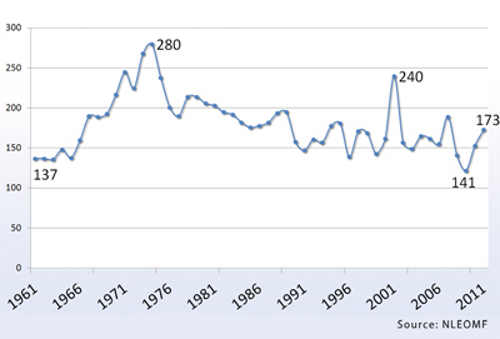
For the second straight year, law enforcement fatalities nationwide rose sharply with 173 federal, state and local officers killed in the line of duty during 2011, according to preliminary data compiled and released today by the National Law Enforcement Officers Memorial Fund.
This represents a 13 percent increase over the 153 officers killed in 2010 and an alarming 42 percent spike when compared to the 122 officers who lost their lives in the line of duty in 2009, the group reported.
The primary cause of death in 2011 was gunfire, which claimed the lives of 68 officers and nearly matched the decade-long high of 69 firearms-related deaths in 2007, the report showed.
For the past 13 years in a row, traffic-related incidents had been the primary cause of law enforcement fatalities.
In 2011, though, the number of officers killed on the roadway dropped by 10 percent. There were 64 traffic-related deaths among officers in 2011, which matched 2005 for the second-lowest total in the past 15 years.
Of that total, 44 died in automobile crashes, 11 were struck and killed while outside of their vehicles, seven died in motorcycle crashes and two were killed when their car was struck by a train.
“Drastic budget cuts affecting law enforcement agencies across the country have put our officers at grave risk,” declared National Law Enforcement Officers Memorial Fund Chairman Craig W. Floyd. “At a time when officers are facing a more cold-blooded criminal element and fighting a war on terror, we are cutting vital resources necessary to ensure their safety and the safety of the innocent citizens they protect.”
Floyd also noted that the National Law Enforcement Officers Memorial Fund is partnering with the U.S. Department of Justice and the National Highway Transportation Safety Administration, among others, on a number of law enforcement safety initiatives to combat this growing problem.
Floyd cited a recent survey by the International Association of Chiefs of Police that found 60 percent of responding law enforcement agencies had cut back on training, 64 percent had cut back on buying or upgrading major equipment, and 58 percent had cut back on buying or upgrading technology.
A report issued in October by the U.S. Department of Justice, Office of Community Oriented Policing Services, stated that by year’s end, it is expected that nearly 12,000 police officers and sheriff’s deputies will have been laid off.
In addition to the officers killed by firearms or traffic-related incidents, 27 officers died as a result of job-related illnesses, four died as a result of falls, two drowned and two were stabbed.
One officer died due to each of the following causes: aircraft accident, beating, bomb-related incident, struck by a falling object, electrocution and strangulation, according to the report.
During the past year, more officers were killed in Florida, 14, than in any other state; followed by Texas with 13; New York with 11; and California and Georgia with 10 each.
Ten of the officers killed nationwide in 2011 served with federal law enforcement agencies. Seven of the officers who died during the past year served with correctional agencies. Eleven of the 173 fatalities were women.
On average, the officers who died in 2011 were 41 years old and had served for 13 years.
The preliminary 2011 law enforcement fatality report was released by the National Law Enforcement Officers Memorial Fund in conjunction with Concerns of Police Survivors (C.O.P.S.), a nonprofit organization that provides critical assistance to the surviving family members and loved ones of officers killed in the line of duty.
“The hard fact is that for the first time in 2011, more officers were killed in firearms-related incidents than traffic-related incidents,” said Linda Moon Gregory, national president of Concerns of Police Survivors.
“I’m deeply concerned that budget constraints may be compromising the safety of our remaining law enforcement officers due to cuts in personnel and reduced affordability of life saving equipment. At a time when criminals have the latest technology and weapons, we must ensure that our peace officers are adequately equipped and protected,” she stated.
Her brother, Officer James Homer Moon from the sheriff’s office in Jacksonville, Fla., was shot and killed in the line of duty in September 1971 and Gregory’s family continues to deal with parole issues related to her brother’s death.
The statistics released by the National Law Enforcement Officers Memorial Fund and C.O.P.S. are based on preliminary data compiled and do not represent a final or complete list of individual officers who will be added to the National Law Enforcement Officers Memorial in 2011.
Follow Lake County News on Twitter at http://twitter.com/LakeCoNews, on Tumblr at www.lakeconews.tumblr.com, on Google+, on Facebook at www.facebook.com/pages/Lake-County-News/143156775604?ref=mf and on YouTube at www.youtube.com/user/LakeCoNews .
- Details
- Written by: Lake County News reports
One center of attention will be the manual survey scheduled for 11 a.m. off Highway 50 near Echo Summit. This and other manual and electronic surveys up and down the state will determine the amount of water in the early winter snowpack.
Statewide electronic readings indicate that Wednesday’s snowpack water content – near the end of an unusually dry December – is only 24 percent of normal for the date.
On Dec. 27, 2010, the statewide snowpack water content was 202 percent of average.
Despite the low early readings, the snowpack and its water content can be expected to increase through the winter months to April 1, when melting snow begins flowing into streams and reservoirs.
“Thanks to good reservoir storage left over from last winter’s storms, we anticipate an adequate water supply next summer,” said DWR Director Mark Cowin. “Our initial estimate is that we’ll be able to deliver 60 percent of the slightly more than 4 million acre-feet of water requested from the State Water Project, and we hope to increase the percentage as winter storms develop.”
The initial delivery estimate for this calendar year was only 25 percent of the slightly more than 4 million acre-feet requested by the 29 public agencies that distribute State Water Project water to 25 million Californians and nearly a million acres of irrigated farmland.
As winter took hold, a near-record snowpack and heavy rains sweeping the state resulted in deliveries of 80 percent of requests in 2011.
The final allocation was 50 percent in 2010, 40 percent in 2009, 35 percent in 2008, and 60 percent 2007. The last 100 percent allocation – difficult to achieve even in wet years because of Delta pumping restrictions to protect threatened and endangered fish – was in 2006.
DWR and cooperating agencies conduct manual snow surveys around the first of the month from January to May. The manual surveys supplement and check the accuracy of real-time electronic readings as the snowpack builds then melts in spring and summer.
Most of the state’s major reservoirs are above normal storage for the date.
Lake Oroville in Butte County, the State Water Project’s principal storage reservoir, is at 115 percent of average for the date, or 72 percent of its 3.5 million acre-foot capacity.
Lake Shasta north of Redding, the federal Central Valley Project’s largest reservoir with a capacity of 4.5 million acre-feet, is 108 percent of average for the date, or 68 percent of capacity.
San Luis Reservoir in Merced County, an important storage reservoir south of the Delta, is at 139 percent of average for the date, or 94 percent of capacity.
San Luis, with a capacity of 2,027,840 acre-feet, is a critically important source of water for both the State Water Project and the Central Valley Project when pumping from the Delta is restricted or interrupted. An acre-foot is 325,851 gallons, enough to cover one acre to a depth of one foot.
The mountain snowpack that melts into reservoirs, streams and aquifers provides approximately one-third of the water for California’s households, industries and farms.
Statewide snowpack readings are available on the Internet at http://cdec.water.ca.gov/cgi-progs/snow/DLYSWEQ.
Electronic reservoir level readings may be found at http://cdec.water.ca.gov/cdecapp/resapp/getResGraphsMain.action.
Follow Lake County News on Twitter at http://twitter.com/LakeCoNews, on Tumblr at www.lakeconews.tumblr.com, on Google+, on Facebook at www.facebook.com/pages/Lake-County-News/143156775604?ref=mf and on YouTube at www.youtube.com/user/LakeCoNews .