How to resolve AdBlock issue?
Refresh this page
How to resolve AdBlock issue?
Refresh this page
Lake County News,California
  • Home
    • Registration Form
  • News
    • Community
      • Obituaries
      • Letters
      • Commentary
    • Education
    • Veterans
    • Police Logs
    • Business
    • Recreation
    • Health
    • Religion
    • Legals
    • Arts & Life
    • Regional
  • Calendar
  • Contact us
    • FAQs
    • Phones, E-Mail
    • Subscribe
  • Advertise Here
  • Login
How to resolve AdBlock issue?
Refresh this page
How to resolve AdBlock issue?
Refresh this page

News

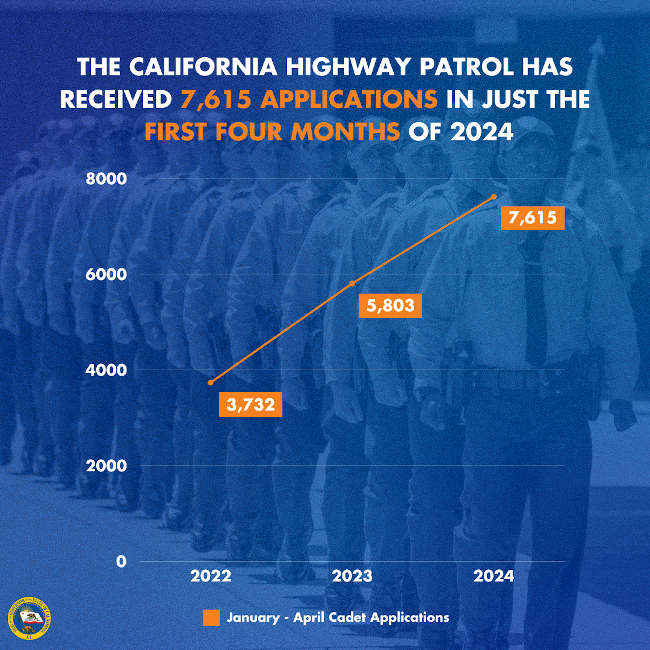
CHP continues to receive increased applications


Updated data released from the California Highway Patrol shows more people are applying to join the nation’s largest public-facing state law enforcement agency.

In the last four months, the CHP has received 7,615 applications, an increase from 2023 and 2022 which saw 5,803 applications and 3,732, respectively, in the same period.

“The officers of the California Highway Patrol are the best of the best, committing daily to public service and public safety,” said Gov. Gavin Newsom. “I encourage more Californians to answer the call to serve their neighborhoods and continue helping build community-oriented bridges across California.”

“Recruitment for the CHP is more than just filling vacant positions; it’s about finding individuals who embody our professional values and are passionate about a career dedicated to serving the public,” said CHP Commissioner Sean Duryee. “The surge in interest reflects not only a desire to serve, but also a recognition of the noble calling of policing.”

You can be one of the new CHP officers ready to make a difference. Apply and register for an upcoming hiring seminar here.

Marking progress to fulfill the administration’s multi-year campaign to recruit 1,000 new CHP officers from the state’s diverse communities, more than 300 cadets have been sworn in as officers this year.

To accommodate the interest, the CHP is holding multiple Academy classes simultaneously for the first time in the department’s history, with three more classes completing training this year.

The next CHP Academy graduation is scheduled for July 12.

The CHP is the largest public-facing state law enforcement agency in the United States with over 6,500 sworn officers assigned across California.

Following the launch of the CHP 1000 recruitment campaign and other recent recruitment efforts and hiring investments — including a new recruitment web series “Cadets” — CHP reports that there have been an average of about 1,900 applicants a month since the start of the year.

California has invested expanded resources and personnel since 2019 to fight crime, help local governments hire more police, and improve public safety.

In 2023, as part of California’s Real Public Safety Plan, the Governor announced the largest-ever investment to combat organized retail crime in state history, an annual 310% increase in proactive operations targeting organized retail crime, and special operations across the state to fight crime and improve public safety.
Details
Written by: LAKE COUNTY NEWS REPORTS
Published: 19 May 2024

Space News: The northern lights came to California — but will it happen again?

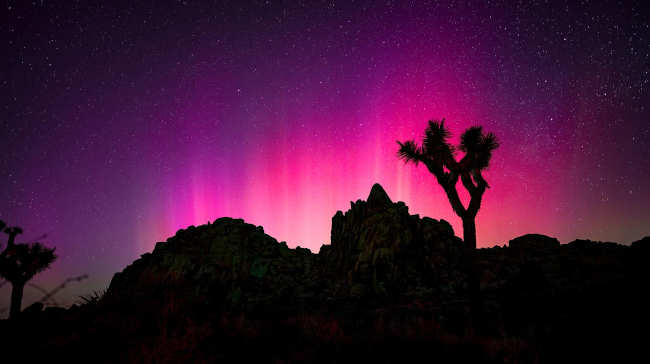
The Aurora borealis, visible from Joshua Tree National Park, from Friday, May 10 to Saturday, May 11, 2024. "At the aurora’s peak around 11:30 p.m. and again at 1:30 a.m., the sky was noticeably red, and streaks of lights could be seen without the assistance of a camera. It was pretty incredible to watch," says photographer Erik Jepsen, photographer for UC San Diego Publications, who kindly provided the photos above and below.


If you were in California this past week, you probably spent more time than usual gazing at the stars.

Why? Because the Northern Lights, or Aurora Borealis, made a surprise trip down to the continental United States, lighting up skies as far south as Joshua Tree and giving Californians a rare look at a celestial show that usually requires getting on a plane.

Those that missed it (or those who caught it and loved it) may wonder if this was this a once-in-a-lifetime opportunity, or if it could happen here again. To find out, we asked three experts at the UC Berkeley Space Sciences Laboratory, Chris Chaston, Harald Frey and Yan Li. Chaston and Frey are research physicists and Li is an associate research physicist at the lab.

Q: First things first — what are the Northern Lights? Why do we call them that? Where are they usually seen?

Chris Chaston (CC): The Northern Lights, or Aurora Borealis, are emissions of light from atoms and molecules in the upper atmosphere stimulated by collisions with energetic electrons and ions streaming downward from near-Earth space. They are usually seen at high latitudes — above 60 degrees and during the night when the light becomes visible. They occur in an oval roughly centered around the poles. In the Southern Hemisphere they are referred to as the Aurora Australis.

Harald Frey (HF): There is a widespread misconception that aurora on Earth is generated by energetic particles coming directly from the sun. The real processes are more complicated. The sun continuously emits the solar wind, as a stream of energetic electrons and protons that carries electric and magnetic fields with it. The interaction of these fields with the Earth’s magnetic field distorts it and transfers energy into it. Our magnetic field cannot accumulate endless amounts of energy and has to release this excess energy. This energy release generates energetic electrons in the so-called auroral acceleration region about 6000 kilometers above ground. When these energetic electrons collide with the atoms and molecules of the upper atmosphere at about 100-200 km altitude, these atoms and molecules emit light that we consider as aurora. Very often we refer to is as just aurora or polar lights that occur in the north and south.

Q: Why do you think people are fascinated by the Northern Lights?

HF: You have to consider the aspect of surprise. You likely look up into the sky hundreds of times and nothing is happening, except for the occasional meteor. But when suddenly the whole sky lights up, changes color, and forms change and dance around, you are admiring what nature is capable of doing.

CC: Because it’s one of those things that ‘blows you away’ when you see it in full swing. It’s not just the light itself, but more how it moves or ‘dances’ — like a kaleidoscope in the sky, truly wonderful.

Q: Did you get a chance to see the lights over California this past weekend?

CC: I missed it on Friday night but I did try after sunset on Saturday from a high point in the Bay area. It was perhaps just a faint glow above the horizon to the North. I read of people driving up to Shasta on Friday who saw a good show late in the evening.

Q: Why were they visible in California over the past weekend, and as far south and east as Florida? Is that normal — or worrisome?

CC: There was a major geomagnetic storm over the weekend due to the shedding of matter and magnetic field from the Sun in the form of a series of coronal mass ejections (CMEs) that collided with Earth, or more specifically Earth’s magnetic field. Under these circumstances Earth’s magnetic field gets compressed and the low latitude edge where those energetic particles stream downward to collide with the atmosphere moves southward in the Northern Hemisphere. This southward shift is related to the strength of the storm. The weekend’s storm was a particularly strong event such that the aurora could be seen from Northern California and the southern states. It’s not something to be especially worried about, but it can impact the power grid due to currents induced in electrical transmissions lines and radio communications may be disrupted due to variations in the upper atmosphere or more correctly the ionosphere.

HF: The impact of such geomagnetic storms on the ground is generally rather limited, but similar events in the past have caused damage to electric power lines and transformers. More worrisome is the potential damage to satellites in orbit around the Earth. The energetic electrons can damage the electronic components of satellites and make them unusable. One way to limit damage to satellites is to turn them off temporarily, which was actually done with the three THEMIS satellites around Earth that are managed by our UC Berkeley Space Sciences Laboratory. Many other satellite operators must have taken similar precautions.

Q: Some reports suggest that this may happen in the continental U.S. more frequently in the next few years. Do you agree with that? Why is that?

Yan Li (YL): Solar flares and CMEs as energetic solar activity are more frequent during the maximum of the solar cycle. These violent solar activity produce intense solar energetic electrons and ions. The Sun is on the rising phase of the solar cycle and approaching its activity maximum soon. Therefore, it is reasonable to expect more frequent aurora sightings in the next few years.

CC: Solar cycle prediction is an evolving art and sometimes things don’t work out as expected, but around 11 years is the average and we are close to the peak now, I think. Here’s a link to the sunspot number charts that define where we are in the solar cycle: Solar Cycle Progression | NOAA / NWS Space Weather Prediction Center.

On a short-term basis ‘hotspots’ on the Sun can stick around for a while, so with an average solar rotation period of 4 weeks there could be some increased auroral action in a little under a month from now.

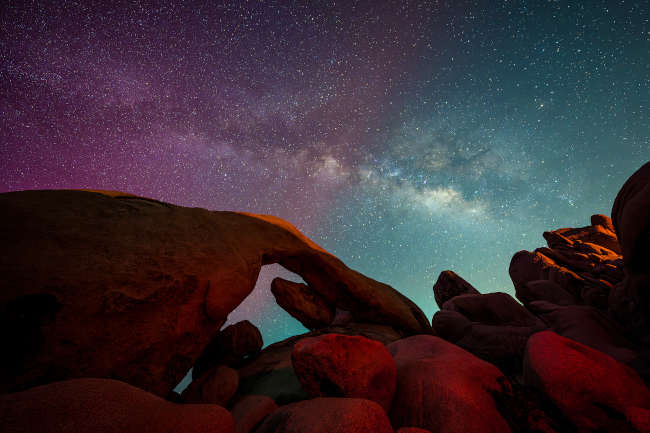
Aurora borealis, in shades of magenta to pink, to teal, over a rock formation in Joshua Tree National Park. Photo by Erik Jepsen.


Q: Why do the Northern Lights appear in different colors here than the usual green we see in photos from Alaska?

CC: The color of light that is seen is dependent on the atmospheric composition and the energy and type of colliding particle that stimulates the light emitted. The classic green aurora is due to energized electrons colliding with atomic oxygen and is the most common auroral emission reported. At lower latitudes, such as here in California, the downward streaming electrons which stimulate the light seen from the ground have a different distribution in energy than those observed at high latitudes and the aurora is only observed from the side looking northward, rather than from below. These factors lead to us observing different colors and mixtures of colors.

Q: Can they be seen by the naked eye? Why are iPhones so much better at capturing them?

CC: Certainly, the aurora is observed by the naked eye. Cameras with long exposure times and sensitive light sensors (CCD and CMOS) can capture faint aurora but the best way to view the Northern Lights for the amateur observer is with the naked eye.

HF: The human eye is most sensitive to green light, less to red, and even less to blue. The optical detectors of iPhones try to mimic the human eye sensitivity as best as possible but they are still more sensitive to red. Therefore a mix of blue/green/red will appear slightly different to the naked eye and on a picture taken by the phone.

Q: Is there any way to know when they will be visible near us? (Friends of mine now send me solar forecasts, but I have no idea how to interpret them!)

CC: Yes. I can suggest NOAA’s Space Weather Prediction Center’ at Homepage | NOAA / NWS Space Weather Prediction Center that provides forecasts every day.

YL: The accuracy of Solar forecasts for flares and CMEs are improving, but it’s still very difficult. Even when a forecast of flare or CME is successful, the direction of the energetic electrons produced needs to be right to reach the earth. So, a direct forecast of auroral sightings is not simple. But when there are super strong flares (like X-class flares) and super fast (>1000km/s) CMEs, energetic electrons produced can span a large angle, sometimes almost in all directions around the Sun, in which cases we might be in luck for auroral activity while we might also be in 'luck' for blackouts and loss of satellite communications, using cell phones etc.

Q: If you really want to see the Northern Lights, should you wait for them to come to California, or where might you go?

CC: You might be waiting a long time to see it here again in California and even then, you will likely not see it at its best. If you want to see the aurora in all its glory, I would suggest booking into a hotel near Fairbanks, Alaska for a couple of weeks during mid-winter.

HF: Other good places are northern Norway, Sweden, and Finland and central Canada. You need a clear sky and as little moonlight as possible. There is aurora over Iceland, but this region is known for many cloudy days and coastal fog. The weather is more stable in inland regions, like Fairbanks, Alaska.

Q: What if you want to go somewhere warmer?

CC: You can also see aurora in the Southern Hemisphere. This past weekend I heard it was good from Hobart, Tasmania, and was supposed to be visible all the way up to Coffs Harbour in New South Wales, Australia, although I have not searched for images.

Q: When should I plan this kind of trip, in terms of timing around solar cycles?

CC: Aurora is observed throughout the solar cycle at high latitudes. I spent several weeks in Fairbanks in the winters of 1996 and 1997, i.e., around solar minimum, and saw some fantastic displays. So I would not be too concerned with the timing — just make sure there is plenty of darkness and as Harald pointed out it’s better if the moon is out of view.

HF: Last week you would not have seen the bright aurora from Fairbanks because the aurora was much too far south. May through August are bad times for aurora viewing from Alaska because the sun does not completely set in the far northern regions and the background light would have made it difficult (impossible?) to see aurora, even if it were there. If you want to have it warm while watching the Northern Lights, you have to stay in California and wait for the rare ~10-year event.

Q: When you look for the Northern Lights, what direction should you be looking in?

CC: This depends on where you are, but in the continental U.S. just looking north is a good start.

Chris Chaston has been studying the physics of auroral particle acceleration since arriving at UC Berkeley in 1996. This work has involved NASA’s FAST, POLAR, THEMIS and Van Allen Probes missions, the European Space Agency’s Cluster mission and Japan’s Reimei satellite as well as sounding rockets. His work on this topic has focused on the physics of Alfvén waves and how these waves can drive auroral arc formation through the acceleration of ions and electrons.

Harald Frey received his education in Germany and joined the Space Sciences Laboratory at UC Berkeley in 1997. He has been working on the detection and analysis of optical phenomena in near-Earth space using cameras on satellites and on the ground. He was the instrument scientist for the Far Ultraviolet Imager on the NASA IMAGE mission that observed aurora, the U.S. project scientist for the Imager for Sprites and Upper Atmospheric Lightning (ISUAL), and instrument scientist for the Far Ultraviolet Imager on the NASA Ionospheric Connection Explorer (ICON). He is now retired.

Yan Li has been a research physicist at the UC Berkeley Space Sciences Laboratory since 1999 and is an expert on solar coronal mass ejections that trigger aurora events. Before arriving at UC Berkeley more than 20 years ago, her work carried her from the Institute of Space Physics at the Space Academy in Beijing, China, the University of Sydney in Australia and Kyushu University in Japan.

Robyn Schelenz writes for the University of California newsroom.


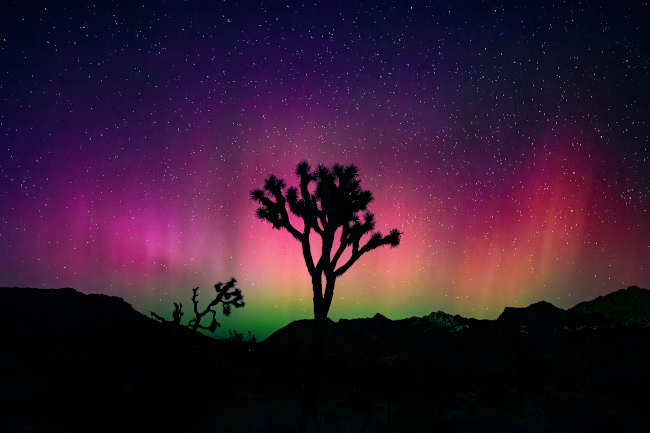
Aurora borealis, in shades of green leading up to orange, pink and dark purple, shines over a Joshua tree in Joshua Tree National Park. Photo by Erik Jepsen.
Details
Written by: Robyn Schelenz
Published: 19 May 2024

Avenue of the Flags seeks volunteers

The Avenue of the Flags. Courtesy photo.

LAKE COUNTY, Calif. — On Memorial Day — Monday, May 27 — the flags of fallen veterans will be flown at cemeteries throughout Lake County.

The Avenue of Flags members, with the help of volunteers, will install flagpoles and mount large flags which once draped the caskets of fallen veterans along the avenue of the county cemeteries.

Veterans flags will be flown at the following cemeteries: Lower Lake, Hartley in Lakeport, Kelseyville and Upper Lake.

Organizers ask community members to help respect veterans by volunteering to help place the flags at the participating cemeteries between 6:30 and 8 a.m. on Memorial Day, weather permitting.

Taking down of flags and poles will happen at various times starting at around 3 p.m. but check with the coordinators at each site for the exact time.

They will conclude the day with the folding of the flags.

Anyone willing to volunteer at any of the participating cemeteries would be greatly appreciated.

Information is available from Mike Dean, coordinator of the Avenue of the Flags, at 510-206-6531.
Details
Written by: LAKE COUNTY NEWS REPORTS
Published: 18 May 2024

Dow tops 40,000 as stock indexes continue to cross milestones − making many investors feel wealthier


Major stock indexes were hitting or nearing records in February 2024, as they were in early 2020 when this TV chyron appeared. AP Photo/Richard Drew

The Dow Jones Industrial Average topped 40,000 for the first time on May 16, 2024. It spent the next few hours hovering around that mark, occasionally dipping under. But the breakthrough, even if fleeting, nonetheless marks another symbolic milestone in a monthslong bull market, coming three months after the S&P 500 index surpassed 5,000 for the first time.

The Conversation asked Alexander Kurov, a financial markets scholar, to explain what stock indexes are and to say whether these kinds of milestones are a big deal or not.

What are stock indexes?

Stock indexes measure the performance of a group of stocks. When prices rise or fall overall for the shares of those companies, so do stock indexes. The number of stocks in those baskets varies, as does the system for how this mix of shares gets updated.

The Dow Jones Industrial Average, also known as the Dow, includes shares in the 30 U.S. companies with the largest market capitalization – meaning the total value of all the stock belonging to shareholders. That list currently spans companies from Apple to Walt Disney Co.

The S&P 500 tracks shares in 500 of the largest U.S. publicly traded companies.

The Nasdaq composite tracks performance of more than 2,500 stocks listed on the Nasdaq stock exchange.

The DJIA, launched on May 26, 1896, is the oldest of these three popular indexes, and it was one of the first established.

Two enterprising journalists, Charles H. Dow and Edward Jones, had created a different index tied to the railroad industry a dozen years earlier. Most of the 12 stocks the DJIA originally included wouldn’t ring many bells today, such as Chicago Gas and National Lead. But one company that only got booted in 2018 had stayed on the list for 120 years: General Electric.

The S&P 500 index was introduced in 1957 because many investors wanted an option that was more representative of the overall U.S. stock market. The Nasdaq composite was launched in 1971.

You can buy shares in an index fund that mirrors a particular index. This approach can diversify your investments and make them less prone to big losses.

Index funds, which have existed only since Vanguard Group founder John Bogle launched the first one in 1976, now hold trillions of dollars.

Why are there so many?

There are hundreds of stock indexes in the world, but only about 50 major ones.

Most of them, including the Nasdaq composite and the S&P 500, are value-weighted. That means stocks with larger market values account for a larger share of the index’s performance.

In addition to these broad-based indexes, there are many less prominent ones. Many of those emphasize a niche by tracking stocks of companies in specific industries like energy or finance.

Do these milestones matter?

Stock prices move constantly in response to corporate, economic and political news, as well as changes in investor psychology. Because company profits will typically grow gradually over time, the market usually fluctuates in the short term while increasing in value over the long term.

The DJIA first reached 1,000 in November 1972, and it crossed the 10,000 mark on March 29, 1999. On Jan. 22, 2024, it surpassed 38,000 for the first time. Breaking through 40,000 on May 16 prompted a flurry of congratulatory news reports.

Because there’s a lot of randomness in financial markets, the significance of round-number milestones is mostly psychological. There is no evidence they portend any further gains.

For example, the Nasdaq composite first hit 5,000 on March 10, 2000, at the end of the dot-com bubble.

The index then plunged by almost 80% by October 2002. It took 15 years – until March 3, 2015 – for it to return to 5,000.

As 2024 has progressed, the Nasdaq composite has regularly closed at record highs.

Index milestones matter to the extent they pique investors’ attention and boost market sentiment.

Investors afflicted with a fear of missing out may then invest more in stocks, pushing stock prices to new highs. Chasing after stock trends may destabilize markets by moving prices away from their underlying values.

When a stock index passes a new milestone, investors become more aware of their growing portfolios. Feeling richer can lead them to spend more.

This is called the wealth effect. Many economists believe that the consumption boost that arises in response to a buoyant stock market can make the economy stronger.

Is there a best stock index to follow?

Not really. They all measure somewhat different things and have their own quirks.

For example, the S&P 500 tracks many different industries. However, because it is value-weighted, it’s heavily influenced by only seven stocks with very large market values.

Known as the “Magnificent Seven,” shares in Amazon, Apple, Alphabet, Meta, Microsoft, Nvidia and Tesla now account for over one-fourth of the S&P 500’s value. Nearly all are in the tech sector, and they played a big role in pushing the S&P across the 5,000 mark.

This makes the index more concentrated on a single sector than it appears.

But if you check out several stock indexes rather than just one, you’ll get a good sense of how the market is doing. If they’re all rising quickly or breaking records, that’s a clear sign that the market as a whole is gaining.

Sometimes the smartest thing is to not pay too much attention to any of them.

For example, after hitting record highs on Feb. 19, 2020, the S&P 500 plunged by 34% in just 23 trading days because of concerns about what COVID-19 would do to the economy. But the market rebounded, with stock indexes hitting new milestones and notching new highs by the end of that year.

Panicking in response to short-term market swings would have made investors more likely to sell off their investments in too big a hurry – a move they might have later regretted. This is why I believe advice from the immensely successful investor and fan of stock index funds Warren Buffett is worth heeding.

Buffett, whose stock-selecting prowess has made him one of the world’s 10 richest people, likes to say, “Don’t watch the market closely.”

If you’re reading this because stock prices are falling and you’re wondering if you should be worried about that, consider something else Buffett has said: “The light can at any time go from green to red without pausing at yellow.”

And the opposite is true as well.

This article is an updated version of a story that was first published on Feb. 15, 2024.The Conversation

Alexander Kurov, Professor of Finance and Fred T. Tattersall Excellence in Finance Research Chair, West Virginia University

This article is republished from The Conversation under a Creative Commons license. Read the original article.

Details
Written by: Alexander Kurov, West Virginia University
Published: 18 May 2024
  1. Clearlake Animal Control: ‘Archie,’ ‘Frannie,’ ‘Poppy’ and the dogs
  2. Clean energy keeps exceeding California’s grid demand
  3. Space News: Black holes are mysterious, yet also deceptively simple − a new space mission may help physicists answer hairy questions about these astronomical objects

Subcategories

Community

  • 670
  • 671
  • 672
  • 673
  • 674
  • 675
  • 676
  • 677
  • 678
  • 679
How to resolve AdBlock issue?
Refresh this page
Copyright © 2026 Lake County News,California. All Rights Reserved.