How to resolve AdBlock issue?
News
- Details
- Written by: Tom Philpott
The report came out earlier this month, just ahead of the Senate vote that determined “Don't Ask, Don't Tell” will remain in place, at least for the time being.
Will service members with same-sex partners qualify for the higher “with dependents” housing allowance rate? No.
Will same-sex partners qualify for military health coverage? No.
What if a gay couple is legally married in a state allowing such unions?
Still no, because the 1996 Defense of Marriage Act defines marriage, for federal program purposes, as “a legal union between one man and one woman as husband and wife” and defines “spouse” to mean “a person of the opposite sex who is a husband or a wife.”
Because this law bars the federal government from recognizing same-sex marriages, it also that blocks spousal benefits for gay partners across hundreds of federal programs including many military benefits. There are, however, active court challenges.
Will service members with same-sex partners be eligible for on-base family housing? Legally, that could be allowed. It is already is for gay civilian employees working for some federal agencies. But the study advises against opening military base housing to such arrangements.
Will gay members be able to designate partners as beneficiaries of Servicemembers’ Group Life Insurance and federal Thrift Savings Plans? Yes.
Will same-sex partners be eligible for base shopping, family support programs, legal assistance, space-available travel and relocation assistance when members move to new assignments?
Some of these benefits could be allowed. It will depend on how the Department of Defense and the services define “dependent” and “family member” for benefit eligibility. For now, if gays are allowed to serve openly, the report recommends that regulations not be revised to benefit same-sex partners, at least “for the time being.”
“Other federal agencies are managing this by establishing a domestic partner status for same-sex partners, through an affidavit or other evidence of the relationship,” the report says. “Within the military community, where benefits are much more prominent and visible…administering such a system distracts from the military’s core mission and runs counter to the Secretary of Defense’s basic direction that implementation of a repeal of Don’t Ask, Don’t Tell be done in a way that minimizes disruption to the force.”
Will members who identify themselves as gay have to use separate bathroom and shower facilities? Absolutely not, though the report acknowledges privacy concerns will become a bigger leadership challenge.
Gen. Carter Ham, commander of U.S. Army Europe, and DoD General Counsel Jeh Johnson, led the nine-month examination of the impact of repealing “Don’t Ask, Don’t Tell,” the law that for 17 years has barred homosexuals from serving openly in U.S. armed forces.
In their 350-page, two-part report, Ham and Johnson conclude it can be repealed without endangering readiness, but it will require strong leadership and careful preparation.
Ham, Johnson and a 66-person team reviewed all regulations and policies likely to need revision including those on fraternization and misconduct discharges. They held 95 face-to-face forums at 51 bases. They conducted a survey to which 115,000 members and 44,000 spouses responded on how they, their units and families would react to this change.
Marines and Army soldiers – the ground forces doing most of the fighting in Iraq and Afghanistan – reacted most negatively, with 48 percent of ground combat Marines expecting unit performance to be harmed.
But the overall response from the military community was more positive. Seventy percent of members predicted that allowing gays to serve openly would have a positive, mixed or no effect on units.
The House passed its version of the 2011 defense authorization bill with language to repeal Don’t Ask, Don’t Tell. The Senate’s defense bill had similar language but Republicans opposed repeal in the lame duck session and will gain seats for the new Congress in January.
Adm. Mike Mullen, chairman of the Joint Chiefs, testified for repeal in February saying gay Americans shouldn’t have to lie to serve their country.
That “personal opinion” then, Mullen said in an interview earlier this month, “is now my professional view – that this is a policy change that we can make. And we can do it in a relatively low-risk fashion, given the time and given the ability to mitigate whatever risk is out there through strong leadership.”
TFL TARGETED: Military retirees age 65 and older who rely on TRICARE for Life (TFL) as a golden insurance supplement to Medicare would face higher out-of-pocket costs, along with other older Americans, if Congress adopts the final plan of National Commission on Fiscal Responsibility and Reform. The plan was released Dec. 1.
Gone are some controversial provisions, such as a three-year pay freeze on the military, that had been part of a draft plan released in early November by commission co-chairmen Alan Simpson and Erskine Bowles.
But to encourage the elderly to use health care more efficiently, TFL and other Medigap plans would be barred from covering the first $500 of costs not paid by Medicare, and would cover only half of the next $5000. Thus elderly could pay up to $3000 more ($500 + $2500) annually to save $4 billion for Medicare and TRICARE through 2015.
Not found in this report are specific calls to raise TRICARE fees for working age military retirees or specific “reforms” to military retirement. But the panel wants a task force created to “re-evaluate” federal retirement plans which now are “out of line” with private sector pensions. The goal is $70 billion in federal retirement savings over 10 years.
A separate “process” should be set up to control federal health care spending including by TRICARE beneficiaries, the commission says.
To comment, send e-mail to
Follow Lake County News on Twitter at http://twitter.com/LakeCoNews , on Facebook at http://www.facebook.com/pages/Lake-County-News/143156775604?ref=mf and on YouTube at http://www.youtube.com/user/LakeCoNews .
- Details
- Written by: Elizabeth Larson
LUCERNE, Calif. – A vehicle collision knocked down a power pole in Lucerne Saturday night, resulting in a closed highway.
The California Highway Patrol reported that the vehicle hit the power pole at 14th Avenue and Highway 20 just before 9 p.m.
The CHP assisted Caltrans in closing Highway 20 at 13th and 15th avenues in order to keep motorists far from the downed lines. They routed vehicles around the area.
Fire line tape also was put up across the sidewalks to keep people from getting too close.
The downed pole was lying partially in the yard of a nearby residence.
Shortly before 11:30 p.m. a crew began working on the pole. The roadway remained closed into early Sunday morning.
A radio report indicated that Lake County Environmental Health was to be called to the scene.
E-mail Elizabeth Larson at
- Details
- Written by: Lake County News Reports

- Details
- Written by: Dr. Tony Phillips
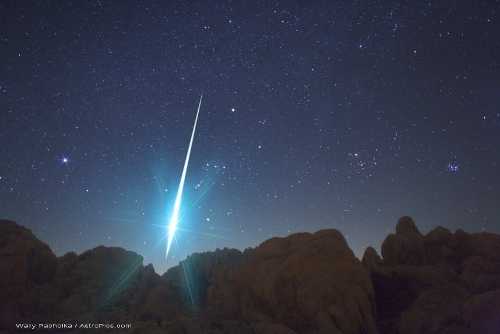
The Geminid meteor shower, which peaks this year on Dec. 13 and 14, is the most intense meteor shower of the year. It lasts for days, is rich in fireballs, and can be seen from almost any point on Earth.
It's also NASA astronomer Bill Cooke's favorite meteor shower—but not for any of the reasons listed above.
“The Geminids are my favorite,” he explains, “because they defy explanation.”
Most meteor showers come from comets, which spew ample meteoroids for a night of “shooting stars.” The Geminids are different. The parent is not a comet but a weird rocky object named 3200 Phaethon that sheds very little dusty debris – not nearly enough to explain the Geminids.
“Of all the debris streams Earth passes through every year, the Geminids' is by far the most massive,” says Cooke. “When we add up the amount of dust in the Geminid stream, it outweighs other streams by factors of 5 to 500.”
This makes the Geminids the 900-lb gorilla of meteor showers. Yet 3200 Phaethon is more of a 98-lb weakling.
In 1983, 3200 Phaethon was discovered by NASA's IRAS satellite and promptly classified as an asteroid.
What else could it be? It did not have a tail; its orbit intersected the main asteroid belt; and its colors strongly resembled that of other asteroids. Indeed, 3200 Phaethon resembles main belt asteroid Pallas so much, it might be a 5-kilometer chip off that 544 km block.
“If 3200 Phaethon broke apart from asteroid Pallas, as some researchers believe, then Geminid meteoroids might be debris from the breakup,” speculated Cooke. “But that doesn't agree with other things we know.”
Researchers have looked carefully at the orbits of Geminid meteoroids and concluded that they were ejected from 3200 Phaethon when Phaethon was close to the sun – not when it was out in the asteroid belt breaking up with Pallas.
The eccentric orbit of 3200 Phaethon brings it well inside the orbit of Mercury every 1.4 years. The rocky body thus receives a regular blast of solar heating that might boil jets of dust into the Geminid stream.
Could this be the answer?
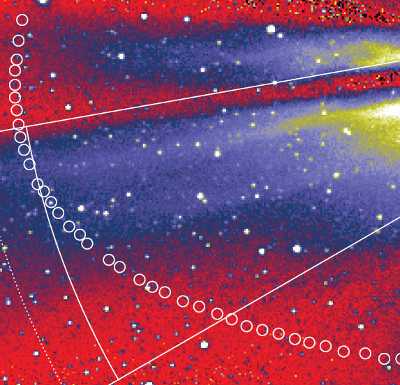
To test the hypothesis, researchers turned to NASA's twin STEREO spacecraft, which are designed to study solar activity.
Coronagraphs onboard STEREO can detect sungrazing asteroids and comets, and in June 2009 they detected 3200 Phaethon only 15 solar diameters from the sun's surface.
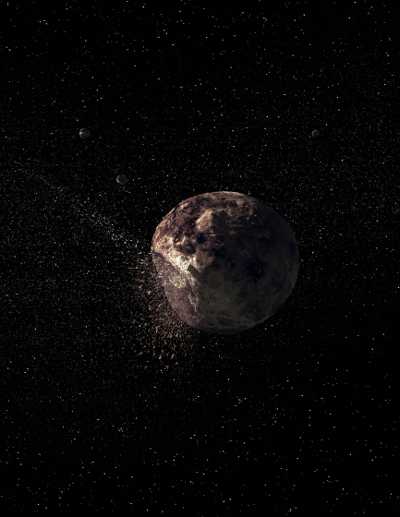
What happened next surprised UCLA planetary scientists David Jewitt and Jing Li, who analyzed the data. “3200 Phaethon unexpectedly brightened by a factor of two,” they wrote. “The most likely explanation is that Phaethon ejected dust, perhaps in response to a break-down of surface rocks (through thermal fracture and decomposition cracking of hydrated minerals) in the intense heat of the Sun.”
Jewett and Li's “rock comet” hypothesis is compelling, but they point out a problem: The amount of dust 3200 Phaethon ejected during its 2009 sun-encounter added a mere 0.01 percent to the mass of the Geminid debris stream – not nearly enough to keep the stream replenished over time. Perhaps the rock comet was more active in the past …?
“We just don't know,” said Cooke. “Every new thing we learn about the Geminids seems to deepen the mystery.”
This month Earth will pass through the Geminid debris stream, producing as many as 120 meteors per hour over dark-sky sites. The best time to look is probably between local midnight and sunrise on Tuesday, Dec. 14, when the Moon is low and the constellation Gemini is high overhead, spitting bright Geminids across a sparkling starry sky.
Bundle up, go outside, and savor the mystery.
Dr. Tony Phillips works for the National Aeronautics and Space Administration.
Follow Lake County News on Twitter at http://twitter.com/LakeCoNews , on Facebook at http://www.facebook.com/pages/Lake-County-News/143156775604?ref=mf and on YouTube at http://www.youtube.com/user/LakeCoNews .