 How to resolve AdBlock issue?
News
- Details
- Written by: Lake County News reports
Arthur Gonzales, 36, a transient from Covelo, was arrested in the case, according to Capt. Kurt Smallcomb of the Mendocino County Sheriff's Office.
At 11:30 a.m. Dec. 3, Round Valley Tribal Police were investigating a possible intoxicated driver on Tabor Lane in Covelo when Gonzales allegedly attacked a tribal police officer, Smallcomb said.
During the attack, Gonzales punched and kicked the tribal police officer several times, causing injury. Smallcomb said the officer was able to use his portable radio to summon emergency assistance from the sheriff's office and California Highway Patrol. The closest available deputies and CHP officers responded from the Willits area.
Smallcomb said the tribal police officer attempted to subdue Gonzales by spraying him in the face with pepper spray but it had no effect. The officer then withdrew to a safer location and awaited the arrival of the responding deputies and officers.
Gonzales then allegedly directed his anger toward the tribal police vehicle that had been left at the scene. Smallcomb said Gonzales picked up an old car tire and began to throw it at the windows of the tribal police vehicle, which resulted in more than $400 worth of damage.
Gonzales had fled the immediate area prior to the arrival of sheriff deputies and CHP officers, Smallcomb siad. A search was conducted and Gonzales was located near Lot No. 4 on Concow Boulevard.
A sheriff's deputy drew his sidearm and ordered Gonzales down to the ground. Smallcomb said Gonzales refused to comply with the orders and instead ran at a full sprint towards the deputy.
Smallcomb said the deputy quickly holstered his sidearm and drew his Taser. Gonzales closed within feet of the deputy before the Taser was deployed. The deployment of the Taser brought Gonzales' attack to an immediate end.
Located in the area where Gonzales was apprehended were a large knife and an ax handle. Smallcomb said both the knife and ax handle had blood present on them.
It was later discovered that Gonzales had entered or attempted to enter several residences on the Reservation while evading from law enforcement, Smallcomb said.
In one of the residences five pit bull puppies had been bludgeoned to death. Smallcomb said Gonzales is a suspect in the death of the five puppies and the investigation is ongoing.
Smallcomb said Gonzales was transported to Howard Hospital for medical clearance and then to the Mendocino County Jail.
p { margin-bottom: 0.08in; }a:link { }
Follow Lake County News on Twitter at http://twitter.com/LakeCoNews , on Facebook at http://www.facebook.com/pages/Lake-County-News/143156775604?ref=mf and on YouTube at http://www.youtube.com/user/LakeCoNews .
- Details
- Written by: Lake County News reports
“This landmark settlement mandates the replacement of outmoded wind turbines with newer models that are more efficient, generate more power and are less harmful to eagles, falcons and other birds,” Brown said.
The Altamont Pass Wind Resources Area in Alameda and Contra Costa counties is the site of the world's first wind turbines.
These units, constructed more than three decades ago, are now outdated, inefficient and deadly to thousands of birds each year, Brown's office said.
Tuesday's settlement is between environmental groups, the state, and NextEra Energy Resources, the largest turbine operator at the site.
Under the agreement, NextEra will upgrade all its older-model turbines. Scientific data shows that newer, larger turbines are more efficient and kill far fewer birds.
A 2004 study commissioned by the California Energy Commission found that the 5,400 older turbines operating at Altamont Pass killed an estimated 1,766 to 4,271 birds annually, including between 881 and 1330 raptors such as golden eagles – which are protected under federal law -- hawks, falcons and owls.
The bird fatalities at Altamont Pass – an important raptor breeding area that lies on a major migratory route – are greater than on any other wind farm in the country, the study showed.
In September 2005, Alameda County renewed permits for the turbines, but several Audubon Society chapters and Californians for Renewable Energy (CARE), a local environmental group, challenged the permits in a lawsuit under the California Environmental Quality Act (CEQA).
After a settlement failed to substantially reduce the large number of bird fatalities, Brown stepped in and brokered today's agreement.
Under the agreement, NextEra will replace some 2,400 turbines over the next four years and will shut down all its existing turbines no later than 2015.
The company also has agreed to erect the new turbines in environmentally friendly locations.
NextEra agreed to pay $2.5 million in mitigation fees, half to the state Energy Commission's Public Integrated Energy Research Program and half to East Bay Regional Park District and the Livermore Area Regional Park District for raptor habitat creation.
Follow Lake County News on Twitter at http://twitter.com/LakeCoNews , on Facebook at http://www.facebook.com/pages/Lake-County-News/143156775604?ref=mf and on YouTube at http://www.youtube.com/user/LakeCoNews .
- Details
- Written by: Elizabeth Larson
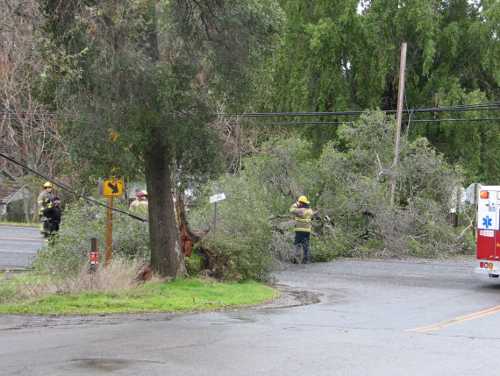
LAKE COUNTY, Calif. – The heavy rain that hit Lake County on Sunday led to some spots of minor flooding in Lakeport, a downed tree and utility lines in Nice and hazardous road conditions elsewhere.
Rain fell steadily around the county on Sunday afternoon after forecasters had warned area residents to be prepared for precipitation.
The forecast proved accurate, with the resulting rains making for tricky driving conditions. The California Highway Patrol reported that rocks and small boulders had been spotted along areas of Highway 175 near the Granite Construction quarry, on Bottle Rock Road not far from Highway 29 and on Highway 20.
Early in the afternoon a large oak tree fell on Highway 20 at Hudson, knocking utility lines into the roadway, the CHP reported.
The incident originally was reported as a traffic collision just after 1 p.m. but later blamed on the tree alone, according to reports from the scene.
The CHP created a detour off of Highway 20 and onto Manzanita in order to allow utility crews to work on the pole. Caltrans, Northshore Fire and the sheriff's office also responded to assist with controlling the scene.
A call to Pacific Gas & Electric about possible power outages and other impacts was not returned Sunday evening. Mediacom also was reported to be working on lines at the site.
The roadway was reopened at about 4:45 p.m., the CHP said.
The rain appeared to get heavier in the late afternoon, and at around 5 p.m. Sgt. Kevin Odom of the Lakeport Police Department said he noticed some minor areas of flooding in the city, especially at around N. Forbes and 10th streets.
“Heavy rain has obviously done something to overload the system,” he said.
After he drove through the area and saw the flooding, Odom notified the city's Public Works Department.
Public Works staff put up barricades around the flooded areas and were working late Sunday evening to try to find out what was going on and how to fix it, Odom said, noting the water appeared to be going toward the lakefront.
Lake County News had received reports of some businesses in the area being flooded, but Odom said he wasn't aware of actual flooded structures.
The National Weather Service said Sunday that a surface cold front was located coming through the county, with rain expected to continue through the night and early Monday.
E-mail Elizabeth Larson at
- Details
- Written by: Tom Philpott
Bernard Rostker, former under secretary of defense for personnel and now a senior fellow at the RAND Corp., has a more optimistic perspective on how, over time, America cares for and compensates its wartime veterans.
For more than a year Rostker has been researching what will be a two-volume study on the treatment of veterans and their survivors, going back to before the Revolutionary War, with a special focus on wounded warrior care.
His original working premise, as he explained it in a phone interview, was that veterans’ care and benefits today reflect a deeper attachment to the force, the result of moving away from a military of conscripts, after the Vietnam War, to a more professional force comprised entirely of volunteers.
But as he completed volume one of his study, covering the Colonial era through World War II, Rostker said he found the working premise to be wrong. Much of what’s being done today for veterans of the all-volunteer force is “rediscovering” what’s been done before.
One glaring exception, he said, is the focus today on treating mental wounds of war, post-traumatic stress disorder. Resources aimed at the invisible wounds are unprecedented, reflecting more medical knowledge, the nature of current wars and an attitude shift, even since the Persian Gulf War.
“Today it’s remarkably different. Much more willing to deal with issues of stress than what came out of the Gulf War,” said Rostker.
In the late 1990s he was the defense secretary’s special assistant on Gulf War Illness.
Otherwise the infusion of money and staff for veterans’ care and benefits today fits an historical pattern, Rostker said, the nation’s deep appreciation for those who fight for country and suffer wounds or illness.
Other patterns emerge, Rostker said.
Government support tends to deepen with budget surpluses. Benefits tend to improve as veterans age, their ranks thin out, and enhancements become more affordable.
Wars bring change too. The Department of Veterans Affairs budget has more than doubled since U.S. troops invaded Afghanistan in October 2001 – from $51 billion then to $114 billion in the fiscal years that ended Sept. 30. VA spending is set to climb another 10 percent this year, to $125 billion.
Vet groups laud a 25 percent rise in VA spending since President Obama took office. Some contrast that largess to the Bush administration difficulty in June 2005 when it had to request $2 billion supplemental for VA to meet pressing health care obligations. Some veterans groups had called the original budget that year “tightfisted, miserly” and “woefully inadequate.”
Rostker avoids such comparisons. But his research might inform cost-conscious politicians about the perils of scrimping on veterans.
President Franklin Roosevelt made such a misstep, he said, while trying to pull the nation out of the Great Depression.
At his urging, Congress in 1933 passed the Economy Act, which cut deeply into veterans’ benefits. Roosevelt told the American Legion convention “the mere wearing of a uniform” in war should not entitle a veteran, and later his survivors, to a pension for disabilities incurred after he left service.
The backlash was strong enough that the following March, Congress had enough votes to override Roosevelt’s veto and it restored almost all of the benefits it had cut a year earlier.
The Continental Congress in 1776 first recognized responsibility for wounded veterans, voting to authorize half pay for life to anyone who lost a limb or their ability to earn a living due to the revolution. By 1805 Congress approved pay for disabilities developed years after a veteran left service.
Support for lifetime “half pay,” particularly for officers, drew criticism. Funds to pay it sometimes could not be found. Yet Congress extended the same pension rights to disabled veterans from the War of 1812 and other wars.
By 1818, with federal coffers flush with tariff money, the Department of War gave pensions to anyone who served in wartime, not just disabled.
Ten years later Congress settled complaints of Revolutionary War veterans by granting 850 surviving officers and soldiers full pay for life.
Rostker noted too that in 1833 Congress first approved “concurrent receipt” – payment of both an “invalid pension” and service pension. In 1836, Congress extended pension eligibility to widows and children of Revolutionary War veterans, adding enormously to the cost. The last spouse eligible for that Revolutionary War pension died in 1906, Rostker said.
The Civil War Pension Law of 1862 was viewed as the most generous any government had ever adopted, Rostker said, allowing disability payments for injuries or ailments incurred as a direct result of service. It even set up a medical screening system, though reliance on hometown doctors led to rampant fraud and soon a purging of the rolls, Rostker said.
Payments to surviving spouse and children could exceed what veterans got. The last Civil War pensioners lived well into the 20th Century, all the while drawing payments.
Our conversation provided just a glimpse of how America has cared for veterans long ago. The study will span newer, more controversial periods including Gen. Omar Bradley’s reform of the VA after World War II, Korea and Vietnam and Gulf War Syndrome.
Given the history, I asked, what might be ahead for the newest generation of war veterans. More effective help, Rostker suggested. The nation knows now that not all wounded have missing limbs or physical scars.
Through history, he said, “you see the generosity in many ways. You see it in the amount of money given, in the change of eligibility standards. And recently in the understanding of the mental aspects of conflict.”
To comment, send e-mail to
Follow Lake County News on Twitter at http://twitter.com/LakeCoNews , on Facebook at http://www.facebook.com/pages/Lake-County-News/143156775604?ref=mf and on YouTube at http://www.youtube.com/user/LakeCoNews .