 How to resolve AdBlock issue?
News
- Details
- Written by: Lake County News reports
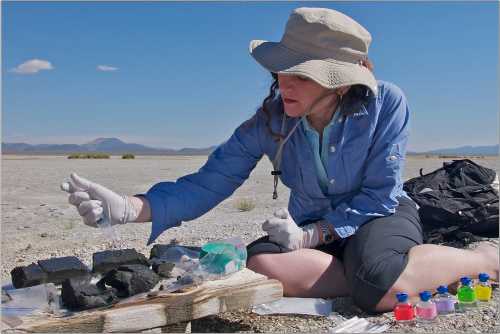
Researchers conducting tests in the harsh environment of Mono Lake in California have discovered the first known microorganism on Earth able to thrive and reproduce using the toxic chemical arsenic. The microorganism substitutes arsenic for phosphorus in its cell components.
“The definition of life has just expanded,” said Ed Weiler, NASA's associate administrator for the Science Mission Directorate at the agency's Headquarters in Washington. “As we pursue our efforts to seek signs of life in the solar system, we have to think more broadly, more diversely and consider life as we do not know it.”
This finding of an alternative biochemistry makeup will alter biology textbooks and expand the scope of the search for life beyond Earth, according to a NASA report. The research is published in this week's edition of Science Express.
Carbon, hydrogen, nitrogen, oxygen, phosphorus and sulfur are the six basic building blocks of all known forms of life on Earth.
Phosphorus is part of the chemical backbone of DNA and RNA, the structures that carry genetic instructions for life, and is considered an essential element for all living cells.
Phosphorus is a central component of the energy-carrying molecule in all cells (adenosine triphosphate) and also the phospholipids that form all cell membranes.
Arsenic, which is chemically similar to phosphorus, is poisonous for most life on Earth. Arsenic disrupts metabolic pathways because chemically it behaves similarly to phosphate.
“We know that some microbes can breathe arsenic, but what we've found is a microbe doing something new – building parts of itself out of arsenic,” said Felisa Wolfe-Simon, a NASA astrobiology research fellow in residence at the U.S. Geological Survey in Menlo Park, Calif., and the research team's lead scientist. “If something here on Earth can do something so unexpected, what else can life do that we haven't seen yet?”
The newly discovered microbe, strain GFAJ-1, is a member of a common group of bacteria, the Gammaproteobacteria.
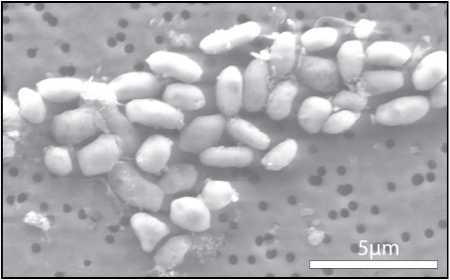
In the laboratory, the researchers successfully grew microbes from the lake on a diet that was very lean on phosphorus, but included generous helpings of arsenic.
When researchers removed the phosphorus and replaced it with arsenic the microbes continued to grow. Subsequent analyses indicated that the arsenic was being used to produce the building blocks of new GFAJ-1 cells.
The key issue the researchers investigated was when the microbe was grown on arsenic did the arsenic actually became incorporated into the organisms' vital biochemical machinery, such as DNA, proteins and the cell membranes. A variety of sophisticated laboratory techniques were used to determine where the arsenic was incorporated.
The team chose to explore Mono Lake because of its unusual chemistry, especially its high salinity, high alkalinity, and high levels of arsenic. This chemistry is in part a result of Mono Lake's isolation from its sources of fresh water for 50 years.
The results of this study will inform ongoing research in many areas, including the study of Earth's evolution, organic chemistry, biogeochemical cycles, disease mitigation and Earth system research. These findings also will open up new frontiers in microbiology and other areas of research.
“The idea of alternative biochemistries for life is common in science fiction,” said Carl Pilcher, director of the NASA Astrobiology Institute at the agency's Ames Research Center in Moffett Field, Calif. “Until now a life form using arsenic as a building block was only theoretical, but now we know such life exists in Mono Lake.”
The research team included scientists from the U.S. Geological Survey, Arizona State University in Tempe, Ariz., Lawrence Livermore National Laboratory in Livermore, Calif., Duquesne University in Pittsburgh and the Stanford Synchrotron Radiation Lightsource in Menlo Park.
NASA's Astrobiology Program in Washington contributed funding for the research through its Exobiology and Evolutionary Biology program and the NASA Astrobiology Institute. NASA's Astrobiology Program supports research into the origin, evolution, distribution and future of life on Earth.
Additional reports on the work can be found at http://astrobiology.nasa.gov .
Follow Lake County News on Twitter at http://twitter.com/LakeCoNews , on Facebook at http://www.facebook.com/pages/Lake-County-News/143156775604?ref=mf and on YouTube at http://www.youtube.com/user/LakeCoNews .

- Details
- Written by: Lake County News reports
Spirit of the Season, a program of Catholic Charities, collects donations of toys and money to help give families in need a happy holiday.
Wish trees feature bells that represent the hopes and dreams of children from the area. Community members can take the bells and purchase the requested gifts for the children, who range in age from newborns to eighth graders.
All families that have approached SOS have great need of our help and support, according to the group, which has reviewed monthly income, checked that potential recipients live in the area, and verified ages and school grades of children.
But with the Dec. 8 deadline looming, many bells are still hanging on trees, the group reported Thursday.
Wish trees are located at Middletown Flower and Gifts, St. Joseph’s Catholic Church, Tri-Counties Bank and WestAmerica Bank in Middletown, as well as in Hidden Valley Lake at HVL Realty and Mulligan’s Bar. On Cobb, wish trees are located at Mountain High Coffee and Haute Spot Beauty Shop.
You can visit one of these sites, take a bell and shop to make a child’s wish come true. Please be sure to sign in when you take a bell and bring back to the site from which you took the bell originally by Dec. 8.
To date some 140 families have asked for assistance, but some of these represent only a desire for a food basket, the donations for which are inching up too slowly, the group reported.
So far, only $4,000 has been received. Hedy Montoya, Spirit of the Season coordinator, said it takes about $10,500 to provide food for 450 to 500 individuals.
The Christmas box dinners will be distributed from 11 a.m. to 2 p.m. Saturday, Dec. 18, at St. Joseph’s Church in Middletown and also from the Little Red School House on Cobb
Anyone needing a box of food needs to register immediately by calling Montoya at 707-987-8139. There will be no boxes given to anyone who has not pre-registered for Spirit of the Season. The Wish Tree portion of the program is now closed to new sign-ups.
Anyone wishing to donate is asked to send a tax-deductible donation to Spirit of the Season, P. O. Box 1468, Middletown, CA 95461.
Follow Lake County News on Twitter at http://twitter.com/LakeCoNews , on Facebook at http://www.facebook.com/pages/Lake-County-News/143156775604?ref=mf and on YouTube at http://www.youtube.com/user/LakeCoNews .
- Details
- Written by: Elizabeth Larson
Gerald Stanley, 65, has been on San Quentin's death row since February 1984, sent there for the August 1980 murder of his wife, Cynthia Rogers, in Nice, as Lake County News has reported.
He previously had been convicted of killing his first wife, Kathleen Rhiley, in 1975. Another wife, Diana Lynn Ramel, went missing on Feb. 14, 1980. He has claimed she died of a drug overdose but has offered to give up information about the location of her body in exchange for an execution date.
In March 2008, federal court Judge Frank C. Damrell ruled that a new hearing was needed to determine whether or not Stanley had been mentally competent during his trial's death penalty phase, due to a finding that a female juror who had been a domestic violence victim hadn't disclosed that fact to the court.
Stanley told Lake County News in a March 2009 phone interview that he and his attorneys had been aware of the woman's experience but had wanted to keep her on the jury anyway.
Nevertheless, the matter of Stanley's competency is moving forward to a hearing later this month in Butte County Superior Court, where Stanley's trial was moved in 1983 due to media coverage.
His death penalty also is on stay while the proceedings take place, according to Lake County District Jon Hopkins.
Hopkins said at a Tuesday hearing in Butte County – in which Hopkins appeared by phone and Stanley by video conference – Stanley made a Marsden motion. A Marsden motion is when a defendant tries to discharge their lawyer on allegations of incompetence or inadequate representation.
Stanley has tried before to fire his court-appointed attorney in Butte County, Dennis Hoptowit, to no avail, and he got the same outcome Tuesday when that motion was denied by Judge Gerald Hermansen, Hopkins said.
Hopkins said Stanley then made a Faretta motion to represent himself. But before that matter was ruled on Stanley, Hopkins, Hoptowit and the judge began talking and Stanley postponed his motion in favor of going forward with the hearing on the feasibility of a new competency hearing.
That will take place starting at 9 a.m. Dec. 13, Hopkins said.
He said Stanley agreed that the hearing didn't have to take place at San Quentin, but can be held in Oroville.
“I've got two witnesses that are going to testify that it is feasible to hold a retrospective competency trial and Stanley will appear by video conference,” said Hopkins.
Hopkins' two witnesses are a psychiatrist and a psychologist. He said neither has worked with Stanley previously.
“The issue of his competency in 1983 at the time of his competency trial is assisted a great deal by having a transcript of the entire trial and the proceedings around the trial,” said Hopkins, noting the Butte County Superior Court was able to locate the original transcript.
It's possible that Hermansen could make a decision Dec. 13 or hold over the hearing, Hopkins said.
If a retrospective hearing is ordered, Hopkins said Stanley has been talking about wanting a court trial – which will be quicker – and having it moved back to Lake County, which Hopkins said the penal code would allow.
But with Hopkins' term as district attorney set to end this month, it's unclear about the future of the case.
Stanley's issues have been the source of countless hearings, which have been handled by Hopkins since his time as chief deputy district attorney under Gary Luck. Hopkins said he has worked with about four deputy attorneys general who were assigned to the case.
Hopkins said he hopes to be successful at the feasibility hearing, which would clear the way for a retrospective competency trial.
“Who will do that I don't know,” he said.
District Attorney-elect Don Anderson, who is working to close down his private practice before beginning his transition later this month, said Wednesday he isn't up on where the case is currently, and that he and Hopkins haven't yet discussed the case.
As for keeping Hopkins on in a part-time capacity to handle the Stanley case, Anderson said, “It's definitely an option.”
However, he added, that he wants to keep as much work as possible in house at the District Attorney's Office in order to save money.
Hopkins said if the feasibility hearing is successful, it will be up to Anderson to decide whether or not to go forward on the competency trial. If he doesn't, then the death penalty is off the table.
In a fall debate, Anderson made mention of his support for the death penalty.
If Hopkins loses the competency hearing, the death penalty would be set aside, but that would allow for the retrying of the death penalty phase of Stanley's trial.
Anderson “hasn't asked me for my recommendation,” said Hopkins.
However, Hopkins – who has tried five death penalty cases in his career, including the Charles Craft and Jeffrey Duvardo cases in Lake County – said he has been in touch with Rogers' family and others involved in the case.
“My belief is we should go forward, have him found to have been competent back then and have the death penalty reinstated and sent back to the federal court for them to approve it,” he said.
Hopkins alleged that Stanley killed three of his four wives, and possibly another woman, and called him an “extremely manipulative and very dangerous” man who deserves the death penalty.
Anderson, formerly a Lake County Sheriff's deputy, noted that he was on duty the day that Stanley shot Rogers at her father's resort. Stanley, a hunting guide, shot her through the heart at long distance with a high-powered rifle.
The search for Stanley became one of the county's largest manhunts, as Lake County News has reported.
Anderson recalled taking part in the search.
He said of the Stanley case, “It's just kind of strange that after all of these years, it's still coming up.”
E-mail Elizabeth Larson at
- Details
- Written by: Elizabeth Larson
Mendo Lake Credit Union is planning to open another full-service Lake County branch – similar to the one in Lakeport – in Clearlake in early April, according to Richard Cooper, the credit union's president and chief executive officer.
Cooper said the branch will be located in the Burns Valley Mall, in the storefront once occupied by a Rent-A-Center.
“We considered a lot of other places but we kept coming back to Burns Valley Mall,” Cooper said, noting the location is in close proximity to the senior center and apartment complexes.
The location also puts the new branch near a newly opened Dollar Store and Grocery Outlet, tenants that the credit union is excited about, Cooper said, noting the stores have gotten “substantially better than planned business” in the location.
When those businesses signed leases in the mall, Cooper said that was the final icing on the cake for the credit union, which has been looking at opening a Clearlake branch since 2008, the year he started there.
“We have really studied this one hard,” Cooper said.
Clearlake Building Inspector Scott Spivey said that on Sept. 10 he received the credit union's application and set of plans, which called for 90-percent interior remodeling and about 10-percent for the building's exterior. He said he was waiting for a new set of revised plans to review.
Cooper said they are planning to hire several new employees early next year.
“This has been a long time in coming,” Cooper said.
He credited credit union board member Cameron Reeves, also the retired county counsel for Lake County, with being a huge advocate for opening a Clearlake branch.
Cooper said the credit union has gotten a lot of encouragement from city officials and the Clear Lake Chamber of Commerce.
Noting that part of the credit union's 51-year-old charter calls for it to serve people of more modest incomes, he said a location in Clearlake is “such a great match for us.”
In addition to being nearer to its 1,000 south county members, Cooper said the credit union hopes to encourage more people who don't use traditional financial service providers to use the institution's services.
No matter what a person's previous issues were with banks, they can come in and get a free basic checking account, he said, rather than depending on check cashing services. They'll also be offered direct access to low-cost consumer credit.
Many of Mendo Lake Credit Union's local members came to them through car loans with local car dealers, he said.
Cooper said the credit union is the No. 1 auto lender in both Lake and Mendocino counties, with $48 million in new and used auto loans. This year alone, they put out close to $30 million in new car loans, he said.
The credit union offers loans for older vehicles, offering loans for cars that go back before the current Kelly Blue Book, which is what most banks adhere to when making loans, he said. They'll loan on a car manufactured as early as 1985, with mileage restrictions.
“We've seen a huge decline in our new car volume,” Cooper said, explaining that they're seeing more cars from the late 1990s and the earlier part of this decade. “People are shopping for what they can afford.”
After a few tough years that began in 2008 – the credit union saw a lot of its low income customers get hit early in the recession – Cooper said they're seeing interesting economic changes among their members, which could be evidence of the signs of economic recovery.
For one, the average car loan balance in 2008 was $20,000, now it's $15,000. For another, they're seeing less loan delinquency.
The credit union also is getting back into the mortgage business after a hiatus from making loans during the recession. In July 2009 Mendo Lake Credit Union received $2 million in federal stimulus funds, which it planned to use to get back into making home loans, as Lake County News has reported.
Cooper said the institution current has $19 million in home and manufactured home loans in Lake and Mendocino counties. Their offerings include loans for mobile homes in parks, which are hard to find.
During the foreclosure crisis, the credit union had only one foreclosure, said Cooper. “We've done a lot to work with people.”
Cooper said Mendo Lake Credit Union is very “consumer focused” while some of the major money center banks are business focused. He thinks the credit union and Clearlake will be a good match as a result.
“We just really see lots of strong potential for Clearlake,” Cooper said.
The credit union can be found online at https://www.mlcu.org/site/ or on Facebook at www.facebook.com/pages/Friends-of-Mendo-Lake-Credit-Union/159996074976 .
E-mail Elizabeth Larson at