How to resolve AdBlock issue?
News
- Details
- Written by: Lake County News reports
Cal Fire's Sonoma-Lake-Napa Unit will conduct a control burn on Morgan Valley Road near the location of the Homestake Mine on Wednesday, July 7.
The prescribed control burn will be conducted between the hours of 9 a.m. and 1 p.m.
Prescribed burns are carefully planned and controlled burns which must meet strict criteria of ecological benefit, weather parameters, smoke management and fire safety guidelines, officials reported.
When all conditions and prescriptions are met, trained wildland firefighters manage the control burn while monitoring the set criteria, fire behavior and designated fire control lines.
The benefits of low intensity fire in the natural environment include cleansing of wildland debris. Cal Fire reported that excessive dead and down branches, brush and small trees are burned converting fuels that are hazards in the summer into rich soil nutrients for larger species of vegetation.
The controlled burns also provide habitat. Removal of decadent fuel encourages the growth of seasonal
grasses and leafier plants which affords highly nutritional food and habitat to a wider range of animals.
Low intensity fire also helps eliminate and control diseased plants and trees, encourages the healthy growth of new plants – especially those fire dependent for renewal or seed dispersion – and decreases the size and frequency of large uncontrolled destructive wildfires. Prescribed burns also are safer for firefighters and area residents.
For more information about fire safety or prescribed fire visit www.fire.ca.gov.
Follow Lake County News on Twitter at http://twitter.com/LakeCoNews and on Facebook at http://www.facebook.com/pages/Lake-County-News/143156775604?ref=mf .
- Details
- Written by: Elizabeth Larson
John Medeiros, 46, was flown to Santa Rosa Memorial Hospital via REACH air ambulance following the crash, which occurred at 5:20 p.m. on Highway 20 west of Orchard Shores Drive in Clearlake Oaks, according to the California Highway Patrol.
Medeiros was riding his 1993 Harley Davidson motorcycle westbound on Highway 20 at approximately 55 miles per hour, while 39-year-old David Andrade of Clearlake was driving his 1975 Ford pickup eastbound, also at 55 miles per hour, according to a report prepared by CHP Officer Jake Bushey.
Bushey's report said that, for unknown reasons, Medeiros made an unsafe turn to the left which caused his motorcycle to enter the eastbound lane, directly in the path of Andrade's truck.
Andrade attempted to swerve to the right but couldn't avoid the collision, and Bushey's report said Medeiros' motorcycle hit the left side of Andrade's pickup.
Medeiros' motorcycle went under the left side of the pickup truck and hit the rear axle. He and the motorcycle came to rest in the westbound lane, Bushey's report stated, while Andrade's pickup ended up on the south shoulder of the highway facing westbound.
In addition to Medeiros' injuries, the collision also resulted in Andrade receiving minor injuries, Bushey said. Andrade was treated at the scene by Northshore Fire Protection District paramedics and was not transported to the hospital.
The report noted that both men were using safety equipment.
Drugs and alcohol are not considered as contributing factors to the collision, Bushey reported.
The collision is still under investigation, the report said.
E-mail Elizabeth Larson at
- Details
- Written by: Lake County News reports
Just in time for the July 4 holiday, the Library of Congress has reported that a recent study has given new insight into the drafting of the Declaration of Independence.
Recent hyperspectral imaging of Thomas Jefferson’s rough draft of the Declaration of Independence has clearly confirmed past speculation that Jefferson made an interesting word correction during his writing of the document, according to scientists in the Library of Congress’ Preservation Research and Testing Division (PRTD).
Jefferson originally had written the phrase “our fellow subjects.” But he apparently changed his mind. Heavily scrawled over the word “subjects” was an alternative, the word “citizens.”
The correction seems to illuminate an important moment for Jefferson and for a nation on the eve of breaking from monarchical rule: a moment when he reconsidered his choice of words and articulated the recognition that the people of the fledgling United States of America were no longer subjects of any nation, but citizens of an emerging democracy.
The correction occurs in the portion of the declaration that deals with U.S. grievances against King George III, in particular, his incitement of “treasonable insurrections.”
While the specific sentence doesn’t make it into the final draft, a similar phrase was retained, and the word “citizens” is used elsewhere in the final document. The sentence didn’t carry over, but the idea did.
Fenella France, a scientist in PRTD, conducted the hyperspectral imaging in the fall of 2009 and discovered a blurred word under “citizens.”
“It had been a spine-tingling moment when I was processing data late at night and realized there was a word underneath citizens,” France said. “Then I began the tough process of extracting the differences between spectrally similar materials to elucidate the lost text.”
Hyperspectral imaging is the process of taking digital photos of an object using distinct portions of the visible and non-visible light spectrum, revealing what previously could not be seen by the human eye.
The hyperspectral imaging system is located in the Library’s Optical Properties Laboratory, on the sub-basement level of the James Madison Building.
Fascinating details of our historical heritage have been coming to light with the use of hyperspectral imaging.
For instance, recent imaging of the heavily varnished and visually obscured 1791 Pierre L’Enfant Plan of Washington, D.C., has clearly revealed invisible streets and special locations, including the “President’s House” and “Congress’ House.”
The Thomas Jefferson word correction has been suspected for some time by scholars, the Library of Congress reported.
In “The Papers of Thomas Jefferson, Volume 1: 1760-1776” (Princeton University Press, 1950), Julian P. Boyd wrote, “TJ originally wrote ‘fellow-subjects,’ copying the term from the corresponding passage in the first page of the First Draft of the Virginia Constitution; then, while the ink was still wet on the ‘Rough draught’ he expunged or erased ‘subjects’ and wrote ‘citizens’ over it.”
Incidentally, Jefferson died at age 83 on July 4, 1826, the 50th anniversary of the adoption of the Declaration of Independence.
Dying on that same day at age 90 was John Adams, also a former president and one of the five men – along with Jefferson, Benjamin Franklin, Robert R. Livingston and Roger Sherman – who sat on the declaration's drafting committee, which ultimately instructed Jefferson to draft the document.
Adams and Jefferson were friends, later becoming political rivals. However, late in life they renewed their friendship and entered into a long-running correspondence. Their letters still exist today.
Jefferson died hours ahead of Adams, who – not knowing of his friend's death – is reported to have said, “Jefferson still survives,” according to historical sources.
The rough draft of the Declaration of Independence can be explored in stunning detail in the online version of the exhibition "Creating the United States" at www.myLOC.gov (and on-site, appropriately, at the Library’s Thomas Jefferson Building).
The Library of Congress, the nation’s oldest federal cultural institution and the largest library in the world, holds nearly 145 million items in various languages, disciplines and formats.
The Library serves the U.S. Congress and the nation both on-site in its reading rooms on Capitol Hill and through its award-winning Web site at www.loc.gov.
Many of the Library’s rich resources and treasures may also be accessed via interactive exhibitions on a personalized website at www.myLOC.gov.
Follow Lake County News on Twitter at http://twitter.com/LakeCoNews and on Facebook at http://www.facebook.com/pages/Lake-County-News/143156775604?ref=mf .
- Details
- Written by: Lake County News Reports
My high school science teacher, an avid fisherman, once told me that he liked my freckles because they reminded him of a “nice, speckled trout.” I’m not sure I liked being compared to a fish; however, I do enjoy sharing my freckled identity with a type of lettuce of which I recently became aware.
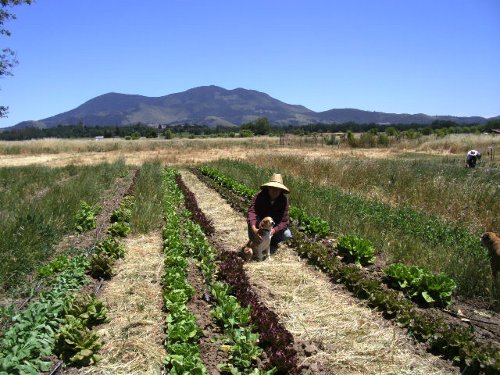
The lettuce in question is “freckled lettuce,” a variety with a loosely formed head that has red blotches on its green leaves. It caught my eye while perusing the stalls at a recent farmers’ market, and, as you can imagine, I was happily intrigued by its moniker. It’s grown by Full Moon Farm in Kelseyville, and when I visited the farm recently, I enjoyed seeing rows of these lettuces growing with Mt. Konocti as an impressive backdrop.
There are hundreds of varieties of lettuce. In 1885, there were 87 varieties identified in the U.S., and while that’s an admirable amount, we’ve come a long way since then.
As many types as there are, they fall into far fewer large categories, or cultivar groups.
Loose leaf (or simply leaf) lettuce doesn’t form heads, but its leaves are joined at the stem. Examples of this variety include oak lettuce and red or green leaf lettuces.
Romaine (or cos) lettuce has a long head with sturdy leaves which have a rib down the center. The outer leaves tend to be dark. This type has gained popularity because it’s the base ingredient for Caesar salad. Its crispy texture may appeal to those who like iceberg lettuce.
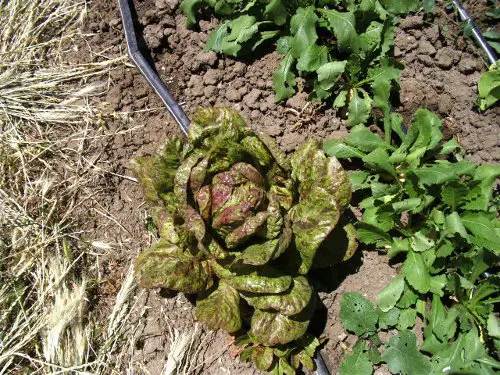
Lettuce in the Butterhead category has loosely formed heads, a buttery texture and mild taste. Boston lettuce, which is shaped like a blooming rose, and Bibb lettuce, which is cup shaped, are both examples of this type.
Chinese lettuces have long, sword-shaped, non-head-forming leaves with a bitter flavor. Unlike the west where lettuce is generally eaten raw, the Chinese use lettuce in stir-fried dishes and stews. (China is the world’s largest lettuce producer by far. The U.S. is a distant second, growing only half of China’s crop.)
Summer Crisp, or Batavian, forms moderately dense heads with a crunchy texture. This type is intermediate between iceberg and loose leaf types.
Finally, the Crisphead variety includes Iceberg lettuce. It is the least nutritious of the salad greens, has pale leaves, a cabbage-like head, crispy texture and mild flavor.
Lettuce is thought to have originated as a weed in the Mediterranean region and has been used in cuisine for about 4,500 years. Ancient Greek scholars identified different types of lettuces, and lettuce appears in tomb paintings in Egypt.
Christopher Columbus introduced lettuce to the new world. By the time Thomas Jefferson was president, he was growing 19 types on his farm at Monticello.
It’s interesting to note that both the Latin and English words for lettuce derive from “lac,” the Latin word for milk, possibly because of the milky juice of some varieties. In fact, in the earliest Egyptian tomb paintings, the ruler Senusret offers lettuce to the god Min, to whom milk was sacred.
Ancient Egyptians considered lettuce an aphrodisiac, and early Greek physicians thought lettuce contained a sleep-inducing agent. The Romans held to this belief, as well, and served lettuce at the end of the meal for this reason. (The custom of serving salad at the end of a meal continues in some European countries.)
The nutritional value of lettuce varies based on the variety. In general, lettuces with darker leaves are more nutrient dense than those with lighter leaves. For example, Romaine lettuce has eight times the beta-carotene, four times the calcium and two times the potassium as Iceberg lettuce.
The darker lettuces are good sources of vitamins A, K and C, folate, manganese and chromium. All lettuces are good sources of dietary fiber, even the nutrient barren Iceberg variety. They’re also low in calories and high in water content.
Lettuce aids digestion and promote liver health. Some research shows it helps reduce the risk of cancer and ease nervous insomnia (which gives credence to the theories of the ancient Greeks and Romans).
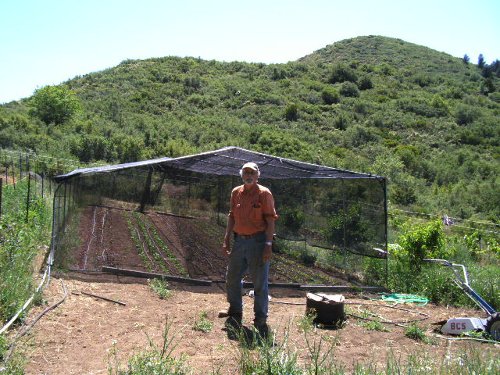
I had an opportunity recently to visit Love Farms at the base of Cobb Mountain in Lower Lake, where Teale Love has devised a way to grow lettuces in the shade in the height of Lake County’s summer heat.
Lettuce is typically a cool weather crop; its growth is stunted in the heat and the leaves grow bitter. Love’s shaded growing tent changes all this.
The tent material is netlike, with holes for the sun to penetrate. Even so, the temperature drops significantly when one steps into it. There are spray nozzles set up along its sides that emit a fine mist to keep the developing lettuces cool, even on the hottest of days.
Love spent last year testing his method using a dozen or more lettuce varieties. He kept careful track of which ones showed more tolerance to heat, eliminating the ones that didn’t do well. The result is that we will have a crop of heat resistant lettuces available to us at Lake County farmers’ markets through the summer. Hurrah!
The recipe I offer today is an unusual Thai appetizer served in lettuce leaves. It bursts with a variety of flavors; in fact, everything we can identify on our palates – sweet, sour, bitter, salty, umami (savory) and piquant – is represented in the lettuce wrap.
Lettuce leaves also make interesting wraps when filled with flavorful ingredients from other world cuisines, such as China or Mexico. Be creative – the possibilities are endless!
This recipe is from Mei Ibach, a Thai cuisine culinary instructor at SRJC, and some of the ingredients are found in Asian markets. (If you’d like a list of markets, please email me.)
For a vegetarian version, simply eliminate the dried shrimp and shrimp paste.
Miang Kam
Lettuce leaves, washed and patted dry, 20 or more
¼ cup fresh roasted peanuts
¼ cup fresh toasted coconut flakes
¼ cup fresh ginger, cut into a fine dice
¼ cup fresh lime, cut into the tiniest of wedges, leaving skin on
¼ cup fresh jalapeño chiles, cut into a fine dice (seed chilies if less heat is desired)
¼ cup dried shrimp (found in Asian markets)
To serve, lay all ingredients out artistically on a large platter. (Lettuce should be presented separately.)
To eat, put a pinch of each ingredient into a lettuce leaf, top with palm ginger sauce (recipe follows), wrap, and eat in one bite.
Palm ginger sauce
½ cup palm sugar (found in Asian markets)
½ cup water
3 to 4 slices fresh ginger
½ teaspoon shrimp paste (optional)
1 tablespoon tamarind juice (found in Asian markets)
¼ cup toasted coconut flakes
Salt and pepper to taste
Bring the water to boil in a small pot, then add the palm sugar and stir until dissolved. Add the ginger, tamarind juice, and shrimp paste and stir well. Add salt & pepper to taste. Simmer and reduce until mixture has thickened a bit. Add the coconut flakes just before serving.
Esther Oertel, the "Veggie Girl," is a personal chef and culinary coach and is passionate about local produce. Oertel owns The SageCoach Personal Chef Service and teaches culinary classes at Chic Le Chef in Hidden Valley Lake. She welcomes your questions and comments; e-mail her at
Follow Lake County News on Twitter at http://twitter.com/LakeCoNews and on Facebook at http://www.facebook.com/pages/Lake-County-News/143156775604?ref=mf .