 How to resolve AdBlock issue?
News
- Details
- Written by: Lake County News reports
NORTHERN CALIFORNIA – With warm weather and family events, the July 4 holiday can be a fun time to create great memories. It also can be a tragic time for fires and critical burn injuries.
As the weekend fun gets set to start, Carl Fire reminds all Californians that before your family celebrates, make sure everyone knows about fireworks safety.
“Fireworks not only create significant dangers to citizens when used improperly or illegally, but also increase the demands on fire departments and firefighters,” said Cal Fire Director Del Walters.
“We recommend that you and your family make memories by attending a local professional fireworks display,” said Walters. “If you live in a jurisdiction that allows fireworks, only use legal fireworks displaying the 'Safe and Sane' State Fire Marshal seal and follow common sense practices to ensure your July 4 holiday remains festive and safe.”
Consumers who choose to purchase legal fireworks need to obey local laws. State fire officials urge you to check first with your local fire department or jurisdiction to find out if fireworks are permitted in your area. If you live in a community that allows the use of State Fire Marshal approved safe and sane fireworks, make sure you only use those fireworks where you purchased them.
In Lake County, safe and sane fireworks only are legal in the city of Lakeport.
It is illegal to transport, store, use, sell or possess fireworks where they are not allowed or are illegal.
Cal Fire Law Enforcement officers in cooperation with local law enforcement agencies will have zero-tolerance for individuals that transport, possess, store, sell, or use fireworks in the wildlands or communities where they are prohibited and illegal.
The celebration of July 4 should not be an excuse to put Californians at risk of fire or injury.
If you live in a community that allows state fire marshal-approved safe and sane fireworks, Cal Fire encourages you to follow these fireworks safety tips:
Use fireworks outdoors only.
Make sure fireworks are legal in your area before buying or using them.
Only light fireworks on a smooth, flat surface away from the house, dry leaves, and flammable materials.
Always have water handy; either by hose or bucket.
Only use fireworks as intended. Don’t try to alter or combine them.
Never relight a “dud” firework. Wait 20 minutes and then soak it in a bucket of water.
Adults should always supervise fireworks activities. Never allow children to play with or ignite fireworks.
Never carry fireworks in a pocket or shoot them off in metal or glass containers.
Think about your pet. Animals have sensitive ears and can be extremely frightened or stressed on July 4. Keep pets indoors to reduce the risk that they will run loose or get injured.
Remember that fireworks are not toys and they should always be used in a safe and legal manner. Cal Fire wants everyone to have a safe and memorable July 4 holiday.
For more information about safe fireworks use, visit the Cal Fire Web site at www.fire.ca.gov.
Follow Lake County News on Twitter at http://twitter.com/LakeCoNews and on Facebook at http://www.facebook.com/pages/Lake-County-News/143156775604?ref=mf .
- Details
- Written by: Lake County News reports
NORTHERN CALIFORNIA – As tens of thousands of Californians prepare to mark Independence Day, the California Highway Patrol (CHP) reminds everyone to keep safety a top priority.
This year the holiday falls on a Sunday, so for many people it will be a three-day weekend full of
celebration and good times.
Fourth of July weekend is a Maximum Enforcement Period (MEP) for the CHP. All available officers will be out on the road during the weekend looking for motorists who are a danger to themselves or others on our state’s highways.
The MEP begins at 6:01 p.m. on Friday, July 2, and continues through midnight on Monday, July 5.
Last year 24 persons were killed statewide during the July 4 weekend, and 80 percent of the vehicle occupants killed in CHP jurisdiction were not wearing a seat belt at the time of the crash.
In addition, CHP officers made 1,239 arrests for driving under the influence during that same time period.
“The CHP wants your holiday memories to be happy ones,” said CHP Commissioner Joe Farrow. “Please be sure to take a few simple precautions to ensure that your friends and family have a safe Fourth of July.”
The CHP offers the following tips for staying safe this holiday weekend:
Don’t drink and drive. If your Independence Day celebration includes drinking alcohol, arrange for a friend or family member who will not be drinking to be the “designated driver.”
Always wear your seat belt. Make sure all passengers, adults and children, are also buckled up, even on short trips.
Watch your speed. Stay at or below the limit, depending upon road conditions.
Plan ahead if you will drive long distances. Add extra time to your trip so you won’t feel rushed and take a break every hour or so to get refreshed.
Follow Lake County News on Twitter at http://twitter.com/LakeCoNews and on Facebook at http://www.facebook.com/pages/Lake-County-News/143156775604?ref=mf .
- Details
- Written by: Elizabeth Larson
LAKEPORT – As business was ending on Thursday, the Lake County Registrar of Voters Office completed its final tally of votes for the June 8 primary election, including thousands of previously uncounted absentee ballots.
The result: No change in placement for candidates in local races.
In recent weeks, Registrar of Voters Diane Fridley and her staff have been processing more than 3,700 absentee, provisional and electronic ballot results, as well as conducting a manual tally of some precincts as part of the normal business of certifying the election.
Fridley had originally suspected there would be no major changes in how the candidates placed, and she was correct.
In the close district attorney's race, Don Anderson took 4,088 votes, or 37.8 percent, in the preliminary tally, followed by Doug Rhoades with 3,463 votes and 32 percent and incumbent Jon Hopkins with 3,258 votes or 30.1 percent.
The final results showed Anderson still in the lead with 5,034 votes or 37.3 percent, with the number of votes separating him and Rhoades narrowing to just over 400.
Rhoades received 4,629 votes, or 32.4 percent.
Hopkins finished with 30.3 percent of the vote, or 4,329 votes cast for him, meaning the November runoff will be between Anderson and Rhoades.
“I have served the people of Lake County for 13 years and am very proud of what we have accomplished in the District Attorney's Office in that time,” Hopkins said Thursday evening.
“As district attorney, I have worked hard with the staff to assure a high level of quality of service to the community,” he added. “I am hopeful that they will be able to continue on that same course, serving Lake County.”
Rhoades said he was very happy with the results.
“I'm very grateful to the voters of Lake County for keeping me in their thoughts and their votes for the District Attorney's Office,” said Rhoades. “I look forward to a runoff election with Don. The voters will decide who is the better candidate.”
In the sheriff's race, preliminary race results placed challenger Francisco Rivero in first place with 4,297 votes, or 38.5 percent of the vote, followed by incumbent Rod Mitchell with 3,852 votes and 34.5 percent, and Jack Baxter with 3,008 votes, or 27 percent.
In the final tally, Rivero widened his margin over Mitchell slightly, with a total of 5,682 votes or 38.4 percent. Mitchell had 5,078 votes or 34.3 percent, followed by the race's other challenger, Jack Baxter, with 4,024 votes, or 27.2 percent.
In the District 3 supervisorial race, incumbent Denise Rushing was returned to office with a final tally of 1,625 votes or 54.6 percent, followed by challengers Gary Lewis with 691 votes or 23.2 percent, and Robert Hesterberg, who brought in 22.1 percent of the vote with 658 ballots cast for him.
District 2 Supervisor Jeff Smith easily won reelection in his race with 1,245 votes or 62.4 percent over challenger and Clearlake Vice Mayor Joyce Overton, who received 750 votes or 37.6 percent.
In the final tally for the superintendent of schools race, Wally Holbrook had 8,631 votes, or 59.6 percent, with Judy Luchsinger bringing in 5,840 votes or 40.4 percent.
E-mail Elizabeth Larson at
- Details
- Written by: Elizabeth Larson
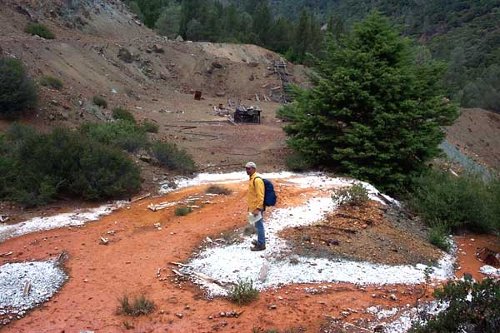
MIDDLETOWN – The Bureau of Land Management is proposing a $1.7 million alternative to clean up an abandoned mercury mine, officials revealed at a community meeting Tuesday.
The BLM hosted a nearly 80-minute-long meeting at the Jesus Christ Fellowship on Pine Street to discuss plans for the Helen mercury mine cleanup.
The original mine site, located four and a half miles west of Middletown off Dry Creek Road, includes 35 acres that is a mix of private property and land managed by BLM, officials reported Tuesday.
Of special concern are three tributaries to Dry Creek that run through the site, which were discussed at the meeting. Dry Creek flows into Putah Creek and then into Lake Berryessa in Napa County.
Gary Sharpe, an associate field manager for the Ukiah BLM office who hosted the meeting, told Lake County News in a followup interview on Wednesday that the Helen mine is one of many in the region that are being studied for cleanup. On Monday, BLM held a meeting in Healdsburg to discuss two other mercury mines set for cleanup – the Contact and Sonoma mines.
“There are a lot of mercury mines in this state,” he said.
Two other mines are located in the same drainage as the Helen and directly upstream – the Chicago and Research – with Sharpe explaining that initial investigations are nearly completed on both. He said he hopes to have public meetings on those mines next year.
The Helen mine's draft final engineering evaluation and cost analysis prepared by Portland, Ore.-based Ecology and Environment Inc., the BLM's consultant on the mine cleanup, explained that the Helen, Research and Chicago mercury deposits are among the youngest in the Coast Range's mineral belt.
North of the Helen there are four or five more mercury mines, located on private land, Sharpe said. BLM also is working in Colusa County on three other mines – the Rathburn, Petray and Clyde – located in the Walker Ridge area.
Mercury was used for gold mining during the 19th century, and during World Wars I and II mercury production again rose as the highly explosive mercury fulminate was used for munitions, Sharpe said.
That boom in mercury production continued up through the 1950s as the arms race gained steam, he added.
While the Helen mine itself hasn't been a high priority, Sharpe said the concerns about the mercury from the mine has been an issue for the State Water Resources Control Board, which is trying to keep mercury out of the Bay Delta.
He said the mine was one of three that were eligible for stimulus funds due to being considered “shovel ready.”
Lenna Cope, a professional engineer with Ecology and Environment Inc., presented the mine's draft final engineering evaluation and cost analysis to the small crowd of about a dozen area residents on Tuesday.
Cope said the analysis included an expanded human health and ecological risk assessment for the mine.
The report explained that the mine was patented in 1874 by John Pershbaker, and then passed through a series of owners until it was nearly shut down in 1921. It continued through additional owners until it was sold in 1976 to Helen Mine, a joint venture between W.C. McCulloch and Richard R. Clements and Sons, according to the evaluation document.
Cope said the first report of mercury production, totaling 128 flasks – each weighing 76 pounds – was in 1873, followed by another 100 flasks by 1903.
In 1913, 5,000 flasks were reported, with the mine's main years of production taking place from 1903 to 1919. Cope said from 1919 to 1975 it produced another 7,000 flasks.
The US Geological Survey had conducted environmental sampling at the mine site in 2003, and Cope's firm took samples earlier this year of soil, sediment and biological resources for the study.
Cope said the site, as it is today, includes five main site features – a northern tailings pile, middle tailings pile, southern disturbed area, and storage tank and retort areas. Tailings are the materials left behind when mercury is extracted.
In places like the northern and middle tailings areas, the contaminated material is believed to be 33 feet deep, she said. However, the storage tank and retort areas had the highest mercury concentration, according to test results.
Water that drains from the mine's nearby adits – or entrances – is neutral, so it isn't contributing an acid load. However, Cope noted that it contains heavy metals.
Altogether, the mine has 6,800 cubic yards of contaminated materials – which Cope defined as materials that have mercury levels above the criteria established in the site's risk assessment. Cope said that amount of material isn't huge when compared to other mine sites.
Testing of the site's main features showed that the highest mercury concentrations were found in the northern tailings pile, with 1,100 milligrams per kilogram, compared to 7,900 millimeters per kilogram for the storage tank area, Cope reported. Those numbers are far higher than a sampling taken near the creek of 83 milligrams per kilogram.
Tests of the three Dry Creek tributaries showed that there was a source of mercury bioaccumulation upstream of the mine, which Cope wasn't any greater than the levels downstream.
For the human risk assessment, she said mercury was the principal contaminant of concern. No cyanide was found, but there were smaller amounts of arsenic detected.
Humans at the greatest risk for encountering mercury would be child campers, who Cope said would risk exposure of 355 milligrams per kilogram.
The greatest hazard for contamination was to terrestrial plans, she said.
The studies laid the groundwork for the response plan, which Cope said seeks to reduce human and ecological exposure.
They considered five alternatives, said Cope. The first was no action, which must be included and is used as a baseline for comparison to other options.
The second option, limited action, proposes construction of a diversion berm and channel system above the mine site to keep water from draining through it and into the creeks, Cope said.
That option, said Cope, also would include building rock pools in the stream, minor recontouring and stabilization of the slopes and institutional controls to prevent human contact, at an estimated total cost of $700,000.
The third alternative, and the one preferred by BLM, costs about $1.7 million and would consolidate all 6,800 cubic yards of contaminated materials from the tailings areas, retort, storage and southern disturbed area into one location, according to Cope.
Cope said permanent surface water diversion structures would be constructed, and there would be capping of the materials with 24 inches of clean materials and revegetation, with the slopes shaped to prevent sediment from moving.
The fourth alternative, which Cope said would cost about $2.2 million, is similar to alternative three, but would include a clay liner below the contaminated materials as well as above it, with a soil cap.
The fifth alternative was off-site disposal. Cope said that plan, estimated at $2.7 million, would require major road improvements in order for trucks to get in and out of the area, as well as excavation and materials transport to appropriate landfills, where they would have to pay tipping fees. The area then would be recontoured, revegetated and reclaimed.
All cost estimates, Cope noted, included ongoing monitoring.
Cope said the recommended alternative is No. 3, which does the best job of getting contamination away from surface water.
Sharpe said BLM will need to find more money to do the project, which will go out for bid through the US Fish and Wildlife Service.
An archaeologist working for BLM had conducted a survey of the area, which local archaeologist Dr. John Parker – representing the Lake County Heritage Commission – asked about at the meeting.
Parker noted that miners working at mines from the 1870s through the 1920s were primarily Chinese. He said archaeologists don't know much about the Chinese in Lake County, and the commission was concerned about the possibility of artifacts.
Sharpe said Wednesday that if he's able to get some additional stimulus funding he expects design work on the mine cleanup could begin this fall, with remediation beginning in the summer of 2011.
To see the Helen mine's draft final engineering evaluation and cost analysis prepared by Ecology and Environment Inc., visit www.blm.gov/ca/st/en/fo/ukiah/contact_sonoma_mines.html; there report begins halfway down the page.
Comments can be provided at the public meeting, through the BLM’s Web site at www.ca.blm.gov/ukiah, by email to
E-mail Elizabeth Larson at