 How to resolve AdBlock issue?
News
- Details
- Written by: Elizabeth Larson
The board will meet beginning at 9 a.m. Tuesday, March 26, in the board chambers on the first floor of the Lake County Courthouse, 255 N. Forbes St., Lakeport.
The meeting can be watched live on Channel 8, online at https://countyoflake.legistar.com/Calendar.aspx and on the county’s Facebook page. Accompanying board documents, the agenda and archived board meeting videos also are available at that link.
To participate in real-time, join the Zoom meeting by clicking this link.
The meeting ID is 898 5454 2089, pass code 874486. The meeting also can be accessed via one tap mobile at +16699006833,,89854542089#,,,,*874486#. The meeting can also be accessed via phone at 669 900 6833.
At 10:30 a.m., Public Services Director Lars Ewing is scheduled to give the board an update on the project to transform the former Lakeport Armory into the new headquarters of the Lake County Sheriff’s Office.
The county acquired the property, next to the Lake County Jail campus, as part of a property swap with the state of California.
Ewing’s memo to the board explains that the preliminary construction cost estimate for the armory is approximately $20 million, and there isn’t a source of funding for the project that’s so far been identified.
“Built infrastructure project designs such as the armory run the risk of becoming outdated or even obsolete as more time passes from the completion of design to construction. Consequently, even though the project is fully funded through design, the decision to advance the project to 100% design requires your Board’s input,” Ewing wrote.
In addition to asking the board to decide on the next steps in the project, Ewing will seek the board’s approval for a second amendment between the county and Dewberry Architects Inc. for architectural engineering design services.
At 2 p.m., the board will receive a presentation from planning staff on an overview of "Lake County 2050," which is the update of the county’s general plan and local area plans updates.
The full agenda follows.
CONSENT AGENDA
5.1: Adopt proclamation designating the month of March 2024 as Women’s History Month in Lake County.
5.2: Second reading of an ordinance amending the purchasing ordinance: Article X of Chapter Two of the Lake County Code to include increased purchasing limits, additional definitions, modify requirements for exemptions from competitive bidding and additional procedures for informal and formal bidding.
5.3: Approve addition to the appendices of the Lake County Community Wildfire Protection Plan (CWPP - 2023) to include Appendix G: Communities At Risk (CAR) Designations.
5.4: Approve resolution authorizing the amendment to the standard agreement between county of Lake and the Department of Health Care Services for the period of July 1, 2022, through June 30, 2027 and authorizing the Behavioral Health director to sign the amendment.
5.5: Approve Amendment No. 1 to the agreement between county of Lake and I.D.E.A. for consulting for professional consulting services in the amount of $50,000 for fiscal year 2023-2024 and authorize the chair to sign.
5.6: Approve Board of Supervisors minutes for March 19, 2024.
5.7: (A) Approve the purchase of 5 Motorola radios from the Sheriff/OES budget 2704, object code 62.74 and (B) Authorize the Sheriff to issue a purchase order to Command Communications in an amount not to exceed $45,000.
5.8: (a) Approve amendment 12 to agreement between the county of Lake and Sun Ridge Systems Inc for the purchase and installation of Mindbase Link software interface in the amount of $5,350; and (b) authorize the chair of the board to sign.
5.9: (a) Waive the formal bidding process pursuant to Lake County Code Section 2-38.2 as competitive bidding would produce no economic benefit to the county; (b) approve agreement between county of Lake and Linebarger Goggan Blair & Sampson LLP pursuant to state of California Master Agreement 2018-18, and authorize the chair to sign.
5.10: Sitting as the Board of Directors for the Lake County Watershed Protection District, approve Amendment 2-A to the agreement between the Lake County Watershed Protection District and Monument Inc. for appraisal and acquisition services for the Middle Creek Flood Damage Reduction and Ecosystem Restoration Project and authorize the chair of the board of directors to sign the agreement.
TIMED ITEMS
6.2, 9:03 a.m.: Pet of the Week.
6.3, 9:05 a.m.: Sitting as the Lake County Housing Commission, consideration of the Lake County Housing Commission Housing Choice Voucher Program Administrative Plan for 2024 and Five-Year Plan for 2024 - 2029 and Signing of HUD Forms HUD-50077-CR, HUD-50077-SL, and HUD-5075-5Y.
6.4, 9:07 a.m.: Presentation of proclamation designating the month of March 2024 as Women’s History Month in Lake County.
6.5, 9:15 a.m.: Presentation of the semi-annual Employee Service Awards for the county of Lake to recognize years of service.
6.6, 10 a.m.: Continued from March 19, public hearing — (a) Consideration of resolution approving an application for funding and the execution of a grant agreement and any amendments thereto from the 2023-2024 Funding Year of the State CDBG Mitigation Resilience Infrastructure (MIT-RIP) Program; and (b) authorize the county administrative officer or designee to submit the grant application.
6.7, 10:30 a.m.: a) Consideration of update on Armory Repurposing project and provide direction to staff for next steps; and b) consideration of amendment two to the agreement between the county of Lake and Dewberry Architects Inc., for Architectural Engineering Design Services.
6.8, 11:15 a.m.: Hearing on account and proposed assessment for 7129 E State Hwy 20, Lucerne CA (APN 006-023-02).
6.9, 11:30 a.m.: Hearing on account and proposed assessment for 7119 E State Hwy 20, Lucerne CA (APN 006-023-01).
6.10, 1:30 p.m.: Presentation and update on the current status of the Hydrilla Eradication Program activities for the Clear Lake area.
6.11, 2 p.m.: Presentation of overview of "Lake County 2050" General Plan and local area plans updates.
UNTIMED ITEMS
7.2: Consideration of letter of support for congressionally directed spending request for Adventist Health.
7.3: Consideration of agreement between county of Lake and BHC Sierra Vista Hospital Inc. for acute inpatient psychiatric hospital services and professional services associated with acute inpatient psychiatric hospitalizations in the amount of $100,000 for fiscal year 2023-24.
7.4: Consideration of Amendment No. 2 to the agreement between county of Lake and North Valley Behavioral Health LLC for acute inpatient psychiatric hospital services and professional services associated with acute inpatient psychiatric hospitalization in the amount of $750,000 for fiscal year 2023-2024.
7.5: Consideration of Amendment No. 1 to the agreement between county of Lake and Sutter Center for psychiatry for acute inpatient psychiatric hospital services and professional services associated with acute inpatient psychiatric hospitalizations in the amount of $225,000 for fiscal year 2023-24.
7.6: Consideration of Amendment No. 1 to the agreement between the county of Lake and Vista Pacifica Enterprises Inc. for adult residential support services and specialty mental health services in the amount of $300,000.00 for fiscal year 2023-2024.
7.7: Consideration of Amendment No. 1 to the agreement between county of Lake and California Psychiatric Transitions for acute inpatient psychiatric hospital services, inpatient competency restoration services and professional services associated with acute inpatient psychiatric hospitalization in the amount of $250,000 for fiscal year 2023-24.
7.8: Consideration of Amendment No. 1 to the Agreement between County of Lake and Crisis Support Services of Alameda County for after hours crisis support services in the amount of $89,400 for fiscal year 2023-24 and authorize the chair to sign.
7.9: Consideration of appointments to the General Plan Advisory Committee.
7.10: Consideration of the distribution of excess proceeds in the amount of $1,346,589.30 from Tax Defaulted Tax Sale #160 held May 27, 2022 (per R&T §4675).
CLOSED SESSION
8.1: Public employee evaluation: Public Works director.
8.2: Public employee evaluation: Registrar of Voters.
8.3: Conference with legal counsel: Significant exposure to litigation pursuant to Gov. Code section 54956.9(d)(2), (e)(1) – One potential case.
8.4: Conference with legal counsel: Existing litigation pursuant to Gov. Code sec. 54956.9 (d)(1) – CPUC Application 22-09-018, Application of Pacific Gas and Electric Company and Pacific Generation LLC (U 39 E).
8.5: Conference with legal counsel: Existing Litigation pursuant to Gov. Code sec. 54956.9 (d)(1) – CPUC Application 21-06-021, Application of Pacific Gas and Electric Company (U39M).
Email Elizabeth Larson at
- Details
- Written by: Lake County News reports
Approximately 60% (1,876) of U.S. counties gained population from 2022 to 2023, an increase from the 52% of counties (1,649) that experienced population growth between 2021 and 2022.
Among the nation's 3,144 counties, the average change from 2022 to 2023 was 0.29%, up from 0.17% the previous year.
For Lake County, the report showed that the population decreased by as much as 1.5%.
All of Lake’s neighboring counties also had decreases, with the exception of Colusa, which grew up to 1.5%.
“Domestic migration patterns are changing, and the impact on counties is especially evident,” said Lauren Bowers, chief of the Census Bureau’s Population Estimates Branch. “Areas which experienced high levels of domestic out-migration during the pandemic, such as in the Midwest and Northeast, are now seeing more counties with population growth. Meanwhile, county population growth is slowing down out west, such as in Arizona and Idaho.”
This was the first time since 2020 that more counties in the Midwest had population gains (542) than losses (513), narrowing the average annual change among the region's 1,055 counties to a loss of 0.02% from a loss of 0.09% a year earlier.
While the Northeast still had more counties losing (113) than gaining (105) population in 2023, population loss among its counties moderated compared to the previous year. The average annual change among the region's 218 counties slowed from -0.24% to -0.07% in 2023. The number of counties with population increases rose from 83 in 2022 to 105 in 2023.
On average, counties in the South experienced faster growth in 2023 than in 2022. Among its 1,422 counties, the average annual change was 0.56%, up from 0.31% the prior year. Approximately 67% (950) of the counties in the region experienced population gains in 2023, up from 59% (836) in 2022.
The West, whose average population change ranked highest among the four regions in 2022, fell behind the South in 2023. The average annual change among the region's 449 counties slowed from 0.51% to 0.34%.
On average, large and moderate-sized counties grew while small counties got smaller. Among the 618 counties with populations over 100,000, the average change from 2022 to 2023 was 0.76%. Moderate-sized counties with populations between 10,000 and 100,000 grew 0.36% on average.
Conversely, among the 741 smallest counties in the nation, those with populations below 10,000, the average annual decrease was 0.27% in 2023 compared to 0.35% the previous year.
Components of change
Sixty-two percent of counties, up from 60% in 2022, experienced positive net domestic migration in 2023. In addition, net domestic migration generally moderated among some of the counties with the largest amounts of net domestic in-migration and out-migration in 2022. The 10 counties with the largest net domestic in-migration were mostly in the South. In contrast, the top 10 counties with largest net domestic out-migration were mostly in large metro areas, with some experiencing considerably less net domestic out-migration in 2023 than in 2022.
The number of counties with positive net domestic migration increased in all regions except the West, where 253 counties experienced positive domestic migration in 2023, down from 275 counties in 2022. The Northeast saw the largest increase in the share of counties with positive domestic migration from 44% in 2022 to 52% in 2023. The number of southern counties with positive rates of domestic migration increased from 957 in 2022 to 1,014 in 2023, while the number of those counties in the Midwest increased from 561 to 581.
Eighty percent (2,515) of U.S. counties had positive net international migration in 2023. Miami-Dade County, Florida (54,457), and Harris County, Texas (41,665), had the largest gains from net international migration. All counties in Connecticut, Delaware, Maine, Maryland, Massachusetts, New Jersey, and Rhode Island experienced positive net international migration.
As the nation's death rate declined in 2023, so did the frequency of natural decrease. Deaths outnumbered births in fewer counties: 2,171 or 69% experienced natural decrease, down from 2,337 (74.3%) in 2022.
Just over 70% of counties in the Northeast, South and Midwest regions had natural decrease. The West was the region with the lowest share, 241 (53.7%) of its 449 counties experiencing natural decrease in 2023.
Maine was the only state where all counties experienced natural decrease. Other states where a majority of counties had natural decrease were Alabama (55 of 67); Arkansas (66 of 75); Illinois (86 of 102); Kentucky (100 of 120); Michigan (73 of 83); Ohio (71 of 88); Pennsylvania (57 of 67); and Tennessee (82 of 95).
Five Florida counties led the nation in natural decrease: Pinellas (4,945); Sarasota (3,399); Brevard (3,044); Volusia (3,003); and Marion (2,480).
Births outnumbered deaths in 961 counties (31%) in 2023, led by Alaska (with 25 of 30 counties) and New Jersey (with 17 of 21).
Nationally, the counties with the highest levels of natural increase in 2023 were Harris County, Texas (34,695); Los Angeles County, California (22,216); Dallas County, Texas (19,550); Kings County, New York (14,174); and Tarrant County, Texas (13,010).
Among counties with a population of 20,000 or more, the 10 fastest-growing were in the South—six in Texas (Kaufman, 7.6%; Rockwall, 6.5%; Liberty, 5.7%; Chambers, 5.0%; Comal, 5.0%; Ellis, 4.9%); two in Georgia (Jackson, 5.5%; Dawson, 5.1%); and one each in South Carolina (Jasper, 4.9%) and Virginia (New Kent, 4.7%).
Of the counties with populations above 20,000, Lassen County, California, experienced the biggest (3.9%) decrease in 2023. Randolph County, Missouri, followed with a loss of 2.1%. Population in Bronx County, New York, continued to decline, dropping by 1.8% in 2023 after dropping 3.0% in 2022 and 2.5% in 2021.
Eight of the 10 counties that led the nation by numeric change in 2023 were in Texas. This included Harris County, which added 53,788 residents and was the largest-gaining county in the nation, followed by Collin County (36,364) and Montgomery County (31,800).
Maricopa County, Arizona, the largest-gaining county in the nation in 2022, dropped to fourth in 2023 with a gain of just over 30,000 residents. Polk County, Florida, ranked fifth after adding 29,948 residents.
The remaining top five population gainers were all in Texas: Denton (29,943); Fort Bend (27,859); Bexar (27,488); Tarrant (27,301); and Williamson (24,918). Denton County gained nearly 30,000 new residents, pushing its population to just over 1 million and making it the seventh Texas county to reach this milestone.
Los Angeles County, California, had the highest numeric population decline of 56,420 in 2023, compared to a loss of 89,697 people in 2022. Both drops stemmed from negative domestic migration. Kings, Queens, and Bronx counties in New York followed with population losses of 28,306; 26,362; and 25,332, respectively.
Among other large declines were Cook County, Illinois, which lost 24,494 people; Philadelphia County, Pennsylvania (-16,294); and Orange County, California (-14,617).
- Details
- Written by: Mohammad Houshmand, Drexel University and Yaghoob Farnam, Drexel University
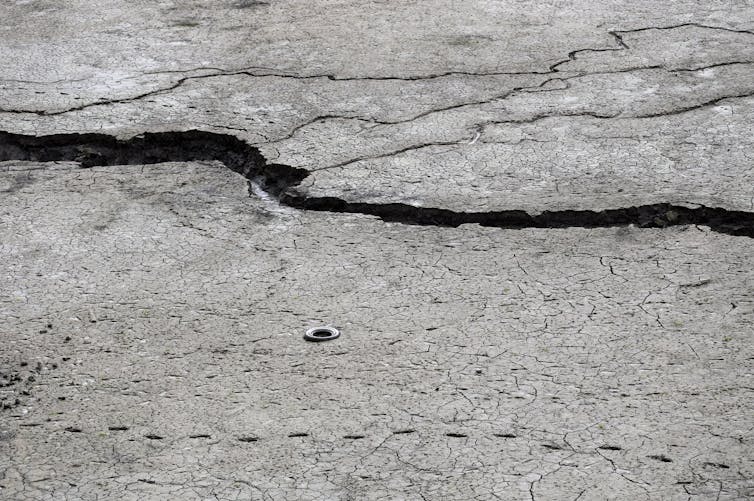
Some say there are two types of concrete – cracked and on the brink of cracking. But what if when concrete cracked, it could heal itself?
We’re part of a team of materials scientists and microbiologists that has harnessed the power of bacteria to create biological fibers that initial results suggest can heal cracks in concrete. We’re working on a technology that, if we work out the kinks and manage to bring it to the market one day, could extend the life span of concrete.
Cracking concrete
Picture a bridge exposed to snow, rain, temperature changes and trucks carrying heavy loads. The concrete on the bridge will gradually develop cracks from stress and wear. Over time, these cracks expand, allowing water and corrosive substances that weaken the concrete to penetrate further down.
At some point, local authorities have to pay for repairs, which are not only expensive but also disrupt traffic and drain public resources.
Now, consider a medical patient recovering from a severe injury. As the patient’s cells recognize the damage, they release tiny healing agents – like microscopic repair crews. These agents target the wounded area, mending tissues and restoring the cells’ functionality. What if concrete had the same kind of self-healing ability as human tissue?
A self-healing concrete
Our team at the Advanced Infrastructure Materials lab at Drexel University was inspired by self-healing tissue in the human body. We developed an addition to concrete we call BioFiber.
BioFiber has three essential functions: It heals itself on its own, it stops cracks from growing wider, and it remains intact inside the concrete when there aren’t any cracks.
Each BioFiber has three key components: a tough core fiber made of a polymer called polyvinyl alcohol, a porous layer of hydrogel infused with Lysinibacillus sphaericus bacteria, and a damage-responsive outer shell. When cracks hit the BioFiber, its outer shell breaks and releases the bacteria into the crack, which starts the self-healing process.
The strong core fibers in BioFiber bridge the cracks and stop them from growing wider during the healing process.
Surrounding the core fiber, the hydrogel layer is made up of a mesh of polymer chains at the molecular level that attract water. Their spongelike structure can absorb and hold large volumes of water. During the production process, we add calcium to help the hydrogel solidify.
The hydrogel itself is made up of a natural polymer found in seaweed called alginate, which has special properties that allow it to trap bacteria. Alginate isn’t toxic and is even safe for biomedical applications such as drug delivery and tissue engineering.
The hydrogel houses endospores, which are dormant bacteria. Once the outer shell cracks and the endospores are awakened from their dormant state, they facilitate the self-healing.
Activating BioFiber
The endospores need water to activate. Luckily, the middle hydrogel layer absorbs water well. When the concrete cracks, and water from rain, humidity or street runoff seeps in, the spores wake up.
The spores ingest carbon that we specifically add into the concrete mix, as well as calcium in the concrete itself. With these materials, the bacteria facilitates a chemical reaction called microbially induced calcium carbonate precipitation, or MICCP. This reaction creates calcium carbonate crystals, which build up and fill in the cracks in the concrete.
The crystal shape varies, from sphere to needle-shaped, and each shape is strong enough to heal the cracks. We can alter the type of crystals the bacteria produces by changing the pH level, calcium source and type of bacteria.
Concrete acts like a solid, tough substance because it’s a mix of cement, sand, gravel and water. We toss the BioFibers into the mix and spread them out as the concrete is mixed, ensuring they’re evenly distributed throughout the mixture.
Once the self-healing process ends and the bacteria dies, the activated BioFiber is done – it can’t heal anymore. But since the concrete has many BioFibers distributed throughout, another fiber can mend the next crack. At the moment, we do not know how many cracks BioFiber concrete can heal, and we’re conducing more research to figure that out.
To feed the bacteria, we add the amount of food it needs to stay alive and heal the cracks, depending on how many cracks we anticipate them having to fix. When the bacteria runs out of food, the process stops. The bacteria can live for roughly a couple of weeks during the healing process.
While BioFiber shows initial promise, it does have shortcomings, which could make manufacturing it at a larger scale challenging. The manufacturing process and materials used are specialized and not always affordable and practical. While our first tests suggest that BioFiber extends the life span of concrete, we’ll need more testing, including field trials, to verify those early results.
We hope to eventually commercialize and manufacture the fibers at larger production scales, while in the meantime we continue to run tests and study how to improve BioFiber’s self-healing abilities. We’d like to one day get these fibers into roads and sidewalks to potentially prevent cracking in aging concrete.
Mohammad Houshmand, Ph.D. Candidate in Civil Engineering, Drexel University and Yaghoob Farnam, Assistant Professor of Civil Engineering, Drexel University
This article is republished from The Conversation under a Creative Commons license. Read the original article.
- Details
- Written by: Lake County News reports

CLEARLAKE, Calif. — The city of Clearlake Recreation and Events Department will hold its second annual Bunny Brunch on Saturday, March 30.
The brunch will take place from 9 to 11 a.m. at the Clearlake Youth Center, located at Redbud Park at 4750 Golf Ave.
The Bunny Brunch includes waffles, eggs and sausage, with juice or milk.
A special appearance by the Easter Bunny will be the highlight of the Bunny Brunch, followed by an egg hunt.
Purchase Bunny Brunch tickets through this Eventbrite link.
A limited number of tickets will also be available at the door (prices subject to slight increase).
The Recreation and Events Department also will be holding monthly Bingo Nights at the Youth Center on the second Saturday of every month (except December) with doors opening at 5:30 p.m.
For more information regarding other Youth Center events or other City sponsored events, please subscribe to the Recreation and Events calendar which can be found on the city of Clearlake website.




