 How to resolve AdBlock issue?
News
- Details
- Written by: Kendall Houghton, Ariel J. Binder, Amanda Eng and Andrew Foote
The gender wage gap — the difference between what men and women earn — is an often-cited marker of the progress women are making in the work force typically measured by comparing the average earnings of men and women.
Previous U.S. Census Bureau research has explored the gender wage gap and how it varies with social, economic and demographic characteristics.
Now, new U.S. Census Bureau research takes it a step further by comparing male and female earnings for graduates of similar educational programs. Rather than comparing male and female wages and controlling for education, it looks at the earnings of men and women with the same level and quality of education.
This research provides new information about the gender pay gap across a range of postsecondary education levels from graduates of the most selective bachelor programs to graduates of certificate programs.
The Census Bureau analyzed the earnings of graduates from certificate, associate and bachelor’s programs for up to 15 years. It estimated the magnitude of the earnings gap at these educational levels and three factors that may contribute to it: field of study; occupation and industry after graduation; and number of weeks and hours worked in a year.
This research was made possible by a partnership between the Census Bureau and state higher education systems, which provided student transcript records that can be linked to other datasets.
In this case, the student records were linked to the American Community Survey (ACS) to gauge post-graduation outcomes such as earnings, occupation, childbearing, and the number of weeks and hours worked. The ACS is the premier source of detailed population and housing information about our nation.
Researchers analyzed the gender pay gap using a statistical model that answered the following questions for each degree level considered:
• How large was the gap between men’s and women’s earnings, on average?
• How much of this gap was driven by women and men majoring in different fields?
• Among women and men with the same education level who graduated in the same field, how much of the gap stemmed from women and men working in different occupations and industries?
• Among men and women with the same education level, who graduated in the same field and worked in the same occupation, how much of the gap was caused by women and men participating in the workforce at different rates and working different numbers of weeks and hours-per-week during the year?
• How much of the gender pay gap was due to other factors?
Answers differed considerably depending on whether someone graduated from a certificate or selective bachelor’s program.
The size of the gender earnings gap
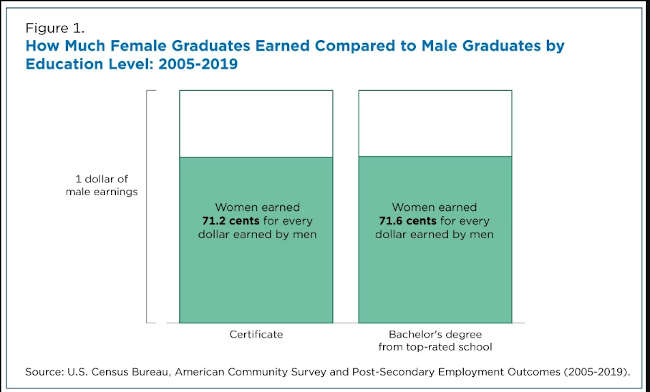
The gap in average earnings from 2005 to 2019 was consistent across all education levels. As shown in Figure 1, women with a certificate degree earned 71.2 cents for every dollar earned by men with a certificate degree. In other words, the gap was 28.8%. For graduates of the most selective bachelor’s institutions, as defined by the Barron’s Admissions Competitiveness Index, the gap was 28.4%.
This gap is larger than the 84 cents for every dollar earned figure reported by the White House, which compares full-time, year-round working men and women. The comparisons in this report are between graduates.
Field of study
College major or field of study accounted for a substantial portion of the gap at higher education levels but were less significant at lower levels.
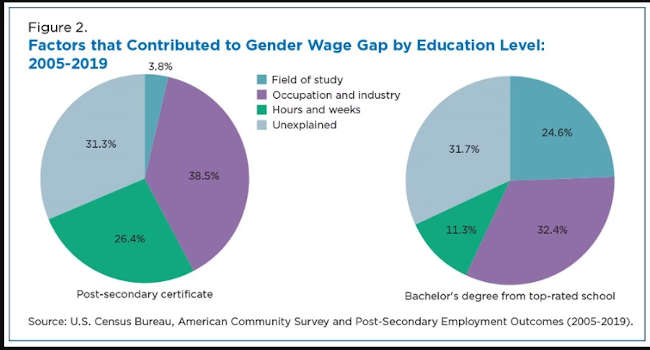
For example, 3.8% of the gender gap in earnings among those with certificate degrees was attributed to choice of major/field of study, compared to 24.6% among graduates of the most selective bachelor’s programs (Figure 2).
After accounting for differences in choice of major, the share of the gap due to occupation and industry chosen was nearly the same regardless of education level.
Occupational choices accounted for 38.5% of the gap among certificate degree graduates and 32.4% of the gap among graduates of selective bachelor’s programs (Figure 2).
Differences in labor supply — which reflect a combination of gender differences in employment rates as well as gender differences in the number of weeks and hours-per-week worked in a year of those employed — had a greater impact on the pay gap among graduates of certificate and associate programs than among those with bachelor’s degrees.
Labor supply accounted for 26.4% of the pay gap among certificate holders but only 11.3% among graduates of the most selective bachelor’s programs (Figure 2).
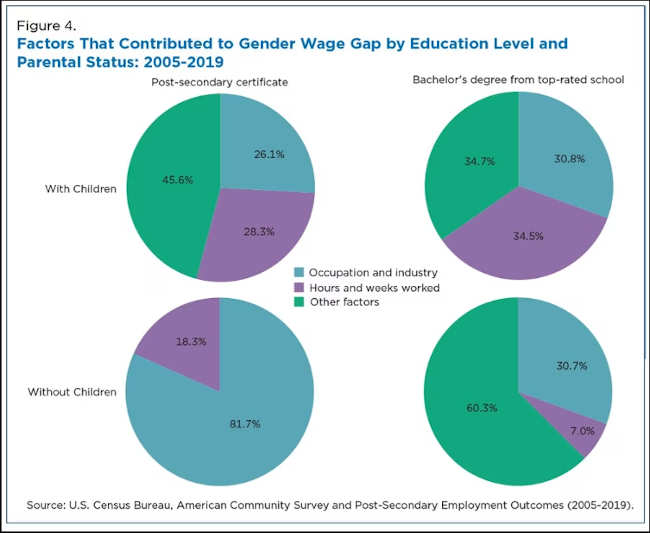
In Figures 2 and 4, the “unexplained” is the share of the gap that is not explained by differences in field of study, occupation and industry, or hours and weeks worked.
The children factor
Previous research has shown that having children contributed significantly to the gender pay gap.
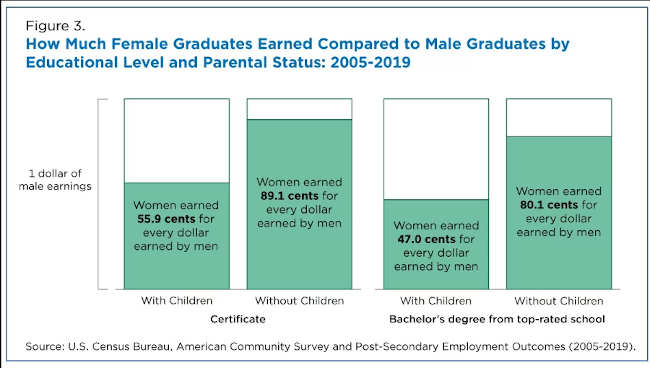
And as Figure 3 shows, this study found the wage gap was considerably wider among men and women with than without children — more than double for top bachelor’s holders and quadruple for certificate graduates.
Figure 4 illustrates this jump was mostly fueled by labor supply among graduates of certificate programs and by occupation and labor supply choices among grads of highly selective bachelor’s programs.
Gender pay gap varied across the educational attainment distribution
Until recently, data limitations prevented researchers from investigating variations in the gender pay gap across different types of degrees and paths taken by graduates.
Thanks to our partnership with higher education systems, we can now get to the bottom of whether and how the gender pay gap relates to types of degrees earned.
The results paint a more complex portrait of the gender pay gap, found to exist at every level. College graduates and policymakers can use this more detailed information to better understand and dismantle contemporary barriers to gender equality.
Ariel Binder, Amanda Eng and Kendall Houghton are economists in the Center for Economic Studies Demographic Research Area. Andrew Foote is a principal economist in the Center for Economic Studies LEHD Research Area. All are U.S. Census Bureau staffers.
- Details
- Written by: Lake County News reports
Originally a religious holiday to honor St. Patrick who introduced Christianity to Ireland in the fifth century, St. Patrick’s Day has evolved into a celebration of all things Irish.
The world’s first St. Patrick’s Day parade occurred on March 17, 1762, in New York City, featuring Irish soldiers who served in the English military. This parade became an annual event, with President Truman attending in 1948.
The following facts are made possible by the invaluable responses to U.S. Census Bureau surveys.
Did You Know?
30.7 million or 9.2%
The number and percentage of U.S. residents who claimed Irish ancestry in 2022.
112,251
The number of foreign-born U.S. residents who reported Ireland as their birthplace in 2022.
418,997
The number of people living in Cook County, Illinois — the nation’s county with the largest Irish American population — who claimed Irish ancestry in 2022.
11.1%
The percentage of residents in Lake County, California, who claim Irish heritage. That makes Irish the third-largest ancestry claimed by county residents, following German (15.5%) and English (11.9%).
St.patricks Day Ff by LakeCoNews on Scribd
- Details
- Written by: Lake County News reports
Recent reports indicate the projected budget shortfall has grown by an additional $15 billion, resulting in a potential shortfall range from $38 billion to $53 billion.
The Senate’s early action plan would reduce the shortfall by over $17 billion.
This immediate action takes the shortfall range down to a more manageable $9 billion to $24 billion and enables final budget negotiations later in the year to focus on closing the remaining gap while working to protect the progress of core programs that California has made in recent years.
With a balanced mix of $17 billion of program reductions and other solutions, along with adopting the governor’s proposed use of the Rainy Day Fund, the Senate’s “Shrink the Shortfall” early action plan is step one of this year’s budget process, which will ultimately lead to a balanced, on-time budget for 2024-25.
The Shrink the Shortfall early action plan will be heard in the Senate Budget and Fiscal Review Committee and could come up for a vote on the Senate Floor as soon as there is agreement with the Assembly and governor.
“When times are tight at home, people buckle down and do what needs to be done. That’s what the Golden State has to do right now too. The quicker we move, the quicker we’ll be able to reduce the deficit, and we know we have to move decisively because the budget shortfall is real and serious,” said McGuire.
He said the Senate’s plan to shrink the shortfall protects core programs, includes no new tax increases for Californians, makes necessary reductions, and takes a prudent approach to utilizing the Rainy Day Fund so the state can be prepared for any future tough times. “We look forward to buckling down with Governor Newsom, Speaker Rivas, and our Assembly partners on these responsible early actions, and on an overall state budget that protects our progress for all Californians.”
“After years of strong progress to advance California values, we face a huge budget challenge. I’m honored to be working hand in glove with Pro Tem McGuire and our Senate colleagues to advance smart solutions that address the deficit while protecting our progress. Time is truly of the essence,” said Wiener.
He added, “The early actions we’re proposing, including $17 billion in General Fund solutions, not only reduce the size of the deficit in this budget year and the next, but also give us more time to develop thoughtful solutions to address the shortfall that will remain. Let’s be clear: Shrinking the shortfall early in the process is step one. The Senate’s 2024-25 budget plan will be released later in the spring and will provide a comprehensive proposal for a balanced, responsible budget that protects core programs and services and positions the Governor and the Legislature to best protect California’s progress.”
Mike McGuire is president pro tempore of the California Senate. He represents the North Coast of California, which stretches from the Golden Gate Bridge to the Oregon border, including Del Norte, Trinity, Humboldt, Lake, Mendocino, Sonoma and Marin counties.
- Details
- Written by: Victoria Colliver
The scientists found pieces of SARS-CoV-2, referred to as COVID antigens, lingering in the blood up to 14 months after infection and for more than two years in tissue samples from people who had COVID.
“These two studies provide some of the strongest evidence so far that COVID antigens can persist in some people, even though we think they have normal immune responses,” said Michael Peluso, MD, an infectious disease researcher in the UCSF School of Medicine, who led both studies.
The findings were presented at the Conference on Retroviruses and Opportunistic Infections (CROI), which was held March 3 to 6, 2024, in Denver.
Evidence of long-term infection
Early in the pandemic, COVID-19 was thought to be a transient illness. But a growing number of patients, even those who had previously been healthy, continued having symptoms, such as, brain fog, digestive problems and vascular issues, for months or even years.
The researchers looked at blood samples from 171 people who had been infected with COVID. Using an ultra-sensitive test for the COVID “spike” protein, which helps the virus break into human cells, the scientists found the virus was still present up to 14 months later in some people.
Among those who were hospitalized for COVID, the likelihood of detecting the COVID antigens was about twice as high as it was for those who were not. It was also higher for those who reported being sicker but were not hospitalized.
“As a clinician, these associations convince me that we are on to something, because it makes sense that someone who had been sicker with COVID would have more antigen that can stick around,” Peluso said.
Virus persists up to two years in tissue
Since the virus is believed to persist in the tissue reservoirs, the scientists turned to UCSF’s Long COVID Tissue Bank, which contains samples donated by patients with and without long COVID.
They detected portions of viral RNA for up to two years after infection, although there was no evidence that the person had become reinfected. They found it in the connective tissue where immune cells are located, suggesting that the viral fragments were causing the immune system to attack. In some of the samples, the researchers found that the virus could be active.
Peluso said more research is needed to determine whether the persistence of these fragments drives long COVID and such associated risks as heart attack and stroke.
But, based on these findings, Peluso’s team at UCSF is involved in multiple clinical trials that are testing whether monoclonal antibodies or antiviral drugs can remove the virus and improve the health of people with long COVID.
“There is a lot more work to be done, but I feel like we are making progress in really understanding the long-term consequences of this infection,” Peluso said.
Authors: Additional UCSF co-authors include Sarah Goldberg, MAS, Brian H. LaFranchi, Scott Lu, MD, Thomas Dalhuisen, MS, Badri Viswanathan, Ma Somsouk, MD, MAS, J.D. Kelly, MD, Steven G. Deeks, MD, Zoltan Laszik, MD, PhD, Jeffrey Martin, MD, MPH, and Timothy J. Henrich, MD.
Funding: The studies were supported by funding from the PolyBio Research Foundation to support UCSF’s Long-Term Impact of Infection with Novel Coronavirus (LIINC) Clinical Core and a Merck Investigator Studies Program Grant. The National Institute of Health’s National Institute of Allergy and Infectious Diseases also provided funding (3R01AI1411003-03S1, R01AI158013 and K23AI134327, K23AI157875 and K24AI145806). Additional support came from the Zuckerberg San Francisco General Hospital Department of Medicine and Division of HIV, Infectious Diseases and Global Medicine.




