 How to resolve AdBlock issue?
News
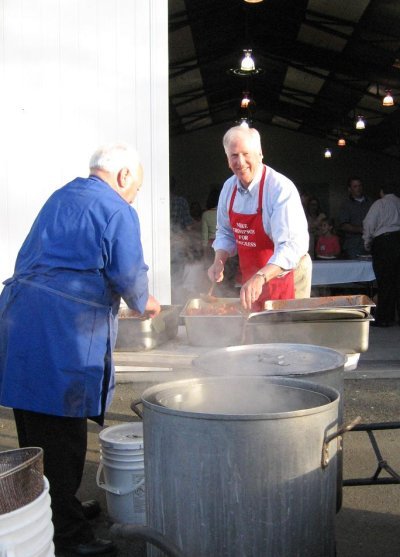
LAKEPORT – About 250 people turned out for Mike Thompson’s 16th annual ravioli feed Saturday night.
Brad Onorato, Thompson’s aide, said the annual event is an important fundraiser for the First District congressman.
Mike Thompson, D-Napa, thanked the crowd, which honored him with a standing ovation after he updated it for about 20 minutes on changes in Washington D.C.
“I’m much more excited this year at pasta time,” Thompson said, calling Congress “no longer a place where great ideas go to die.”
He briefed the audience on the latest round of Iraq bills, summarizing that “the Iraq supplemental debate isn’t over.”
Thompson said he was “cautiously optimistic” about immigration reform and said he hopes Congress will tackle the other “big issues” of health care and education before the “political nonsense of 2008” takes over.
He expressed concern that the Bush administration wants to privatize Social Security.
Thompson also spoke briefly about his recent appointment to the House Intelligence Committee, after which he was named chairman of the Subcommittee on Terrorism and Human Intelligence.
He described the meetings he attends six times a week as cloaked in secrecy in a lead room from which nothing can be removed – no notes, nothing.
“We need to be doing the right things in the right places,” he said of the intelligence work.
In recent months Thompson has worked closely with presidential candidate Sen. Barack Obama on legislation to end the Iraq war. Thompson introduced the House companion bill to Obama's legislation in the Senate.
So, with Obama in the race for president, is Thompson in the running for a vice presidential nod?
In a private interview during the event Thompson denied he was on Obama’s short list for a vice presidential candidate.
E-mail Maile Field at

{mos_sb_discuss:3}
- Details
- Written by: Lake County News Reports
UPPER LAKE – A single-vehicle rollover early Saturday morning left two people injured.
The California Highway Patrol's incident logs reported a traffic collision occurred at about 1:50 a.m. on Elk Mountain Road, with the driver and passenger both injured.
Officer Kevin Domby of the Clear Lake CHP office said that M. Seyms was driving a 1997 Ford F-250 pickup truck northbound on Elk Mountain Road and north of the airstrip early Saturday when he lost control of the vehicle and traveled off the road to the east.
Domby said the front of the pickup subsequently hit a dirt embankment.
California Department of Forestry and Fire Protection (CDF), CHP, Lake County Sheriff's deputies and CalStar responded to the accident, the CHP logs reported.
Seyms was seriously injured at the scene, said Domby, suffering severe head trauma. His passenger, K. Nyholm, suffered a serious neck injury, Domby added.
Officials took a blood sample from Seyms before both he and Nyholm were transported to Santa Rosa Memorial Hospital for treatment, according to the CHP incident logs.
Domby said Seyms was arrested under suspicion of driving under the influence.
No further information on Syems and Nyholm, including ages and cities of residence, were available from the CHP before publication.
E-mail Elizabeth Larson at
{mos_sb_discuss:2}
- Details
- Written by: Elizabeth Larson

By CRAIG THOMSEN AND TANYA MEYER
Tuleyome.org
Cache Creek natural communities are under assault by another wildland weed. A massive invasion of an escaped ornamental – Ravenna grass (Saccharum ravennae) – is under way along the Cache Creek corridor in Lake and Yolo counties.
It is one of the largest exotic grasses in the state, with tussocks reaching 5 feet wide and flowering stalks 12 feet tall.
Ravenna Grass occupies riparian sites similar to those inhabited by two other well-known invasive plants, tamarisk (Tamarix parviflora) and giant reed (Arundo donax), but has also moved into upland areas such as roadsides, cut-banks, and steep slopes in Rumsey Canyon. Individual plants produce thousands of seeds that disperse by both wind and water.
Sometimes referred to as Hardy Pampas grass, Ravenna grass does resemble Pampas grass (Cortaderia selloana) with its large tufts and showy flowers. However, Ravenna grass is actually more closely related to sugarcane, and belongs to the same genus, Saccharum, which is Latin for sugar.
The name Ravenna comes from Ravenna, Italy, a city in northeast Italy near the Adriatic Sea.
Effects on Cache Creek ecosystem
One of the most serious problems affecting natural ecosystems globally is the invasion of non-native, exotic plants and animals.
Renowned ecologist Edward O. Wilson, stated that invasive species are the greatest threat to biodiversity on the planet, second only to habitat loss. (As native plants are displaced, animal populations that rely on the plants for food and shelter also decline.)
While no formal studies have been conducted on the effects of Ravenna grass on the Cache Creek ecosystem, field observations indicate that these enormous plants are having a pronounced influence on the creek’s native habitats.
Arrival to Cache Creek and distribution
Ravenna grass has been used as an ornamental in the United States for over 30 years and joins the ever-growing list of plants that were purposely introduced into landscape settings and later spread, becoming major weeds.
Web sites for this plant show that it is widely promoted by the nursery trade for its size, plume-like flowers, tolerance to harsh sites and resistance to disease. Of course, some of the same qualities are the very traits that make it an invasive weed.
The original source of Ravenna grass along Cache Creek was the Upper Watershed in Lake County. Gregg Mangan, Cache Creek Natural Area manager for the BLM in Ukiah recalls seeing this plant in the early 1990’s during field surveys along the north fork of Cache Creek.
The late Jan Lowrey, a life-long resident of Rumsey and former director of the Cache Creek Conservancy, noted that it appeared in abundance along lower Cache Creek after the intense 1995 flood.
Ravenna grass appears in all of the Yolo County Parks along Cache Creek and also grows at the remote Lake Davis reservoir on Davis Creek, a small tributary to Cache Creek.
John Watson, vegetation manager with the Conservancy, has observed it one mile west of Highway 5 near Woodland and suspects that this weed may occur within the Cache Creek basin, a short distance from the Sacramento River.
Thankfully, Ravenna grass still has a limited distribution in the state; the only other reported occurrence of this species in California is from Imperial Valley, where it is found in marshes and ditches.
Based on its behavior along Cache Creek and invasive history in Utah and Arizona, however, it appears to have potential to move well beyond Cache Creek and into other California watersheds.
Control programs along Cache Creek
Clearly a cooperative regional effort between federal, state and county entities as well as concerned landowners, is needed to address Ravenna grass infestations, as it will continue to expand in the watershed without concerted control efforts. To date, no control work has been done in the upper watershed.
Along lower Cache Creek, control efforts were first initiated by John Watson, recipient of California’s Invasive Plant Council’s “Land Manager of the Year,” who started work on this weed back in 2001.
Last fall, the Yolo County Resource Conservation District, in cooperation with Yolo County Parks, private landowners, Joe Muller and Sons, and the Wildlife Conservation Board, began control efforts on parklands and several private ownerships.
Unfortunately, decisions about controlling wildland weeds along waterways are not always straightforward.
Generally, it is advisable to begin work upstream at the source and move down. This raises questions about the long-term effectiveness of control programs and since efforts began in the lower sections of the creek, Ravenna grass will continue to re-colonize downstream sites. Yet, the precise source location has yet to be identified and much of the upper creek infestations occur in remote areas on BLM property.
At this juncture, practitioners think that downstream control efforts are warranted, provided that follow-up measures are included to eliminate seedlings that might re-establish in future years. Moreover, in many sites, infestations are at low levels where effective containment measures could be accomplished at a relatively low cost. The alternative is to stand back and witness a further degradation of Cache Creek’s biologically-rich natural communities.
In Arizona, Ravenna grass has been subject to control efforts in the Grand Canyon, where it was discovered in the early 1990’s. Since then, National Park Service staff and volunteers have removed over 25,000 plants and it is now rare throughout the canyon.
It's unfortunate that Ravenna grass is now a member of the Cache Creek plant kingdom. We hope that with more awareness of this plant and the problems that it presents eradication can begin as it did in the Grand Canyon.
With a concerted effort the Cache Creek region will one day see more native species and less exotic plants like Ravenna grass, Arundo and tamarisk.
Craig Thomsen is a rangeland ecologist with the Department of Plant Sciences, UC Davis and Upper Cache (Bear Creek) Watershed coordinator. Tanya Meyer is the Lower Cache Creek Watershed coordinator with the Yolo County Resource Conservation District.
Tuleyome Tales is brought to you by Tuleyome, a local nonprofit working to protect both our wild heritage and our agricultural heritage for future generations. Past Tuleyome Tales articles are available in the library section of their Website, www.tuleyome.org.
{mos_sb_discuss:2}
- Details
- Written by: Editor
LAKEPORT – A Clearlake man who is alleged last year to have murdered a woman and shot several others will stand trial on murder and attempted murder charges, and could face life in prison if convicted.
Wilbur Home Cope, 36, of Clearlake was arrested Sept. 10 after he allegedly shot and killed Kristin Raviotta; shot his ex-wife Michelle Cain and her current husband, Terry Cain; and also shot Sharon England.
Cope, who has pleaded not guilty to the crimes, was in Superior Court Judge Arthur Mann's court for a preliminary hearing on Friday, according to the District Attorney's Office. The hearing included testimony from Clearlake Police Detective Richard Towle, who was involved in the investigation for the September incident.
Mann ruled that Cope will stand trial for several criminal charges and allegations.
The charges include:
– First degree murder for the death of Raviotta, with the special allegation of personal and intentional discharge of a firearm causing death;
– Attempted murder of Terry Cain with premediation and deliberation, with the special allegations of personal and intentional discharge of a firearm causing great bodily injury, and personally inflicting great bodily injury resulting in paralysis;
– Aggravated mayhem upon the person of Terry Cain, with the same two special allegations listed in count two;
– Attempted murder of Michelle Cain with premeditation and deliberation, with the special allegation of personal and intentional discharge of a firearm; and
– Attempted murder of England with premeditation and deliberation, with the special allegation of personal and intentional discharge of a firearm.
The District Attorney's Office reported that if Cope were found guilty of the charges, he faces life in prison with the possibility of parole.
However, if found guilty Cope's chances for parole could be slim. The DA's Office reported the charges could result in his having to serve 141 years in prison before being eligible for parole.
A Friday afternoon call to Cope's defense attorney, Bruce Laning, was not returned.
Cope will return to court for further proceedings at 8:15 a.m. April 9 in Superior Court's Department 3.
Deputy District Attorney John Langan is prosecuting the case.
E-mail Elizabeth Larson at
{mos_sb_discuss:2}
- Details
- Written by: Elizabeth Larson