 How to resolve AdBlock issue?
News
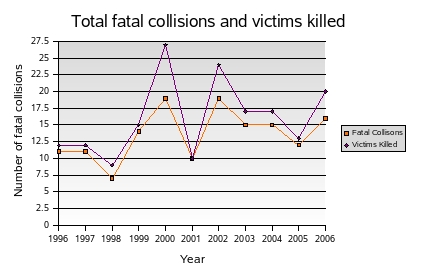
In Lake County, there appears to have been a slight increase both in fatal collisions and the resulting fatalities.
CHP said increased enforcement, along with education, resulted in lives saved statewide.
Highway collision fatalities decreased 9.22 percent in 2006, with 3,907 collision fatalities compared to 4,304 in 2005. Statewide, there were 3,542 fatal collision in 2006, down from 3,822 in 2005.
Jaime Coffee of the Sacramento CHP Office reported that fatal collisions in Lake County in 2005 numbered 12, with 13 victims killed. Statistics for 2006, which she said were preliminary and only extended through September, listed 16 fatal collisions and 20 victims killed.
The county's fatality statistics over the last 10 years show a steady overall increase, with some years showing notable drops. (See graph below.)
“While I am saddened to see these deaths, I am pleased to see what appears to be a substantial reduction in the number of casualties,” said CHP Commissioner Mike Brown. “The projected reduction reflects the emphasis the CHP places on safety.”
CHP said its goals include preventing death, injury and property damage. The indicator of a state’s relative success in traffic safety is represented by the number of traffic fatalities per every 100 million miles of vehicle travel, referred to as the Mileage Death Rate (MDR). The MDR is affected by both increased educational and enforcement efforts.
“Early indications are that California’s estimated mileage death rate in 2006 is 1.21, that’s a dramatic improvement from the previous year’s 1.31 if that holds up,” said Brown.
The MDR won’t be official until the third quarter of 2007 when all data elements are finalized.
“These projected reductions in collisions and victims killed are primarily the result of increased enforcement and education in the three main causes of fatal crashes – seat belt usage, DUIs and speeding,” Brown added.
The preliminary figures were also good news at the California Office of Traffic Safety (OTS).
OTS awards grants to agencies throughout the state for programs aimed at reducing deaths and injuries on California's roadways.
In the last year OTS awarded $103 million to 290 agencies, more funding to more agencies than ever before, with greater emphasis on combating DUI offenders, increasing seat belt use and promoting public awareness campaigns.
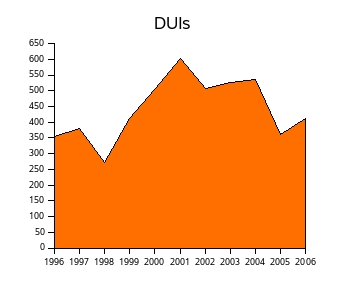
DUI arrests statewide rose 4 percent between 2005 and 2006, going from 89,944 to 93.690. In Lake County, 2005 DUI arrests numbered 360, compared to a preliminary estimate of 411 for 2006 (for 10 years of Lake County DUI statistics, see graph below).
The Lake County District Attorney's Office received an OTS grant last year, according to District Attorney Jon Hopkins. The funds, said Hopkins, were used to create a new DUI Vertical Prosecution Unit and fund a prosecutor whose sole function is to work DUI cases. The unit won its first prosecution in February.
E-mail Elizabeth Larson at
{mos_sb_discuss:2}
- Details
- Written by: Elizabeth Larson
The incident took place at the park's boat ramp at about 8 p.m., according to Lakeport resident Harold LaBonte.
LaBonte said the victim survived, and that two arrests may have taken place at the nearby Willopoint trailer park.
He reported some confusion at the scene as patrons at the nearby TNT on the Lake restaurant hurried to leave the area.
Police officials at the scene would not release details, said La Bonte.
A dispatcher at Lakeport Police reported at shortly before 11 p.m. that no one with the authority to release information on the case was available for comment.
E-mail Elizabeth Larson at
{mos_sb_discuss:2}
- Details
- Written by: Elizabeth Larson
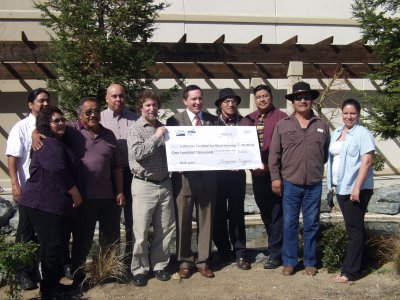
LAKE COUNTY – Five local American Indian tribes have received a $100,000 federal grant to help them improve housing in their communities.
The U.S. Department of Agricultural Rural Development visited Big Valley Rancheria's Konocti Vista Casino Thursday to make the official presentation to the tribes, which include Big Valley, Scotts Valley Band of Pomo Indians, Habematolel Pomo of Upper Lake, Robinson Rancheria and Elem Indian Colony.
The grant funds will be used to provide training and technical assistance to assist tribes in acquiring and developing land for housing projects and related infrastructure, rehabilitating and building housing, and operating housing assistance programs, the agency reported.
State USDA Rural Development Director Ben Higgins came for the event. He said the grant is modest when considering the nearly $80 million the agency has awarded over the last seven years to help foster growth in business development, homeownership and infrastructure in rural communities.
However, Higgins said in the case of Lake County's tribes, “Money alone isn't the answer,” and that it's necessary to have an element of community leadership as well.
“There are unique and pressing problems we're looking to address,” he said, which include a poverty rate of 17 percent in Lake County, which is five points above the state average.
Also on hand was Rob Wiener of California Coalition for Rural Housing. That organization is partnering with the tribes on an implementation plan for the grant, which includes conducting an analysis to identify each tribe's training and housing needs, training in affordable housing and training for housing and community development applications.
By funding that important training, said Higgins, the grant will help the tribes plan for the future.
This is one of the first grants the agency has been able to award in this fiscal year, said Higgins, which has been delayed in Congress.
The California Coalition for Rural Housing has done numerous farmworker housing projects, said Wiener, but tribal housing is a brand new experience for them. He said the coalition hopes to see if they can get existing housing programs to work for the county's tribes.
“We see this as a wonderful opportunity to learn about tribal housing issues,” he said.
The visitors from USDA Rural Development and California Coalition for Rural Housing also had what Higgins called an “eye opening” experience.
That came in the form of a tour of Big Valley Rancheria's housing conditions, led by Tribal Administrator Anthony Jack and Linda Hedstrom, the tribe's housing director.
“We're going to dispel the myth that all gaming tribes are rich,” said Jack.
What they showed were conditions that Wiener and Higgins said were some of the worst they had ever witnessed: numerous travel trailers clustered around each other, hooked up to hoses for running water; badly dilapidated homes and trailer houses that looked barely habitable.
And yet they sit in a beautiful area looking out on the lake, on land that Hedstrom called “an incredible, priceless piece of property.”
Even the rancheria's construction department lacked heating, wheelchair access and hot water, said Hedstrom.
“All tribes around here have the same stories,” said Hedstrom.
About 200 of the tribes 860 members live on the Rancheria, said Jack. Hedstrom said many more would like to return to the rancheria to live in their native communities, but the tribe needs more land and better housing.
They're hoping to expand the rancheria, said Hedstrom. While there's prospective land nearby, she said, the owners usually ask exorbitant prices.
The perception, said Jack, is that the tribe has a lot of money thanks to the casino, but that's wrong. Due to competition, he said, “It's hard to make a buck right now.”
That's one reason why the rancheria aggressively pursues grants, said Hedstrom.
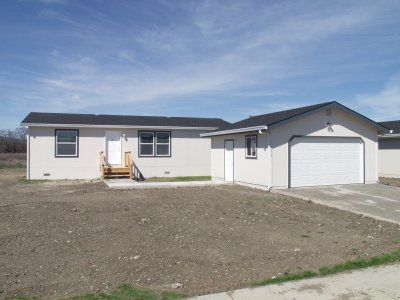
The tribe recently put in 10 new manufactured homes next to 10 newer stick-built homes along Yellow Hammer Lane. Hedstrom said they had many people on a list for those manufactured homes. The families which received the homes were determined by lottery, she said, and began moving in at the start of March.
Hedstrom said the tribe wants to hold a construction boot camp, similar to one which has been held successfully in Lake County over the past few years, in order to help tribal members learn how to assist in building their own homes.
Afterward, Higgins said, “The housing conditions here are some of the worst in the state, if not the country.”
For more in USDA Rural Development's programs, visit www.rurdev.usda.gov/ca.
E-mail Elizabeth Larson at
{mos_sb_discuss:2}
- Details
- Written by: Elizabeth Larson
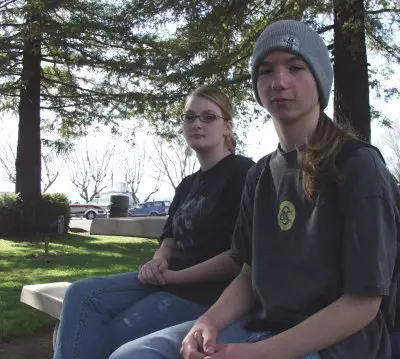
LUCERNE – Conrad Kiczenski is worried – about global warming, poverty and war. And he's only 15.
Those are the major issues that will impact his future, he said.
Rather than just worry, Conrad is moving his feet.
This Saturday, the teen hopes to inspire other young people from around the county to speak out in defense of their future at a 2 p.m. rally in Lucerne Harbor Park.
Lake County's version of the “Shut Down the War Machine” rally, which Conrad and friend Alie Stout have organized, is part of a series of protests scheduled in major cities around the U.S. that same day.
Saturday, events such as the “Gathering of Eagles” rally in Sacramento, will show support for U.S. troops in Iraq. Organizers say that rally is nonpolitical.
Conrad said he first heard about the nationwide rally on Myspace.com, which has emerged as an important social forum for teens.
“I decided, we got to get up and do something,” he said.
He and Alie, 15, began making fliers and putting them up around town, although many of them were immediately torn down, they reported.
That hasn't stopped them, though. In fact, they've been out every day putting up new fliers to replace those that went missing.
This isn't the first time the teens have been involved with political action.
Alie and Conrad met while attending Upper Lake High School. Last October, they were part of a student walkout to protest the war. Alie estimates 70 students left class Oct. 5, despite the fact that they were facing “dire consequences.”
They were both hassled and cheered on by other students and community members, she said. “The positive overruled the negative by far.”
All of the teens ended up receiving detention, she said.
Since then, Conrad left Upper Lake High to study in California Virtual Academy's home school program. He said the school system doesn't motivate original thinking.
The October rally, like Saturday's, was organized largely through Conrad's efforts using Myspace.com and posting fliers.
“I just really think it's a good cause,” said Alie. “This area needs more things for teens to do that are positive, not negative.”
Still, she said she's gotten a lot of negative comments from classmates, whose views have ranged from the rally being a “dumb” idea to the more ominous opinion that it will look bad on her resume when she prepares to go to college.
“I just kinda give 'em the cold shoulder,” she said. “They can say what they want.”
Both the teens say their parents have been very supportive of their work to organize the rally.
Do teens think much about the war in Iraq, and what it might mean for their future?
Conrad and Alie certainly do, but they said other teens either don't think much about it or, worse yet, don't have any hope that they can make a difference by speaking out.
They said the kids who do think about it a lot don't appear to hang out with the popular crowd.
Conrad believes a draft may be imposed soon, because, he said, “We're making enemies faster than we can kill them.”
What would they like to see happen at Saturday's rally?
“What we're trying to do is inspire people to stand up for their future,” said Conrad.
The rally will start at 2 p.m. Saturday in the picnic table area of Lucerne Harbor Park, Conrad explained. There will be an open mike for a discussion of both sides of the war issue.
Conrad and Alie say they want people of all viewpoints to come and share their thoughts “so we can learn from them,” added Conrad.
“I want to leave people inspired, with hope that they can make a difference, because that's really missing,” said Conrad.
He said he expects a pretty good turnout of both adults and teens.
Lake County Youth Action (LCYA), a group Conrad and Alie are helping organize, will meet at noon on Sunday at the Lucerne Senior Center, to discuss the rally and possible future events.
For anyone needing a ride to the rally, Conrad suggests visiting laketransit.org/systemmap.asp.
For more info on LCYA go to groups.myspace.com/lakecountyyouthaction or email Conrad at
E-mail Elizabeth Larson at
{mos_sb_discuss:2}
- Details
- Written by: Elizabeth Larson