 How to resolve AdBlock issue?
News
- Details
- Written by: Elizabeth Larson
The commission will meet at 5:30 p.m. Wednesday, March 13, in the council chambers at Lakeport City Hall, 225 Park St.
The council chambers will be open to the public for the meeting. Masks are highly encouraged where 6-foot distancing cannot be maintained.
The agenda is available here.
To speak on an agenda item, access the meeting remotely here; the meeting ID is 814 1135 4347, pass code is 847985.
To join by phone, dial 1-669-444-9171; for one tap mobile, 16694449171,,81411354347#,,,,*847985#.
Comments can be submitted by email to
On the agenda is the annual progress report for the housing element.
Commissioners also will discuss the planning department and commission goals for this year.
Email Elizabeth Larson at
Climate change matters to more and more people – and could be a deciding factor in the 2024 election
- Details
- Written by: Matt Burgess, University of Colorado Boulder
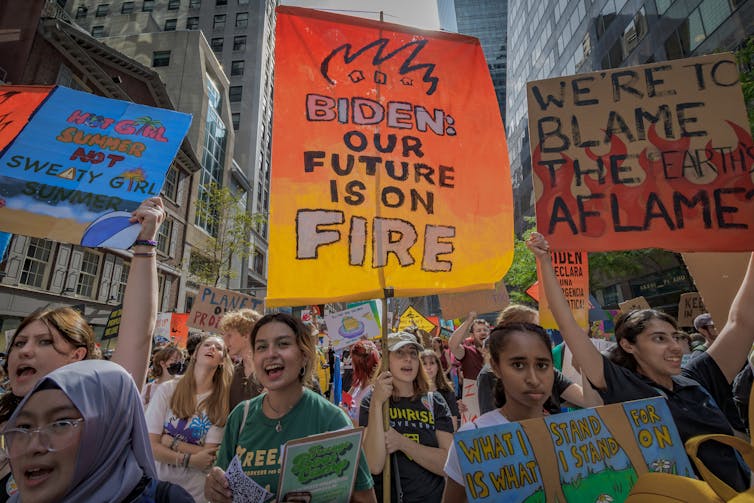
If you ask American voters what their top issues are, most will point to kitchen-table issues like the economy, inflation, crime, health care or education.
Fewer than 5% of respondents in 2023 and 2024 Gallup surveys said that climate change was the most important problem facing the country.
Despite this, research that I conducted with my colleages suggests that concern about climate change has had a significant effect on voters’ choices in the past two presidential elections. Climate change opinions may even have had a large enough effect to change the 2020 election outcome in President Joe Biden’s favor. This was the conclusion of an analysis of polling data that we published on Jan. 17, 2024, through the University of Colorado’s Center for Social and Environmental Futures.
What explains these results, and what effect might climate change have on the 2024 election?
Measuring climate change’s effect on elections
We used 2016 and 2020 survey data from the nonpartisan organization Voter Study Group to analyze the relationships between thousands of voters’ presidential picks in the past two elections with their demographics and their opinions on 22 different issues, including climate change.
The survey asked voters to rate climate change’s importance with four options: “unimportant,” “not very important,” “somewhat important” or “very important.”
In 2020, 67% of voters rated climate change as “somewhat important” or “very important,” up from 62% in 2016. Of these voters rating climate change as important, 77% supported Biden in 2020, up from 69% who supported Hillary Clinton in 2016. This suggests that climate change opinion has been providing the Democrats with a growing electoral advantage.
Using two different statistical models, we estimated that climate change opinion could have shifted the 2020 national popular vote margin (Democratic vote share minus Republican vote share) by 3% or more toward Biden. Using an Electoral College model, we estimated that a 3% shift would have been large enough to change the election outcome in his favor.
These patterns echo the results of a November 2023 poll. This poll found that more voters trust the Democrats’ approach to climate change, compared to Republicans’ approach to the issue.
What might explain the effect of climate change on voting
So, if most voters – even Democrats – do not rank climate change as their top issue, how could climate change opinion have tipped the 2020 presidential election?
Our analysis could not answer this question directly, but here are three educated guesses:
First, recent presidential elections have been extremely close. This means that climate change opinion would not need to have a very large effect on voting to change election outcomes. In 2020, Biden won Georgia by about 10,000 votes – 0.2% of the votes cast – and he won Wisconsin by about 20,000 votes, 0.6% of votes cast.
Second, candidates who deny that climate change is real or a problem might turn off some moderate swing voters, even if climate change was not those voters’ top issue. The scientific evidence for climate change being real is so strong that if a candidate were to deny the basic science of climate change, some moderate voters might wonder whether to trust that candidate in general.
Third, some voters may be starting to see the connections between climate change and the kitchen-table issues that they consider to be higher priorities than climate change. For example, there is strong evidence that climate change affects health, national security, the economy and immigration patterns in the U.S. and around the world.
Where the candidates stand
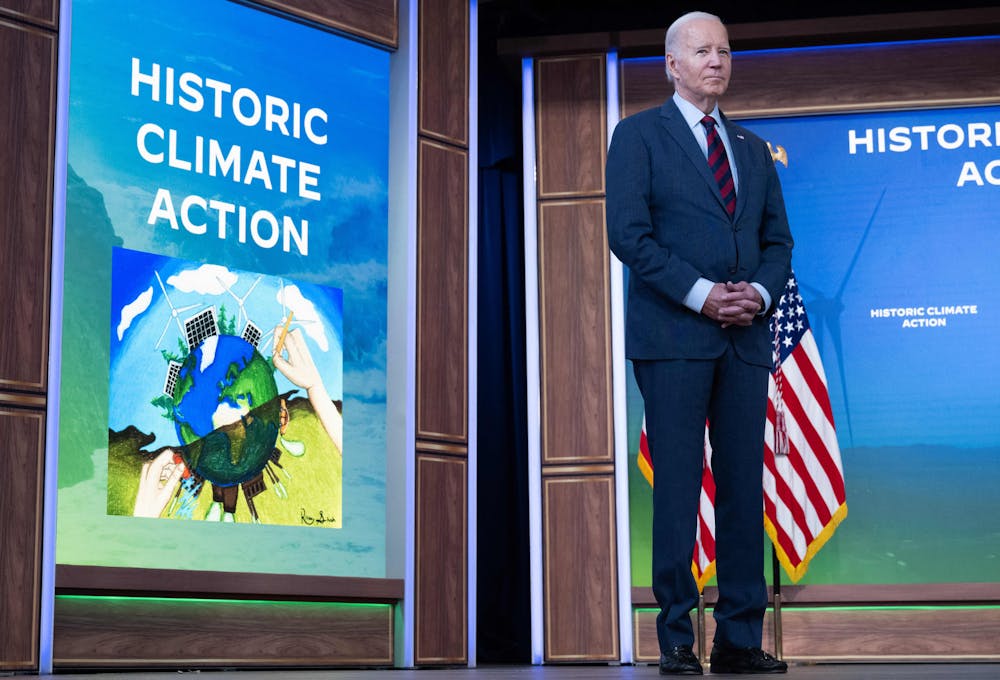
Biden and former President Donald Trump have very different records on climate change and approaches to the environment.
Trump has previously called climate change a “hoax.”
In 2017, Trump withdrew the U.S. from the Paris Agreement, an international treaty that legally commits countries to reduce their greenhouse gas emissions.
Biden reversed that decision in 2021.
While in office, Trump rolled back 125 environmental rules and policies aimed at protecting the country’s air, water, land and wildlife, arguing that these regulations hurt businesses.
Biden has restored many of these regulations. He has also added several new rules and regulations, including a requirement for businesses to publicly disclose their greenhouse gas emissions.
Biden has also signed three major laws that each provides tens of billions in annual spending to address climate change. Two of those laws were bipartisan.
On the other hand, the U.S. has also become the world’s largest producer of oil and gas, and the largest exporter of natural gas, during Biden’s term.
In the current campaign, Trump has promised to eliminate subsidies for renewable energy and electric vehicles, to increase domestic fossil fuel production and to roll back environmental regulations. In practice, some of these efforts could face opposition from congressional Republicans, in addition to Democrats.
Public opinion varies on particular climate policies that Biden has enacted.
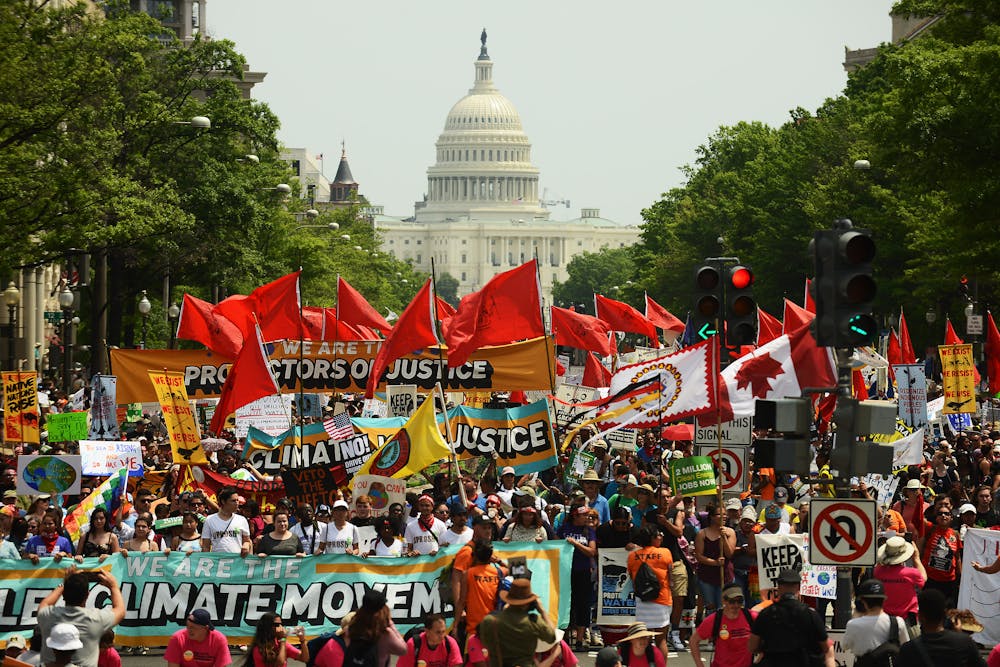
Nonetheless, doing something about climate change remains much more popular than doing nothing. For example, a November 2023 Yale survey found 57% of voters would prefer a candidate who supports action on global warming over a candidate who opposes action.
What this means for 2024
Our study found that between the 2016 and the 2020 presidential elections, climate change became increasingly important to voters, and the importance voters assign to climate change became increasingly predictive of voting for the Democrats. If these trends continue, then climate change could provide the Democrats with an even larger electoral advantage in 2024.
Of course, this does not necessarily mean that the Democrats will win the 2024 election. For example, our study estimated that climate change gave the Democrats an advantage in 2016, and yet Trump still won that election because of other issues. Immigration is currently the top issue for a plurality of voters, and recent national polls suggest that Trump currently leads the 2024 presidential race over Biden.
Although a majority of voters currently prefer the Democrats’ climate stances, this need not always be true. For example, Democrats risk losing voters when their policies impose economic costs, or when they are framed as anti-capitalist, racial, or overly pessimistic. Some Republican-backed climate policies, like trying to speed up renewable energy projects, are popular.
Nonetheless, if the election were held today, the totality of evidence suggests that most voters would prefer a climate-conscious candidate, and that most climate-conscious voters currently prefer a Democrat.
Matt Burgess, Assistant Professor of Environmental Studies, University of Colorado Boulder
This article is republished from The Conversation under a Creative Commons license. Read the original article.
- Details
- Written by: Elizabeth Larson
The crash occurred shortly after 10 p.m. Sunday on Butte Street in Nice, according to a report from the California Highway Patrol’s Clear Lake Area office.
The names of the two men who died — the 39-year-old driver from Nice and the 34-year-old passenger from Upper Lake — were not immediately released pending the notification of next of kin.
The CHP said that at 10:18 p.m. Sunday CHP Officer Officer Zachary Cornell was dispatched to a solo vehicle traffic crash involving a red 2021 Subaru WRX that hit a fence and landed in a swimming pool at a residence on Tehama Street.
Radio reports indicated that the vehicle landed upside down in about six feet of water, with the individual who called the CHP indicating that they couldn’t get those inside of the vehicle out of it.
Shortly after the crash, the Northshore Dive Team was requested to respond to the team to assist with the rescue, according to radio reports.
The CHP said that its investigation so far has found that the Subaru was traveling on Butte Street when it went over the embankment.
Neither the driver nor the passenger, who was found in the rear seat, were wearing seat belts, at the time of the crash, the CHP said.
The cause of the collision is still under investigation, however, the CHP said in its preliminary statement on the crash that alcohol use is suspected to be a factor.
Along with the CHP and Northshore Fire Protection District, the Lake County Sheriff’s Office and All in One Towing responded to the scene to assist with the crash recovery.
Email Elizabeth Larson at
- Details
- Written by: Elizabeth Larson
MATH will meet at 7 p.m. Thursday, March 14, in the Middletown Community Meeting Room/Library at 21256 Washington St., Middletown. The meeting is open to the public.
To join the meeting via Zoom click on this link; the meeting ID is 869-1824-5695, pass code is 808449. Call in at 669-900-6833.
The meeting will be recorded and livestreamed by Mediacom Public Education and Government Channel, or Lake County PEG TV.
On the agenda is an update from Pacific Gas and Electric on the GI landfill project on Butts Canyon Road and hear from Chief Climate Resiliency Officer Terre Logsdon on a report on survey results and community priorities.
MATH also will offer suggestions to the supervisor for use of discretionary funds, discuss MATH bylaw amendments per the Lake County counsel and as presented at the February meeting, and discuss the results of the March 5 election.
MATH — established by resolution of the Lake County Board of Supervisors on Dec. 12, 2006 — is a municipal advisory council serving the residents of Anderson Springs, Cobb, Coyote Valley (including Hidden Valley Lake), Long Valley and Middletown.
For more information email
Email Elizabeth Larson at