 How to resolve AdBlock issue?
News
- Details
- Written by: Elizabeth Larson
Daylight Saving Time begins at 2 a.m. Sunday, March 10.
California goes from Pacific Standard Time to Pacific Daylight Time when clocks “spring forward” by one hour.
At this time of year, it’s also a good idea to remember to change batteries in smoke and carbon monoxide detectors as well as in NOAA weather radios.
This year, Daylight Saving Time ends on Sunday, Nov. 3.
Email Elizabeth Larson at
- Details
- Written by: LAKE COUNTY NEWS REPORTS
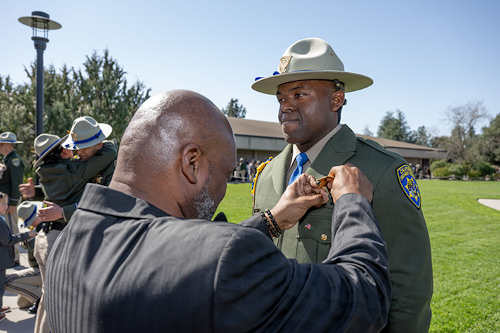
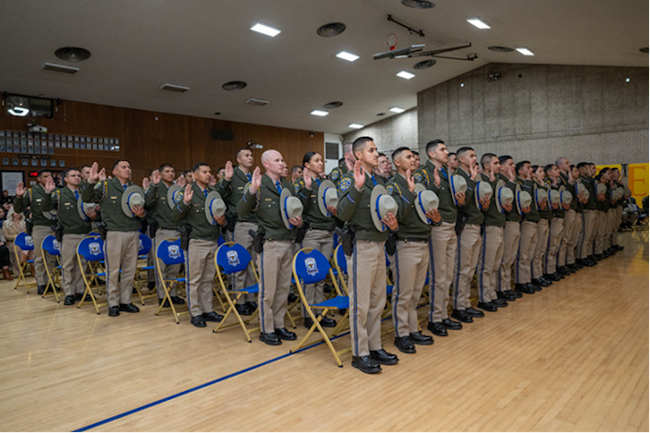
The newest members of the California Highway Patrol were sworn in today during a graduation ceremony at the CHP Academy in West Sacramento.
The 105 officers are part of the CHP’s multiyear recruiting campaign to fill 1,000 vacant officer positions by hiring qualified individuals from California’s diverse communities.
“Today marks a significant milestone in the lives of these new officers. I want to commend these men and women for their dedication and perseverance these past several months while training at the Academy,” CHP Commissioner Sean Duryee said Friday. “Success in training and on the job is only achieved by the most dedicated of individuals. We look forward to working alongside them as we uphold the law and safeguard California’s communities.”
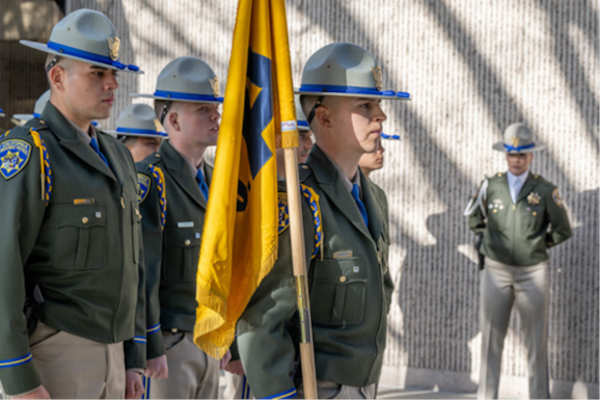
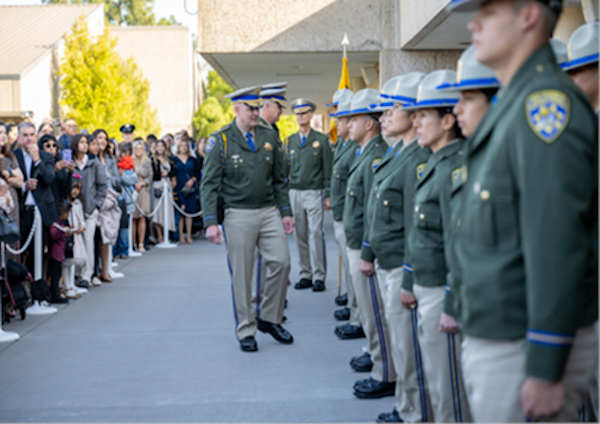
The swearing-in ceremony for the new officers marks the completion of a challenging 26-week journey at the CHP Academy. They will report to one of the more than 100 CHP offices throughout the state to begin serving the people of California.
At the CHP Academy, cadet training starts with nobility in policing, leadership, professionalism and ethics, and cultural diversity. Additionally, cadets receive instruction on mental illness response and crisis intervention techniques.
Training also covers vehicle patrol, crash investigation, first aid, and the apprehension of suspected violators, including those who drive under the influence. Cadets also receive training in traffic control, report writing, recovery of stolen vehicles, assisting the motoring public, issuing citations, emergency scene management, and various codes, including the California Vehicle Code, Penal Code, and Health and Safety Code.
The CHP has seen a significant increase in the number of applications since the onset of its multiyear recruitment campaign in June 2022. To accommodate the surge of interest, the CHP has been holding three Academy classes simultaneously for the first time in the Department’s history. The next cadet graduation from the CHP Academy is scheduled for May 10.
For more information about a life changing career with the CHP, visit the agency’s website and apply today.
- Details
- Written by: DENNIS FORDHAM
In California, under section 17200 of the Probate Code, the trustee or a beneficiary of a trust may petition the court for instructions or other guidance regarding the internal affairs of the trust or the existence of the trust.
Section 17200 has wide scope, and applies, amongst other things, to interpreting the trust, determining the validity of the trust, ascertaining beneficiaries, settling accounts, instructing the trustee, appointing or removing a trustee, requiring an accounting, and much more.
What rights does a person who is neither a trustee nor a beneficiary of the trust have with respect to receiving notice of such a section 17200 petition and then to participating in such trust proceedings?
In Colvis V. Binswanger, 96 Cal. App. 5th 393 (October 13, 2023), the First Appellate District recently addressed that issue.
In Colvis, the trust owned 70 % of the shares in a Company and the remaining 30% was owned by two siblings. The siblings filed a petition under section 17200 of the Probate Code to instruct the trustee to use its 70% ownership to direct the company to borrow substantial sums of money.
The company filed a response to the petition in the trust proceedings. The petitioners objected and argued that the company lacked standing as it was neither a beneficiary nor a trustee.
Section 1043 of the Probate Code, however, provides that, “(a) An interested person may appear and make a response or objection in writing at or before the hearing. [and] (b) An interested person may appear and make a response or objection orally at the hearing. The court in its discretion shall either hear and determine the response or objection at the hearing, or grant a continuance for the purpose of allowing a response or objection to be made in writing.”
Who then qualifies as, “an interested person” who may appear, respond and object to a petition by a trustee or beneficiary? Section 48 of the Probate Code provides, “(a) …“interested person” includes any of the following: (1) An heir, devisee, child, spouse, creditor, beneficiary, and any other person having a property right in or claim against a trust estate or the estate of a decedent which may be affected by the proceeding. (2) Any person having priority for appointment as personal representative. (3) A fiduciary representing an interested person.” Thus, creditors and, “any other person have a property right in or claim against a trust estate … which may be affected by the proceeding” are interested persons.
In Colvis, the Appellate Court held that while only a trustee or a beneficiary may initiate a trust petition under section 17200, any interested person may appear, respond and object to the petition. The court considered that section 17203 of the Probate Code which requires notice of the section 17200 petition to be given to interested persons strong indication that interested persons could also appear, respond and object because otherwise given interest persons notice without an ability to participate to protect their interest was meaningless.
Whether a person qualifies as an interested party is specific to the subject of the court proceedings. In Colvis, the court quoted relevant case law precedent, as follows: “The probate court has flexibility in determining whether to permit a party to participate as an interested party. … Thus, a party may qualify as an interested person entitled to participate for purposes of one proceeding but not for another.”
In sum, it makes sense for interested parties to be vigilant and proactive when probate proceedings are involved or are expected.
An interested party might give the trustee written notice that they consider themselves to be an interested party with respect to matters where the affairs of the trust and the interested party overlap and so request that they receive notice of any section 17200 petition involving such matters.
The foregoing brief discussion is not legal advice. Consult a qualified attorney for guidance.
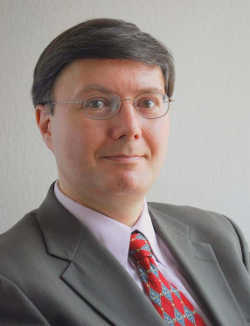
Dennis A. Fordham, attorney, is a State Bar-Certified Specialist in estate planning, probate and trust law. His office is at 870 S. Main St., Lakeport, Calif. He can be reached at
- Details
- Written by: PRESTON DYCHES
What's up for March? Some close pair-ups with the Moon, and Mercury makes an appearance, a subtle lunar eclipse, and a chance to catch a comet.
In March, you'll find Jupiter shining brightly in the west during the early evening hours all month long. And on March 13th, it's joined by a crescent Moon so close that the pair will be visible together through binoculars.
On the following evening, the Moon visits the Pleiades. This is another close pairing — with the five-day-old lunar crescent hanging right next to the bright star cluster — that will look great through a small telescope or binoculars.
Near the end of March, observers in the Northern Hemisphere will have the best opportunity of the year to catch a glimpse of Mercury in the evening sky. Look for it shining brightly low in the west following sunset.
Overnight on March 24 and into March 25, the Moon will pass through the outer part of Earth's shadow, creating a faint lunar eclipse called a penumbral eclipse.
Now, the more spectacular variety of lunar eclipses happens when the Moon passes through Earth's inner shadow, or umbra. That's when we see a dark “bite” taken out of the Moon, or in the case of a total lunar eclipse, a reddish, so-called “blood moon.”
Penumbral eclipses cause only a slight dimming of the Moon's brightness, so if you're not looking for it, you might not know there was an eclipse happening. But if you glance at the Moon early in the night, and then later, around the peak of the eclipse, you might notice the difference in brightness.
Even faint lunar eclipses like this one are always accompanied by a solar eclipse either a couple of weeks before or after. And on April 8, a total solar eclipse will sweep across the U.S. (We'll tell you more about that in next month's video.)
There's a comet making its way into the inner solar system that's already observable with a telescope, and might start to become visible to the unaided eye by late March or in April. It’s a mountain of rock, dust, and ice several miles wide named 12P/Pons-Brooks.
It has a stretched-out, 71-year-long orbit that carries it as far from the Sun as the orbit of Neptune and nearly as close as the orbit of Venus. Fortunately, because this orbit is tilted, it doesn't cross our planet's path, so there's no chance of a collision.
Comet 12P has been observed on several of its previous appearances going back hundreds of years, and one thing it's known for is its occasional outbursts. Sometimes this comet suddenly brightens by quite a bit, due to bursts of gas and dust being released from beneath its surface. If this happens in the March-April time frame as the comet nears the Sun, it could become bright enough to observe with the eye alone.
But even without additional brightening from outbursts, the comet is predicted to peak at a brightness that should make it easy to see with binoculars, and possibly just naked-eye visible under dark skies by the end of March.
Now, comets are notoriously unpredictable, so it's hard to know for sure how bright Pons-Brooks will get as it nears the Sun, but it's certainly worth a look. You can find it low in the west-northwest part of the sky at the end of evening twilight.
Comets, along with asteroids, are leftover pieces of the materials that formed the Sun and planets. So catch a comet and glimpse one of the building blocks of our solar system with your own eyes.
Stay up to date on NASA's missions exploring the solar system and beyond at science.nasa.gov.
Preston Dyches works for NASA's Jet Propulsion Laboratory.