How to resolve AdBlock issue?
Refresh this page
How to resolve AdBlock issue?
Refresh this page
Lake County News,California
  • Home
    • Registration Form
  • News
    • Education
    • Veterans
    • Community
      • Obituaries
      • Letters
      • Commentary
    • Police Logs
    • Business
    • Recreation
    • Health
    • Religion
    • Legals
    • Arts & Life
    • Regional
  • Calendar
  • Contact us
    • FAQs
    • Phones, E-Mail
    • Subscribe
  • Advertise Here
  • Login
How to resolve AdBlock issue?
Refresh this page

News

‘Tis the season to slow down; CHP launches holiday enforcement effort

Details
Written by: LAKE COUNTY NEWS REPORTS
Published: 23 December 2025


LAKE COUNTY, Calif. — The California Highway Patrol encourages the public to “brake” the habit of speeding this holiday season. 

The CHP will launch a Holiday Enforcement Period, or HEP, starting at 6 p.m. on Wednesday, Dec. 24, and ending at 11:59 p.m. on Thursday, Dec. 25.

During last year’s 30-hour holiday enforcement effort for Christmas, CHP officers arrested over 300 impaired drivers in just 30 hours, issued 2,251 speeding tickets — including 132 to motorists going over 100 mph. 

Tragically, during that same time period, at least 17 people lost their lives in crashes across the state.

“Every instance of speeding or reckless driving carries the potential for life-changing consequences. Our officers see the destruction these choices can cause, and we urge every driver to slow down, stay alert, and make decisions that protect themselves and others. No destination is worth risking a life,” said CHP Commissioner Sean Duryee.

Removing dangerous drivers from California’s roads remains a top priority for the CHP. 

To support this goal, the CHP and the Department of Motor Vehicles recently launched Forwarded Actions for Speeding Tickets, or FAST, a pilot program that speeds up the process of removing drivers who exceed 100 mph from the roads. 

FAST automatically sends these citations to the DMV’s Driver Safety Branch, which can suspend or revoke a license. 

The CHP has also deployed 100 low-profile, specially marked patrol vehicles that have issued nearly 33,000 speed-related citations since May.

These steps, along with the upcoming Christmas HEP, send a clear message to drivers: slow down or face being stopped. 

Every decision behind the wheel matters, and obeying the speed limit can make the difference between arriving safely or not at all.

Additionally, winter weather can present significant challenges for motorists, particularly as storms impact roadways across the state. Rain, snow, and debris can quickly change driving conditions, reducing visibility and traction and increasing the risk of collisions.

To help everyone get home safely for the holidays, the CHP urges drivers to slow down, allow extra following distance, and remain alert for hazards such as standing water, rockslides, mud, or icy pavement.

Before traveling, check the weather and road conditions, ensure vehicles are properly equipped, and adjust driving behavior accordingly. Patience and preparedness are critical, as arriving safely is always more important than arriving on time.

The world risks forgetting one of humanity’s greatest triumphs as polio nears global eradication − 70 years after Jonas Salk developed the vaccine in a Pittsburgh lab

Details
Written by: Carl Kurlander, University of Pittsburgh
Published: 23 December 2025

Dr. Jonas Salk displays his polio vaccine, which he developed in a University of Pittsburgh laboratory. Bettmann/Bettmann Collection via Getty Images

It was like a horror movie. The invisible polio virus would strike, leaving young children on crutches, in wheelchairs or in a dreaded “iron lung” ventilator. Each summer, the fear was so great that public pools and movie theaters closed. Parents canceled birthday parties, afraid their child might be the next victim. A U.S. president paralyzed by polio called for Americans to send dimes to the White House to support the nonprofit National Foundation for Infantile Paralysis, established by President Franklin D. Roosevelt and his lawyer, Basil O’Connor. Celebrities from Lucille Ball to Elvis were enlisted to promote this “March of Dimes,” and mothers went door to door raising funds to conquer this dreaded disease.

Some of those funds went to 33-year-old scientist Jonas Salk and his team at the University of Pittsburgh, where they worked in a lab between a morgue and a darkroom to develop the world’s first successful polio vaccine.

To prove it worked, the experimental vaccine was tested on Pittsburgh schoolchildren and then 1.8 million children from around the country as part of the largest medical field trial in history. On April 12, 1955, when the Salk polio vaccine was declared “safe and effective,” church bells rang out, kids were let out of school, and headlines around the world celebrated the victory over polio.

When asked whether he was going to patent the vaccine, Salk told journalist Edward R. Murrow it belonged to the people and would be like “patenting the sun.”

I first learned about this 20 years ago when my students and I filmed the 50th anniversary celebration of the Salk polio vaccine at the University of Pittsburgh. I had just started teaching after working in Los Angeles as a screenwriter and TV producer, and the footage became “The Shot Felt Round the World,” a documentary that featured those we met that day.
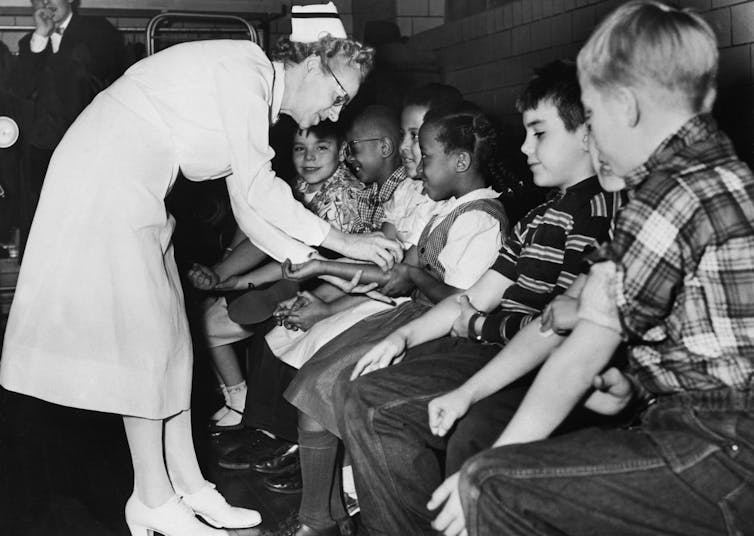
Black and white photo of nurse in white leaning over row of seated elementary school-aged children with sleeves rolled up
A nurse prepares children for a polio vaccine shot in February 1954 as part of a citywide testing of the vaccine on Pittsburgh elementary school students. Bettmann/Bettmann Collection via Getty Images

The ‘Pittsburgh polio pioneers’

Among the people we interviewed was Ethyl “Mickey” Bailey, who worked in the lab pipetting the deadly polio virus by mouth, and Julius Youngner, the lab’s senior scientist who had worked on the Manhattan Project before coming to Pittsburgh. Within a decade, Youngner had worked on the scientific achievement that brought the most destruction, the atomic bomb, and one that did great good by sparing millions from the scourge of “[The Great Crippler].”

Three floors above the lab, Dr. Sidney Busis performed tracheotomies on 2-year-old iron lung patients, opening their windpipes so the ventilator could help them breath. The fierce Dr. Jessie Wright, an innovator in the field of rehabilitation sciences, ran the polio ward, and she was also the medical director of the D.T. Watson Home for Crippled Children, where the Salk vaccine was first tested on humans. Polio victims like Jimmy Sarkett and Ron Flynn volunteered themselves as guinea pigs for a vaccine they knew would never benefit them.

Many “Pittsburgh polio pioneers,” as they called the local children who were given Salk’s still-experimental vaccine, in our documentary recalled getting the shot from Salk himself. Salk also gave it to his own children, including his eldest son, Peter, then 10 years old, who later worked with his father on trying to develop an AIDS vaccine.
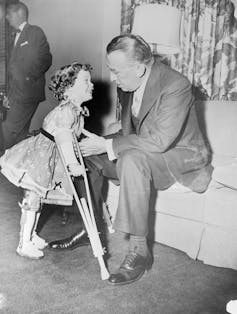
Young girl using crutches and leg braces smiles while walking to man in suit seated on a sofa
Kathy Dressel, a 3-year-old poster girl for the March of Dimes in Pennsylvania, smiles as she is greeted by Basil O’Connor, president of the National Foundation for Infantile Paralysis, in 1954. Bettmann/Bettmann Collection via Getty Images

While Jonas Salk became the most famous scientist in the world, his relationship with the University of Pittsburgh became complicated, and the administration rejected his plans for an institute. As a result, the Salk Institute for Biological Studies was built in 1963 on the coastline in La Jolla, California, where it fueled San Diego’s biotech industry.

Near the end of his life, Salk would say sometimes he would run into people who didn’t know what polio was, and he found that gratifying. But today the world is paying a high price for those who don’t remember what life was like before these events and now question the value of vaccines. The polio virus may not be visible, but it is still with us.

The final mile to eradication

On Oct. 24, 2025, as the Salk vaccine turned 70, I was invited to screen the trailer for “The Shot Felt Round the World” at a World Polio Day event on Roosevelt Island in New York City, in a building next to the ruins of the Smallpox Hospital – a legacy of the only human disease ever eradicated.

Those present included the executive director of UNICEF, the polio director from the Gates Foundation, the U.N. representative for Rotary International and government officials from around the world who spoke about the global coalition dedicated to eradicating this disease. Since the 1980s, the Global Polio Eradication Initiative has put tremendous resources into taking polio from being endemic in 125 countries to now just in two: Pakistan and Afghanistan. This group, whom I like to call “The Avengers of Public Health,” continue to work relentlessly to make the world polio-free.
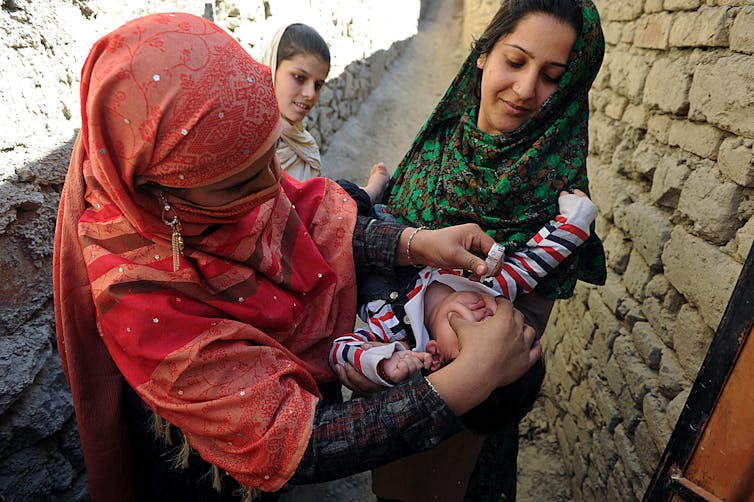
Woman in traditional Afghan dress tries to squeeze medical drops into mouth of a baby held in another woman's arms
An Afghan health worker administers polio vaccine to a child in Kabul in 2010. Afghanistan and Pakistan are the only two countries where polio has not yet been eradicated. Shah Marai/AFP via Getty Images

My greatest fear is that when polio is finally defeated, the world won’t recognize what an extraordinary achievement it is. In our film, Dr. Jonathan Salk, Jonas Salk’s youngest son, recalls his father wondering whether the model that developed the polio vaccine could be used to conquer poverty and other social problems.

Many of the polio survivors we spoke to at the 50th anniversary are no longer with us. To ensure that future generations know this story, perhaps now is the time to launch a “March of Dimes” marketing technique to engage young people from around the world to help finish the job that began in the Salk lab in Pittsburgh.

One polio survivor who is still alive is “The Godfather” director Francis Ford Coppola, who has spoken about contracting polio as a child. Imagine him being interviewed by his granddaughter Romy Mars, a TikTok influencer, and his daughter Sophia Coppola, the film director and actress. They could make a video that features cameos from actor and comedian Bill Murray, who played Franklin D. Roosevelt in a movie and whose sister had polio; and U.S. Sen. Mitch McConnell, who is a polio survivor; and Secretary of State Marco Rubio, whose grandfather was crippled from polio. For such a cruel disease, polio has a strange way of bringing us together.

I pray that when we finally wipe polio off the planet, a feat the Global Polio Eradication Initiative targets for 2029, the whole world will celebrate and realize the power of pulling together to defeat a common enemy.

Read more of our stories about Philadelphia and Pennsylvania, or sign up for our Philadelphia newsletter on Substack.The Conversation

Carl Kurlander, Senior Lecturer, Film and Media Studies, University of Pittsburgh

This article is republished from The Conversation under a Creative Commons license. Read the original article.

Lake County Rotary Clubs and local schools unite to protect youth from online predators

Details
Written by: LAKE COUNTY NEWS REPORTS
Published: 22 December 2025

LAKE COUNTY, Calif. — In a major collaborative effort to ensure student safety, the Rotary Clubs of Kelseyville, Lakeport, and Clearlake have joined forces with Lake County School Districts to launch a pilot protection initiative against sex trafficking and exploitation.

As part of the collaboration, the Rotary Clubs have secured the necessary funding and leadership to license the Polly Klaas Foundation’s expert "Social Media Safety Education,” or SMSE, program.

In turn, the local school districts are acting as the operational hub for this initiative, generously providing campus facilities, childcare and dinner to ensure every family can attend these critical training sessions.

Local leaders concluded that Lake County is vulnerable to exploitation. With statistics showing that 85% of missing children are runaways — many lured by adult predators online — the schools and Rotary agreed that immediate, united action was required.

“The urgency to act is clear, and Rotary is stepping up to lead this vital effort,” said Kelseyville Rotary President Michael Contos.

Clearlake Rotary President Zabdy Neria added, "I am incredibly grateful to be surrounded by such supportive partners from across the lake as we join this urgent fight against child exploitation. Parents in our community are actively seeking guidance and support to get the crucial message across to our vulnerable youth: that danger is, tragically, often only a click away."

The collaboration goes beyond simple presentations; it empowers students to protect one another. 

The pilot launches with assemblies at Kelseyville Middle School in late January, where trained high school students will teach sixth, seventh and eighth graders under the supervision of the Polly Klaas Foundation.

Contos added, "We are proud to pilot this program in Kelseyville. By empowering our High School students to teach middle schoolers, we can foster a culture of safety. Kids listen to their peers.”

Public events to offer dinner, education


To support families, the participating schools are removing barriers to attendance. The Rotary Clubs and Schools invite their students, families and staff to five presentations held throughout January. 

All events begin at 5:30 p.m. and include dinner, education, childcare and door prizes.  

The planned events are:

• Thursday, Jan. 8: Kelseyville/Lakeport at Kelseyville High School.
• Tuesday, Jan. 27: Middletown Middle School.
• Wednesday, Jan. 28: Upper Lake/Lucerne at the Middle School.
• Thursday, Jan. 29: Konocti Unified (English) at Obsidian Middle School.
• Friday, Jan. 30: Konocti Unified (Spanish) at Obsidian Middle School.

"Educating the parents of our young adults may be the difference between life or unspeakable heartbreak," said Lake County Rotary Area Governor Mark Lipps.  

Ciara Shuttleworth, executive director of the Polly Klaas Foundation, emphasized the importance of this partnership. “It is no longer that a predator might come in through an unlocked door; what we address now is how to keep your children safe in their own bedrooms through online safety education,” she said.

The Rotary Clubs of Lake County thanked county sSupervisors EJ Crandell and Jessica Pyska for their support. A special thank you is also extended to the Lake County schools for donating the venue, dinner and staff for these meetings. Redbud Health Care District has joined in supporting this effort as a major sponsor.

For more information on this project, please contact Kelseyville Rotary at This email address is being protected from spambots. You need JavaScript enabled to view it.. 

Clearlake, county of Lake among communities receiving state funding to build housing and infrastructure, address homelessness

Details
Written by: LAKE COUNTY NEWS REPORTS
Published: 22 December 2025

CLEARLAKE, Calif. — More than $52 million in grant funding has been awarded to revitalize communities and address homelessness, benefiting 53 counties statewide through 90 new projects, through federal Community Development Block Grants and 2024 Emergency Solutions Grants.

The city of Clearlake and North Coast Opportunities are among the awardees, announced by the Governor’s Office.

Clearlake will receive a $2.5 million planning and technical assistance grant.

“We’re delivering for our communities — full stop,” said Gov. Gavin Newsom. “Whether it’s housing, infrastructure or homelessness services, we’re stepping up and standing shoulder to shoulder with local leaders to make sure they have what they need. These grants are about strengthening neighborhoods and ensuring communities across California can thrive, while preserving the pride people have in the places they call home.”

The funding through the 2024 Community Development Block Grant, or CDBG, awards will fund 38 projects in 20 counties and provide more than 160,000 Californians with improved sewer and street infrastructure, public facilities, and recreational opportunities. 

Gov. Newsom announced that an additional $14.3 million in federal funds went to 52 projects across California serving 25 counties through 2024 Emergency Solutions Grants, or ESG, giving local governments and service providers yet another tool to support regional solutions to homelessness. Both federal programs are administered in California by the California Department of Housing and Community Development, or HCD.

“For more than 50 years, Community Development Block Grants have been a key tool for creating housing and economic opportunity in American communities,” said Business, Consumer Services and Housing Agency Secretary Tomiquia Moss. “From food banks to fire protection equipment, HCD is making these awards to help meet the critical needs of Californians and expand access to opportunity.”

CDBG awards included 18 grants totaling $4.6 million for public service activities such as advocacy for children in the court systems, operation of shelters for survivors of domestic violence, housing and shelter navigation for people experiencing homelessness, support for veterans experiencing behavioral health challenges, and nutrition and food access for seniors, as well as support for food banks, transportation, and utility assistance for low- to moderate-income Californians. 

“The CDBG grants awarded this year will foster improved quality of life for low-income Californians in rural communities in every corner of the state,” said HCD Director Gustavo Velasquez. “From the North Coast, to the colonias, our stewardship of federal funding will transform infrastructure and uplift some of our most vulnerable residents, building a stronger, more equitable California future.”

Examples from the CDBG awards include:

• An economic development grant for a business assistance loan program in Crescent City ($1.5 million)
• A homebuyer-assistance grant for a program in the City of Ukiah ($1.5 million)
• Six public facility improvement projects including parks and community centers ($18 million) in Capitola, Corning, Eureka, Firebaugh, and Oroville, as well as Imperial County. 
• Three infrastructure projects including sewer and street improvements ($9.9 million) in Dinuba, King, and Marysville. 
• Nine planning and technical assistance grants ($2.5 million)in Clearlake, Dinuba, Oroville, Shasta Lake, Weed, and Willows, as well as Imperial and Solano counties.

HCD also made 52 ESG awards serving 36 counties totaling $14.3 million to California counties and service providers to fund local solutions to homelessness. With ESG funding, recipients can:

• Engage individuals and families experiencing homelessness
• Improve emergency shelters for individuals and families experiencing homelessness by supporting operations and essential services for shelter residents
• Rapidly rehouse individuals and families experiencing homelessness
• Prevent families and individuals from becoming homeless

North Coast Opportunities received $280,486 in ESG funding for work in Lake County.

  1. Woodland College’s Lake County Campus to hold express registration event Jan. 10
  2. As millions of Americans face a steep rise in health insurance costs, lawmakers continue a century-long battle over who should pay for health care
  3. Tradition of New Year’s 'First Day Hikes' to continue at Anderson Marsh State Historic Park 
  • 120
  • 121
  • 122
  • 123
  • 124
  • 125
  • 126
  • 127
  • 128
  • 129
How to resolve AdBlock issue?
Refresh this page