How to resolve AdBlock issue?
Refresh this page
How to resolve AdBlock issue?
Refresh this page
Lake County News,California
  • Home
    • Registration Form
  • News
    • Education
    • Veterans
    • Community
      • Obituaries
      • Letters
      • Commentary
    • Police Logs
    • Business
    • Recreation
    • Health
    • Religion
    • Legals
    • Arts & Life
    • Regional
  • Calendar
  • Contact us
    • FAQs
    • Phones, E-Mail
    • Subscribe
  • Advertise Here
  • Login
How to resolve AdBlock issue?
Refresh this page

News

Registrar’s office issues updates on vote count progress

Details
Written by: Elizabeth Larson
Published: 08 November 2025

LAKE COUNTY, Calif. — On Friday, the Registrar of Voters Office issued an update on its work to complete the final count for Tuesday’s special statewide election.

The official canvass for the Proposition 50 election has been underway since Wednesday.

The elections office said the ballots remaining to be counted as of Friday totaled 8,585, about 2,000 fewer than the previous day. 

That total count includes 8,049 vote-by-mail ballots; 386 provisional or conditional ballots; and 160 vote-by-mail ballots under further review.

Until Nov. 12, the registrar’s office also is accepting ballots postmarked on or before Election Day.

The next report is expected on Wednesday, the elections office said.

Statewide, the Secretary of State’s Office said 9,830,003 ballots from 18,399 precincts have been processed and 1,683,596 ballots remain to be counted.

The preliminary statewide results show a 64.1% “yes” vote, or 6,422,621 ballots, to a 35.9% “no” vote, totaling 3,596,569 ballots.

County elections officials must complete final official results on Dec. 4, and the Secretary of State will certify results on Dec. 12.

Email Elizabeth Larson at This email address is being protected from spambots. You need JavaScript enabled to view it.. Follow her on Twitter, @ERLarson, and on Bluesky, @erlarson.bsky.social. Find Lake County News on the following platforms: Facebook, @LakeCoNews; X, @LakeCoNews; Threads, @lakeconews, and on Bluesky, @lakeconews.bsky.social. 

Clearlake Animal Control: ‘Beezy’ and the dogs

Details
Written by: Elizabeth Larson
Published: 08 November 2025
“Beezy.” Photo courtesy of Clearlake Animal Control.

CLEARLAKE, Calif. — Clearlake Animal Control has a lot of great dogs waiting to be adopted.

The shelter has 48 adoptable dogs listed on its website.

This week’s dogs include “Beezy,” a nearly 3-year-old Rottweiler mix with a short black and brown coat.
 
The shelter is located at 6820 Old Highway 53. It’s open from 9 a.m. to 6 p.m. Tuesday through Saturday. 

For more information, call the shelter at 707-762-6227, email This email address is being protected from spambots. You need JavaScript enabled to view it. or visit Clearlake’s adoptable dogs here.

This week’s adoptable dogs are featured below.

Email Elizabeth Larson at This email address is being protected from spambots. You need JavaScript enabled to view it.. Follow her on Twitter, @ERLarson, and on Bluesky, @erlarson.bsky.social. Find Lake County News on the following platforms: Facebook, @LakeCoNews; X, @LakeCoNews; Threads, @lakeconews, and on Bluesky, @lakeconews.bsky.social. 

Estate Planning: Drafting flexibility into trusts

Details
Written by: DENNIS FORDHAM
Published: 08 November 2025
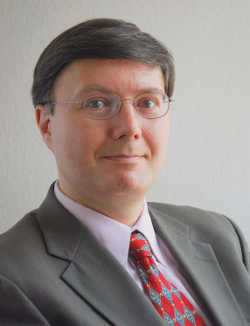
Dennis Fordham. Courtesy photo.
Discretionary decision making authority over the administration of the trust or its assets directly can be delegated or reserved to the settlors.
Persons with discretionary decision making may include the trustees, trust protectors, trust directors, and holders of powers of appointment. Provisions for trust protectors and trust directors, however, are not typically seen in most living trusts.  
A trust may give the trustee discretionary authority over distributions, asset investments, and asset management. Such discretionary authority can be broadly or narrowly defined and tailored to the purpose. 
For example, the trustee of a special needs trust always has absolute discretion over whether to make distributions for the special needs beneficiary. Also, the trustee of a support trust may have discretion to make additional distributions. 
Trust protectors can be given authority to hire and fire trustees and amend the terms of the trust as needed to keep current with the law. Trust protectors are relevant when inheritances are administered in ongoing trusts over years and not simply distributed outright to the beneficiary at the settlor’s death. 
For example, special needs trusts for persons on needs based government benefits typically always have a robust set of trust protector provisions that authorize the trust protector to amend the terms of the trust to remain compliant with ever changing government benefits rules. 
A trust protector may have a fiduciary role (i.e., legal duties and accountability) or a non-fiduciary role (i.e., no duties) depending on their authority and the settlor’s intentions. That is, a trust protector may have a non-fiduciary capacity when firing and hiring replacement trustees but may have a fiduciary capacity when amending the trust to conform its terms to current law. 
Trust directors, new to California law, are “trustee like” fiduciaries with power(s) of direction over some specific aspects of the trustee’s administration of the trust; the power of direction can be narrow or broad. 
A trust may include one or more separate trust directors who, for example, may decide when and how a trustee makes beneficiary distributions, invests trust assets, or manages special trust assets, or any other aspect of trust administration. 
Trust directors are typically advisors — be they professionals, family or friends – whom the settlor wants involved in a decision making capacity to tell the trustee how certain trust administration matters are handled. 
Trust directors never hold title to trust assets themselves, the trustee does, and so directors can only act through the trustee who keeps all trustee duties not otherwise assigned to the trust directors.
Powers of appointment included in a trust allow a person, even the settlor, certain specific or general authority to distribute trust assets either to anyone or to specific persons. The power is held in a non-fiduciary capacity, which means that the person has full freedom to use or not use the power as they personally choose. 
Revocable trusts typically include a reserved power of appointment by the settlors to direct the transfer of assets by way of a written instrument to the trustee, which could be exercised in life or at death through a will (called a testamentary power of appointment). 
A power of appointment is different than a trust director’s power of direction over the trustee’s administration. The power of direction is always a fiduciary responsibility that requires the trust director to act under the same standards as a trustee would act if the trustee were exercising that same authority over the trust administration.
Whether to include any of the foregoing authority in a person’s trust is best understood in terms of the person’s estate planning goals, concerns, and circumstances. 
During the estate planning discussion it should become apparent whether such provisions may be needed to address future and unforeseen circumstances. 
The foregoing brief discussion is not legal advice. Consult a qualified estate planning attorney for guidance. 
Dennis A. Fordham, attorney, is a State Bar-Certified Specialist in estate planning, probate and trust law. His office is at 870 S. Main St., Lakeport, Calif. He can be reached at This email address is being protected from spambots. You need JavaScript enabled to view it. and 707-263-3235.

Space News: 25 Years of the International Space Station: What archaeology tells us about living and working in space

Details
Written by: Justin St. P. Walsh, Chapman University
Published: 08 November 2025

The International Space Station has housed visitors continuously for roughly 25 years. NASA

The International Space Station is one of the most remarkable achievements of the modern age. It is the largest, most complex, most expensive and most durable spacecraft ever built.

Its first modules were launched in 1998. The first crew to live on the International Space Station – an American and two Russians – entered it in 2000. Nov. 2, 2025, marks 25 years of continuous habitation by at least two people, and as many as 13 at one time. It is a singular example of international cooperation that has stood the test of time.

Two hundred and ninety people from 26 countries have now visited the space station, several of them staying for a year or more. More than 40% of all the humans who have ever been to space have been International Space Station visitors.

The station has been the locus of thousands of scientific and engineering studies using almost 200 distinct scientific facilities, investigating everything from astronomical phenomena and basic physics to crew health and plant growth. The phenomenon of space tourism was born on the space station. Altogether, astronauts have accumulated almost 127 person-years of experience on the station, and a deep understanding of what it takes to live in low Earth orbit.
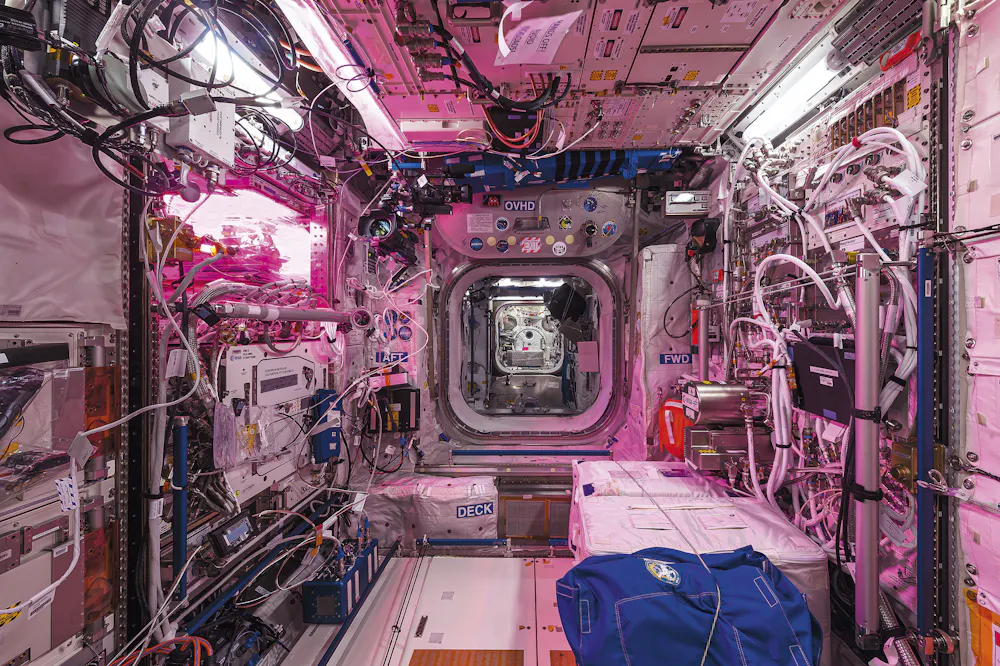
A module of a space station. It has white plastic walls, but the light is pinkish-purple from a plant habitat on one side. The space is cluttered with cables and equipment. Other modules are visible through the hatch at the far end.
A view of the European Space Agency’s Columbus laboratory module on the International Space Station. Paolo Nespoli and Roland Miller, courtesy of NASA and ASI.

If you’ve ever seen photos of the inside of the International Space Station, you’ve probably noticed the clutter. There are cables everywhere. Equipment sticks out into corridors. It doesn’t look like Star Trek’s Enterprise or other science fiction spacecraft. There’s no shower for the crew, or a kitchen for cooking a meal from scratch. It doesn’t have an area designed for the crew to gather in their downtime. But even without those niceties, it clearly represents a vision of the future from the past, one where humanity would live permanently in space for the first time.

Space archaeology

November 2025, by coincidence, also marks the 10th anniversary of my team’s research on the space station, the International Space Station Archaeological Project. The long history of habitation on the space station makes it perfect for the kind of studies that archaeologists like my colleagues and me carry out.

We recognized that there had been hardly any research on the social and cultural aspects of life in space. We wanted to show space agencies that were already planning three-year missions to Mars what they were overlooking.

We wanted to go beyond just talking to the crew about their experiences, though we have also done that. But as previous studies of contemporary societies have shown, people often don’t want to discuss all their lives with researchers, or they’re unable to articulate all their experiences.

Astronauts on Earth are usually trying to get their next ride back to space, and they understandably don’t want to rock the boat. Our research provides an additional window onto life on a space station by using archaeological evidence: the traces of human interactions with the objects and built spaces of the site.

The problem, of course, is that we can’t go to the station and observe it directly. So we had to come up with other ways to capture data. In November 2015, I realized that we could use the thousands of photos taken by the crew and published by NASA as a starting point. These would allow us to track the movement of people and things around the site over time, and to map the behaviors and associations between them.

In 2022, the International Space Station Archaeological Project also carried out the first archaeological fieldwork off the Earth, an experiment designed by my collaborator, Alice Gorman. We asked the crew to document six sample locations in different modules by taking photos of each one every day for two months.

A view from one module of a space station into the airlock. In the airlock are two spacesuits facing each other. At the threshold, there is a hatch door at the top with pictures of people and other items on it. Below is a salmon-colored bulkhead with stickers of mission patches on it.
A view of the hatch from the Node 1 (Unity) module of the International Space Station into the U.S. airlock displays a crew-created memorial to deceased colleagues on the hatch door at the top. Paolo Nespoli and Roland Miller, courtesy of NASA and ASI.

Lessons from photos

We learned that the crew of the International Space Station is a lot like those of us on Earth – perhaps unsurprising, since they live 95% or more of their lives here with the rest of us. They decorate the walls of the station with pictures, memorabilia and, on the Russian side, religious items, the way you might put photos and souvenirs on your refrigerator door to say something about yourself and your family. They make birthday cakes for their colleagues. They love to snack on candy or other special foods that they selected to be sent.

Unlike the rest of us, however, they live without much freedom to make choices about their lives. Their days are governed by lengthy procedures overseen by Mission Control, and by lists of items and their locations.

Crew members do show some signs of autonomy, though. They sometimes create new uses for different areas. They used a maintenance work station for the storage of all kinds of unrelated things, just because it has a lot of Velcro for holding items in place. They have to come up with solutions for storing their toiletry kits because that kind of affordance wasn’t considered necessary by the station’s designers 30 or 40 years ago.
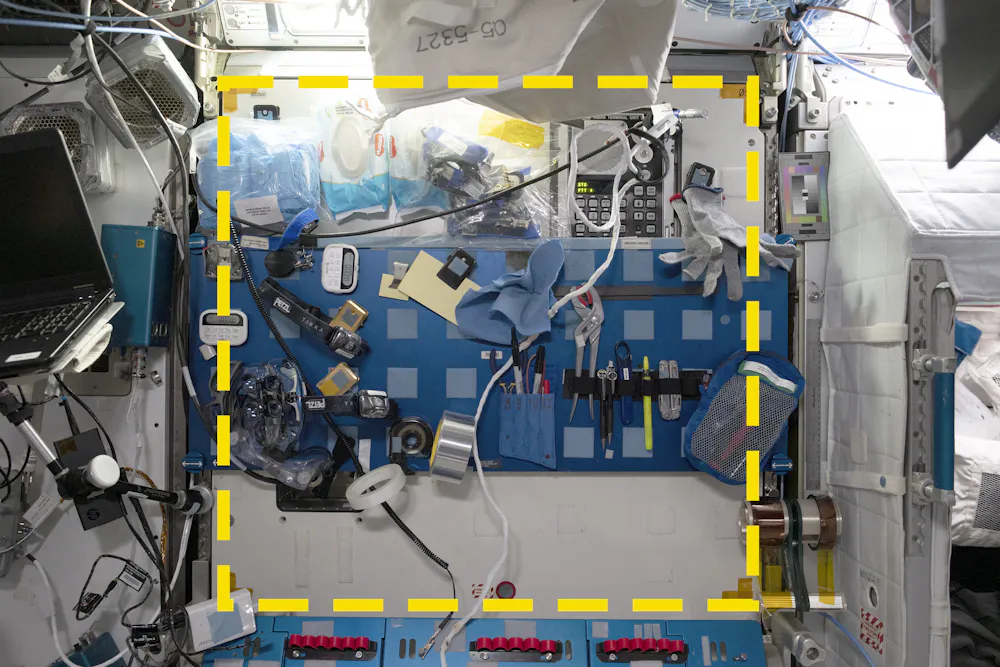
The wall of a space station module. In the center is a blue metal panel with 40 pieces of Velcro arranged in a grid. More Velcro is visible on the wall. Many different items are stuck to the wall. A yellow square is superimposed on the central part of the image.
One of the sample locations for the International Space Station Archaeological Project’s archaeological experiment on the space station was the maintenance work area in the Node 2 (Harmony) module. On the wall, many different kinds of items are stored, mostly attached to patches of Velcro. The yellow dotted line shows the boundary of the sample area. NASA/ISSAP

We discovered that despite the international nature of the station, most areas of it are highly nationalized, with each space agency controlling its own modules and, often, the activities going on in each one. This makes sense, since each agency is responsible to their own taxpayers and needs to show how their money is being spent. But it probably isn’t the most efficient way to run what is the most expensive building project in the history of humanity.

In our latest research, we tracked changes in scientific activity, which we found has become increasingly diverse, by documenting the use of specialized experimental equipment. This work was the result of questions from one of the companies competing to build a commercial successor to the International Space Station in low Earth orbit.

The company wanted to know if we could tell them what facilities their customers were likely going to need. Of course, understanding how people have used different parts of a site over time is a typical archaeological problem. They are using our results to improve the experiences of their crews.

The archaeology of the contemporary world

Similar archaeological studies of contemporary issues here on Earth can also make future lives better, whether by studying phenomena such as migration, ethnonationalism or ecological issues.

In this way, we and other contemporary archaeologists are charting a new future for studying the past, a path for our discipline that lies alongside our traditional work of investigating ancient societies and managing heritage resources. Our International Space Station work also demonstrates the relevance of social science research for solving all kinds of problems – even ones that seem to be purely technical, like living in space.The Conversation

Justin St. P. Walsh, Professor of Art History, Archaeology and Space Studies, Chapman University

This article is republished from The Conversation under a Creative Commons license. Read the original article.

  1. Board of Supervisors allocates $80,000 to ease food shortage in face of SNAP/CalFresh delays
  2. Register’s Office continues ballot count for Prop. 50 election
  3. Alzheimer’s Disease Awareness Month observed in November
  • 167
  • 168
  • 169
  • 170
  • 171
  • 172
  • 173
  • 174
  • 175
  • 176
How to resolve AdBlock issue?
Refresh this page