How to resolve AdBlock issue?
Refresh this page
How to resolve AdBlock issue?
Refresh this page
Lake County News,California
  • Home
    • Registration Form
  • News
    • Education
    • Veterans
    • Community
      • Obituaries
      • Letters
      • Commentary
    • Police Logs
    • Business
    • Recreation
    • Health
    • Religion
    • Legals
    • Arts & Life
    • Regional
  • Calendar
  • Contact us
    • FAQs
    • Phones, E-Mail
    • Subscribe
  • Advertise Here
  • Login
How to resolve AdBlock issue?
Refresh this page

News

At the polls: Precinct staff report on their work during Tuesday’s election

Details
Written by: Elizabeth Larson
Published: 06 November 2025
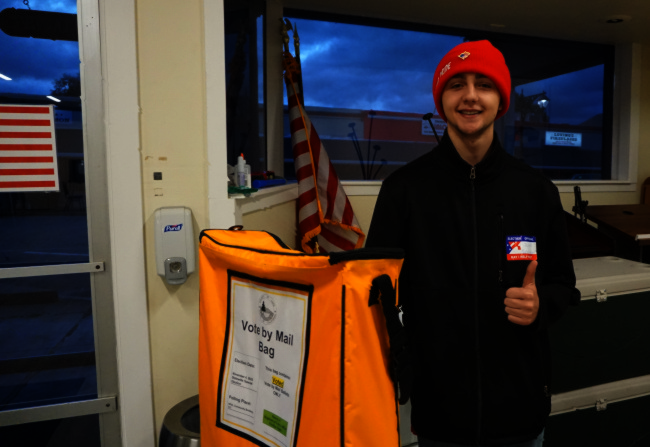
Jacob McKelvey served as vote-by-mail clerk at the Upper Lake precinct during California’s special statewide election on Tuesday, Nov. 4, 2025. Photo by Elizabeth Larson/Lake County News.


LAKE COUNTY, Calif. — Thousands of Lake County voters headed to the polls on Tuesday for the special statewide election called to decide on Proposition 50.

Lake County News staff once again participated as part of the Lake County Registrar of Voters Office’s Election Observer Panel, which visits precincts throughout the course of election day.

For this election, Lake County News sampled the four Northshore precincts, visiting them on Tuesday afternoon in the following order: Lucerne, Clearlake Oaks, Upper Lake and Nice.

At the Lucerne precinct, located once again at First Lutheran Church on Country Club Drive, election staff said the flow of voters coming in to cast their vote was busier than expected.

“I thought it was going to be a lot slower than it is,” said Marilyn Pivniska, a longtime inspector at  the Lucerne precinct for the Lake County Registrar of Voters Office.

For all of the precincts, the fact that voters receive ballots by mail has required an additional step in order to make sure ballots aren’t cast twice.

Voters can mail their ballots or drop them off at their precinct on Election Day. At the Nice precinct, located at the Community Baptist Church on Highway 20, staff said about 60 people came in to vote but there were many who came in to drop off their ballots. Staff said many people want to come in to do that ballot dropoff specifically for themselves.

When a voter comes to the precinct to cast their vote, they should bring their ballot, which they can then turn in before voting. 

If they don’t bring the ballot or simply forget, they have to essentially register to vote again and fill out a provisional ballot. Pivniska said when that happens, they need to call the Registrar of Voters Office to make sure the ballot they received in the mail wasn’t already cast.

She said all of the precincts now have explainer sheets for community members to help them understand the process.

In Clearlake Oaks, elections staff were busy helping voters navigate the process and get their ballots cast.

Election Clerk Estelle Austin welcomed people, offered help, answered questions and kept the action moving.

She said the voter traffic had been pretty steady. “So far, so good,” she said late Tuesday afternoon. 

While special elections tend to have less turnout, “It’s actually been pretty decent,” Austin said.

Down the road in Upper Lake, election staff welcomed voters at the Habematolel Pomo community room, next door to the space on Main Street where the precinct used to be located. 

Inspector Sue Dillard said Upper Lake is unique. Voters there aren’t crazy about mail-in voting and instead want to come in and cast their votes in person.

“People like to come out,” she said, noting that the precinct usually has large turnouts.

Voters turning up without their mail-in ballots was a consistent issue for the Upper Lake precinct. 

On hand to offer additional help was Jacob McKelvey, a senior at Upper Lake High School.

Following a recent presentation at his school by Registrar of Voters Office staff, McKelvey’s interest was piqued. He hadn’t thought about it before, but after the presentation, he decided to volunteer as a precinct worker — and he got the day off from school to offer that service.

Stationed near the door and overseeing the ballot boxes, McKelvey was assigned the vote-by-mail clerk position, and also helped voters with their provisional ballots. 

McKelvey didn’t just help voters, he also learned a lot about the process and the system and found people welcoming. As a result, he wants to work at the precinct again next year. 

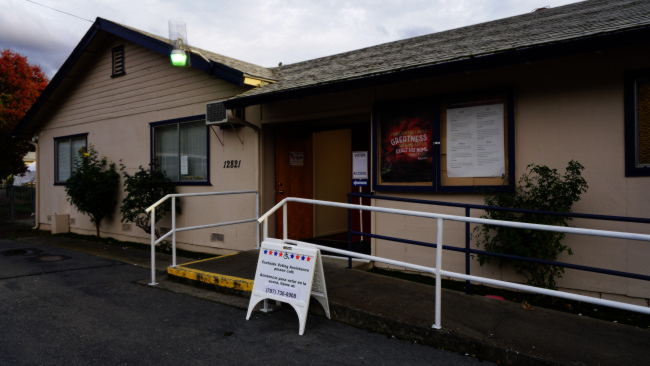
The voting precinct at the First Baptist Church in Clearlake Oaks, California, during California’s special statewide election on Tuesday, Nov. 4, 2025. Photo by Elizabeth Larson/Lake County News.


Few voters use machines

One of the common denominators across all of the precincts was the lack of interest in using the voting machines.

At the Clearlake Oaks precinct, located at the First Baptist Church on First Street, when asked about how often people use the voting machine, staff replied, “Never,” explaining that people want to use paper ballots because they don’t trust the machine.

In Nice, Inspector Ron Stewart said nobody used the voting machine Tuesday, although in the past they had a woman who regularly used it. Nevertheless, “Gotta have it,” he noted.

In Lucerne, two people used the voting machine, but there were no takers in Upper Lake.

Bob Rauch is a longtime volunteer who has also worked with voting machines in Nevada and Sonoma counties. Fellow precinct worker, Clerk Paul Rykert, called Rauch “a legend.”

“I feel like I’m past legend,” said Rauch, who has worked with the voting machines in Lake County for six years.

Did anyone use the voting machine he diligently oversaw for another year?

“Not today,” said Rauch, acknowledging that people don’t use them much.

Voting disability rights advocates say the machines are important for accessibility, and Rauch said that’s who they are primarily intended to serve.

In Nice, precinct staff said the day was “moderately busy,” as people came through either to cast their votes or drop them off. 

During the day, they had one person coming through who used the drive-thru handicap voting, which has long been an option but isn’t always used.

They said there was nothing unusual that took place.

Young people needed

As precinct staff were coming in to deliver the ballot boxes to the Registrar of Voters Office in Lakeport on Tuesday night, one of them asked a Lake County News reporter if she realized how many older people are staffing precincts.

Before leaving, she said the message needed to get out that more young people need to get involved.

For information about the Registrar of Voters Office and how to contact the agency to be involved with future elections, visit https://www.lakecountyca.gov/818/Registrar-of-Voters. 

Email Elizabeth Larson at This email address is being protected from spambots. You need JavaScript enabled to view it.. Follow her on Twitter, @ERLarson, and on Bluesky, @erlarson.bsky.social. Find Lake County News on the following platforms: Facebook, @LakeCoNews; X, @LakeCoNews; Threads, @lakeconews, and on Bluesky, @lakeconews.bsky.social. 

Clearlake City Council to discuss climate plan, street naming

Details
Written by: Elizabeth Larson
Published: 06 November 2025

LAKE COUNTY, Calif. — The Clearlake City Council is set to consider a draft climate plan, the naming of two city streets and a road project.

The council will meet at 6 p.m. Thursday, Nov. 6, in the council chambers at Clearlake City Hall, 14050 Olympic Drive.

The agenda can be found here.

The meeting will be broadcast live on the city's YouTube channel or the Lake County PEGTV YouTube Channel. 

Community members also can participate via Zoom. The pass code is 474452. One tap mobile is available at +16694449171,,82771053751#, or join by phone at 669-444-9171 or 646-931-3860.
 
The public will not be allowed to provide verbal comment during the meeting if attending via Zoom. The public can submit comments in writing for City Council consideration by commenting via the Q&A function in the Zoom platform or by sending comments to the Administrative Services Director/City Clerk at This email address is being protected from spambots. You need JavaScript enabled to view it.. To give the City Council adequate time to review your comments, you must submit your written emailed comments prior to 4 p.m. on the day of the meeting.

On Thursday, the council will host presentations from the North Coast Opportunities Community Emergency Response Team and for certificates of appreciation to Trunk or Treat supporters and volunteers.

Under business items, the council will discuss and consider the draft climate adaptation plan and provide direction to staff.

Also up for consideration and discussion is a proposed contract in the amount of $3,198,680.33 with Lamon Construction for the Burns Valley/Arrowhead/Olympic Drive Project, with authorization for the city manager to approve up to 10% for additional unforeseen contract amendments.

The Thursday meeting also will include a public hearing to consider the naming of two public streets: Sandlot Drive and Corporation Way, located off of Burns Valley Road, next to the Burns Valley Shopping Center.

On the meeting’s consent agenda — items that are considered routine in nature and usually adopted on a single vote — are warrants; minutes; authorization of an amendment of the contract with BKF Engineers for the Dam Road Roundabout Design Project in the amount of $32,250; cancellation of construction contract with Argonaut Constructors for the 18th Avenue Improvement Project in the amount of $4,632,295; receipt of the Sept. 10 Lake County Vector Control Board minutes; authorization of termination of winter storm emergency; authorization of termination of the Boyles Fire Emergency Declaration; receipt of Resolution No. OC 2025-01, A Resolution of the Measure V Oversight Committee of the city Of Clearlake declaring compliance with Section 3-7.14 of Ordinance No. 189-2016; and acceptance of proposals for city facilities building maintenance including HVAC, plumbing and pest control services.

The council will hold a closed session for conference with legal counsel regarding a case of anticipated litigation; existing litigation, City of Clearlake v. Andrew and Bailey Hulett; and a liability claim filed against the city by Leon Ballew.

Email Elizabeth Larson at This email address is being protected from spambots. You need JavaScript enabled to view it.. Follow her on Twitter, @ERLarson, and on Bluesky, @erlarson.bsky.social. Find Lake County News on the following platforms: Facebook, @LakeCoNews; X, @LakeCoNews; Threads, @lakeconews, and on Bluesky, @lakeconews.bsky.social. 

Cobb Mountain Lions Club to host Nov. 10 community dinner

Details
Written by: LAKE COUNTY NEWS REPORTS
Published: 06 November 2025

LAKE COUNTY, Calif. — As concerns continue to rise for community members hit by the delay in federal food assistance, the Cobb Mountain Lions Club is planning to offer a free, hot meal for those who need it.

The dinner will take place at the club’s community center, located at the Little Red Schoolhouse, from 6 to 7 p.m. Monday, Nov. 10.

“Did you know that 23% of Lake County residents receive assistance through food programs such as CalFresh? With the program's funding in jeopardy due to the government shutdown, we're rolling up our sleeves to help,” the club said in its announcement about the dinner.

The community is invited to join them for a meal and good conversation.

On the menu are burgers — regular and veggie — along with hot dogs, baked beans, salad and a few sweet treats, although they said the menu is subject to change.

Those who plan to attend also are asked to bring their own plates and utensils if they have some.

The Little Red Schoolhouse is located at 15780 Bottle Rock Road.

All government shutdowns disrupt science − in 2025, the consequences extend far beyond a lapse in funding

Details
Written by: Kenneth M. Evans, Rice University
Published: 06 November 2025

The government shutdown will continue until Congress can pass a bill reopening it. Samuel Corum/AFP via Getty Images

U.S. science always suffers during government shutdowns. Funding lapses send government scientists home without pay. Federal agencies suspend new grant opportunities, place expert review panels on hold, and stop collecting and analyzing critical public datasets that tell us about the economy, the environment and public health.

In 2025, the stakes are higher than in past shutdowns.

This shutdown arrives at a time of massive upheaval to American science and innovation driven by President Donald Trump’s ongoing attempts to extend executive power and assert political control of scientific institutions.

With the shutdown entering its fifth week, and with no end in sight, the Trump administration’s rapid and contentious changes to federal research policy are rewriting the social contract between the U.S. government and research universities – where the government provides funding and autonomy in exchange for the promise of downstream public benefits.

As a physicist and policy scholar, I both study and have a vested interest in the state of U.S. science funding as a recipient of federal grants. I write about the history and governance of American science policy, including the nation’s investments in research and development.

In the context of broader policy reforms to federal grantmaking, student and high-skilled immigration, and scientific integrity, this shutdown has both known and unknown consequences for the future of U.S. science.

Funding freezes, data gaps and unpaid workers

Over the past two decades, the story of government shutdowns has become all too familiar. Shutdowns occur when Congress fails to pass an appropriations bill before the start of the new fiscal year on Oct. 1, and, paraphrasing Article 1, Section 9 of the U.S. Constitution, the government can no longer spend money.

This funding gap affects all but essential government operations, such as the work of postal workers, air traffic controllers and satellite operators. Nonessential employees, including tens of thousands of government scientists, are barred from working and stop receiving paychecks.

With scientists and program officers at home, activities at the nearly two dozen federal agencies participating in research and development, such as the National Science Foundation and the National Institutes of Health, come to a halt. New grant opportunities and review panels are postponed or canceled, researchers at government laboratories stop collecting and analyzing data, and university projects reliant on federal funding are put at risk.

Extended shutdowns accelerate the damage. They leave bigger gaps in government data, throw federal employees into debt or lead them to dip into their savings, and force academic institutions to lay off staff paid through government grants and contracts.

Funding, public services and the rule of law

Even for shutdowns lasting a few days, it can take science agencies months to catch up on the backlog of paperwork, paychecks and peer review panels before they return to regular operations.

This year, the government faces mounting challenges to overcome once the shutdown ends: Trump and the director of the White House budget office, Russell Vought, are using the shutdown as an opportunity to “shutter the bureaucracy” and pressure universities to bend to the administration’s ideological positions on topics such as campus speech, gender identity and admission standards.

As the budget standoff nears the record for the longest shutdown ever, agency furloughs, reductions in force, canceled grants and jeopardized infrastructure projects document the devastating and immediate damage to the government’s ability to serve the public.

President Trump and Russel Vought stand by a microphone. In the background is a painting of a Theodore Roosevelt on a horse.
President Donald Trump alongside Office of Management and Budget Director Russell Vought. Brendan Smialowski/AFP via Getty Images

However, the full impact of the shutdown and the Trump administration’s broader assaults on science to U.S. international competitiveness, economic security and electoral politics could take years to materialize.

In parallel, the dramatic drop in international student enrollment, the financial squeeze facing research institutions, and research security measures to curb foreign interference spell an uncertain future for American higher education.

With neither the White House nor Congress showing signs of reaching a budget deal, Trump continues to test the limits of executive authority, reinterpreting the law – or simply ignoring it.

Earlier in October, Trump redirected unspent research funding to pay furloughed service members before they missed their Oct. 15 paycheck. Changing appropriated funds directly challenges the power vested in Congress – not the president – to control federal spending.

The White House’s promise to fire an additional 10,000 civil servants during the shutdown, its threat to withhold back pay from furloughed workers and its push to end any programs with lapsed funding “not consistent with the President’s priorities” similarly move to broaden presidential power.

Here, the damage to science could snowball. If Trump and Vought chip enough authority away from Congress by making funding decisions or shuttering statutory agencies, the next three years will see an untold amount of impounded, rescinded or repurposed research funds.

A lab filled with scientific equipment but not staffed.
The government shutdown has emptied many laboratories staffed by federal scientists. Combined with other actions by the Trump administration, more scientists could continue to lose funding. Monty Rakusen/DigitalVision via Getty Images

Science, democracy and global competition

While technology has long served as a core pillar of national and economic security, science has only recently reemerged as a key driver of greater geopolitical and cultural change.

China’s extraordinary rise in science over the past three decades and its arrival as the United States’ chief technological competitor has upended conventional wisdom that innovation can thrive only in liberal democracies.

The White House’s efforts to centralize federal grantmaking, restrict free speech, erase public data and expand surveillance mirror China’s successful playbook for building scientific capacity while suppressing dissent.

As the shape of the Trump administration’s vision for American science has come into focus, what remains unclear is whether, after the shutdown, it can outcompete China by following its lead.The Conversation

Kenneth M. Evans, Fellow in Science, Technology, and Innovation Policy, Baker Institute for Public Policy, Rice University

This article is republished from The Conversation under a Creative Commons license. Read the original article.

  1. Prop. 50 passes statewide; early count shows measure with narrow lead in Lake County
  2. Board of Supervisors appoints deputy county counsel as interim chief public defender
  3. Sheriff’s new drone technology helps Search and Rescue find lost hiker
  • 169
  • 170
  • 171
  • 172
  • 173
  • 174
  • 175
  • 176
  • 177
  • 178
How to resolve AdBlock issue?
Refresh this page