How to resolve AdBlock issue?
News
- Details
- Written by: Lake County News reports

LAKE COUNTY, Calif. – The Bureau of Land Management Ukiah Field Office will host a second virtual Berryessa Snow Mountain National Monument Trails and Travel Management Planning Workshop on Wednesday, April 21, from 5:30 to 8 p.m.
Similar to the first workshop, the public will be able to use an online map and survey tools to help the BLM build a database of existing trails and routes within the monument, understand how each route is used and the amount of use.
During the workshop, the BLM will provide an overview of public input received to date, summarize the points of interest identified on the interactive map, explain the travel management planning process and timeline, as well as highlight the additional public input still needed.
Travel Management Planning can help the BLM provide better access to public lands, improve route connectivity to ensure a more enjoyable experience, increase efficiency and reduce impacts to the environment.
The BLM Trails and Travel Management Planning Workshop will focus on identifying existing routes and is designed to engage stakeholders and members of the public about the vision for travel management at the Berryessa Snow Mountain National Monument.
The plan will be important for designating a wide variety of roads and trails for motorized, non-motorized and non-mechanized recreational opportunities.
This summer, when scoping begins for an environmental assessment, the public will have an opportunity to propose new routes within the monument.
The BLM and Mendocino National Forest co-manage the Berryessa Snow Mountain National Monument and believe partnerships and inclusion are vital to managing sustainable, working public lands. This workshop and associated planning efforts are specific to travel management on public lands administered by the BLM within the monument.
To participate in the workshop, please register at least 30 minutes prior to the event at https://register.gotowebinar.com/register/5815845177969242640.
Please contact the BLM for reasonable accommodations to participate.
For specific questions, please contact Rebecca Carr Wong at 707-468-4023 or
- Details
- Written by: Lake County News reports
In recognition of their service, the CHP joins other law enforcement agencies to recognize National Public Safety Telecommunicators Week on April 11 to 17.
California legislation enacted in 2020 reclassified public safety dispatchers as “first responders.” The new classification acknowledges their vital role in the state’s emergency response chain.
“As recognized first responders in California, our CHP public safety dispatchers and operators remain resilient in times of crisis,” CHP Commissioner Amanda Ray said. “They are devoted professionals who provide the timely handling of all calls for services and are the lifeline between the public and emergency services.”
The CHP employs more than 700 dispatchers who provide critical services to communities throughout California.
In 2020, these dispatchers who work out of one of the 24 CHP communications centers statewide handled more than 4.9 million 911 calls from the public.
In emergency situations, dispatchers must instantly determine the correct response to ensure the safety of all parties involved.
They are also in constant communication with patrol officers, looking up license plates, driver license numbers, and running criminal record checks on wanted subjects.
Those interested in a rewarding career as a CHP public safety dispatcher are encouraged to apply for one of the more than 175 positions available statewide. Details are available at www.chp.ca.gov/chp-careers.
- Details
- Written by: Elizabeth Larson
Dogs available for adoption this week include mixes of boxer, husky, shepherd, terrier and pit bull.
Dogs that are adopted from Lake County Animal Care and Control are either neutered or spayed, microchipped and, if old enough, given a rabies shot and county license before being released to their new owner. License fees do not apply to residents of the cities of Lakeport or Clearlake.
The following dogs at the Lake County Animal Care and Control shelter have been cleared for adoption (additional dogs on the animal control Web site not listed are still “on hold”).
Call Lake County Animal Care and Control at 707-263-0278 or visit the shelter online at http://www.co.lake.ca.us/Government/Directory/Animal_Care_And_Control.htm for information on visiting or adopting.

‘Sophie’
“Sophie” is a female boxer-pit bull mix with a short red coat.
She is in kennel No. 18, ID No. 14356.

Pit bull terrier mix
This female pit bull terrier mix has a short brown coat.
She is in kennel No. 19, ID No. 14459.

‘Lobo’
“Lobo” is a male husky with a medium-length fawn and white coat.
He is in kennel No. 25, ID No. 14453.
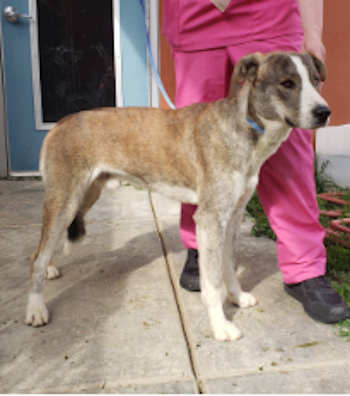
Husky-pit bull terrier
This young male husky-pit bull terrier mix has a short blue and white coat.
He’s in kennel No. 26, ID No. 14437.
Email Elizabeth Larson at
- Details
- Written by: Claire Andreoli and Ashley Balzer
NASA’s Nancy Grace Roman Space Telescope will create enormous cosmic panoramas, helping us answer questions about the evolution of our universe.
Astronomers also expect the mission to find thousands of planets using two different techniques as it surveys a wide range of stars in the Milky Way.
Roman will locate these potential new worlds, or exoplanets, by tracking the amount of light coming from distant stars over time. In a technique called gravitational microlensing, a spike in light signals that a planet may be present.
On the other hand, if the light from a star dims periodically, it could be because there is a planet crossing the face of a star as it completes an orbit. This technique is called the transit method.
By employing these two methods to find new worlds, astronomers will capture an unprecedented view of the composition and arrangement of planetary systems across our galaxy.
Scheduled for launch in the mid-2020s, Roman will be one of NASA’s most prolific planet hunters.
The mission’s large field of view, exquisite resolution, and incredible stability will provide a unique observational platform for discovering the tiny changes in light required to find other worlds via microlensing. This detection method takes advantage of the gravitational light-bending effects of massive objects predicted by Einstein's general theory of relativity.
It occurs when a foreground star, the lens, randomly aligns with a distant background star, the source, as seen from Earth. As the stars drift along in their orbits around the galaxy, the alignment shifts over days to weeks, changing the apparent brightness of the source star. The precise pattern of these changes provides astronomers with clues about the nature of the lensing star in the foreground, including the presence of planets around it.
Many of the stars Roman will already be looking at for the microlensing survey may harbor transiting planets.
“Microlensing events are rare and occur quickly, so you need to look at a lot of stars repeatedly and precisely measure brightness changes to detect them,” said astrophysicist Benjamin Montet, a Scientia Lecturer at the University of New South Wales in Sydney. “Those are exactly the same things you need to do to find transiting planets, so by creating a robust microlensing survey, Roman will produce a nice transit survey as well.”
In a 2017 paper, Montet and his colleagues showed that Roman – formerly known as WFIRST – could catch more than 100,000 planets passing in front of, or transiting, their host stars. Periodic dimming as a planet repeatedly crosses in front of its star provides strong evidence of its presence, something astronomers typically have to confirm through follow-up observations.
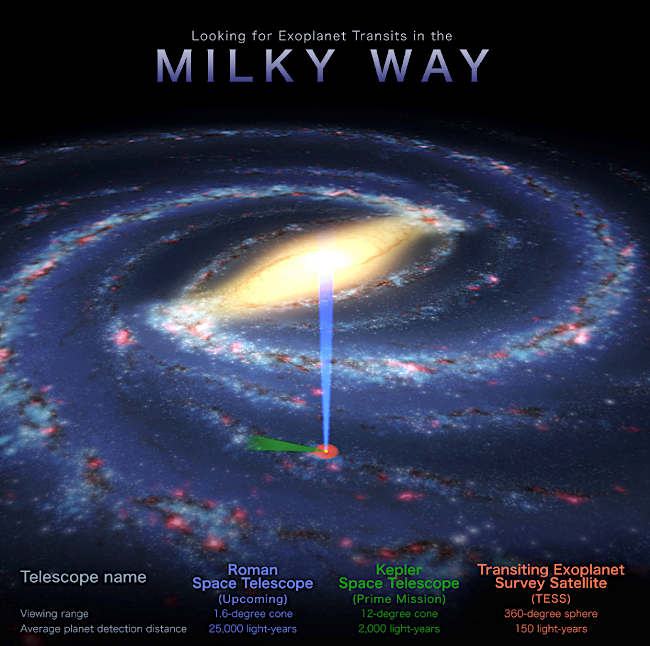
The transit approach to finding exoplanets has been wildly successful for NASA's Kepler and K2 missions, which have discovered about 2,800 confirmed planets to date, and is currently used by NASA’s Transiting Exoplanet Survey Satellite, or TESS.
Since Roman will find planets orbiting more distant, fainter stars, scientists will often have to rely on the mission’s expansive data set to verify the planets. For example, Roman might see secondary eclipses – small brightness dips when a planetary candidate passes behind its host star, which could help confirm its presence.
The twin detection methods of microlensing and transits complement each other, allowing Roman to find a diverse array of planets. The transit method works best for planets orbiting very close to their star.
Microlensing, on the other hand, can detect planets orbiting far from their host stars. This technique can also find so-called rogue planets, which are not gravitationally bound to a star at all. These worlds can range from rocky planets smaller than Mars to gas giants.
Roughly three quarters of the transiting planets Roman will find are expected to be gas giants like Jupiter and Saturn, or ice giants like Uranus and Neptune. Most of the remainder will likely be planets that are between four and eight times as massive as Earth, known as mini-Neptunes. These worlds are particularly interesting since there are no planets like them in our solar system.
Some of the transiting worlds Roman captures are expected to lie within their star’s habitable zone, or the range of orbital distances where a planet may host liquid water on its surface. The location of this region varies depending on how large and hot the host star is – the smaller and cooler the star, the closer in its habitable zone will be. Roman’s sensitivity to infrared light makes it a powerful tool for finding planets around these dimmer orange stars.
Roman will also look farther out from Earth than previous planet-hunting missions. Kepler’s original survey monitored stars at an average distance of around 2,000 light-years. It viewed a modest region of the sky, totaling about 115 square degrees.
TESS scans nearly the entire sky, however it aims to find worlds that are closer to Earth, with typical distances of around 150 light-years. Roman will use both the microlensing and transit detection methods to find planets up to 26,000 light-years away.
Combining the results from Roman’s microlensing and transiting planet searches will help provide a more complete planet census by revealing worlds with a wide range of sizes and orbits.
The mission will offer the first opportunity to find large numbers of transiting planets located thousands of light-years away, helping astronomers learn more about the demographics of planets in different regions of the galaxy.
“The fact that we’ll be able to detect thousands of transiting planets just by looking at microlensing data that’s already been taken is exciting,” said study co-author Jennifer Yee, an astrophysicist at the Center for Astrophysics | Harvard & Smithsonian in Cambridge, Massachusetts. “It’s free science.”
The Nancy Grace Roman Space Telescope is managed at NASA’s Goddard Space Flight Center in Greenbelt, Maryland, with participation by NASA's Jet Propulsion Laboratory and Caltech/IPAC in Southern California, the Space Telescope Science Institute in Baltimore, and a science team comprising scientists from various research institutions. The primary industrial partners are Ball Aerospace and Technologies Corporation in Boulder, Colorado, L3Harris Technologies in Melbourne, Florida, and Teledyne Scientific & Imaging in Thousand Oaks, California.
For more information about NASA's Nancy Grace Roman Space Telescope, visit https://www.nasa.gov/roman.
Claire Andreoli and Ashley Balzer work for NASA’s Goddard Space Flight Center in Greenbelt, Maryland.