How to resolve AdBlock issue?
News
Thompson convenes AAPI roundtable to hear from community about recent Anti-Asian sentiment, violence
- Details
- Written by: LAKE COUNTY NEWS REPORTS
NORTHERN CALIFORNIA – On Friday, Rep. Mike Thompson (CA-05) convened a roundtable with Asian American and Pacific Islander leaders from across the Fifth Congressional District to discuss the rise in anti-Asian rhetoric and violence both in the region and across our nation.
He pledged to take their solutions and suggestions to Congress and continue the conversation in order to keep the local AAPI community safe from such hateful racism.
“Asian Americans and Pacific Islanders in our community and our nation have been subjected to terrible bigotry and violence in recent months,” Thompson said. “It’s unacceptable and we must take steps to end this hate and bigotry. Today I was honored to hear from AAPI community leaders and deeply thankful to those who shared their stories. Our community must do better than this. Know I am committed to taking the solutions and stories we heard today back to Congress, so we can work to end this and keep our community safe.”
Thompson is a coauthor of several bills to address the rise in anti-Asian hate and violence, including The COVID-19 Hate Crimes Act, which directs the Attorney General to conduct a Department of Justice review of hate crimes motivated by COVID-19 and issue guidance for law enforcement to address this issue.
He also cosponsored the Hate Crimes Commission Act, which would establish a bipartisan commission to study the rise in hate crimes.
Thompson also coauthored a resolution condemning anti-Asian sentiment and calling on law enforcement to investigate these hate crimes.
Thompson represents California’s Fifth Congressional District, which includes all or part of Contra Costa, Lake, Napa, Solano and Sonoma counties.
- Details
- Written by: Lake County News reports
Starting April 1, individuals aged 50 and over will be eligible to make an appointment, and individuals 16 and over will be eligible to make an appointment to be vaccinated starting on April 15.
“With vaccine supply increasing and by expanding eligibility to more Californians, the light at the end of the tunnel continues to get brighter,” said Gov. Newsom. “We remain focused on equity as we extend vaccine eligibility to those older than 50 starting April 1, and those older than 16 starting April 15. This is possible thanks to the leadership of the Biden-Harris Administration and the countless public health officials across the state who have stepped up to get shots into arms.”
Based on the current estimates, California expects to be allocated approximately 2.5 million first and second doses per week in the first half of April, and more than 3 million doses in the second half of April. California currently receives about 1.8 million doses per week.
These estimates may be adjusted as time goes on. The state has the capacity to administer more than 3 million vaccines per week, and is building the capacity to administer 4 million vaccines weekly by the end of April.
“We are even closer to putting this pandemic behind us with today’s announcement and with vaccine supplies expected to increase dramatically in the months ahead," said California Health and Human Services Secretary Dr. Mark Ghaly. "However, we are not there yet. It will take time to vaccinate all eligible Californians. During this time, we must not let our guard down. It is important that we remain vigilant, continue to wear masks and follow public health guidance."
In addition to increased allocations of vaccines to providers serving the hardest hit communities, the state has embarked on a series of initiatives to vaccinate those populations that have faced the highest rates of COVID infections before vaccines become available to the entire 16+ population.
These efforts include:
– Provider funding for programs to reach and vaccinate communities facing the biggest health disparities;
– Working with organized labor to reach essential workers;
– Partnering with agricultural organizations and community-based organizations to vaccinate agricultural workers;
– Allowing providers to target by ZIP code via My Turn with single-use codes (scheduled to launch at the end of March);
– Supporting a subset of community-based organizations currently partnering with the state on COVID-19 education to provide direct vaccination appointment assistance;
– Prioritizing currently eligible populations and allowing providers the discretion to vaccinate those who live in high-impact areas (County Healthy Places Index Quartiles 1 and 2), including families.
Even with expanded vaccine supplies, it is expected to take several months for willing Californians to be vaccinated. Based on public information shared by vaccine manufacturers and the federal government, California expects to receive several million vaccine doses per week starting sometime in April.
Along with the expanded eligibility and to align with upcoming federal guidance, California will update its vaccine allocation methodology.
This will transition over four weeks, beginning with the March 22 allocation (delivered to providers the following week), from one based on the distribution of the 65+ population, workers in the agriculture and food, education and child care, and emergency services sectors to one based on the distribution of the 16+ population across California.
This will be done in conjunction with completion of the shift to the state directly allocating vaccines to providers. The state will continue to double the amount of vaccine allocated to the lowest Healthy Places Index (HPI) quartile as announced on March 4.
Forty percent of COVID-19 cases and deaths have occurred in the lowest quartile of the HPI, developed by the Public Health Alliance of Southern California, which provides overall scores and data that predict life expectancy and compares community conditions that shape health across the state.
The rate of infections for households making less than $40,000 per year (5.7) is 84 percent higher than that of households with an income of $120,000 or more (3.1). At the same time, California’s wealthiest populations have received 50 percent more vaccinations when compared to the rate of our most vulnerable populations. This approach recognizes that the pandemic did not affect California communities equally and that the state is committed to doing better.
- Details
- Written by: DENNIS FORDHAM
Estate planning often involves various asset types, such as, real property, tangible personal property, bank accounts, retirement accounts and life insurance.
How each asset type is managed during incapacity and transferred at death to beneficiaries also varies.
Real property, tangible personal property, and bank accounts can be transferred to a trust for lifetime management (in the event of incapacity) and distribution at death outside probate.
California law, under certain circumstances, permits assets omitted from a living trust to be transferred into the trust upon court petition.
Using a so-called, “Heggstad petition” assets titled in a decedent’s name may be retitled to the decedent’s trust.
This requires evidence that the settlor (who created the trust) had intended to transfer the omitted assets to the trust. Evidence can be in the form of a pour over will (leaving all assets in the decedent’s individual name to the trust), an assignment of assets to the trust, and the decedent’s declaration to hold assets in trust.
Next, a will speaks only at death and says who inherits the decedent’s probate assets. In California, probate is required when a deceased resident has an estate whose probate assets have a combined gross value over $166,250 (2020). Thus, people use a living trust to hold title to their real and tangible personal property.
The will, however, does not speak to “non-probate” assets, such as assets in a trust, joint tenancy assets (e.g., financial accounts and real property) that pass to the surviving joint tenant(s), and assets with designated death beneficiaries (e.g., bank accounts, brokerage accounts, retirement accounts and life insurance) that pass to the surviving beneficiaries.
Whether such assets should pass to the surviving joint tenant or designated death beneficiary, however, can be challenged. That is, if there is clear and convincing evidence showing a contrary intention by the decedent.
Such evidence needs to be specific and credible. A will itself can provide clear and convincing evidence that the decedent’s prior designation of a death beneficiary was no longer the person whom the decedent intended to inherit the account.
The fact that a decedent’s estate planning documents (e.g., wills and trusts) can be used to overturn designated death beneficiary forms raises concern. A person may intentionally leave certain financial accounts and real properties outside his living trust or will to different beneficiaries.
Estate planning documents may speak in general terms when discussing the allocation of assets whereas designated death beneficiary forms are very specific.
For example, a wife may name her second husband as death beneficiary on her transfer on death, or TOD, brokerage account but leave other assets in her living trust to her children.
The wife’s living trust may be accompanied by a general assignment assigning all her financial accounts (including brokerages) to her living trust.
That assignment, if executed after she named the husband as the TOD death beneficiary, might be offered by the children as arguable proof that she intended the TOD brokerage account to pass to her children under the trust.
Next, another way that complications may arise is with powers of attorney and joint tenancy bank accounts or when a principal either has more than one power of attorney, has more than one agent under the same power of attorney, or has an agent who is not the same as the joint tenant on a bank account.
Problems may arise if the agents and/or joint tenant(s), as relevant, do not act together in agreement to control the same assets or affairs.
The foregoing general discussion shows the importance of having a knowledgeable estate planning attorney who understands and can address such issues so that they do not later create problems.
Dennis A. Fordham, attorney, is a State Bar-Certified Specialist in estate planning, probate and trust law. His office is at 870 S. Main St., Lakeport, Calif. He can be reached at
- Details
- Written by: NATIONAL AERONAUTICS AND SPACE ADMINISTRATION

In the quest for habitable planets beyond our own, NASA is studying a mission concept called Pandora, which could eventually help decode the atmospheric mysteries of distant worlds in our galaxy.
One of four low-cost astrophysics missions selected for further concept development under NASA’s new Pioneers program, Pandora would study approximately 20 stars and exoplanets – planets outside of our solar system – to provide precise measurements of exoplanetary atmospheres.
This mission would seek to determine atmospheric compositions by observing planets and their host stars simultaneously in visible and infrared light over long periods. Most notably, Pandora would examine how variations in a host star’s light impacts exoplanet measurements. This remains a substantial problem in identifying the atmospheric makeup of planets orbiting stars covered in starspots, which can cause brightness variations as a star rotates.
Pandora is a small satellite mission known as a SmallSat, one of three such orbital missions receiving the green light from NASA to move into the next phase of development in the Pioneers program. SmallSats are low-cost spaceflight missions that enable the agency to advance scientific exploration and increase access to space.
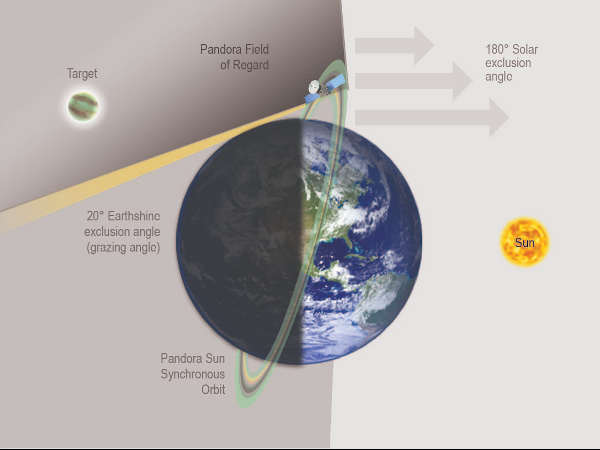
Pandora would operate in Sun-synchronous low-Earth orbit, which always keeps the Sun directly behind the satellite. This orbit minimizes light changes on the satellite and allows Pandora to obtain data over extended periods. Of the SmallSat concepts selected for further study, Pandora is the only one focused on exoplanets.
“Exoplanetary science is moving from an era of planet discovery to an era of atmospheric characterization,” said Elisa Quintana, an astrophysicist at NASA’s Goddard Space Flight Center in Greenbelt, Maryland, and the principal investigator for Pandora. “Pandora is focused on trying to understand how stellar activity affects our measurements of exoplanet atmospheres, which will lay the groundwork for future exoplanet missions aiming to find planets with Earth-like atmospheres.”
Maximizing the scientific potential
Pandora concentrates on studying exoplanetary and stellar atmospheres by surveying planets as they cross in front of – or transit – their host stars.
To accomplish this, Pandora would take advantage of a proven technique called transit spectroscopy, which involves measuring the amount of starlight filtering through a planet’s atmosphere, and splitting it into bands of color known as a spectrum.
These colors encode information that helps scientists identify gases present in the planet’s atmosphere, and can help determine if a planet is rocky with a thin atmosphere like Earth or if it has a thick gas envelope like Neptune.
This mission, however, would take transit spectroscopy a step further. Pandora is designed to mitigate one of the technique’s most crucial setbacks: stellar contamination.
“Stars have atmospheres and changing surface features like spots that affect our measurements,” said Jessie Christiansen, the deputy science lead at the NASA Exoplanet Archive at Caltech in Pasadena, California, and a co-investigator for Pandora. “To be sure we’re really observing an exoplanet’s atmosphere, we need to untangle the planet’s variations from those of the star.”
Pandora would separate stellar and exoplanetary signals by observing them simultaneously in infrared and visible light. Stellar contamination is easier to detect at the shorter wavelengths of visible light, and so obtaining atmospheric data through both infrared and visible light would allow scientists to better differentiate observations coming from exoplanet atmospheres and stars.
“Stellar contamination is a sticking point that complicates precise observations of exoplanets,” said Benjamin Rackham, a 51 Pegasi b Postdoctoral Fellow at the Massachusetts Institute of Technology in Cambridge and a co-investigator for Pandora. “Pandora would help build the necessary tools for disentangling stellar and planetary signals, allowing us to better study the properties of both starspots and exoplanetary atmospheres.”
Synergy in space
Joining forces with NASA’s larger missions, Pandora would operate concurrently with the James Webb Space Telescope, slated for launch later this year. Webb will provide the ability to study the atmospheres of exoplanets as small as Earth with unprecedented precision, and Pandora would seek to expand the telescope’s research and findings by observing the host stars of previously identified planets over longer periods.
Missions such as NASA’s Transiting Exoplanet Survey Satellite (TESS), Hubble Space Telescope, and the retired Kepler and Spitzer spacecraft have given scientists astonishing glimpses at these distant worlds, and laid a strong foundation in exoplanetary knowledge. These missions, however, have yet to fully address the stellar contamination problem, the magnitude of which is uncertain in previous studies of exoplanetary atmospheres. Pandora seeks to fill these critical gaps in NASA’s understanding of planetary atmospheres and increase the capabilities in exoplanet research.
“Pandora is the right mission at the right time because thousands of exoplanets have already been discovered, and we are aware of many that are amenable to atmospheric characterization that orbit small active stars,” said Jessie Dotson, an astrophysicist at NASA’s Ames Research Center in California’s Silicon Valley and the deputy principal investigator for Pandora. “The next frontier is to understand the atmospheres of these planets, and Pandora would play a key role in uncovering how stellar activity impacts our ability to characterize atmospheres. It would be a great complement to Webb’s mission.”
A launch pad for exploration
Lawrence Livermore National Laboratory, or LLNL, in Livermore, California, is co-leading the Pandora mission with NASA’s Goddard Space Flight Center.
LLNL will manage the mission and leverage capabilities developed for other government agencies, including a low-cost approach to the telescope design and fabrication that enables this groundbreaking exoplanet science from a SmallSat platform.
NASA’s Pioneers program, which consists of SmallSats, payloads attached to the International Space Station, and scientific balloon experiments, fosters innovative space and suborbital experiments for early-to-mid-career researchers through low-cost, small hardware missions. Under this new program, Pandora would operate on a five-year timeline with a budget cap of $20 million.
Despite tight constraints, the Pioneers program enables Pandora to concentrate on a focused research question while engaging a diverse team of students and early career scientists from more than a dozen of universities and research institutes. This SmallSat platform creates an excellent blueprint for small-scale missions to make an impact in the astrophysics community.
“Pandora’s long-duration observations in visible and infrared light are unique and well-suited for SmallSats,” said Quintana. “We are excited that Pandora will play a crucial role in NASA’s quest for finding other worlds that could potentially be habitable.”
For more information about the Pioneers program, visit https://science.nasa.gov/astrophysics/programs/astrophysics-pioneers.