 How to resolve AdBlock issue?
News
- Details
- Written by: Bennett Doughty, Binghamton University, State University of New York and Pamela Stewart Fahs, Binghamton University, State University of New York
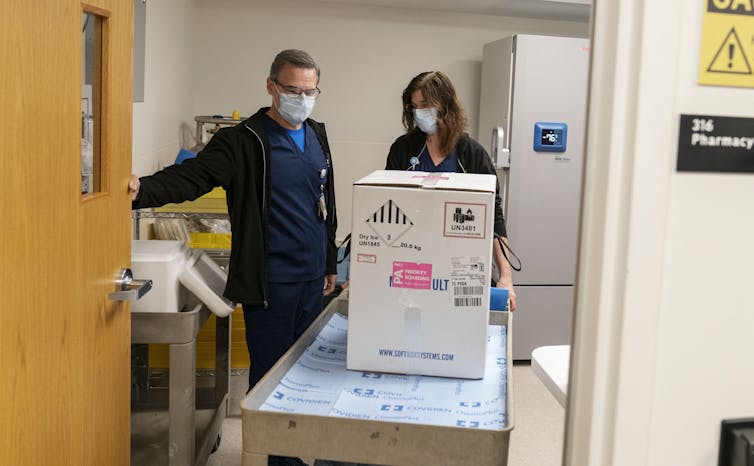
The enormous job of vaccinating the nation is underway, but for rural Americans, getting a COVID-19 vaccine becomes harder the farther they are from urban centers.
The current vaccines’ cold storage requirements and shipping rules mean many rural hospitals can’t serve as vaccination distribution hubs. That can leave rural residents – about 20% of the U.S. population in all – traveling long distances, if they’re able to travel at all.
Getting the word to rural residents about when they can be vaccinated isn’t easy either, and the extraordinary amount of misinformation downplaying the risk of the coronavirus this past year has had an impact on rural residents’ willingness to get the vaccine.
We work in rural health care settings and have been examining the barriers to health care for these patients to find ways to ensure health and safety.
The problem with big batches and cold storage
The first two authorized vaccines – one made by Pfizer and BioNTech and the other by Moderna – are mRNA vaccines. It’s a new type of vaccine that uses the molecular instructions for building virus proteins rather than injecting parts of the weakened virus itself. Both must be kept in very cold temperatures.
To ensure stability, the vaccine doses are shipped in special containers with dry ice, and for now, vaccines are being delivered only in large batches. The Pfizer vaccine is shipped in increments of 975 doses at a time, which creates a challenge for small hospitals.
Urban areas will be able to quickly distribute those doses, but finding enough patients to vaccinate quickly in rural areas may prove more difficult.
Moderna’s vaccine is somewhat more manageable, with a minimum order of 100 doses.
Both vaccines also require two doses per person, with the second dose of Pfizer’s vaccine given 21 days later and Moderna’s 28 days.
As a result, the vaccine distribution efforts will favor hubs that cater to more populated areas to avoid wasting any vaccine or leaving patients unable to get their second dose.
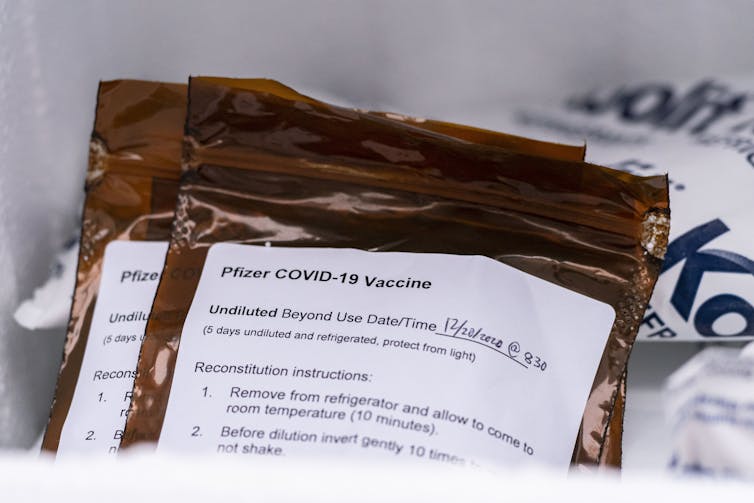
Cold storage is another challenge, since small hospitals are less likely to have expensive freezers. The Pfizer vaccine must be stored at minus 94 degrees Fahrenheit (minus 70 Celsius) and Moderna’s at minus 4 Fahrenheit. There are limits on how many times the vaccine shipping containers can be opened and how quickly the vaccines must be distributed. Once thawed and prepared, the Pfizer vaccine must be used within five days and Moderna’s within 30 days.
Each patient must receive both doses of the vaccine from the same manufacturer to ensure safety and effectiveness, adding to the challenge. Manufacturers have included personal dosing cards for patients to carry with them to help address this challenge.
Rural America’s take on COVID-19 and vaccines
Rural America already has difficult barriers to health care access.
It has fewer health care providers serving a more geographically diverse population than in metropolitan communities. And in many of these areas, rural hospitals have been closing at an alarming rate, leaving people to travel farther for care. The population is also older. Public transportation that could help poor or elderly residents reach hospitals is rare, and distance and geography, such as mountain roads, can mean driving to those sites takes time.
Getting accurate information about the vaccine and how to receive it into rural areas has also proved difficult. Many rural counties still have limited access to broadband internet connections, smartphone service and other technologies. That often means residents rely on television, newspapers and radio for news, which can limit the depth and scope of information.
While some rural counties have started getting the word out, many don’t not seem to have specific plans on how to inform their residents about how and when each person can get the vaccine, let alone specific plans for actually giving it. They often rely just on local press releases that many residents never see.
Rural nonprofit health care organizations have tried to bridge that gap and improve rural communications about vaccines and the pandemic. Care Compass Network, which coordinates organizations across southern New York, has offered educational webinars with the latest information about the virus and the vaccines, for example. But there is still much work to do.
[Get facts about coronavirus and the latest research. Sign up for The Conversation’s newsletter.]
Rural Americans’ views on vaccines are influenced by media and word of mouth, politics and religion, as well as previous experience with vaccinations and, perhaps most importantly, the difficulty of accessing health care.
In a survey conducted by the Kaiser Family Foundation in December, about 35% of rural Americans said they probably or definitely would not get the vaccine, higher than the 27% nationwide.
Small batches, new vaccines and pharmacies
Getting enough of the U.S. vaccinated to eventually end the pandemic will require more work in all of these areas. That includes improving shipping and storage processes so orders can be broken up and distributed to smaller hospitals, distributing more vaccine doses, and improving communication.
With Moderna’s vaccine arriving in smaller batches and not requiring such low temperatures for stability, it may prove to be more accessible for rural areas in the near future. Utah has already taken advantage of those characteristics to get initial doses to smaller hospitals outside its urban areas and has started vaccinating health care providers. Pfizer has said it may be able to offer smaller batches by April.
Other vaccines on the horizon are also expected to have less stringent storage requirements and may potentially be delivered in a one-shot method rather than a two-dose series. The falling number of rural hospitals still remains a challenge for getting vaccines to patients, though. Allowing community pharmacies to offer the vaccine – particularly if independent pharmacies are included – could eventually help expand the distribution network in rural areas.
Bennett Doughty, Clinical Assistant Professor, Pharmacy Practice, Binghamton University, State University of New York and Pamela Stewart Fahs, Professor of Rural Nursing, Binghamton University, State University of New York
This article is republished from The Conversation under a Creative Commons license. Read the original article.
- Details
- Written by: Lake County News reports
The funding is the result of Proposition 64, the Control, Regulate and Tax Adult Use of Marijuana Act, which provided specified cannabis tax funding to the CHP to administer local grants for education, prevention, and enforcement programs regarding impaired driving.
Funding for the grants comes from a tax on the cultivation and sale of cannabis and cannabis products sold in California since January 2018.
For the current grant cycle, the CHP’s Cannabis Tax Fund Grant Program will be awarding grants based on a competitive process to California law enforcement agencies and local toxicology laboratories meeting the eligibility requirements described in the 2021 Request for Application, available on the CHP website.
The CHP will hold a virtual workshop on Jan. 6, 2021, to answer questions from potential grant applicants regarding the application process, the 2021 Request for Application, administrative program regulations, and other general questions.
Applications will be accepted beginning Jan. 7, 2021, through Feb. 23, 2021, for programs beginning on July 1, 2021.
These grants will enhance existing efforts to address impaired driving.
“These grants represent an opportunity for the CHP to work collaboratively with local traffic safety stakeholders to strategically address impaired driving issues while making California’s roadways a safer place to travel,” CHP Commissioner Amanda Ray said.
Those interested in this grant opportunity can learn more about the program, obtain workshop updates, and view the 2021 Request for Application by visiting the Cannabis Tax Fund Grant Program page on the CHP’s website, under the Programs and Services tab.
The mission of the CHP is to provide the highest level of safety, service and security.
- Details
- Written by: Elizabeth Larson
Judge Andrew Blum handed down the sentence to 22-year-old Mavrick William Fisher on Dec. 21.
In November, a jury convicted Fisher of involuntary manslaughter for the death of 25-year-old Grant David Whitaker of Mackinaw, Illinois, on Aug. 20, 2019. They also found Fisher guilty of taking a vehicle without permission, as Lake County News has reported.
At the same time, the jury found Fisher not guilty of murder and hung on charges of voluntary manslaughter and assault with a deadly weapon with a special allegation of great bodily injury or death.
Fisher and Whitaker, both deaf, had been traveling around California in a car loaned to Whitaker by his grandmother when they had a physical confrontation while camping at Richardson Grove State Park in Humboldt County.
Fisher claimed he used a rock to hit Whitaker in self-defense. He then took Whitaker’s body to a ranch in Scotts Valley near Lakeport and disposed of it before he fled to Mexico, where he was arrested days later. Authorities extradited him to Lake County, where the criminal proceedings were transferred because Whitaker’s body was located here.
In a Dec. 11 hearing, Judge Blum had ruled against retrying Fisher for voluntary manslaughter, concluding from his research that the law does not allow for conviction of both voluntary and involuntary manslaughter.
Blum also dismissed the other charges the jury hung on, assault with a deadly weapon and the special allegation of great bodily injury or death, in the interest of justice, which is his prerogative under the state’s penal code.
Defendant’s mother appears at sentencing hearing
During the Dec. 21 sentencing hearing, District Attorney Susan Krones – who personally prosecuted the case – said 12 impact statements by Whitaker’s family and friends were read to the court and Fisher.
Defense attorney Tom Feimer said Fisher’s family and friends also submitted letters in support of him, but Feimer opted to not read them aloud in court since they were already made available to the judge.
The case’s unique nature – involving both a defendant and a victim who are deaf – has received a large amount of attention from the deaf community nationwide.
The Daily Moth, a news outlet serving the deaf community, covered the trial extensively and posted a video of the sentencing that included the reading of the victim impact statements.
Also appearing during the sentencing was Fisher’s mother, Michelina Fisher of Nevada, who described her son’s accomplishments both as a student and after his graduation.
Through an interpreter, Michelina Fisher told the court, “I would be thrilled to have him back home. He can work on his land again. So he can keep his dreams up.”
Part of the result of the nationwide attention for the case has been “a lot of terrible and untrue things” said about Mavrick Fisher in online comments, Feimer said.
“There was a level of vindictiveness to it” in the online attacks that Feimer said left a bad taste in everyone’s mouth.
Feimer said he understood why Whitaker’s family members feel the way they do. But he noted that his client’s reputation has been tarnished well beyond the charges, and some of the claims about him worked their way into the victim impact statements from people who Feimer said don’t know Fisher personally.
While Feimer said that as a defense attorney he can’t offer much in the way of response to victim impact statements, he said Judge Blum did respond to some of the comments in the statements that targeted the jury for criticism.
“This jury gave the case their full attention,” said Feimer. “I’ve rarely seen a jury so engaged in terms of questions asked.”
He said the jurors asked very good questions – as good or even better than the attorneys asked during the trial – and added that they deserve a lot of thanks for their performance under the unique circumstances of being involved in a trial during a pandemic.
Judge decides on maximum sentence
Blum gave Fisher a four-year state prison sentence, which Krones said is the maximum term.
“I am pleased that the court gave him the maximum sentence as that is what I had argued to the court and I feel that is appropriate given the facts of the crime in this case,” she said.
She explained that the four-year sentence requires Fisher to concurrently serve time for both charges for which he was convicted – the involuntary manslaughter and taking a motor vehicle without permission of the owner.
She said Blum found that Fisher’s use of great violence and use of a weapon – in this case, a rock – were aggravating factors that outweighed any mitigating factors including the fact that Fisher had no prior criminal record.
Blum also concluded that Fisher displayed a high degree of callousness by not going to get help for Whitaker. Instead, Fisher dumped Whitaker’s body a few days later and lied, telling people that Whitaker was still alive for several days after he had killed him.
Because Fisher has been in custody for over a year he received 965 days total credits as of Dec. 21, Krones said.
Based on her calculations, as of Monday Fisher should have about 240 days left to serve.
“After serving his sentence he will either be on parole or Post Release Community Supervision for a time period,” said Krones.
“He was obviously hoping for less,” Feimer said of Fisher’s response to the sentencing.
However, Feimer added, “He’s still relieved that there won’t be another trial,” and that he now has a date when he knows he’ll be out of prison and can start moving on with his life.
One part of the case that remains unresolved is where, exactly, Fisher will serve the remainder of his time in custody.
Feimer said that, generally, under California’s criminal realignment, involuntary manslaughter is considered a local offense and so the prison sentence is served in local jails.
However, there are certain circumstances in which such terms are served in state prison. Feimer said Krones had argued – and the judge agreed – that, in this case, the circumstances called for Fisher to go to state prison and not serve the remainder of the term in the county jail.
Feimer said that while Blum sentenced Fisher to serve the time in state prison, he will allow for Feimer to argue for serving his sentence locally since neither the judge nor Krones could find a case on point that spoke to similar circumstances.
If his research supports it, Feimer said he’ll file a motion to seek to keep Fisher in the Lake County Jail for the remainder of his prison term.
Even if Fisher has to go to state prison, it could be some time before he’s sent there.
For months, the California Department of Corrections and Rehabilitation has not been accepting new inmates due to COVID-19.
Krones said it’s unknown when Fisher may be transported to state prison due to the pandemic.
Feimer agreed.
“Right now, for the foreseeable future, he’ll be staying here,” Feimer said.
Email Elizabeth Larson at
- Details
- Written by: Elizabeth Larson
Dr. Gary Pace gave a Monday update on the local COVID-19 situation in a Facebook video.
Pace said that the statewide case growth curve is starting to flatten a little bit, which he attributed to the beginning of a decrease in the Thanksgiving surge and stay-at-home orders in other parts of the state having some effect.
He said that now that the Christmas weekend is past, there could be another case increase in the next few weeks.
The hospitalization rate usually lags a week or two behind the positive case rate, and Pace said the hospitalization curve is still on an upward swing.
Lake County is in the Northern California region, one of five regions the state is using to track case rates and hospitalizations. So far, that’s the only region not in a lockdown because of falling below a 15-percent intensive care unit bed availability.
Pace said Northern California still has about a 25-percent ICU bed capacity, while the Central Valley and Southern California are each under 5 percent and the Bay Area has about 10 percent.
He said Lake County’s case rate started rising in November and is now at 41 cases per 100,000, the highest it’s ever been.
Lake County’s testing positivity rate is now 11 percent, Pace said.
As of Monday, Lake County had a total caseload of 1,791 cases, 1,462 cases recovered and 23 deaths, according to Public Health.
Lake County on Monday had 300 active cases, which Pace said also is the highest ever for that measure.
Twelve residents currently are hospitalized with 98 total hospitalizations to date, the county reported.
Of those hospitalized cases, Pace said 50 have been transferred to other regional hospitals in Napa, Sonoma, San Francisco and Ukiah.
Pace expects to see increased pressure in trying to move people out of the county to other ICU beds in the region. “It’s a little bit of a tight situation we might find ourselves in in the coming weeks.”
New approach to case management
COVID-19 cases are now showing up all over Lake County, Pace said.
He said outbreaks in the tribal community and in local skilled nursing facilities appear to be slowing down, and while schools are closed now for winter break some were reporting cases as well.
There also are reports of positive cases amongst employees at small and large businesses alike, Pace said.
Pace said Public Health is taking a new approach to managing cases in businesses. “Our No. 1 goal is to protect the health of the public and decrease the spread out in the community.”
He said Public Health is not trying to close down businesses for the 24-hour disinfection period – which doesn’t appear to have been effective – but working directly with them on how to disinfect and do contact tracing.
So far, the business community has been very responsive, as it also wants to keep the community safe and stay open, he said.
Pace said his staff is focusing on community outreach as it doesn’t have enough staff for contact tracing on the very large number of cases and, in some instances, people are not being cooperative. The county also is still working to get enforcement officers in place to work on compliance with the county’s COVID-19 enforcement ordinance.
Vaccine update
Pace said that Lake County has received just over 1,000 doses of the COVID-19 vaccine, and as of Monday morning a little over 300 health care workers had been vaccinated.
He said the county is following the guidelines handed down from the state that prioritize the order of those who receive the vaccine. He said the first tier include staff at hospitals and nursing homes, EMS/first responders and then dialysis centers.
One of the challenges is that the state is not communicating with the county about how much of the vaccine it can expect to get. Pace said Lake County Public Health is ordering more vaccine doses every week, and sometimes they get the doses and sometimes they don’t.
He said the hospitals are supposed to be getting more vaccine shipments through their corporate structures, but there also is a breakdown in communication between the hospitals and the state.
Once the hospitals receive more of their own supply, Pace said the county can back off and redirect its vaccine supply elsewhere.
Two local skilled nursing facilities have an agreement with CVS, which Pace said will send out workers to vaccinate staff and residents.
However, Pace said he just got word a few days ago that those vaccinations won’t take place before the middle of January, so Public Health is going to start vaccinating skilled nursing facility staff as soon as possible.
Once CVS and Walgreens – which are partnering with the state of California to provide Pfizer vaccines to residents and staff in long-term care facilities – begin distributing the vaccines locally, Pace said Public Health will back off of its efforts for those facilities.
On Monday a vaccination clinic was held for EMS and first responders, and Pace said another clinic for that group will be held on Wednesday.
He expects that next week the next tier of vaccinations – for outpatient clinic workers and In-Home Supportive Services workers who are providing services in other people’s homes – could begin, with two standup clinics planned for that group.
The next group will be jail medical staff and those working in other congregate living facilities, and then toward the end of January the focus will move to dentists, labs, optometrists and residents of congregate living situations, he said.
Pace said the state is working on guidelines for the next tier after that, which is expected to include essential workers, people over age 74 and those with chronic medical illnesses.
“We’re really trying to support the medical community right now” because they’re needed to keep people safe during the outbreak, Pace said.
He reassured people about the vaccine’s safety, noting that while there have been some reports of people having allergic reactions to the vaccine, that on the local level they’re getting good results.
Both the Pfizer-BioNTech and Moderna vaccines require second vaccinations about three weeks apart. Pace said so far there have been no issues with the first shot but it’s possible that the second shots could have more of a side effect.
He said Dr. Anthony Fauci, director of the National Institute of Allergy and Infectious Diseases, is now estimating that up to 85 percent of the United States’ population will need to get the vaccine before the country can go back to normal.
As such, Pace encouraged people to get the vaccine as soon as it becomes available to them, both to protect against the virus and because there could be delays due to issues with the supply chain at various times.
Pace continued to warn that there are difficult months ahead and that the holidays could lead to another case surge.
“It’s a different landscape right now” due to more virus in the community, he said, cautioning that being in crowded stores right now is a bad idea.
Email Elizabeth Larson at
- Governor announces partnership with CVS and Walgreens to provide Pfizer vaccines to residents and staff in long-term care facilities
- How to help dogs and cats manage separation anxiety when their humans return to work
- Jameson Humane receives grant to help low-income Clearlake residents with spaying and neutering pets