 How to resolve AdBlock issue?
News
- Details
- Written by: Elizabeth Larson
The Lake County Registrar of Voters Office, continuing the process of counting the ballots, issued one update on Wednesday afternoon.
That report showed no change in the shape of the local races so far, including the most closely-watched race of the season, for the District 5 seat on the Board of Supervisors, in which Jessica Pyska continues to lead Bill Kearney with a substantial margin.
The report showed that 11,157 ballots have been counted for the state and federal races. However, a total of 37,717 vote by mail ballots were issued in Lake County, and of those 16,823 had been reported returned by Monday.
With thousands more ballots cast in person on Tuesday or still making their way to the elections office via mail, knowing just how many ballots there are to count could take weeks. That’s because the state has extended the deadline for accepted mailed ballots; those postmarked by Election Day can be accepted up to 17 days afterward.
Presidential elections have typically seen voter turnout close to, or above, 70 percent in Lake County, and vote by mail – or absentee – voting has increased in recent years.
The registrar’s office typically issues a report within a week or so of the election that will give an estimate on how many ballots remain to be counted.
Elections officials have a month to conduct the official canvass in which they go through a thorough process that leads to the final certification of the results in early December.
Typically, once it reports on the number of ballots left to count, the Lake County Registrar of Voters will not issue updates until the final canvass is completed.
Email Elizabeth Larson at
- Details
- Written by: Lake County News reports

NORTHERN CALIFORNIA – Crews are making good progress on fire suppression repair across all areas of the South Zone of the August Complex.
The US Forest Service said the hard work of fire personnel is paying off keeping the South Zone at 499,826 acres and increasing containment to 97 percent. The South Zone includes the Mendocino National Forest in northern Lake County.
In addition to the Mendocino National Forest, the complex is burning in the Six Rivers and Shasta Trinity National Forests.
The entire August Complex, started by lightning on Aug. 16 and 17, is estimated at 1,032,649 acres and 93 percent containment.
As the August Complex nears full containment, incident management personnel are beginning to plan for a smooth transfer of responsibility back to local forest leadership, officials said.
There are 273 personnel working on the South Zone and 687 personnel on the entire incident, the Forest Service said.
The Forest Service said crews are continuing to focus on fire suppression repair in priority areas around the Sanhedrin Wilderness, in wild and scenic river corridors in the Mill Creek area, and in locations that are prone to landslides along key forest travel routes such as the M1 and M6 roads.
Additionally, officials said progress is being made on opening roadways and removing hazard trees to allow for further suppression repair activity throughout the forest.
In the interest of the safety of firefighters and visitors to the national forests in the Pacific Southwest Region, fire restrictions were extended to Nov. 6 to prevent further fires from being started and overtaxing the resources of those fighting existing wildfires.
The Forest Service estimates the complex will be fully contained on Dec. 15, at which point it will have burned for four months.
- Details
- Written by: Tracy Roof, University of Richmond
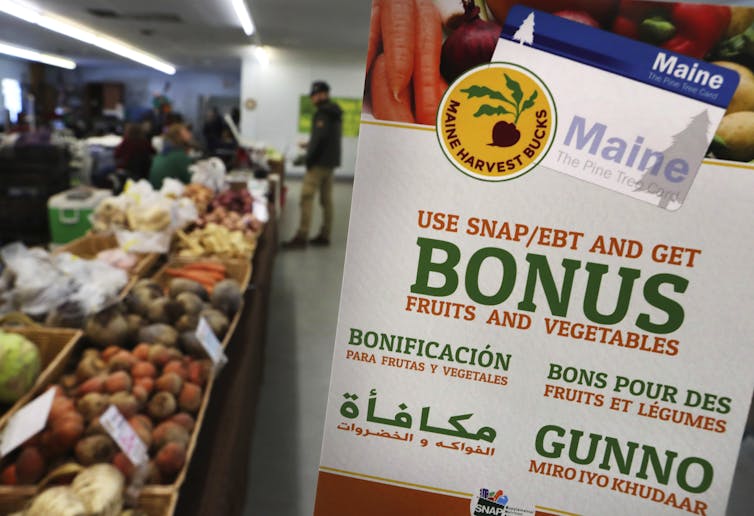
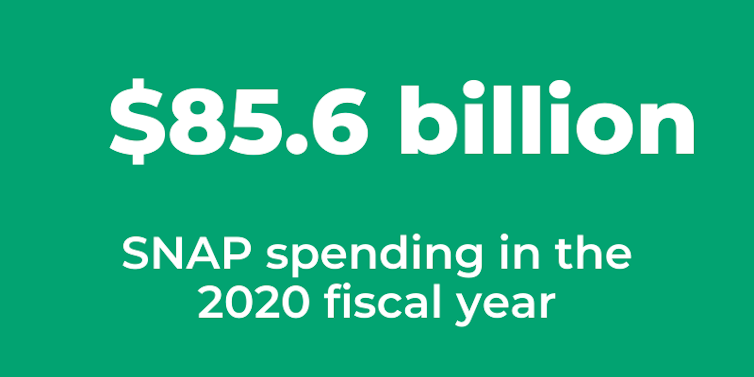
The government spent a record US$85.6 billion on the Supplemental Nutrition Assistance Program in the fiscal year ending in September. This sum, included in an October Treasury Department report, was about 35% higher than the $63.5 billion the federal government spent in 2019.
Spending on this state-administered program, which helps struggling families put food on the table, typically rises and falls in tandem with unemployment and poverty. Along with unemployment insurance, SNAP is one of the most responsive programs in a recession. The most vulnerable families can get benefits within seven days of applying.
Before the coronavirus pandemic, SNAP spending had been steadily declining since a 2013 peak of nearly $80 billion following the Great Recession. But as the COVID-19-triggered economic crisis hit, monthly spending more than doubled, from $4.9 billion in February to $10.6 billion in June, according to Treasury Department data.
The jump came from two factors. First, more people are getting benefits. Second, roughly 60% of the families who get them are eligible for more support than before.
Specifically, after the Families First Coronavirus Response Act relief package Congress passed in March 2020, the government temporarily offered the maximum benefit, typically given only to those with no income, to all families on SNAP. Following a 5.3% increase announced Oct. 1 in response to rising food costs, that maximum level stands at $680 a month for a family of four.
Despite this SNAP spending boost, lines at food banks have grown much longer during the pandemic.
To help both overwhelmed food banks and struggling farmers, the U.S. Department of Agriculture launched the Farmers to Families Food Box Program. The government had sent by mid-October 110 million boxes of fresh fruit, vegetables, dairy products and meat to food banks and other organizations assisting people facing economic hardship.
The USDA is spending about $4 billion to purchase the food. But the program has been criticized by lawmakers and anti-hunger groups as inefficient and poorly managed. Although food banks have appreciated the help, even people who run food banks see SNAP as the best way to help the hungry.
In fact, in researching the history of SNAP for an upcoming book, I found that the program long known as food stamps slowly replaced another program distributing surplus food to the needy in the 1960s. Government researchers found that giving families stamps to exchange for food in grocery stores was more efficient and effective.
In 2019, 92% of SNAP spending went directly to benefits. The program boosts the economy, leading to more consumer spending and jobs. SNAP also provides nine meals for every one meal supplied by Feeding America, the largest network of food banks.
[Deep knowledge, daily. Sign up for The Conversation’s newsletter.]
Almost 2,500 organizations serving the poor are calling for increasing maximum SNAP benefits by 15%. This would help all families on SNAP – including the 40% with the lowest incomes who have not gotten additional help so far during the pandemic. The House passed relief legislation in May and October that called for this 15% increase. As of late October, the Senate had not taken this step even though food insecurity has grown substantially.
Tracy Roof, Associate Professor of Political Science, University of Richmond
This article is republished from The Conversation under a Creative Commons license. Read the original article.
- Details
- Written by: Elizabeth Larson

LAKE COUNTY, Calif. – While thousands of ballots remain to be counted, initial reports from Lake County election officials overnight gave early indications of the winners in key races on the general election ballot.
The Registrar of Voter’s Office issued several initial ballot count reports from Tuesday night into early Wednesday, with the last issued at 1:40 a.m.
Based on those preliminary reports, Jessica Pyska of Cobb is leading the race for District 5 supervisor with 944 votes, or 69.21 percent of the vote, while Bill Kearney of Kelseyville has 420 votes, or 30.79 percent.
For the District 4 State Assembly race, incumbent Cecelia Aguiar-Curry appears to have won reelection.
The Secretary of State’s Office reported that, with 100 percent of 522 precincts partially reporting, Aguiar-Curry, a Democrat, leads with 95,635 votes or 70.4 percent, while Republican challenger Matthew Nelson trails with 40,223 votes or 29.6 percent.
In the contested Lakeport City Council race, preliminary results show incumbent Kenny Parlet tied with Michael Green, at 579 votes each, followed by Nathan Maxman with 366 votes and Michael Froio with 355 votes.
In the Clearlake City Council race, with three seats available and two qualified candidates, incumbent Joyce Overton has 1,063 votes, followed by David Claffey, with 1,009 votes.
Three local school board races are on the ballot this year.
The Kelseyville Unified School District Board has three seats. Gilbert Rangel has the most votes in the preliminary count, 750, followed by Natalie Higley, 661; Mary Beth Mosko, 480; and incumbent, Beniakem D. Cromwell, 421.
In the Konocti Unified School District, with two seats up for election, incumbents Mary Silva, with 1,382 votes, and Susan Burton, with 1,348 votes, lead the field based on the count so far, followed by challengers Zabdy Neria, 1,171 votes, and Michael “Mac” McMurtrey, with 1,074 votes.
For the Upper Lake Unified School Board, with two seats up for election, incumbent Claudine Pedroncelli leads the field with 786 ballots, followed by Franklin Gudmundson, 606 votes, and Don Meri, 444 votes.
In the Callayomi County Water District, two board seats are being selected in the election. The initial vote count has incumbent Rosemary Córdova in the lead with 54 votes, followed by Sandra Harris, 47 votes, and Roger Rosenthal, 28 votes.
Email Elizabeth Larson at